



Acrylic vs Glass Sneeze Guard: Buyer Guide
One material shatters and one chips. In a food environment, that single difference reorganizes the whole comparison — hardware, insurance, and the closing checklist included.
Need this made?Custom acrylic fabrication services →
Key Takeaways
- Breakage behavior matters in food service, but any damaged guard should be taken out of service and handled under the buyer's food-safety and incident procedure.
- Acrylic runs about 1.2 g/cm³ against glass at roughly 2.5 g/cm³ — a 900 x 600 x 5mm panel weighs about 3.2 kg in acrylic versus about 6.8 kg in glass, and the hardware requirement scales with the panel.
- Glass keeps an advantage in surface hardness. Acrylic care and any restoration method must follow the named sheet manufacturer's guidance and be tested away from bonded, coated or load-bearing features.
- Approve the exact cleaner against the quoted sheet grade and the buyer's sanitation program; no material name alone guarantees chemical compatibility.
- For multi-site rollouts, sheet-cut acrylic carries the logistics: custom brackets, no tooling fee on most designs, MOQ 100 pieces, samples in 3-5 days, and production in 15-20 days — a 32-location program shipped as one coordinated run.
On this page
- Acrylic vs Glass Sneeze Guard: What Changed in 32 Sites?
- Breakage: chips versus shards
- Weight and mounting hardware
- Scratches and refurbishment
- Cleaning chemicals in a food environment
- Acrylic sneeze guard specs: thickness, edges, mounts and cutouts
- Price, lead time, and multi-site rollouts
- Decision rules: which guard wins where
- Ordering acrylic sneeze guards from Wetop
Acrylic vs Glass Sneeze Guard: What Changed in 32 Sites?
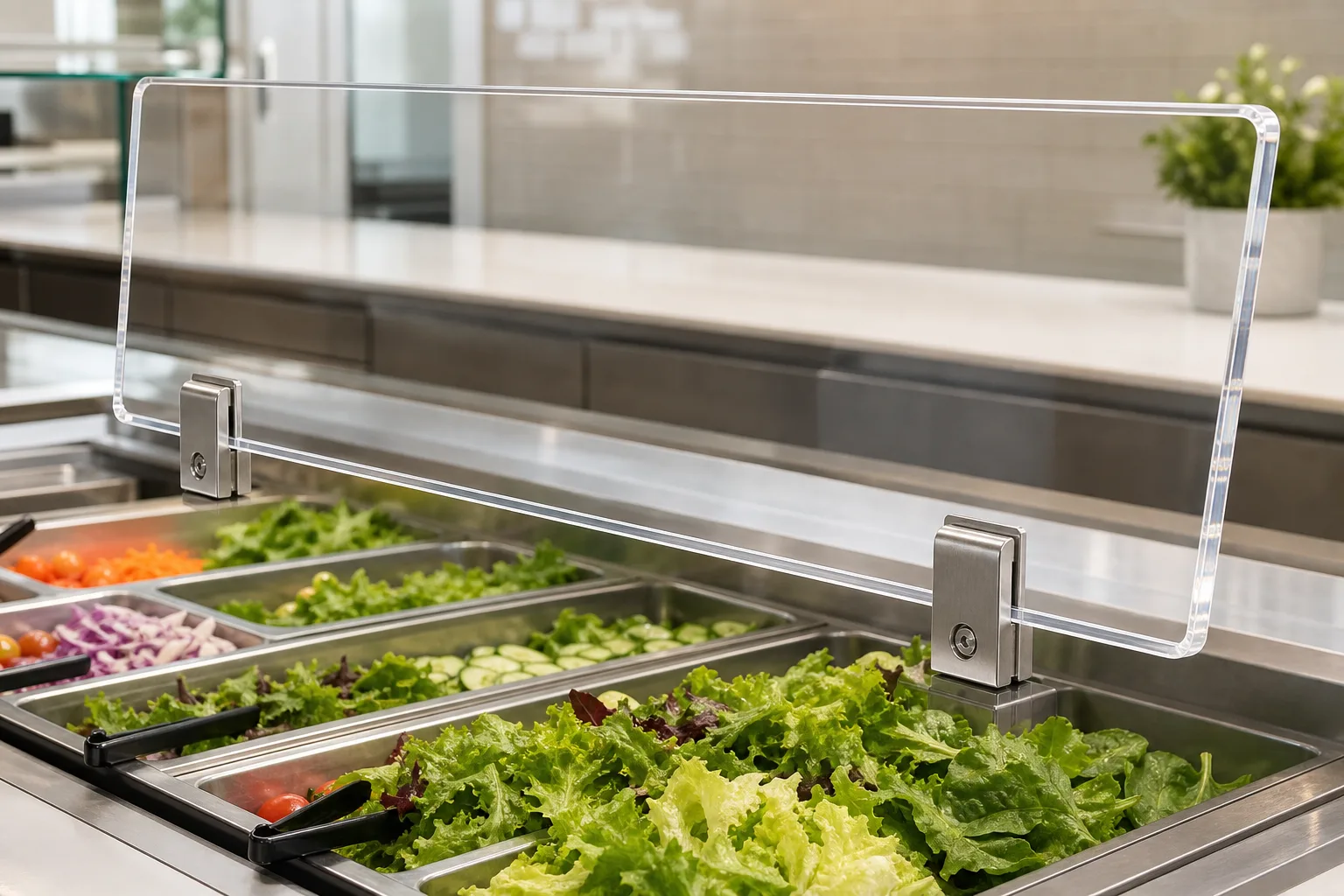
The salad-bar sneeze-guard project shows how measured fixture conditions, named material, mounting, cleaning, sampling, inspection, and packing were defined.
Three numbers frame that comparison: 5 mm cast acrylic, 192 panels and 32 installation sites. Material density, breakage behavior and surface care still matter, but the approved panel-to-bracket interface and the rollout packing plan determine whether the choice works across every counter.
Everything else in this comparison is those numbers meeting a real counter. Impact behavior decides what happens on the worst day — a tray corner, a ladder, a customer’s elbow. Density decides what happens every day: the hardware holding the panel, the freight moving it, the staff repositioning it at closing. And the 5mm working thickness is where both stories are told honestly, because at equal thickness the materials genuinely differ instead of hiding behind spec games.
We fabricate acrylic rather than glass, so this comparison states that boundary directly. Glass keeps its real advantage in surface hardness, while the acrylic side is tied to the documented 192-panel program and the buyer-approved panel, bracket, packing and cleaning plan.
Breakage: chips versus shards
An acrylic guard can chip or crack; glass breakage behavior depends on whether the construction is annealed, tempered or laminated. Near open food, any damaged guard is an operational issue rather than a cosmetic one.
If a guard is chipped, cracked, loose or otherwise damaged, stop using the affected counter area and follow the buyer’s food-safety, inspection and incident procedure. Do not assume that an acrylic edge can remain in service or be field-polished; replacement or repair must be approved for the exact construction and contact zone.
Transit packing should protect the actual panel, bracket and finish. Specify protective film, edge protection, internal restraint, carton labels and receiving inspection for either material; no packing plan makes a dropped carton harmless.
Weight and mounting hardware
Density sets the hardware bill. At about 1.2 g/cm³, a 900 x 600 x 5mm acrylic panel weighs roughly 3.2 kg;1 the same panel in glass at about 2.5 g/cm³ weighs near 6.8 kg.2 Every bracket, post, and counter fixing is sized for that difference — and so is the installer’s day.
| Factor | 5mm cast acrylic guard | 5mm glass guard |
|---|---|---|
| Density | ~1.2 g/cm³ | ~2.5 g/cm³ |
| 900 x 600mm panel weight | ~3.2 kg | ~6.8 kg |
| Typical mounting | Clamp brackets, posts, or slotted feet | Framed channels, heavier fittings |
| One-person install | Yes, routinely | Often a two-person lift |
| Counter loading | Light — suits retrofit fixtures | Needs stronger anchoring |
| Drilled holes / cutouts | CNC-cut with the panel, no extra risk | Specialist drilling, breakage risk |
The mounting line in that table is where projects are won and lost. Glass wants engineered channels and framing sized to its weight; acrylic can support lighter clamp and bracket concepts, but the buyer must provide the measured counter, loads, access, and local installation requirements. The salad-bar sneeze-guard project records those inputs and the sample checks without claiming a fixed bracket, panel weight, or installation time.
Weight also compounds across logistics: lighter cartons, lower freight class, and pass-through fixtures (like a reception guard with a document slot) that one person can reposition for cleaning. If your guard needs holes, slots, or a speak-through cutout, acrylic takes them as CNC operations cut with the panel itself — through our custom acrylic fabrication service they’re part of the drawing, not a risky post-process.
Clear acrylic sheet can publish about 92% total light transmission under ASTM D1003,3 but the installed view still depends on the quoted grade, thickness, surface condition, cleaner, lighting and mounting. Treat that datasheet value as a material reference, not a promise that every fabricated guard remains optically identical in every counter environment.
Scratches and refurbishment
Glass is harder than PMMA, but neither material should be cleaned with an unapproved abrasive. Scratch response and replacement depend on the named grade, surface, mounting and approved care plan.
Do not assume that haze, an edge mark or impact damage is suitable for field polishing. Remove a damaged guard from service, identify the grade and affected feature, and have the material supplier or a qualified fabricator approve repair or replacement. Archived drawings can support a like-for-like replacement review, but the remedy remains project-specific.
Prevention starts with the named sheet manufacturer’s care guidance and the buyer’s sanitation program. Approve the exact cleaner, dilution, contact time and cloth on the selected grade; do not substitute a sanitizer category or promise an undefined service life. Thickness by span, edge finish and mounting by counter type are covered in the spec section below.
What I inspect before a guard panel ships is worth knowing, because it’s also what you should check when any supplier’s panels arrive. Four things, in order: dimensions against the drawing, including every bracket hole position; edge finish under raking light, where a rushed polish shows as ripple; surface clarity with the protective film lifted at a corner, since film hides scratches until installation day; and film adhesion itself, because film that lifts in transit lets grit under it and does the scratching for you. On a guard program those four checks run on every panel, not a sample — a counter shield is the most looked-through object in the store, and optical defects that would vanish on a shelf edge sit at eye level here.
Cleaning chemicals in a food environment
Cleaner compatibility depends on the named panel grade, surface treatment and concentration. Match the proposed cleaner and contact time to the material manufacturer’s guidance and the buyer’s sanitation program, then approve it before rollout.
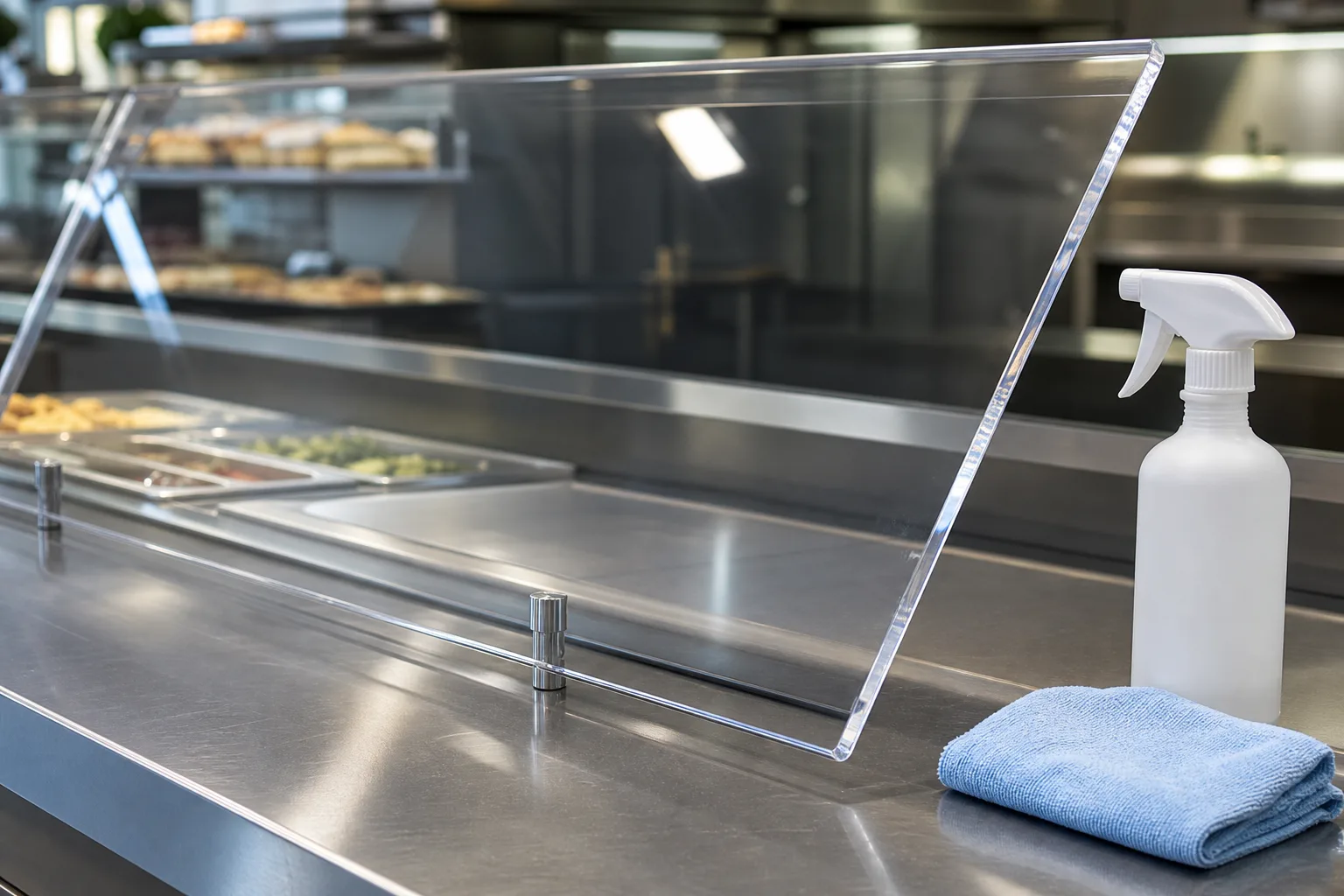
US retail food-safety guidance addresses smooth, non-absorbent and cleanable surfaces,4 but compliance depends on the finished construction, intended zone, governing authority and approved sanitation procedure. The buyer should approve the named grade, joints, edges, cleaner and contact time rather than treating polished PMMA as automatic Food Code compliance.
Neither material is the hygiene layer. The guard is a physical barrier, and the buyer’s approved sanitation program controls cleaning. Panel thickness, edge finish and cleaner compatibility must be reviewed for the actual span, mounting, grade and authority requirements; no single 5 mm service-life rule applies to every installation.
Acrylic sneeze guard specs: thickness, edges, mounts and cutouts
For a counter-mounted acrylic sneeze guard, we start at 5 mm cast acrylic for spans of 16–32 inches, move to 6 mm above 32 inches or for any suspended design, diamond-polish every edge including cutouts, and give every inside corner a radius of at least 5 mm. These are quoting starting points; the final spec follows the measured span, cutouts, load and the buyer’s approvals.
Thickness by span
| Thickness | Where it fits | Why |
|---|---|---|
| 3 mm | Desktop dividers under 14 in wide, fully framed partitions, portable shields | Flex shows from about a 16 in unsupported span |
| 5 mm | Counter-mounted guards 16–32 in wide, about 75% of the rollouts we quote | About 4× less deflection than 3 mm under the same load |
| 6 mm | Wider than 32 in, ceiling-suspended designs, pharmacy and nursing-station traffic | Stays rigid on through-counter studs; resists bowing at cable points |
| 8 mm and up | Security transaction windows | Separate engineering review |
Deflection scales with the cube of the span and inversely with the cube of thickness, so going from 3 mm to 5 mm cuts flex under the same hand pressure by roughly four times.5 A thin panel that flexes often enough takes a permanent bow at the top edge. The 5 mm sheet costs about 40% more, but material is only 35–45% of a custom guard’s unit cost, so the finished unit rises about 14–18%.
Edge finish under daily disinfection
Edge finish is a sanitation choice as much as a cosmetic one. Flame polishing melts the edge and locks in stress, and PMMA with stressed surfaces is prone to crazing under alcohols and some cleaners;6 under repeated quaternary ammonium, 70% isopropyl alcohol or diluted bleach wiping, a flame-polished edge is the first to show a hairline cloudy ring that holds soil. Diamond-polished edges are cut rather than melted, carry little residual stress and hold up best. CNC-routed edges sit in between and suit back-of-house guards. For ICU, pharmacy and front-of-house guards near food prep, a sealed-edge urethane top-coat adds about $4–6 per linear meter of edge and shields the cut surface from direct chemical contact.
Mounting by counter type
- Counter clamps: no drilling, under five minutes per unit and removable at lease end. A 5 mm panel up to about 32 in wide flexes a few millimeters under about 8 kgf at the center; at 36 in the same panel roughly doubles that flex, so wider guards move to 6 mm.
- Through-counter studs: stainless studs through gasketed countertop holes hold 6 mm panels up to about 48 in wide and survive cart impacts that would dislodge a clamp. The holes are permanent, which rules them out on short leases.
- Ceiling-suspended: 6 mm minimum. A 24 × 36 in, 6 mm panel weighs about 4.4 kg before hardware; rate cables at five times the load and anchor into a joist or a rated track, because most acoustic tile grids are not rated. Suspended designs need a site-specific structural review.
Cutouts and tolerances
Transaction windows, microphone slots and card-reader pass-throughs are where most spec mismatches happen, so we cut them on CNC with the panel:
- Size and position: ±0.2 mm standard, ±0.1 mm where the opening must fit hardware.
- Inside corners: 5 mm minimum radius; a sharp corner concentrates stress and is where cracks start.
- Cutout edges: diamond-polished to the same spec as the outside edges.
- Transaction window: a horizontal slot 75–90 mm tall and 200–280 mm wide passes documents and cards without defeating the guard.
- Microphone slot: set by the hardware; send the model number. Most lapel and gooseneck units fit an 8–12 mm × 60–80 mm vertical slot with 2 mm clearance per side.
Cutouts are priced per pattern, not per location: at 100 units the first cutout adds roughly $8–12 per unit and a second about $3–5. Consolidating a rollout to one or two cutout patterns saves real money.
Price, lead time, and multi-site rollouts
Panel for panel at guard sizes, acrylic vs glass sneeze guard quotes land closer on price than buyers expect — acrylic’s advantage compounds in everything around the panel: no tooling fee on most custom shapes and bracket holes, lower freight cost at half the weight, simpler hardware, and faster install labor at every site.
Where the comparison stops being close is program work. A guard rollout is rarely one panel; it’s dozens of counters across locations, each needing the same panel, bracket, and hole pattern, delivered inside one calendar window. Sheet-cut acrylic ships that as one production run: the 32-location program above delivered 192 panels in an 18-day production window, staged by region so every store installed in the same weekend. Samples run 3-5 days, production 15-20 days at a 100-piece MOQ, with a 30% deposit and the balance before shipment. The sample fee is paid separately and is not credited to production.
Custom-fit is the quiet cost saver. A guard that matches the counter — right span, right cutout, bracket holes where the fixture already has structure — installs in minutes and never gets “adjusted” by a site handyman with a drill. That fit is a drawing exercise: send counter photos and dimensions, and the panel arrives ready. It’s the same fabrication line as our retail custom acrylic display stands, which is why guard programs inherit display-grade edge polish. For a smaller-scale example of fit doing the work, our dental reception guard with an integrated brochure holder folded two fixtures into one panel — a shape glass could not have delivered without framing.
Decision rules: which guard wins where
The acrylic vs glass sneeze guard decision depends on the governing requirement, named construction, span, mounting, cleaning program and installation plan. Compare those inputs for the actual counter rather than assigning either material a universal application.
The split as I give it to buyers:
- Review glass construction when surface hardness, an architectural frame or a specified safety-glazing system controls the brief.
- Review acrylic construction when lower panel weight, custom cutouts or a repeatable multi-site fixture interface controls the brief.
- Check the authority, insurer and sanitation requirements either way. Failure mode and cleanability depend on the finished construction, not the material name alone.
For a multi-location repeat brief, control the approved panel, bracket, counter interface, packing and archived drawing regardless of material.
Before requesting quotes, settle who installs, which exact cleaner and contact time the sanitation program uses, and how a damaged panel will be isolated and replaced. Put those answers in the drawing, sample checklist and operating procedure.
Ordering acrylic sneeze guards from Wetop
To quote a guard program we need five things: panel dimensions and quantity, counter type with photos if possible, mounting preference (clamp, post, freestanding, slotted feet), any cutouts or pass-throughs, and your install date. Send them through our contact form and we respond within 24 hours with a drawing-backed quote.
The production path is a sample in 3–5 days—the sample fee is paid separately and is not credited to production—then 15–20 days for production at a 100-piece MOQ per design. The inspection plan should name dimensions, edge finish, hole positions and protective-film acceptance against the approved drawing and sample.
If you are still building the spec, start from the thickness, edge, mount and cutout starting points above, then obtain the required material and sanitation approvals for the finished construction. For cleaning guards already in service, see the acrylic display cleaning guide.
Footnotes
-
PMMA (Acrylic) material properties — MakeItFrom — independent material database listing PMMA density at ~1.2 g/cm³, the acrylic-side figure behind the panel weight comparison. ↩
-
Soda-lime float glass material properties — MakeItFrom — material database listing soda-lime glass density near 2.5 g/cm³, the glass-side figure used to compute the 900 x 600mm panel weights. ↩
-
OPTIX acrylic sheet datasheet — Plaskolite — manufacturer datasheet listing acrylic total light transmission at 92% per ASTM D1003, the transparency figure cited for cast acrylic guard panels. ↩
-
FDA Food Code 2022 — U.S. Food and Drug Administration — the model food code requiring surfaces in food areas to be smooth, non-absorbent, and easily cleanable, cited for the food-environment cleaning requirement. ↩
-
PMMA (Acrylic) mechanical properties — MakeItFrom — material database listing cast PMMA flexural modulus (about 3.0–3.3 GPa) and flexural strength, the basis for the thickness-by-span guidance. ↩
-
Polymethyl Methacrylate (PMMA, Acrylic) — AZoM — materials reference covering PMMA chemical resistance and environmental stress cracking under alcohols and cleaning agents. ↩
Frequently Asked Questions
Sneeze guard glass or acrylic sneeze guard: which fits a rollout?
A 32-location US restaurant-chain program used 192 custom acrylic panels where lower weight, bracket-ready fabrication and coordinated store installation mattered. Glass still deserves comparison when surface hardness or a permanent architectural system outweighs handling and transit considerations.
How thick should an acrylic sneeze guard be?
The 192-panel restaurant program used 5 mm cast acrylic and approved the panel, bracket and counter interface together. Final thickness must follow the actual span, cutouts, mounting points and load rather than a universal food-service label.
Do acrylic sneeze guards scratch easily?
The restaurant rollout paired the panel approval with a cleaning check because acrylic is softer than glass and abrasive wiping can haze it. Use a clean soft cloth and the approved cleaning agent, and keep the released cutting file so a worn panel can be reproduced to the same dimensions.
Can you clean acrylic sneeze guards with regular glass cleaner?
The 32-location project used an approved wipe-down procedure rather than treating acrylic as glass. Check the exact cleaner against the quoted acrylic grade, avoid ammonia or incompatible solvents, and approve the cleaning instruction before the rollout reaches store staff.
What is the minimum order for custom acrylic sneeze guards?
The restaurant-chain case ran 192 panels across 32 locations, above Wetop's 100-piece production MOQ per design. Paid samples take 3–5 days, standard production takes 15–20 days after approval, sample fees are paid separately and are not credited, and payment is 30% deposit with the balance before shipment.
What edge finish should an acrylic sneeze guard have?
Diamond-polished edges, including the edges of every cutout. Flame polishing leaves residual stress at the edge, and repeated quaternary ammonium, alcohol or bleach wiping can craze it into a cloudy ring that holds soil. CNC-routed edges sit between the two and suit back-of-house guards. Approve the cleaner against the quoted grade either way.
What tolerance do you hold on sneeze guard cutouts?
Cutout size and position hold ±0.2 mm, our standard tolerance. Where the opening has to fit hardware such as a card reader or microphone housing, we hold ±0.1 mm. Every inside corner gets a radius of at least 5 mm, because a sharp corner concentrates stress and is where cracks start in daily use.
Compare one sneeze-guard brief on material and installed cost
Send the panel dimensions, counter photos, mounting preference, quantity, cleaning protocol, store split and destination. We will return a drawing-backed quote and a paid-sample plan; sample fees are paid separately and are not credited to production.