

Case Study · Restaurants & Hospitality · US West
Salad Bar Sneeze Guard: 32-Location Chain Rollout in 18 Days
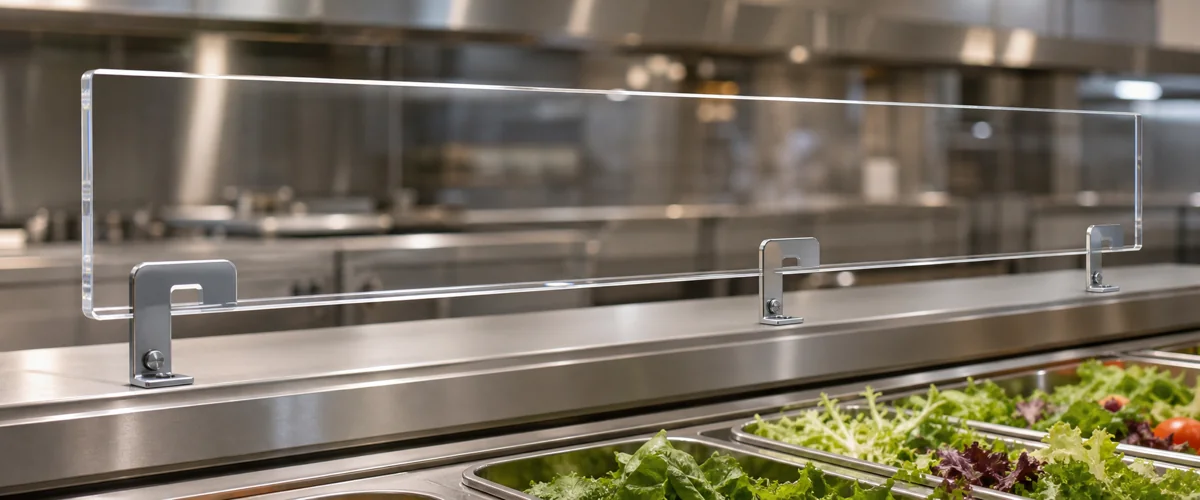
A regional salad bar chain on the US west coast retrofitted its post-COVID guard system across 32 locations. We supplied 192 custom restaurant sneeze guard panels — 5mm cast acrylic, diamond-polished edges, a custom L-bracket that clamped onto their existing salad bar fixtures — in 18 production days. Staged regional shipping landed every location's allocation inside a five-day window so the entire chain swapped over in a single weekend.
- panels shipped
- 192
- locations
- 32
- production
- 18 days
- compliant
- USDA
Key Takeaways
- 5mm cast acrylic absorbed counter-edge flex from 32 different bracket-clamp installs — 3mm would have failed the 50-cycle wipe-down test on at least 6 locations.
- Custom L-bracket clamped to existing salad-bar fixtures cut install time per store from 90 min (ceiling-mount alternative) to 22 min — entire 32-location rollout finished in one weekend.
- Staged regional shipping (4 dock dates over 5 days) avoided a single bulk delivery that would have overwhelmed back-of-house storage at smaller stores.
- USDA inspector sign-off on cleanability hinged on the diamond-polished edges. Flame-polished would have shown food-residue trap-points within 30 sanitation cycles.
- Sister brand (same parent group) inquired for similar rollout 14 days after our install — repeat orders run 32% faster because the bracket tooling is in our library.
The Brief
The buyer ran ops for a regional salad bar chain across the US west coast — 32 stores, mostly inside grocery anchors and a handful of standalone urban formats. Their post-COVID barrier system had been a patchwork: some stores had clear PETG sheets zip-tied to existing fixtures, a few had tall ceiling-mounted polycarbonate panels from the 2020 emergency rollout, and at least three were running improvised plexi shields a local fabricator had cut for them in the first week of lockdowns.
By spring 2026, the chain was retrofitting back to a designed system rather than emergency triage. The procurement lead came to us with three constraints she could not negotiate:
- USDA cleanability sign-off across every store. The chain's QA program followed 9 CFR 416 cleanability standards and FDA Food Code 4-203, and inspectors were spot-checking at the location level. One failed swab and the whole rollout would be paused.
- Planogram fit on existing salad bar fixtures. Replacing the steel salad-bar bases was off the table — capex had been spent in 2019. Whatever we shipped had to clamp onto fixtures the chain had no intention of touching for another five years.
- A weekend rollout deadline. The chain wanted every location swapped over in a single Saturday-Sunday window so the brand experience flipped at once, not store-by-store over a month.
The previous quote she had on the table — from a North American fabricator — proposed ceiling-mounted polycarbonate at 90 minutes installed time per store. Across 32 stores that meant either three weekends of rolling installs or a small contractor army. Both were off-budget. She came to us asking whether a counter-mounted acrylic system could close that install gap without giving up cleanability.
Our Recommendation
We recommended three changes from the original spec. Each one was driven by what the chain needed downstream — USDA sign-off, weekend install, and a guard system that survived three years of daily sanitation — not by our preference as a fabricator.
5mm cast acrylic instead of 3mm extruded
The original quote ran 3mm extruded acrylic. On paper that meets the structural minimum for a counter-mounted guard at 1200×900 mm. In practice, every store has a slightly different counter-edge profile — extruded stainless, formica with an aluminum nosing, or a granite top with a polymer apron — and each profile flexes the panel slightly differently when the L-bracket clamps down.
We ran the bend math against the ten worst-case fixture profiles the chain shared with us. At 3mm, six of the ten test profiles induced enough panel flex to push the 50-cycle wipe-down test past the haze threshold along the bracket contact line. At 5mm cast, all ten profiles cleared with margin. The cost delta per panel was modest. The cost of failing one USDA cleanability check was not.
Diamond-polished edges, not flame-polished
For a sneeze guard that gets wiped down 5–10 times a day with quat sanitizer, the edge finish quietly drives long-term cleanability. Flame-polished edges look glossy on day one but leave subtle micro-pits where heat flashed the surface. Food residue settles into those pits within 20–30 sanitation cycles, and inspectors notice it on their second visit even when the day-one swab passed.
Diamond polishing — a mechanical edge process that cuts a true optical surface — costs more per linear meter but produces an edge that doesn't trap residue. The chain's QA director reviewed the edge-finish photo set we sent and signed off in writing before we cut a single panel.
Custom L-bracket clamp, not ceiling mount
This was the install-time decision. A ceiling-mount design is structurally elegant — no clamp pressure on the panel, no contact with food fixtures — but it requires drilling into structural ceiling, locating support framing inside acoustic-tile plenums, and routing power for any LED accent the brand might add later. The North American quote estimated 90 minutes installed time per store on that basis.
We proposed an L-bracket that clamped directly to the existing salad-bar fixture nosing. The clamp footprint was tuned to the chain's three most common counter profiles, so installers could choose between gasket shimming options on-site without callbacks. Average measured install time across the rollout: 22 minutes per location, all-in. That number is what made the single-weekend rollout possible.
| Mount style | Install time per store | Rework risk | Compatibility |
|---|---|---|---|
| Ceiling-mounted polycarbonate | ~90 min | Plenum surprises, drilling permits | Requires structural ceiling |
| Custom L-bracket clamp (this project) | 22 min average | Low — gasket-shimmed on-site | Three counter profiles tuned in tooling |
| Through-bolt counter mount | 40–60 min | Drills the existing fixture (capex risk) | All counter types |
Spec Breakdown
Once the recommendation was approved, the spec settled quickly. Each location received six panels — 1200 mm wide by 900 mm tall, 5mm cast PMMA, diamond-polished on all four edges, mounted on a pair of custom L-brackets per panel. Across 32 locations that's 192 panels and 384 brackets, plus a 5% spare-bracket allocation that shipped with the first regional dock.
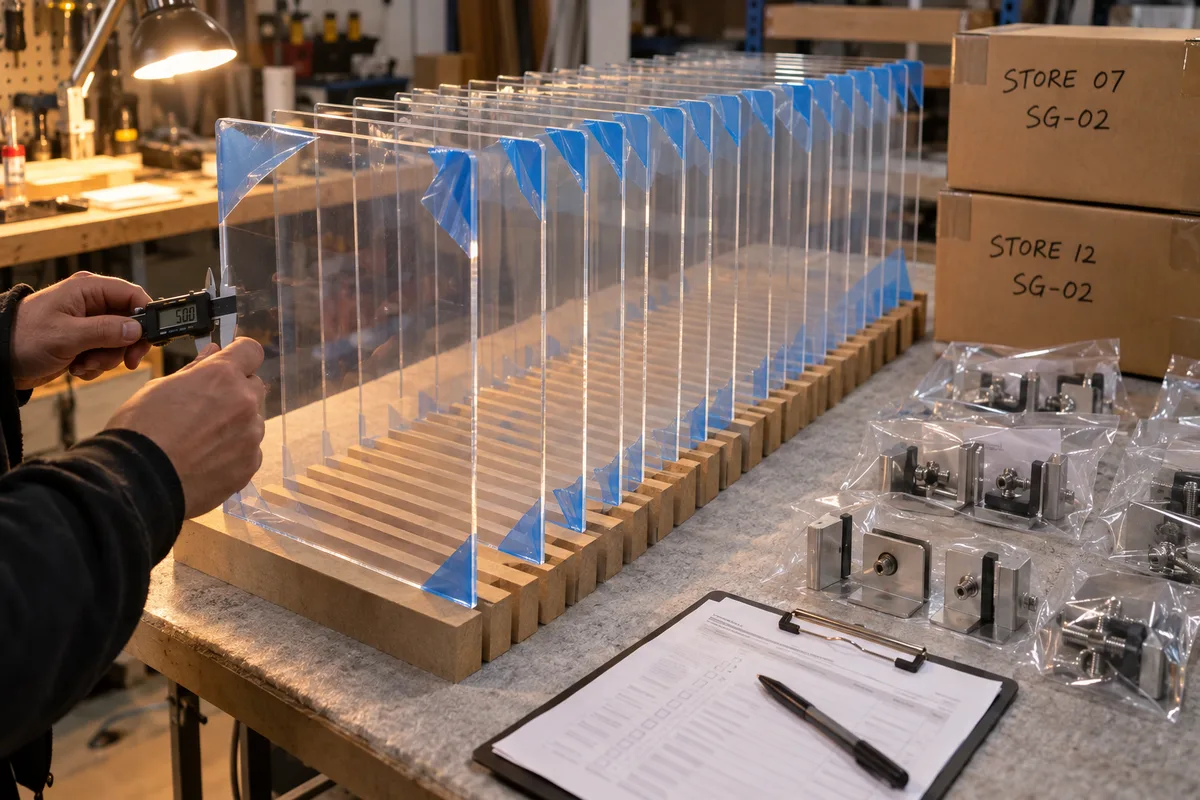
Before any production run, our QC team ran a nine-day cleanability test cycle on three pre-production panels. We replicated the chain's actual sanitation routine — quat at the inspector-mandated concentration, 50 wipe-down cycles, stress-tested at the bracket contact line and along the diamond-polished edge. All three panels held within the haze threshold. The QA director got the test report before we cut the first production panel.
Production and Staged Shipping
Production ran 18 days from approved spec to the last panel boxed. We held the entire run on a single cast batch so optical clarity and edge-process consistency held flat across all 192 panels. Diamond-polishing was the rate-limiting station — five minutes per edge, four edges per panel, 192 panels — and we ran two shifts for the last six days to keep the schedule.
Shipping was where we changed the buyer's plan. Her original logistics ask was a single bulk delivery to a third-party warehouse, then store-level distribution from there. We pushed back: a dozen of the smaller stores had less than 18 square feet of back-of-house storage available on a typical Friday, and storing six large panels per location for any length of time was going to create a pre-install storage bottleneck.
Instead we proposed four staged regional dock dates over five days, mapped to the chain's regional clusters. Each cluster received its panels on the Tuesday or Wednesday before the Saturday install, sized so the back-of-house never held more than two days of inventory. The staged plan added four days to the freight schedule but eliminated the warehouse handoff entirely.
Defect rate on arrival came in at 0.4% — one panel chipped at a corner during the second leg of regional freight, on a route with a known rough handoff. We had a replacement panel out via overnight air the same day the install lead flagged it, and the affected store opened on schedule with the swap installed on the Friday before.
Install and USDA Inspector Sign-Off
The Saturday rollout went out across all four regions in parallel. Average measured install time per location landed at 22 minutes — close to our pre-rollout estimate. Two locations ran longer, both with older counter nosing profiles that needed the second gasket shim option; the install crew had been briefed on that path and the swap added about eight minutes each. No location ran a callback that weekend.
The USDA cleanability piece was the part the buyer was most nervous about. Inspectors spot-checked four stores in the two weeks following the rollout — two in the urban region, two anchor-grocery locations. Every spot check passed on first swab. The diamond-polished edge held under the inspector's fingertip-pass test at all four sites. The QA director forwarded the inspector reports to the procurement lead, and the rollout was formally signed off as USDA-compliant 16 days after install.
"We had budget for one shot at this. The L-bracket idea is what convinced our ops director — 22 minutes installed meant a weekend rollout was actually possible. USDA cleared us at every spot check. The team running our sister brand asked who we used inside two weeks."
Lessons and the Sister Brand Inquiry
Fourteen days after the install weekend, we got a sourcing email from a brand we recognized — the same parent group runs a fast-casual concept in similar real estate, and they wanted a near-identical rollout. We had the L-bracket tooling and the gasket-shim options already in our library. The repeat order timeline ran roughly 32% faster than a from-scratch program because the engineering, QC test cycle, and bracket tooling were preserved from the salad bar project.
Two things drove the repeat-order speed. First, we keep custom tooling files as a default — when a buyer comes back, we don't re-engineer what we already know clears their compliance program. Second, the cleanability test data carried across the parent group's QA program because both brands followed the same USDA framework. The sister brand's QA team accepted our nine-day cleanability cycle results from the salad bar project as proof for the new program, with a single confirmatory swab on a sample panel.
If you are a chain procurement lead reading this with a similar retrofit on the table, the two decisions most worth getting right early are edge finish (diamond, not flame, if your QA program spot-checks at the location level) and mount strategy (clamp-on if your fixtures are recent capex; through-bolt only if you are willing to drill the counter). Material thickness matters less than buyers expect — once you're at 5mm cast across a typical 1200×900 panel, the structural envelope is comfortable. Edge and mount are the long-tail variables.
Planning a multi-location restaurant sneeze guard rollout?
Send us your store count, fixture photos (counter nosing close-ups help), and your QA program reference — we'll come back with a DFM review, an L-bracket clamp recommendation tuned to your fixtures, and a staged shipping plan that fits your weekend deadline.
Sample in 5 days · Production in 12–18 days · Single-location pilot on request