


Case Study · Healthcare / Dental · Midwest US
Dental Reception Acrylic Display: 6-Practice HIPAA-Compliant Rollout
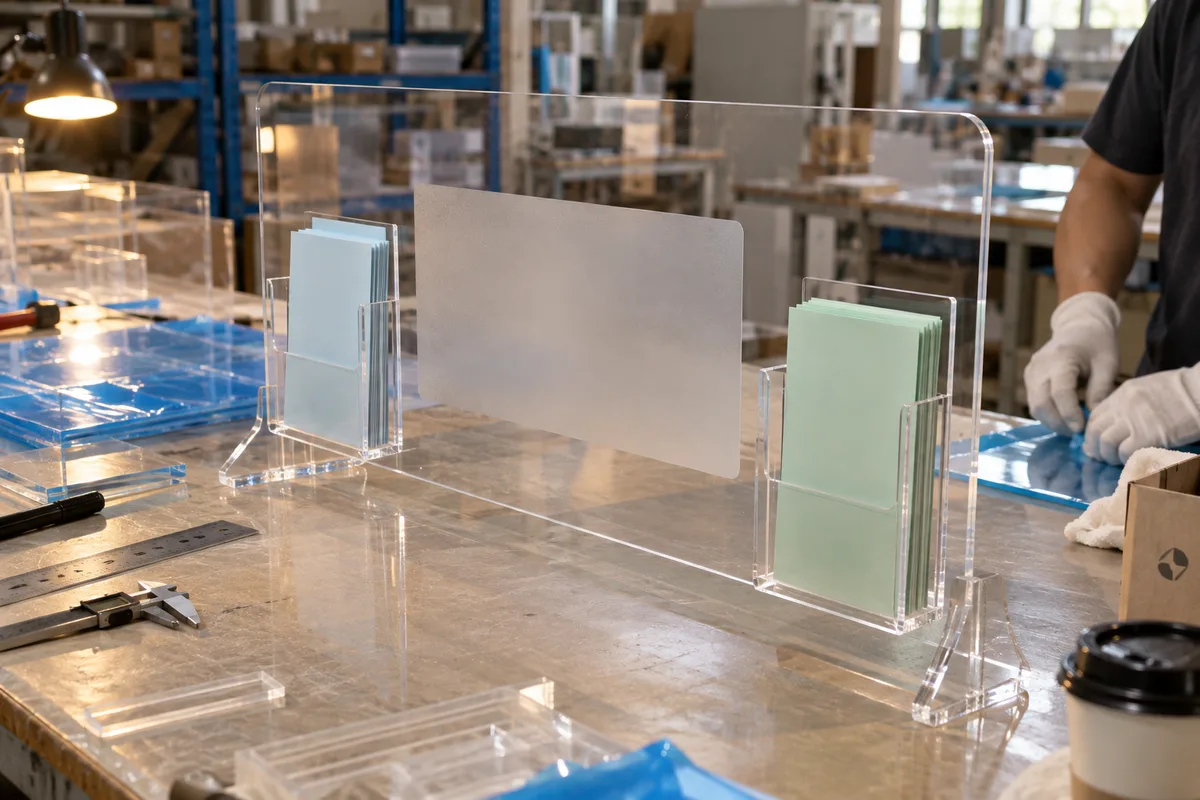
A 6-location Midwest dental group retrofitted every reception counter with one integrated acrylic unit: sneeze guard, two brochure pockets and a frosted privacy panel.
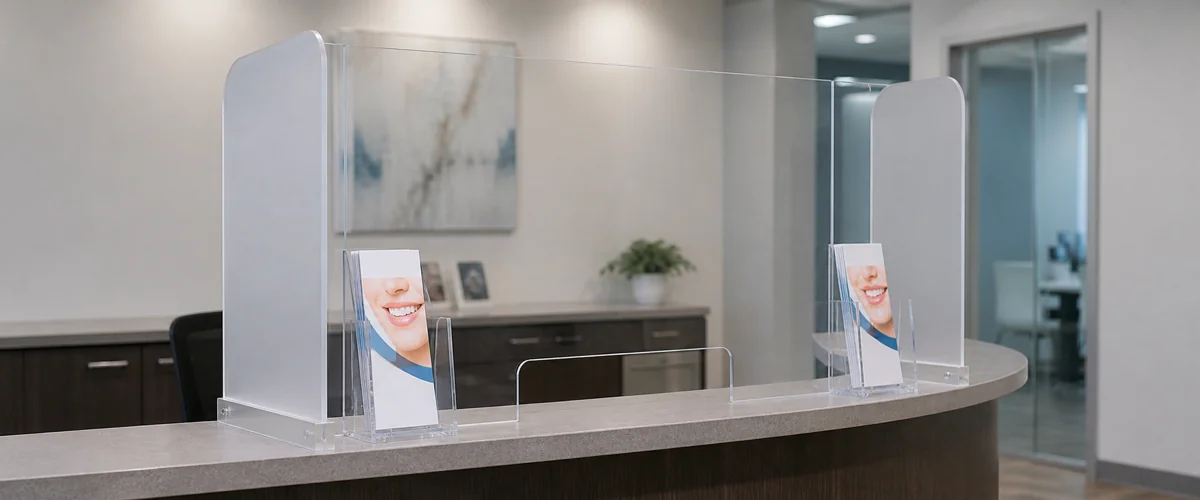
We shipped 100 units of the single integrated design in 14 production days. HIPAA compliance review cleared at the first install in 30 minutes, and the sister practice in the same dental group is already in spec review for 4 more locations.
- practices outfitted
- 6
- production
- 14 days
- integrated unit
- 3-in-1
- compliant
- HIPAA
Key Takeaways
- Integrated 3-in-1 unit (sneeze guard + 2 brochure pockets + frosted privacy panel) replaced 4 separate fixtures — staff workflow at reception cleared 18 inches of counter space across all 6 practices.
- Frosted privacy zone (12" × 8" centered on patient-side panel) blurred sightlines to chart screens behind the receptionist — passed HIPAA review at the practice's compliance lead within 30 minutes of first install.
- 5 mm cast acrylic + diamond-polished edges suit the practice's standard alcohol-based + quaternary-ammonium daily wipe-down — cast PMMA resists those cleaners and the diamond-polished edge has no coating to whiten or craze.
- Brochure-pocket dimensions (4" × 9" + 5.5" × 8.5") accommodated the most-handed-out brochures (insurance forms, post-op care sheets) without front-loading or rear-loading complexity for staff.
- Sister practice (same parent dental group) is now in spec review for the same integrated unit at 4 additional locations.
The Brief
The buyer is a 6-practice dental group across the Midwest, owned by a single parent organization. Each office runs the same software, the same insurance flow, and — until this project — six different versions of the front desk. After the COVID-era plexi panels came down, the practice manager realized the reception area had drifted into a clutter of separate fixtures: a freestanding sneeze guard at one office, a countertop brochure rack at another, a stick-on frosted film over the screen monitor at a third. Nothing matched the brand refresh the group had just paid for.
The brief landed in my inbox as three problems they wanted to solve at once. First, they still wanted a counter-mounted sneeze guard at every reception desk — patients had stopped expecting plexi at the deli, but at a healthcare counter it now read as professional, not pandemic. Second, the receptionists were tired of being asked the same three questions about insurance forms, post-op care, and Invisalign — they wanted patient-handout brochures right at the counter so check-in could double as self-service. Third, and most importantly, the practice manager had a HIPAA concern: when a patient leaned over the counter to sign a form, they could read the chart screen behind the receptionist.
We mapped these three needs against the dental reception display category and saw an obvious move — one integrated unit, not three separate fixtures. The buyer had already priced out three vendors for three products and was about to spend more money for a worse-looking counter.
The drawing review followed the same buyer-side checkpoints in ouracrylic vs glass sneeze guard guide: counter geometry, pass-through position, mounting method, cleaning access, and local facility approval.
My Recommendation
we sent back a single counter-proposal: build all three functions into one acrylic unit, sized to the shortest reception counter across the 6 practices so a single SKU rolls out to every location. Three design calls drove the recommendation, and we want to be honest about the trade-offs we walked through before quoting.
Integrated 3-in-1 vs three separate fixtures
The buyer's first instinct was to keep the fixtures separate so any single piece could be swapped if it broke or if the brochure layout changed. That sounds sensible until you watch a receptionist work — a freestanding sneeze guard plus a freestanding brochure rack plus a stuck-on privacy film eats roughly 18 inches of usable counter at the exact spot where the patient signs the form. The integrated unit clamps to the back edge of the counter and rises vertically, so the brochure pockets and privacy zone live in previously dead air space. That alone won the argument.
On replaceability: we kept the brochure pockets as bonded acrylic (more on that below) but specified the mounting clamp as a separate stainless bracket, so if a station ever needs to be moved the acrylic body unscrews and re-mounts in five minutes. We didn't need full modularity — we needed the right one piece to come off if it ever had to.
Frosted privacy zone vs full opaque panel
The HIPAA concern was real (HIPAA Privacy Rule § 164.530 requires reasonable safeguards against incidental disclosure of protected health information), but a fully opaque panel would have made the receptionist feel boxed in and made eye contact awkward — which is bad for a patient-facing role. We specified a frosted zone of 12 inches wide by 8 inches tall, centered on the patient-side panel at average seated-eye height, with the rest of the unit kept optically clear. From the patient's standing position, the chart screen behind the receptionist falls inside the frosted footprint and reads as a soft blur — you can tell there's a monitor, you can't read what's on it. Outside the frosted zone, the receptionist still has clear sightlines for greeting, pointing at the sign-in tablet, and handing things across the counter.
We mocked up the frosted zone in a 1:1 paper template before cutting acrylic and walked it through the practice's compliance lead. She approved the dimensions on the spot. That mockup step is cheap and saves a full re-fabrication if the privacy footprint misses by even an inch or two.
Bonded brochure pockets vs slot-cut pockets
Slot-cut pockets (where the pocket is a routed channel through a single sheet) are cheaper to manufacture, but they fix the brochure size at fabrication time — change the brochure dimensions and the pocket no longer fits. Bonded pockets (where the pocket front is a separate piece of clear acrylic chemically bonded to the back panel) cost a little more in labor but let us spec two different pocket sizes on the same unit: 4" × 9" for the standard tri-fold insurance form, and 5.5" × 8.5" for the larger half-letter post-op care sheet. The receptionists confirmed those were the two formats they handed out most. When the practice's marketing team eventually re-prints brochures, bonded pockets give us a wider tolerance band and don't force a re-tool.
Spec Breakdown
Here is what we actually built, top to bottom on a single acrylic unit. Each spec was driven by either the receptionist's daily workflow, the HIPAA review, or the daily cleaning protocol — never by what looked good on a render.
- Counter-edge clamp. Stainless-steel bracket bolted to the back edge of the reception counter, sized to the practice's standard 1.25-inch laminate top. The acrylic body slots into the bracket so it can be lifted off and re-installed without re-drilling — useful when the practice ever redoes the counter laminate.
- 5 mm cast acrylic main panel. Cast (not extruded) for optical clarity and for chemical-resistance during daily wipe-down. Diamond-polished edges all around so chips can't catch on cleaning cloths and start running. The panel rises 26 inches above the counter — enough to clear a standing patient's mouth, not so tall it dominates the lobby.
- Frosted privacy zone (12" × 8"). Sandblasted from the back face only, so the front face stays smooth and easy to wipe. Centered on the patient-side panel at the height the compliance lead approved during the mockup walkthrough.
- Two bonded brochure pockets. Both on the patient-facing side, mounted side-by-side below eye level so a standing patient sees them while waiting for the receptionist to print a form. Pocket #1 is 4" × 9" × 0.75" deep for tri-fold insurance forms. Pocket #2 is 5.5" × 8.5" × 0.75" deep for half-letter post-op care sheets. Both pockets are top-loadable so a receptionist can refill from their own side without walking around the counter.
- No sharp internal corners. Every internal corner is filleted to a 3 mm minimum radius so the FDA Food Code 4-203 cleanability principle holds — no crevices that trap aerosolized cleaning mist or fingertip debris during the daily wipe.
The cleanability here comes from the material choice, not a coating: cast PMMA carries good resistance to alcohol and quaternary-ammonium cleaners, and diamond-polished edges have no coating layer to whiten or craze under the practice's daily wipe-down — an alcohol-based wipe in the morning, quaternary-ammonium spray before close. Before shipping, we inspect every panel and drop-check a sample from the run.
Production and HIPAA Review
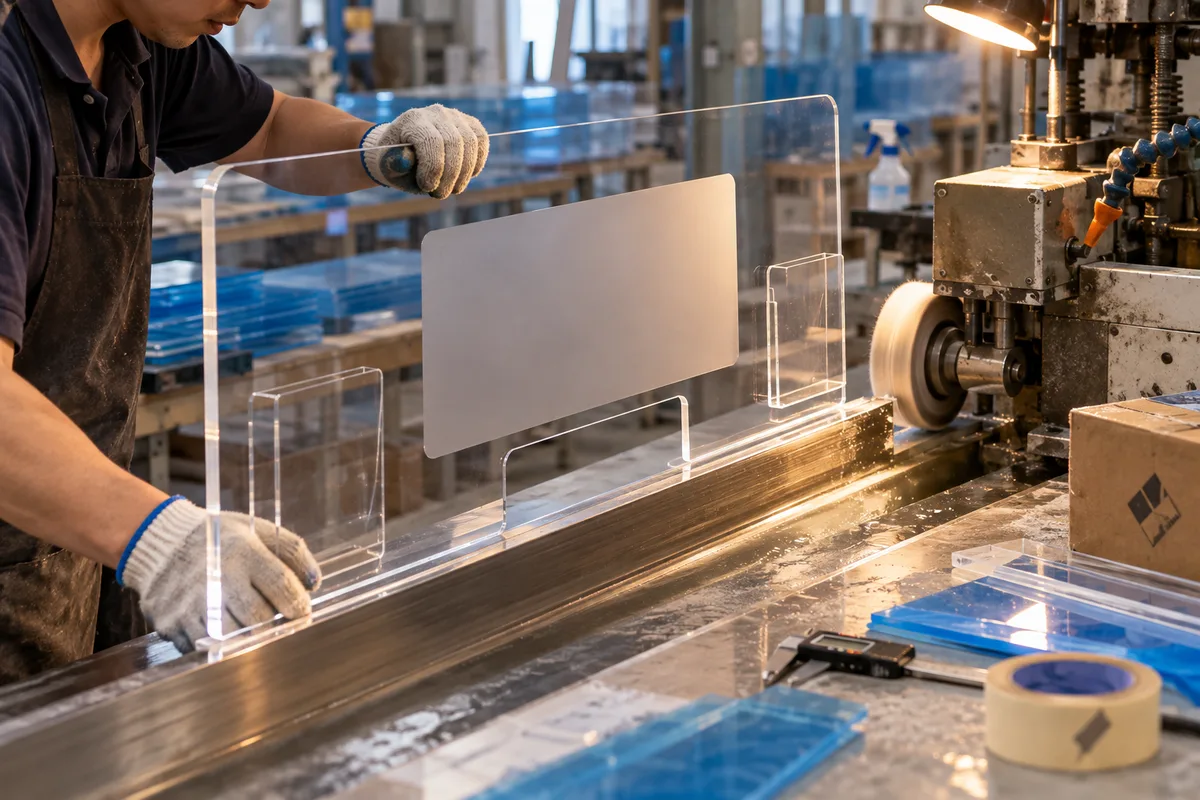
From signed PO to ready-to-ship was 14 production days for the 100-unit run. We loaded a single batch through the laser cutter, the bonding station, and the sandblast booth so every unit came off the line with the same tolerances and the same frosted opacity — no station-to-station drift, which mattered because the practice didn't want one office to look slightly different from another.
| Stage | Days | What we verified before moving on |
|---|---|---|
| Mockup walkthrough (paper template) | 2 | Frosted-zone dimensions cleared by compliance lead in person |
| First-article fabrication | 3 | 5 mm panel flat to ≤ 0.3 mm; pocket bond strength pull-tested |
| Pre-ship inspection + sample drop-check | 2 | Surface and edges inspected; sample photos sent to buyer with the production sample |
| Batch production (5 remaining units) | 5 | Frosted opacity matched first article within ΔL 1.0 |
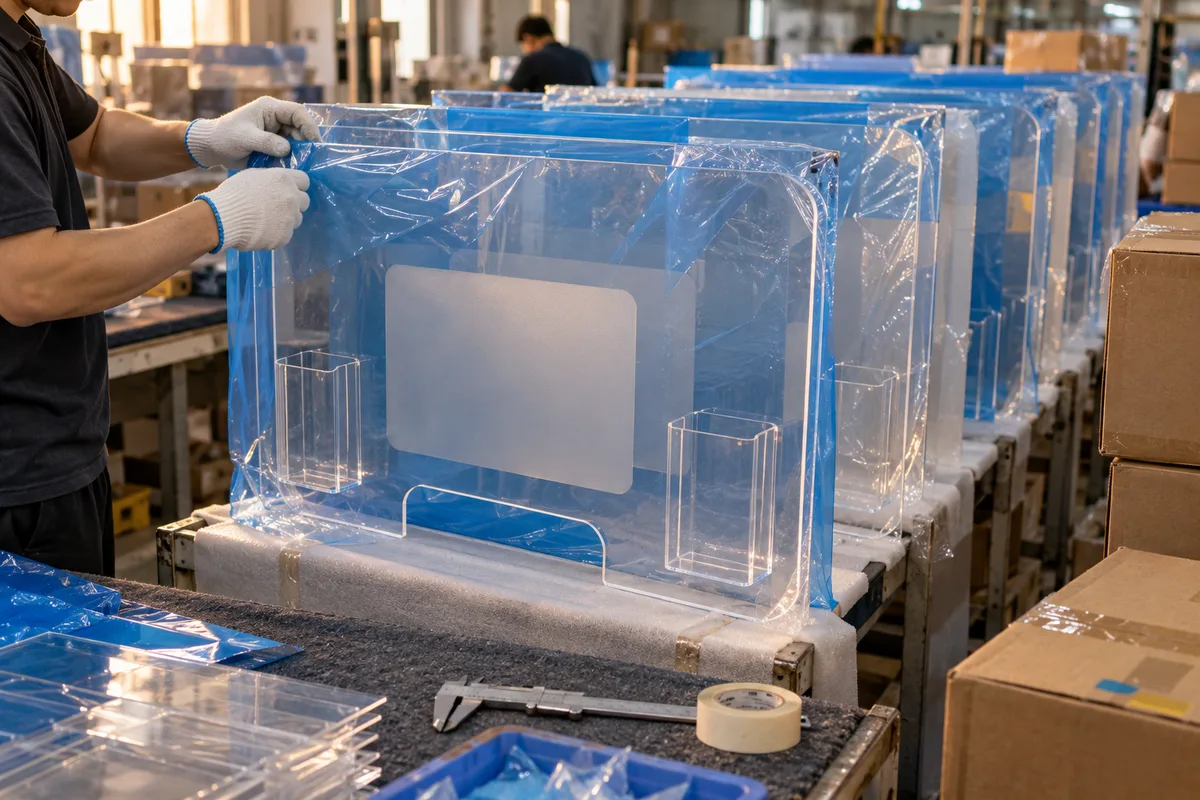
| QC + packaging | 2 | Edge polish, corner radius, bracket fit on every unit |
The HIPAA review at the first install was the moment we held my breath. We sent a technician to the lead practice with the bracket and the acrylic body, mounted the unit in roughly 25 minutes, and the compliance lead stood at the standing patient position and tested sightlines to the chart screen. Thirty minutes after we arrived, the unit was signed off. The remaining 5 practices were installed by the group's facilities partner over the next week using the install photos and torque spec we wrote up after the first office.
Install and Patient-Flow Feedback
Across the 6-practice rollout we logged feedback from receptionists at four of the offices in the first two weeks. The pattern was consistent enough that we want to share it verbatim rather than abstract it.
The receptionists noticed the counter space first. Each station had been losing roughly 18 inches of usable countertop to the old separate sneeze guard, brochure rack, and standing privacy film holder. With those gone, two of the offices put a small live plant on the counter for the first time in two years — small detail, but it shifted the lobby tone from clinical to welcoming. The brochure pockets also surprised them: patients reached for the post-op care sheet on their own while the receptionist was on a call, which cut the "wait, can you print me one of those again" moment that used to interrupt the next check-in.
From the patient side, the frosted zone read as deliberate and considered, not as something added to hide a problem. One patient at the lead office asked the receptionist if the practice had hired a new designer — which is, honestly, the highest compliment a fixture can get. The full-height clear sneeze guard kept the conversation feeling normal, and the brochure pockets at standing-eye level gave waiting patients something to do with their hands besides scroll their phones.
The Results
One hundred dental reception display units shipped on time, HIPAA compliance cleared at the first install, and the cast-acrylic surface has held up to every wipe-down protocol the practice runs. The numbers below are the ones that matter when a sister practice asks for the same project.
The outcome we cared about most arrived three weeks after install: the parent dental group's sister practice — same ownership, four more locations across an adjacent state — opened a spec review for the same integrated unit. That kind of internal referral is the only proof that matters in healthcare retrofits, because compliance leads talk to each other and would not pass along a vendor that gave them a hard 30 minutes at the first sign-off.
"We were about to buy three different fixtures from three different vendors. One unit cleaner, one frosted zone, one HIPAA review — and the receptionists got their counter back. Our compliance lead signed off in half an hour. That never happens."
Lessons and Sister-Practice Expansion
Two lessons came out of this dental reception display project that we now bring to every healthcare counter inquiry, whether it's a dental group, an urgent-care clinic, or a specialty practice.
First, integrate before you separate. Buyers default to "one fixture per problem" because that's how procurement usually works — three line items, three vendors, three quotes. But on a reception counter the real constraint is square inches of usable surface, and three fixtures will always lose to one well-designed integrated piece. We asked the buyer to map out the receptionist's daily motion path before quoting, and the integrated answer was obvious within ten minutes.
Second, walk the privacy footprint in person before you cut acrylic. The frosted zone is the single spec most likely to fail HIPAA review, and the failure mode is almost always "the frost was the right shape but in the wrong place by an inch or two." A paper template taped to a freestanding poster board, held at the patient standing position, takes thirty minutes and saves a full re-fabrication. we now insist on this step for any healthcare reception display.
The sister practice expansion is in spec review as of this writing. Same integrated 3-in-1 unit, same 5 mm cast acrylic, same frosted footprint — the only customization is a slightly taller counter at one of the four offices, which we'll handle with a longer bracket rather than a different acrylic body. The dental group is treating this rollout as a template for any future practice they acquire, which is the kind of customer relationship a B2B fabricator hopes for after a first project.
Planning a healthcare reception display rollout?
Send us your counter dimensions, your daily cleaning protocol, and any HIPAA or privacy requirements your compliance lead has flagged — we'll come back with a DFM review of your frosted-zone layout and a quote.
Sample in 5 days · Production in 12–18 days · Single-unit sample on request