




Acrylic Candy Dispenser Design & Buying Guide
The clear hopper is the easy part. Whether candy flows, bridges, or avalanches is decided by chute geometry — and that's what this guide specs.
Need this made?Custom acrylic organizers →
Key Takeaways
- Candy flow is geometry, not luck: with standard chute angles, the chute throat should be at least 4-6 times the largest piece dimension, or pieces arch across the opening and bridge — the number-one gravity bin failure.
- One chute angle cannot serve all candy: small dense pieces want a shallower chute (~35°) with a flow baffle to stop avalanching, while large, light, irregular pieces need a steeper chute (~50°) and a wider throat.
- Food-contact compliance is a property of the acrylic formulation — in the US it's regulated under FDA 21 CFR 177.1010 — so spec food-grade sheet and ask for the material declaration; no dispenser hardware makes non-compliant sheet compliant.
- Acrylic's enemies are hot sanitizing cycles and alcohol- or ammonia-based cleaners, both of which craze it — so a dispenser should tear down without tools and wash in warm soapy water at the sink.
- At our MOQ of 100 pieces per design with no tooling fee on most designs, a branded dispenser program samples in 3-5 days and produces in 15-20 days, FOB Shenzhen.
On this page
The geometry decides, not the material
Most acrylic candy dispenser briefs obsess over the wrong spec. The clear hopper is the easy part — any competent fabricator can bond one. Whether the candy actually flows is decided by chute geometry: the chute angle matched to the piece, and a throat opening at least 4-6 times the largest piece dimension.
Loose candy in a gravity bin dispenser behaves like any granular material in a hopper: it flows, arches, or avalanches, and the geometry picks which. Bridging is the classic failure — pieces lock into an arch across a too-small throat and the flow stops dead, usually in front of a customer. Avalanching is the opposite failure: small dense pieces pour so freely that one pull of the gate floods the tray. Both failures get blamed on the dispenser hardware, and both are cured on the drawing, before any acrylic is cut.
The candy-dispenser inquiry almost never arrives speaking in chute angles — it arrives as a retailer whose existing pick-and-mix bins jam. The first question I send back is never about the dispenser. It’s about the candy: the largest piece dimension, the piece weight, and whether the surface is slick, sugared, or waxy. Those three answers set the chute before aesthetics enter the conversation.
| Candy type | Flow behavior | Chute angle | Throat opening |
|---|---|---|---|
| Small, dense, free-flowing (panned candy, jelly beans) | Avalanches — over-delivers per pull | ~35° plus a flow baffle | ≥40mm and ≥4-6x piece size |
| Mid-size or lightly sticky (gummies, wrapped chews) | Slows against walls, occasional hang-ups | 40-45° | ≥5x largest piece dimension |
| Large, light, irregular (wrapped bars, marshmallows) | Arches and bridges across the throat | ~50° | ≥70mm; a 50° steep-assist hopper lets the multiple drop (the UK program ran >3× a 22mm piece with steep assist) |
Treat chute angle and throat width as product-specific variables, not universal bands. A multi-store gravity-bin project shows how small, dense products were split from larger, irregular products so neither group inherited a compromise geometry. Confirm both paths with physical product during sampling, then record the approved angle, throat, and baffle configuration on the production drawing.
Portion-control gate mechanics
The gate is the second engineering decision, and it sets how much candy leaves per customer action. Three mechanisms cover nearly every retail acrylic candy dispenser: a pull-flap gate for self-serve flow, a slide gate for staff-controlled service, and a rotary portion wheel when every serving must be the same size.
The pull-flap is the self-serve default: a hinged or pivoting flap at the chute mouth that the customer holds open, with gravity or a light spring returning it shut. Its portion control is behavioral, not mechanical — the flow rate set by your chute geometry decides how much lands per second of pull, which is precisely why the avalanche problem in the table above matters. A baffle above the throat slows a free-flowing candy so a normal two-second pull delivers a sane portion.
The slide gate suits staffed counters and anything price-sensitive by weight: a flat acrylic slide in a milled track that staff open over a scale scoop. It seals more dust-tight than a flap and can’t be held open by an enthusiastic child. The rotary portion wheel is the strictest option — a paddle wheel in a round housing that meters a fixed chamber volume per quarter-turn. It’s the right mechanism when the business model is “one serving per coin or token,” and the wrong one for mixed piece sizes, which wedge between paddle and housing.
Whichever gate you pick, spec the pivot and track parts in acrylic or stainless — the gate is the highest-wear, highest-touch zone on the whole unit, and it lives in the food zone. Which raises the material question.
Food-contact PMMA: what compliance actually means
Acrylic is permitted for direct food contact when the sheet is made to a food-grade formulation. In the US, that sits under FDA 21 CFR 177.1010 — “Acrylic and modified acrylic plastics, semirigid and rigid” — which sets composition and extraction limits at the material level.1 Compliance belongs to the sheet formulation, not to the finished dispenser.
That distinction protects you from two opposite mistakes. The first is under-speccing: assuming any clear acrylic is fine because it looks identical. Food-grade and general-purpose sheet are visually indistinguishable; the difference lives in the resin formulation and its extraction behavior, which is exactly what the regulation limits. The second is over-trusting hardware claims: no fabricator’s dispenser design makes non-compliant sheet compliant, and a factory that answers “is it FDA?” with “yes” and no paperwork is answering a question about the wrong object. The honest form of the answer is a material declaration for the specific sheet lot, issued by the sheet supplier, passed through to you with the order documents. That is what we provide — we fabricate the dispenser from externally sourced food-grade sheet and document the material; we don’t certify the regulation ourselves, and no fabricator can.
One practical scope note: candy that arrives wrapped never touches the acrylic, and a dispenser running only wrapped pieces can reasonably use general-purpose sheet in the hopper with food-grade reserved for the chute and tray. For unwrapped bulk candy, spec food-grade for every surface in the flow path.
Cleaning and wear: design for the nightly wipe-down
An acrylic candy dispenser lives in a fog of sugar dust, and its lifespan is set by the cleaning routine it makes possible. The rules: warm water and mild dish soap only, no alcohol or ammonia cleaners, no hot sanitizing cycles — and a teardown that needs zero tools, so the wash actually happens.
The chemistry rules aren’t fussiness. Alcohol-, ammonia-, and solvent-based cleaners attack acrylic and cause crazing — a web of fine surface cracks that turns a clear hopper permanently hazy within weeks of daily misuse. Heat does the same job slower: PMMA’s heat-deflection temperature is roughly 96°C,2 so commercial dishwasher and hot-sanitize cycles pair softening heat with aggressive detergent, the exact combination that kills clarity. Warm soapy water and a soft cloth preserve a dispenser for years; one well-meaning shift with glass cleaner can fog it for good. Since 2020, I’ve had store-operations managers ask for “dishwasher-safe acrylic” — the correct answer is that no acrylic is, and the design workaround is making the sink wash effortless.
Design does most of that work. The parts sugar actually coats — chute, gate, tray — should lift off keyhole slots or magnets without a screwdriver, so the nightly wipe-down covers the food zone and the weekly full wash happens at the sink. Inside the hopper, radiused corners beat sharp ones: a 5mm internal radius wipes clean in one pass where a square corner traps sugar paste. Wear concentrates at the gate pivot and the tray lip; spec those edges diamond- or flame-polished, because polished acrylic sheds sugar dust that a saw-cut edge grips. The same warm-soapy-water logic applies across food-service acrylic — our food safe and dishwasher safe acrylic trays guide covers it for trays.
Countertop units vs wall banks
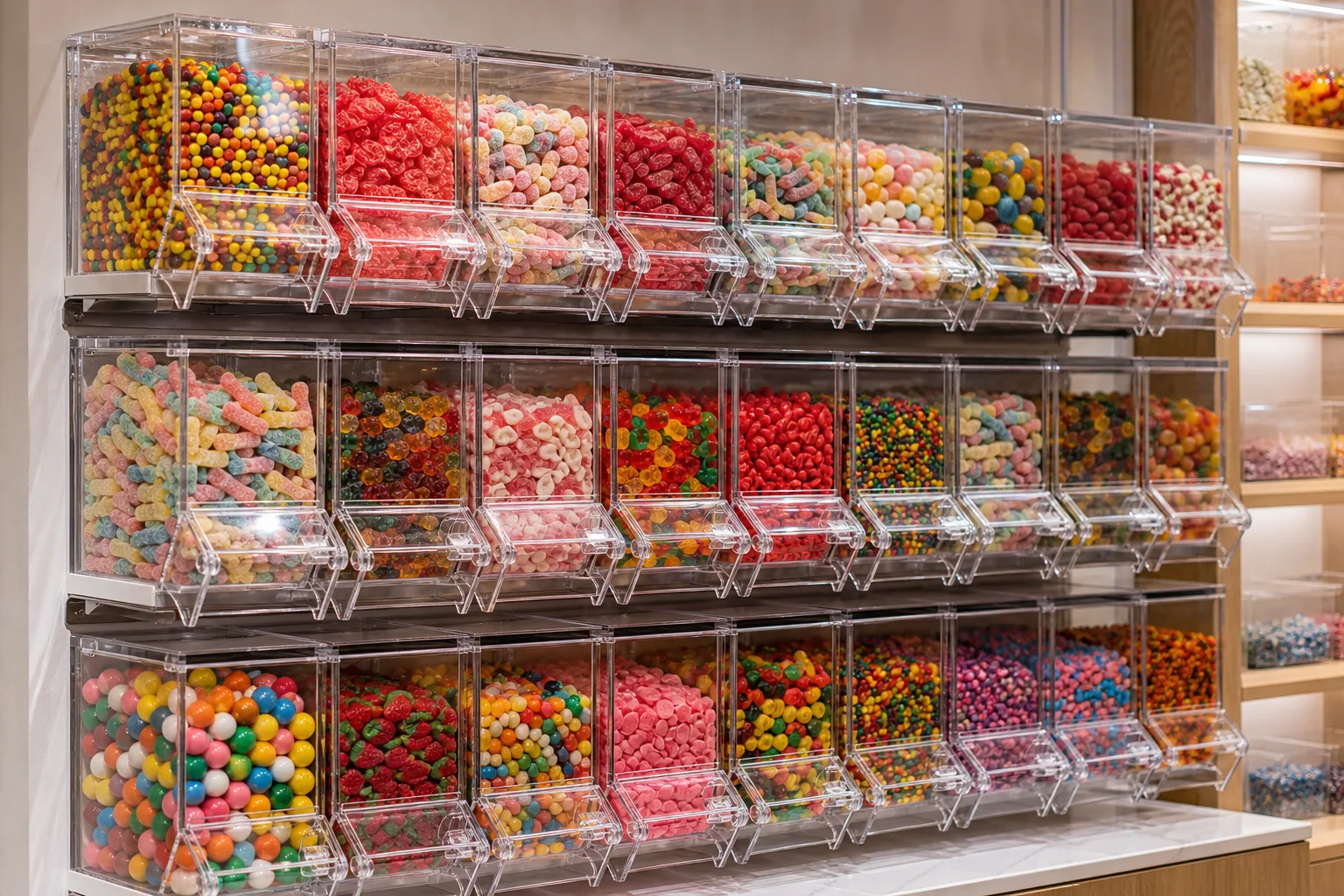
Layout is a capacity-versus-footprint trade. Countertop acrylic candy dispenser units suit 1-6 SKUs at the register and impulse zones; wall-mounted gravity banks turn a vertical surface into 12-40 SKUs of self-serve range. Most programs run both: a wall bank for range, countertop units for high-margin impulse lines.
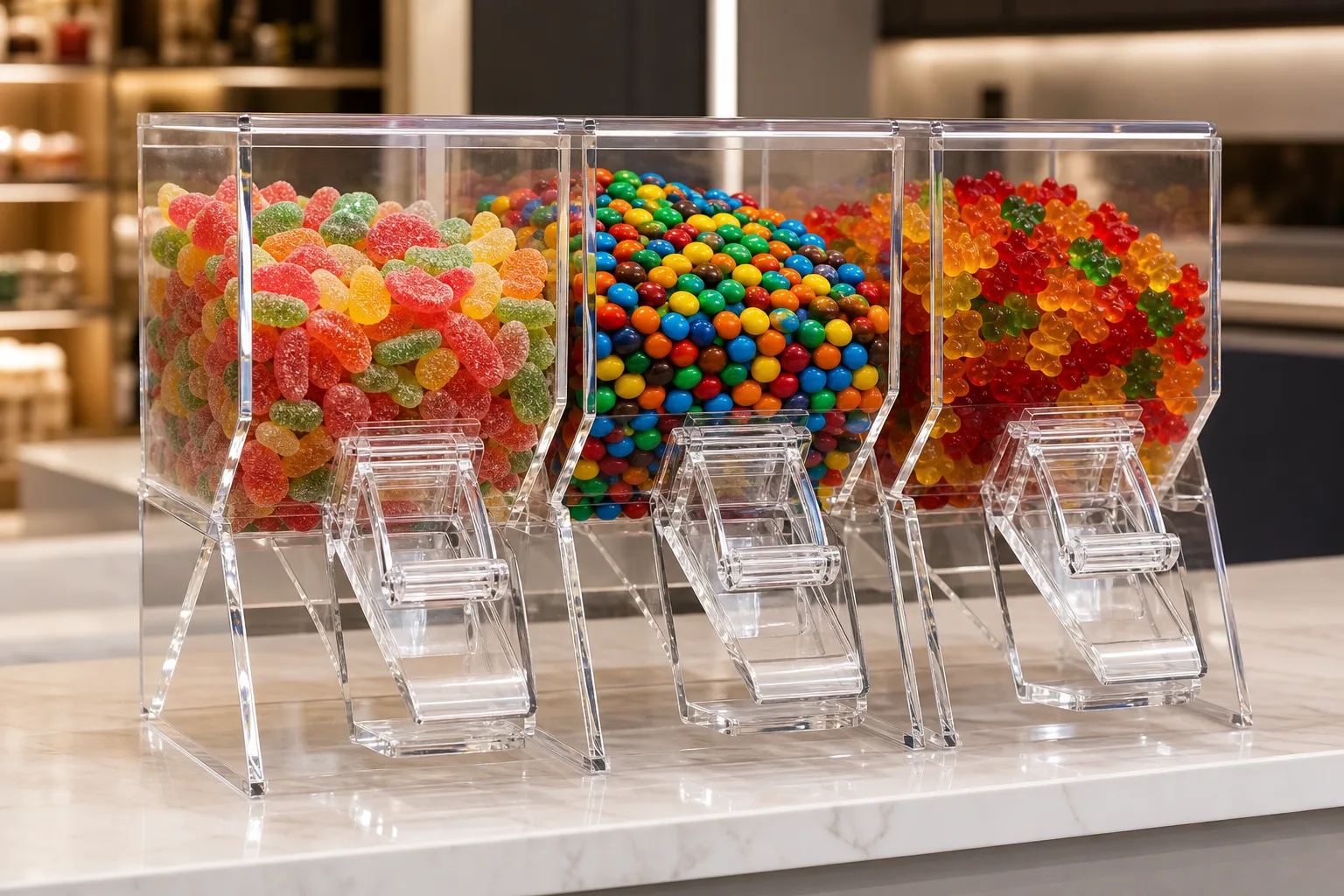
A typical countertop unit lands around 200mm wide x 300mm deep x 400-450mm tall — roughly 8-12 liters of candy, or 5-8kg of dense panned pieces — sized so a staff member can lift and refill it without a ladder. Duo and trio countertop formats share one base and tray, which reads tidier at the register than three loose units and stops the row drifting out of alignment. The numbers that matter at the counter: keep the whole unit under about 450mm tall so it doesn’t wall off the customer-cashier sight line, and give the tray lip 80-100mm of scoop room.
Wall banks change the ergonomic math. Bins mount in rails or a frame grid, filled from a hinged or lift-off top, dispensed at the bottom — so the workable band runs from about 900mm (a child’s comfortable reach at the gate) to about 1,600mm (an adult’s refill reach at the lid). Below and above that band the wall is for graphics, not bins. Module widths of 200-250mm per bin let a 2-meter wall carry 8-10 columns, and three rows inside the reach band puts 24-30 SKUs on one wall. Every one of these dimensions is cut-to-order — the custom acrylic boxes family shares the same fabrication, and our acrylic display stands page covers the countertop fixture side.
One scope line while we are on layouts, because buyers use “candy display” for two different purchases. This guide owns the dispenser: the hopper, chute, gate, and tray that loose candy actually flows through, where the spec is geometry and food-contact material. The rest of a candy display — the risers, tiered stands, and counter fixtures that carry bagged and boxed sweets, seasonal lines, and impulse merchandising — sits on our food and bakery displays page, which covers the retail-display side of the same counter. Most candy programs buy from both: dispensers for the bulk lines, display fixtures for everything that arrives in a wrapper.
Program economics at MOQ 100
A custom acrylic candy dispenser program starts at 100 pieces per design with no tooling fee on most designs — dispensers are laser- and CNC-cut from sheet, not molded, so a chute revision costs drawing time instead of a new mold. Samples ship in 3-5 days; production runs 15-20 days, FOB Shenzhen.
The cost structure rewards exactly the iteration a dispenser program needs. Because there is no mold, testing two chute geometries costs two samples, not two tooling invoices. Unit cost is driven by size, wall thickness, gate mechanism complexity, and finishing; branding rides along in the same run at 100 pieces per design. In store-level terms, that can be one dispenser across 50 stores with one spare at each location, or a 20-store rollout of a five-bin wall bank.
Payment and process follow our standard terms: 30% deposit, balance before shipment, 100% inspection under ISO 9001 before packing. The one thing I ask every candy buyer to send before quoting is a bag of the actual product — real pieces beat any written spec for setting the chute, and the sample you approve is tested with your candy in it. Send us your candy spec — piece size, SKU count, counter or wall, quantity — and we’ll come back with a drawing and a per-unit range within 24 hours.
For an example using the same named-material and buyer-approval discipline, see our UK snack dispenser rollout.
Footnotes
-
FDA 21 CFR 177.1010 — Acrylic and modified acrylic plastics, semirigid and rigid (eCFR) — the US regulation permitting acrylic plastics for direct food contact under defined composition and extraction limits, the material-level compliance basis for unwrapped-candy flow paths. ↩
-
PMMA (Acrylic) material properties — MakeItFrom — displays PMMA’s heat-deflection temperature of roughly 96°C, the number behind the no-hot-sanitizing-cycle cleaning rule. ↩
Frequently Asked Questions
What chute angle should a bulk candy dispenser use?
It depends on the candy. Small dense free-flowing pieces run well at about 35 degrees with a baffle to stop avalanching; large, light, or irregular pieces need around 50 degrees and a wider throat to keep moving. The throat rule matters more than the angle: keep the opening at least 4-6 times the largest piece dimension or the candy bridges.
Is acrylic food-safe for a candy dispenser?
Yes, when the sheet is a food-grade formulation. In the US, acrylic for direct food contact is regulated under FDA 21 CFR 177.1010, which sets composition and extraction limits at the material level. Spec food-grade sheet and request the supplier's material declaration — compliance belongs to the formulation, not to the finished dispenser shape.
How do you clean an acrylic candy dispenser?
Warm water, mild dish soap, a soft cloth, air dry — nightly for the chute and gate, weekly for the full hopper. Never use alcohol-, ammonia-, or solvent-based cleaners, and never run hot sanitizing cycles: both craze acrylic into a web of fine cracks. A well-designed unit tears down without tools so the wash happens at the sink.
How much candy does a countertop dispenser hold?
A typical countertop gravity bin at around 200 x 300 x 450mm holds roughly 8-12 liters of candy depending on chute volume — in the range of 5-8kg for dense panned candy. Wall-bank modules run larger per bin, and capacity is a direct trade against counter footprint, so we size the hopper from your refill schedule, not from a maximum.
What does a custom candy dispenser program cost to start?
Our MOQ is 100 pieces per design, and because dispensers are laser- and CNC-cut rather than molded there is usually no tooling fee — a design change costs drawing time, not a mold. Samples ship in 3-5 days, production runs 15-20 days, FOB Shenzhen, with 30% deposit and the balance before shipment.
Explore Custom Acrylic Products
Browse product categories to compare formats, materials, and customization options before choosing the closest fit for your project.