




Delivered project · Retail Rollout
Acrylic Snack Dispenser Program for Retail
We delivered a gravity-bin program where the actual snack flowed through the sample, staff could remove and clean the chute, and every SKU reached the correct store.
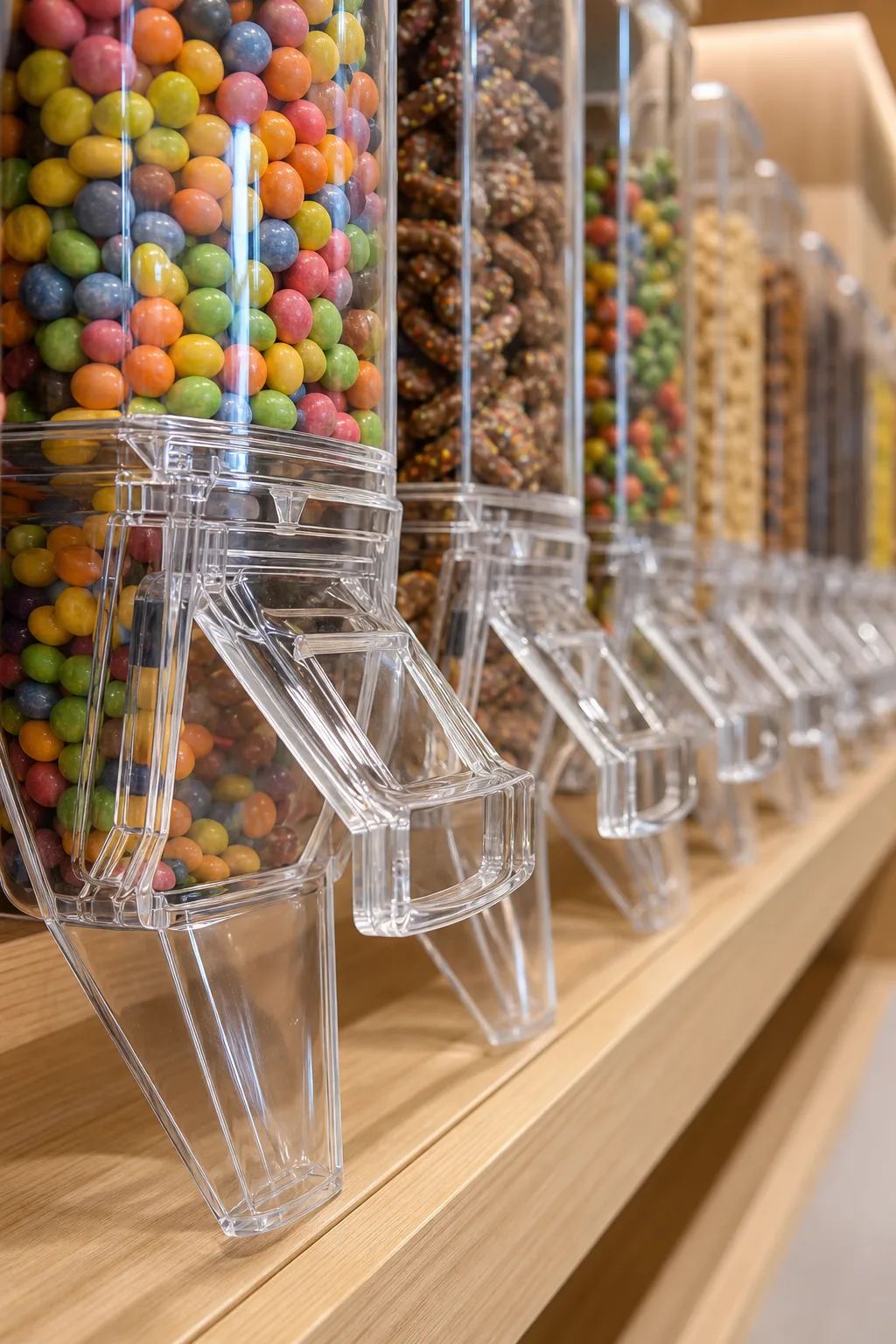
Material records matched the specified sheet. This page records how those requirements became the production program. Project profile: A multi-store gravity-bin program built around buyer-defined chute geometries, real-product flow trials, removable parts, cleaning access, material documentation, sampling, and batch QC. Food-contact requirements lock to the buyer's market and approved material records.
Ordering a similar project
MOQ is 100 pieces per design. Paid samples normally take 3–5 days, are paid separately, and are never credited to production. Standard production takes 15–20 days after product samples, drawings, material records, flow tests, cleaning access, inspection plan, and packing are approved; Wetop responds to a complete brief within 24 hours.
Key Takeaways
- Piece size is only the starting input: shape, surface, density, fill level, wall angle and throat geometry all influence bridging or uncontrolled flow.
- Small dense candy and large irregular snacks often need different chute or baffle geometries; Wetop validates the actual buyer-supplied product in a sample.
- Material documentation belongs to the exact sheet supplier and grade. Wetop passes it through; the buyer approves the finished food-contact application.
- A removable chute and accessible internal radii make the buyer-defined cleaning routine easier to execute without tools.
- The rollout connects each SKU to product type, store allocation, spare quantity, function test and destination label.
The Challenge
Loose snacks flowed differently through the gravity bins as product shape, surface, density, fill level, wall angle, outlet and baffle geometry changed. The retailer came to us replacing generic dispensers that had been designed around one mid-size piece profile, so the program needed the actual product range and a buyer-defined flow test rather than the assumption that one chute would suit every snack.
Two further risks shaped the brief:
- Cleaning access. Screw-together corners and internal crevices could retain sugar dust. We evaluated the removable assembly against the retailer's cleaning procedure during sample approval.
- A fixed refit calendar. Store allocations, spare quantities and freight buffers were agreed before the fixture crews began their rollout.
The retailer sent a spreadsheet of loose-snack lines, product samples, piece-size ranges, fill levels, portion targets and cleaning requirements. Those inputs let the sample test prove whether one chute or several buyer-approved chute variants were appropriate; we built two.
Our Approach
Chute geometry could not be set from piece size alone. Outlet and wall geometry interacted with product shape, surface, density, fill level and the retailer's portion-control target. We built the program on two SKUs that shared a body, footprint and lid and changed only the chute insert. The values below describe the flow inputs we tested; they are not universal flow rules.
Two chute geometries instead of one compromise
We built two chute inserts for the same buyer-defined body and fixture interface rather than compromise on one. The table records what we tested; it does not prescribe thickness, pitch, angle, throat size or capacity. Released dimensions followed the actual product-flow sample and the approved drawing.
| Spec | Chute A: controlled flow | Chute B: higher-clearance flow |
|---|---|---|
| Product profile | Buyer-supplied smaller, denser product | Buyer-supplied larger or irregular product |
| Chute angle | Set through product-flow trials | Set through product-flow trials |
| Throat opening | Set from actual product clearance and portion target | Set from actual product clearance and bridging trial |
| Flow control | Optional baffle tested for portion control | Open or assisted path tested for bridging |
| Body / capacity | Drawing-controlled after load and cleaning review | Drawing-controlled after load and cleaning review |
The sample round used the actual snacks at the intended fill level. We revised a wide-throat starting sample when pieces bridged, and added a baffle to the small-product chute when discharge ran too fast. The buyer approved the test load, the number of dispense cycles and the acceptable residue before volume production.
A cleaning teardown for buyer review
We reviewed cleaning access against the retailer's written procedure. The sample used a removable front chute assembly that lifted from drawing-defined retainers for washing with the buyer-approved method. Internal faces, corner geometry and fastener placement were drawing-controlled and the retailer checked them for reachable surfaces and residue traps on the physical sample. Our standard acrylic cleaning guidance recommends no alcohol, ammonia or solvent cleaners unless the material supplier approves them, because incompatibility can craze acrylic into a web of fine cracks.
The sheet used for food-zone parts carried its maker's food-contact documentation, which Wetop passed through unaltered. The approved drawing identified food-zone surfaces, print or coating exclusions and joint locations. The retailer's compliance team reviewed the finished application because sheet paperwork alone is not a certification of the assembled dispenser in every market and use.
The Results
Production began after the retailer approved product flow, refill access, portion control, cleaning teardown, material record and golden sample; store splits, custom sheet, complex hardware or a revised flow sample can change the standard schedule.
The delivered quantity was stores × units per store, plus a buyer-defined spare ratio, split result by approved chute SKU. We labeled cartons by store or distribution center and retained the approved CNC programs for replenishment. A repeat order still receives a first-article and function check.
Buyer decision summary: send the real product sample, approve flow and cleaning on the golden unit, and map every chute SKU to its store allocation before production.
What This Means for Your Project
If you are sourcing gravity-bin dispensers for snacks, pet treats, coffee beans, or hardware, the piece-size spreadsheet is the most valuable thing you can send with your inquiry. Chute geometry is not a style choice; it is a calculation from your largest and smallest piece, and a supplier needs those dimensions and an actual product sample before releasing the flow path. A shared body with product-specific chute inserts can be evaluated as one option, but the written quote and sample determine whether that architecture is appropriate and what it costs.
The same logic applies to cleaning. Tool access, removable parts and reachable internal surfaces should be reviewed against the buyer's written cleaning procedure. A tool-free teardown is one design option and may affect hardware, fabrication and price. Our custom acrylic fabrication process starts from exactly these constraints: what runs through the unit, who cleans it, and how often. The broaderacrylic display manufacturer page shows the category-level options reference used above; the dispenser still requires its own drawing, sample and quote.
Common Questions
What chute angle stops a gravity-bin dispenser from jamming?
There is no single correct angle. Flow depends on piece size, shape, surface, density, throat width, wall angle and fill level. Wetop uses the product sample and piece-size range as design inputs, then validates the chute and baffle in a production-grade sample before volume manufacture.
Are acrylic snack dispensers food-safe?
Food-contact suitability depends on the exact sheet, fabrication, use, market and buyer approval. Wetop can source sheet with supplier documentation and pass that record through unaltered. The buyer or responsible compliance authority approves the finished application; a product image is not a food-contact certification.
How should staff clean acrylic dispensers without clouding them?
Use warm water, mild dish detergent and a soft cloth, then air dry. Avoid alcohol-, ammonia- and solvent-based cleaners unless the sheet supplier specifically approves them, because incompatible chemicals can cause crazing. A tool-free removable chute makes routine washing easier; the buyer sets the cleaning frequency for the actual food and operating environment.
Need a dispenser or bulk-bin program?
Send us your piece-size list, store count, and a reference photo. We will return a chute geometry recommendation, a DFM review, and a quote.
Paid sample in 3–5 days, separately paid and never credited · Production in 15–20 days · MOQ 100 pieces per design