Delivered Project · Beverage Distribution · United States
Third Run, Same Case, 120 More
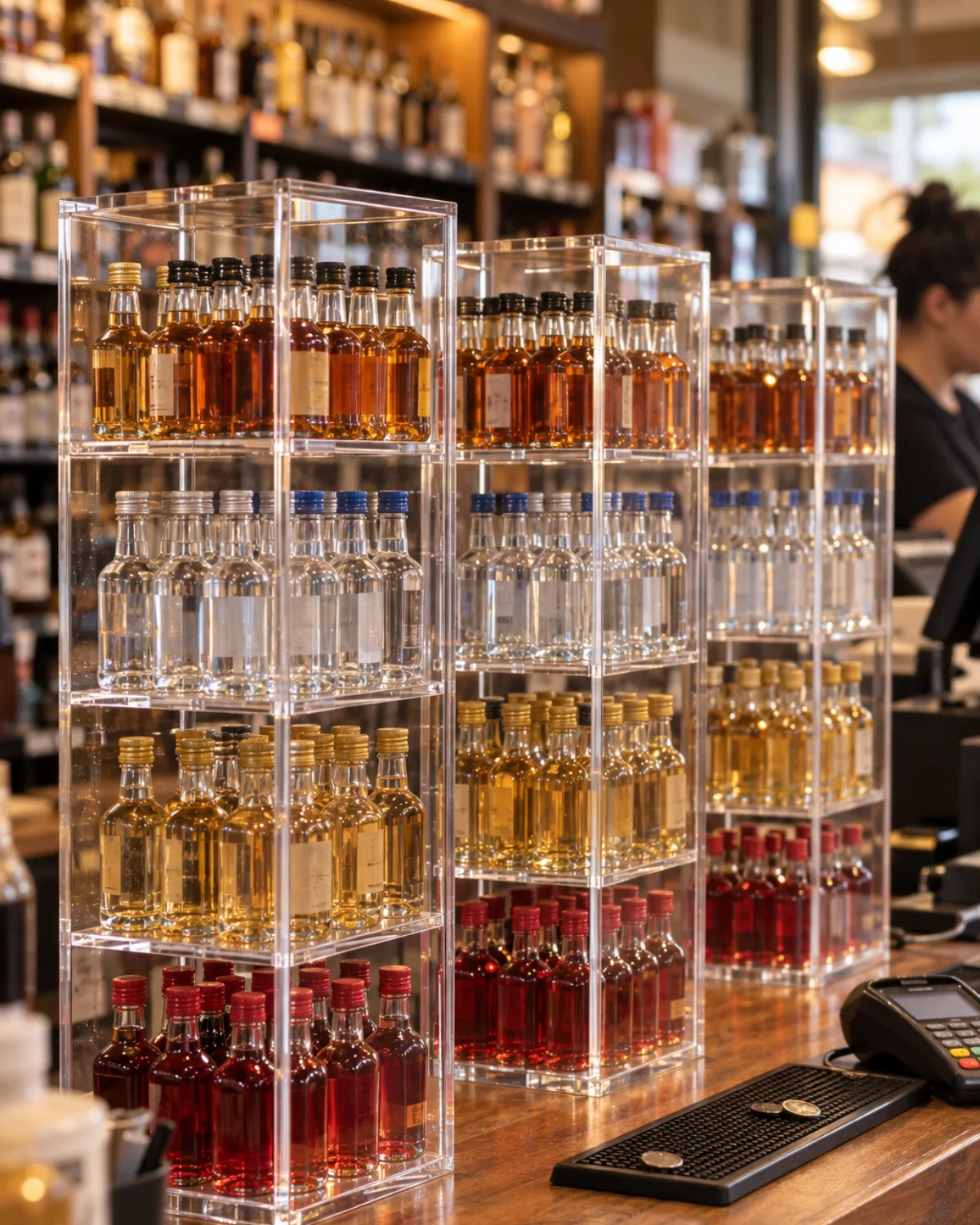
This four shelf acrylic display case reorder came from a US beverage distributor that merchandises 50 ml miniature spirit bottles at the checkout. It ordered 120 more of the open-back, all-6 mm case we first built for it in 2024, its third run of the same design, and received them DDP by sea with duty paid.
- cases, third run
- 120
- cases across three runs
- 320
- clear acrylic, every panel
- 6 mm
- design changes since run one
- 0
Ordering a similar project
MOQ is 100 pieces per design. Paid samples normally take 3–5 days; sample fees are paid separately and never credited. Standard production takes 15–20 days after drawing, thickness, shelf spacing, packing, and sample approval. Wetop responds to a complete brief within 24 hours.
Price context: the USD 20–25 band on this page is this project's product price for a 10 × 10 inch, four-shelf, all-6 mm case at 100–120 units. A different footprint, shelf count, thickness, print, or quantity changes the number; the countertop display case page covers the constructions and a written quote follows the approved drawing.
Key Takeaways
- A US beverage distributor reordered 120 open-back, four-shelf acrylic display cases for 50 ml miniature spirit bottles, its third run of the same design after 100 cases in 2024 and 100 in 2025.
- The first prototype, five shelves in 4 mm acrylic and about 26 inches tall, flexed on the bench; moving to four shelves in 6 mm throughout gave a stiffer case at about 22% below the original five-shelf quote.
- Each shelf opening is 5 inches for a 4.5-inch bottle, the one dimension the buyer fixed from the start; the open back drops the lock and door the buyer did not need on an earlier case.
- Every run shipped DDP by sea with duty paid; on the third run freight was about 55% of the invoice, more than the cases themselves.
- Current ordering for a new display case design starts at 100 pieces per design with a 3–5-day paid sample, paid separately and never credited, and 15–20-day standard production after approval.
The Challenge
The buyer distributes beverages in the US Midwest and puts miniature spirits in front of customers at the point of sale: the 50 ml bottles sold one at a time at a checkout. It needed a clear countertop case that would hold several rows of them, stand on a counter without taking over the counter, and let staff restock it easily.
The first inquiry came through our quote form in August 2024 with a photo of a case the buyer already owned. The brief was short and specific. Four or five shelves, each about 5 inches tall, because the bottles stand 4.5 inches and the shelf had to clear them with a little room. A footprint of roughly 9 to 10 inches square. No back lock, which the old case had and the buyer did not need. And one shelf more than the old case, if the cost allowed it. Shelf height was fixed; everything else could move with price.
The difficulty was in that last clause. A taller case holds more bottles, but acrylic panels get floppy as they get taller, and a case that racks sideways on a counter or bows in a carton is worse than one with a shelf fewer. The buyer wanted the most bottles per case at a price that made sense for a fixture it would put in many places, and it wanted the case to arrive at its own door with duty already paid.
Our Approach
We started from a design we had built before: a five-sided case, open at the back, with fixed shelves. The buyer looked at it and replied that it was exactly what they were looking for. We quoted the five-shelf version at about 26 inches tall on a 10 × 10 inch footprint in 4 mm acrylic, and built a prototype to confirm it before production.
The prototype that changed the specification
Our engineers had already questioned 4 mm while the prototype was being made and asked the buyer how heavy the load would be. Each bottle holds about 0.05 kg of liquid, so the load was light. The problem was not weight. When the 4 mm prototype was finished, it flexed: at 26 inches tall the side panels were too thin to keep the case square, and it would bend in a carton and in daily use. We told the buyer that and recommended 6 mm for the load-bearing panels, which raised the five-shelf price.
The buyer answered within minutes with a better idea than ours: drop to four shelves and make the whole case 6 mm to keep the cost down. We requoted two options, four shelves in 6 mm throughout, or four shelves with only the load-bearing panels in 6 mm. The buyer took the all-6 mm version. It came in about 22% below the original five-shelf 4 mm quote and about 35% below the five-shelf case with 6 mm load panels, and it is the stiffest of the three. One fewer shelf paid for the thicker sheet.
Our acrylic thickness guide explains why panel height, not load, usually decides thickness on a tall case like this one.
Approval from photographs, then production
The buyer chose to approve from photographs rather than wait for a sample to cross the Pacific. We built a four-shelf pre-production case in 6 mm and sent photos of it a week after the option was chosen. The buyer approved it the same day, production finished 11 days later, and the first 100 cases left as 50 cartons, two cases to a carton, each in its own poly bag and inner box. They were delivered to the buyer's door about 34 days after dispatch. When we asked afterwards whether anything needed attention, the buyer replied that the products and the service had both been excellent.
Duty paid, because freight is the larger line
A clear case like this is light for its size and ships mostly air. On every run the DDP sea line has been larger than the product line: on the third run about USD 3,300 of freight, duties and delivery against about USD 2,700 of cases. We quote it as one delivered price to the warehouse address so the distributor never has to clear customs or book a truck. Our FOB versus DDP guide explains what a delivered quote has to state and when FOB is the better choice.
Spec at a glance
The Results
The second order came in February 2025 with one line from the buyer: the same quantity and item as before. We produced another 100 cases from the same specification and shipped them DDP by sea in March. The third order followed in January 2026 at 120 cases, invoiced at the same unit price as the first run, made across our Lunar New Year break, packed in early March as 60 cartons, and shipped duty paid to the same warehouse.
What made the reorders simple was that nothing about the case needed deciding again. The shelf height, the 6 mm sheet, the open back, the two-per-carton packing, and the delivered freight term were settled on the first run, so each reorder was a quantity and a delivery address. Our guide to the acrylic repeat-order tooling library describes what we keep on file so a reorder like this goes straight to production.
Project note: The prototype is where a tall case shows whether its sheet is thick enough. Five shelves in 4 mm flexed; four shelves in 6 mm held square and cost less. The buyer has ordered that version three times, 320 cases in all.
What This Means for Your Project
If you put small packaged products on a counter, whether miniature bottles, sample vials, candy, or vape and CBD items, decide in this order. Fix the dimension that cannot move, here the shelf opening for a 4.5-inch bottle. Let shelf count and footprint follow cost. Then let a physical prototype settle thickness, because a drawing will not show you how a 26-inch panel behaves.
Give us the product height and a photo of a case you like. That was this buyer's whole brief, and it was enough to quote and build a prototype. Our display case dimensions guide lists the measurements that matter.
Trade a shelf for thickness when the case is tall. On a tall, narrow case, sheet thickness costs more than one shelf of sheet. Dropping a shelf can fund the step up from 4 mm to 6 mm and leave a stiffer, cheaper case.
Ask for a delivered price if freight is most of the bill. On a light, bulky fixture the shipping can cost more than the product. A DDP sea quote turns that into one number and one delivery date.
We build custom acrylic display cases for brands, distributors and retailers from 100 pieces per design, with a paid pre-production sample before the first run. The countertop display case page lists the inputs we ask for, and the POP display page shows other point-of-sale programs we build.
Common Questions
Three questions buyers ask most often about a tall countertop case for small bottles.
What acrylic thickness does a four-shelf countertop display case need?
For a case of this size, 6 mm. The first prototype for this buyer was a five-shelf, 4 mm case about 26 inches tall on a 10 × 10 inch footprint, and it flexed enough on the bench that it would have bent in transit and in use. We recommended 6 mm for the load-bearing panels. The buyer then dropped one shelf and moved every panel to 6 mm, which gave a stiffer case at a lower price than either five-shelf version. Three runs later the 6 mm build has not changed.
How tall should each shelf be for 50 ml miniature bottles?
About 5 inches. The buyer's 50 ml bottles stand 4.5 inches tall, so a 5-inch opening leaves room to lift a bottle out without tipping its neighbours, while keeping the case short enough for a checkout counter. Shelf height was the one dimension the buyer would not move; width, depth and shelf count were open to cost.
Why ship a low-cost display case DDP instead of FOB?
Because the freight is the bigger number and the buyer has no importer of record set up. On the third run the DDP sea line was about USD 3,300 against about USD 2,700 of goods, roughly 55% of the invoice. A DDP quote puts duties, customs clearance and delivery to the door in one price, so a beverage distributor can order display fixtures the same way it orders anything else from a domestic vendor.
Need a countertop case sized to your product?
Send the product height and footprint, a photo of any case you like, the quantity, and the delivery address. We will propose shelf spacing and sheet thickness, build a paid pre-production sample, and quote DDP freight as its own line.
Paid samples in 3–5 days · Fees paid separately and never credited · Production in 15–20 days after approval · MOQ 100 pieces per design · Response within 24 hours