


Delivered Project · Industrial Sensors · Germany
A Small Box That Holds a Part Still
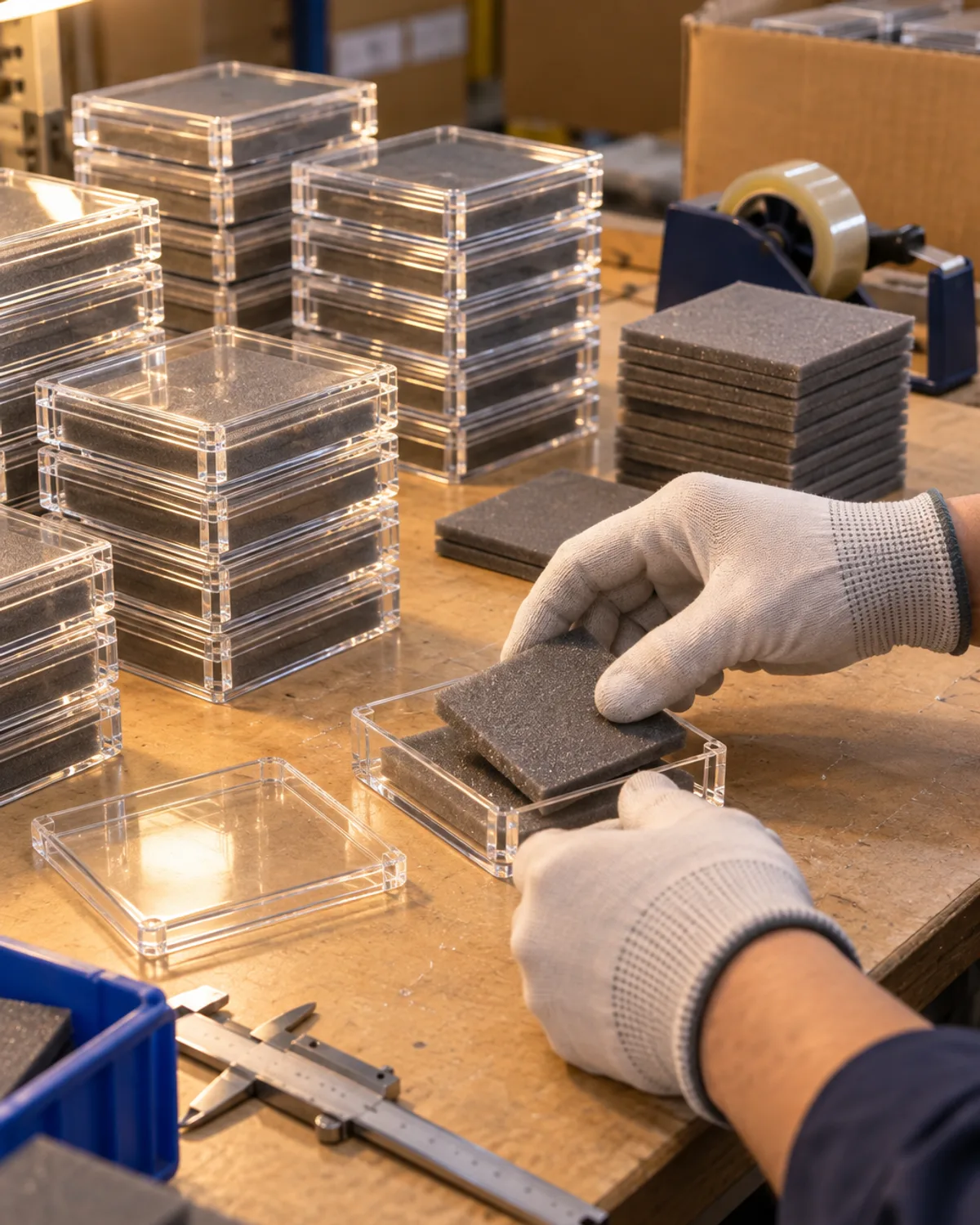
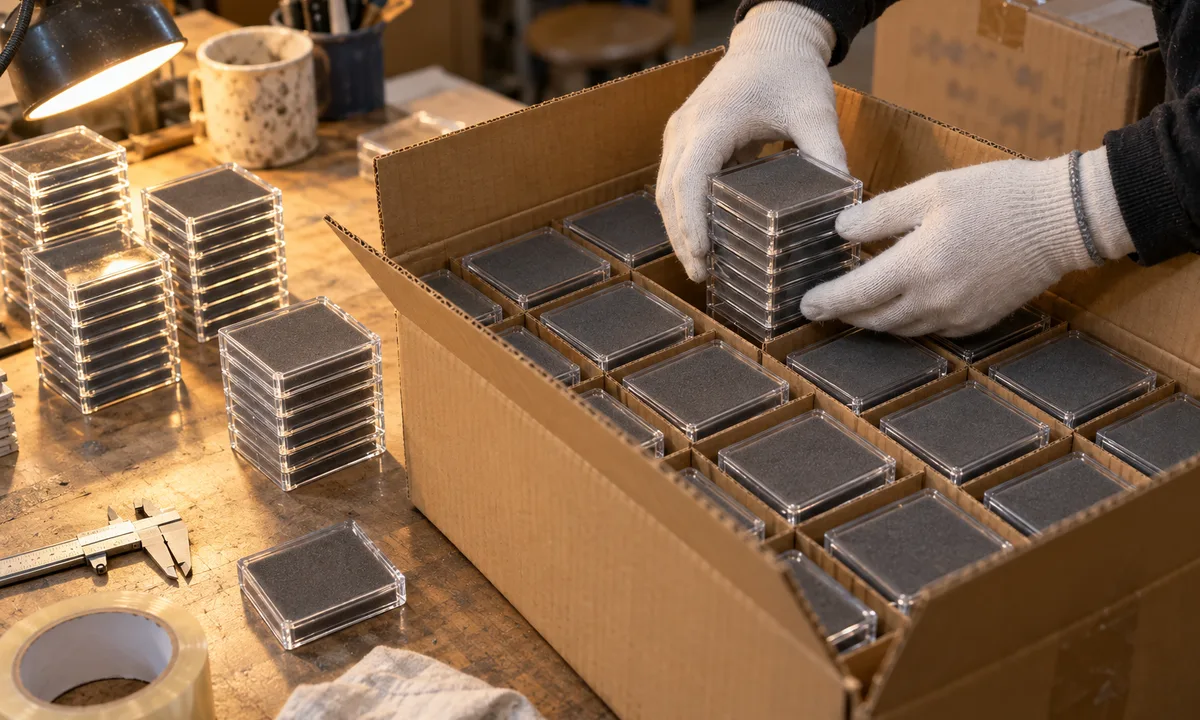
This foam-lined acrylic sensor component box order was a reorder from a German industrial sensor maker: 2,000 small clear acrylic boxes, each 79 × 79 × 15 mm inside, filled with two 6 mm foam pads that press a component between them, built under the buyer's own part number. The first order in March 2025 was 500 boxes. This one went from purchase order to UPS pickup in 19 days, after we sorted out a price mismatch, a foam batch that came in too thick, and a set of outer cartons that were too thin.
- foam-lined boxes
- 2,000
- foam pads per box
- 2 × 6 mm
- purchase order to UPS pickup
- 19 days
- the first order's 500 boxes
- 4×
Ordering a similar box
MOQ is 100 pieces per design. Paid samples normally take 3–5 days; sample fees are paid separately and never credited. Standard production takes 15–20 days after drawing, material, insert, packing, and sample approval. Wetop responds to a complete brief within 24 hours.
Price context for this project: under USD 0.50 per box with two foam pads, Ex-Works, at 2,000 pieces. The custom clear acrylic boxes page covers sizes, closures and inserts; your box gets its own written quote.
Key Takeaways
- A German industrial sensor maker reordered small clear acrylic component boxes, 2,000 this time against 500 on its first order in March 2025, each 79 × 79 × 15 mm inside and filled with two 78 × 78 × 6 mm foam pads.
- The purchase order carried a price that matched the no-foam version; we raised it before confirming, checked the previous order's record, and invoiced the price on record for 2,000 boxes with foam on the same day.
- When one batch of foam sheet came in too thick to fit, the buyer confirmed that 6 mm per pad was what held its part, so the pads stayed at 6 mm instead of dropping to 4 mm.
- The outer cartons delivered for packing were too thin, so we replaced them and moved the pickup by two working days, with the buyer's agreement given in advance.
- A similar packaging box starts at 100 pieces per design, with a 3–5-day paid sample that is paid separately and never credited, and 15–20-day standard production after approval.
The Challenge
The buyer makes industrial sensors in Germany. One of its parts ships and is stored in a small clear acrylic box: square, shallow, and lined with foam above and below, so the part is pressed between two pads and cannot move. The box is not a display piece. It is a packaging part with its own item number in the buyer's system, and it has to arrive in the same form every time.
We first made this box for the buyer in March 2025, when it ordered 500. In June 2026 its purchasing team sent a new purchase order "just like last time": 2,000 boxes, inner size 79 × 79 mm, two foam pads per box, the buyer's item number, and a requested receipt date of 29 June. That left a little under three weeks from order to receipt, with the buyer collecting the goods from our factory on its own UPS account.
A reorder looks simple, and most of this one was. The work was in the three details that a reorder can get wrong without anyone noticing: the price on the purchase order, the foam, and the packing.
Our Approach
We read the purchase order against the first order's record before confirming anything, then built the boxes to the record and checked each change with the buyer before making it.
Checking the price before confirming
The unit price on the purchase order matched our price for the box without foam, while the order asked for two foam pads per box. We pointed this out within half an hour of receiving the order and gave both prices. The buyer replied that the figure was a typo and that the price agreed for 2,000 pieces or more had been different. We checked the previous order's record, confirmed the buyer was right, and sent the invoice at that price the same day. The buyer paid in full before production started.
Raising a price question costs one email. Leaving it alone would have meant either a box built without the foam the buyer needed or an invoice that did not match the purchase order, and either one stops a payment in a German purchasing department.
Keeping the foam at 6 mm
The box is 15 mm tall inside. Two 6 mm pads take 12 mm of that, which leaves about 3 mm for the part before the foam is pressed. That is the point of the design: when the lid closes, the foam squeezes the part from both sides. The pads are cut to 78 × 78 mm, 1 mm under the inner size, so they drop into the box without catching on the walls.
During cutting we found that one batch of foam sheet was thicker than standard, too thick to fit two pads in the box. My first suggestion was to switch to 4 mm pads, which would have fitted easily. The buyer's purchasing contact answered within the hour: the pads need to be about 6 mm per side to squeeze the content together, and pads that are too thin are as unusable as pads that are too thick. So the pads stayed at 6 mm, and the boxes shipped with two 78 × 78 × 6 mm pads each, as invoiced.
The lesson for us was to ask what the foam does before offering a change to it. A thinner pad is a fine fix for a gift box insert. In a box whose job is to hold a part still, the thickness is the specification. Our guide to acrylic box insert options compares foam with other insert types for this reason.
Replacing thin cartons and moving the pickup
The boxes were ready on 26 June, 15 days after the purchase order. The outer cartons delivered for packing them were too thin for five cartons of acrylic boxes travelling by courier, so we asked the buyer whether pickup could move to the following Tuesday while we replaced them with heavier cartons. The buyer agreed the same morning. We repacked into one 48 × 35.5 × 25 cm carton and four 47 × 46 × 34 cm cartons, 72.5 kg in total, and sent the sizes and weights so the buyer could create the UPS labels.
The buyer sent the labels on 29 June and asked us to book the pickup from our side, since we knew when the cartons would be ready. UPS collected on 30 June. That was one day after the receipt date on the purchase order, and the buyer had agreed to it before it happened.
Spec at a glance
The Results
Two thousand foam-lined boxes left our factory with UPS on 30 June, 19 days after the purchase order, in five heavier cartons, at the price on record and with the foam at the thickness the part needs. The invoice was paid in full before production.
None of the three issues on this order was large. Each could have turned a reorder into a problem: an invoice the buyer's accounts team rejects, foam that leaves a sensor part loose in transit, or a carton that splits on a courier belt. Each was solved by asking the buyer one question before acting, and each answer is now part of the record for the next order.
Project note: On a packaging part, "just like last time" means the same price, the same foam and the same packing. Check all three against the record before confirming, and ask what the foam is for before changing it.
What This Means for Your Project
If you buy small acrylic boxes as packaging for your own parts, whether sensors, optics, lenses, or spare components, the box is a part like any other. It needs a part number, a fixed inner size, a fixed insert and a packing method, and each repeat order should match the last one.
Tell us what the insert does. "Two 6 mm foam pads" is a size; "the pads press the part so it cannot move" is the requirement. With the requirement, we know which changes are safe when a material batch varies and which are not.
Put your part number on the order. We carry it onto the invoice, and onto carton labels if you ask, so goods are received against the right item. Our repeat order change-control checklist lists the other details worth fixing on a recurring part.
Choose freight terms that match your courier account. If you already have good courier rates, Ex-Works with your labels is simple: we pack, send carton data, and book the pickup.
We make custom clear acrylic boxes with foam, EVA and acrylic inserts from 100 pieces per design. The custom acrylic boxes hub covers every box type we build, and the precision component program shows our work on machined industrial parts.
Common Questions
Three questions buyers ask most often about small acrylic boxes used as packaging for parts.
How thick should the foam be in a small acrylic component box?
Thick enough to press the part between the pads, and no thicker than the box allows. In this 15 mm tall box, two 6 mm pads take 12 mm and leave about 3 mm for the part, so the lid closes with the part held by the foam. When one foam batch came in too thick, thinner 4 mm pads were offered as a fix, but the buyer confirmed 4 mm would leave the part loose. The pads stayed at 6 mm.
Can an acrylic box be ordered under our own part number?
Yes. On this order the buyer's item number was on the purchase order and carried onto our invoice, so the boxes arrived booked against the right part in the buyer's own system. If you send your part number with the drawing, we use it on the invoice and on carton labels when you ask for it.
What does Ex-Works mean for a small acrylic packaging order?
The buyer books and pays for the freight from our factory. On this order the buyer sent UPS labels on its own account, we packed five cartons, sent the carton sizes and weights, and booked the pickup from our side so the timing suited the packing. Ex-Works suits buyers who already have a courier account with good rates.
Need a small acrylic box for your own parts?
Send the part size, the inner size you want, what the insert has to do, your part number, the quantity, and your preferred freight terms. We will return a written quote and a sample plan.
Paid samples in 3–5 days · Fees paid separately and never credited · Production in 15–20 days after approval · MOQ 100 pieces per design · Response within 24 hours