Custom Acrylic Game Sets: OEM Color & Engraving
Three shop-floor spec choices decide whether a private-label acrylic game line earns boutique reorders or eats returns: single-lot cast PMMA matching, wear-proof markings, and separated transit packout.
Key Takeaways
- Reserve one virgin cast PMMA sheet lot per colorway for the full order so checkers, rim walls, racks, and lids match across every box in a 100+ set run.
- Never put exposed surface ink under sliding game pieces: use 2nd-surface UV printing (with a white barrier) for flat backgammon points, and recessed laser engraving with pigment fill for 106-tile rummy numerals.
- Specify 5-6 mm decks with 6-10 mm bonded rims on 18-inch backgammon boards so trays sit flat, and CNC +/-0.1 mm slot clearance on acrylic tile racks so tiles lean cleanly without sticking.
- Pack loose checkers, tiles, and dice in die-cut EVA compartments isolated from the acrylic board or lid under protective film — most shipping damage is internal piece-on-board scratching.
On this page
- How Do Brands Spec Custom Acrylic Game Sets OEM Without Quality Drift?
- Decoration Method Comparison: 2nd-Surface UV vs Recessed Engraving vs Inlaid Acrylic
- Single Sheet-Lot Color Control for Tortoiseshell, Smoked & Neon Runs
- Thickness, Tolerance & Transit Packout Spec Sheet
- Hardware, Piece Count & Packaging BOM Reference
- 7-Point Sample Sign-Off & Pre-Shipment QC Checklist
- How Wetop Manufactures Private-Label Acrylic Game Programs
How Do Brands Spec Custom Acrylic Game Sets OEM Without Quality Drift?
Specifying custom acrylic backgammon or 106-tile rummy game sets for private-label retail requires locking four production variables before paying for a sample: virgin cast PMMA gauge (5–6 mm decks with 6–10 mm rims on 18-inch trays), wear-protected marking (2nd-surface UV print for boards or recessed engraving with pigment fill for tiles), single sheet-lot color reservation, and separated EVA transit packout. Production starts at 100 complete sets per design (3–5 day paid sample, 15–20 day bulk run).
The three biggest causes of 1- to 3-star reviews on boutique acrylic games are not design flaws — they are omitted factory tolerances. Below is the exact engineering checklist we use when quoting and sampling custom acrylic backgammon sets and custom acrylic rummy tile game sets.
Decoration Method Comparison: 2nd-Surface UV vs Recessed Engraving vs Inlaid Acrylic
Never let loose acrylic checkers, dice, or shuffled tiles rub directly across exposed surface ink. Match the marking process to how players touch the surface during play.
| Marking method | How it is built | Wear resistance under play | Best game component | Relative unit cost |
|---|---|---|---|---|
| 2nd-surface UV print + white barrier | Full-color artwork printed on underside of clear cast PMMA, backed by white ink | High — pieces slide only on uncoated solid acrylic | Backgammon points, multi-color game boards, branded lids | Low to moderate |
| Laser engraving + recessed color fill | CNC/laser groove cut into cast PMMA (min 0.4 mm line width), filled with cured pigment | Highest — ink sits below the playing face | 106-tile rummy numerals, domino pips, permanent logo marks | Moderate |
| Inlaid colored cast acrylic | Contrast-color cast sheet pieces laser-cut and solvent-bonded flush into the deck | Highest — solid through-body color | Luxury boutique backgammon points, tiered chess squares | Higher (manual layup) |
| Swappable 4-pin printed insert | Paper, card, or needlepoint sheet sandwiched between two clear cast panels on corner pins | High — artwork protected under top clear sheet | Seasonal editions, custom monogram/needlepoint boards | Moderate |
Single Sheet-Lot Color Control for Tortoiseshell, Smoked & Neon Runs
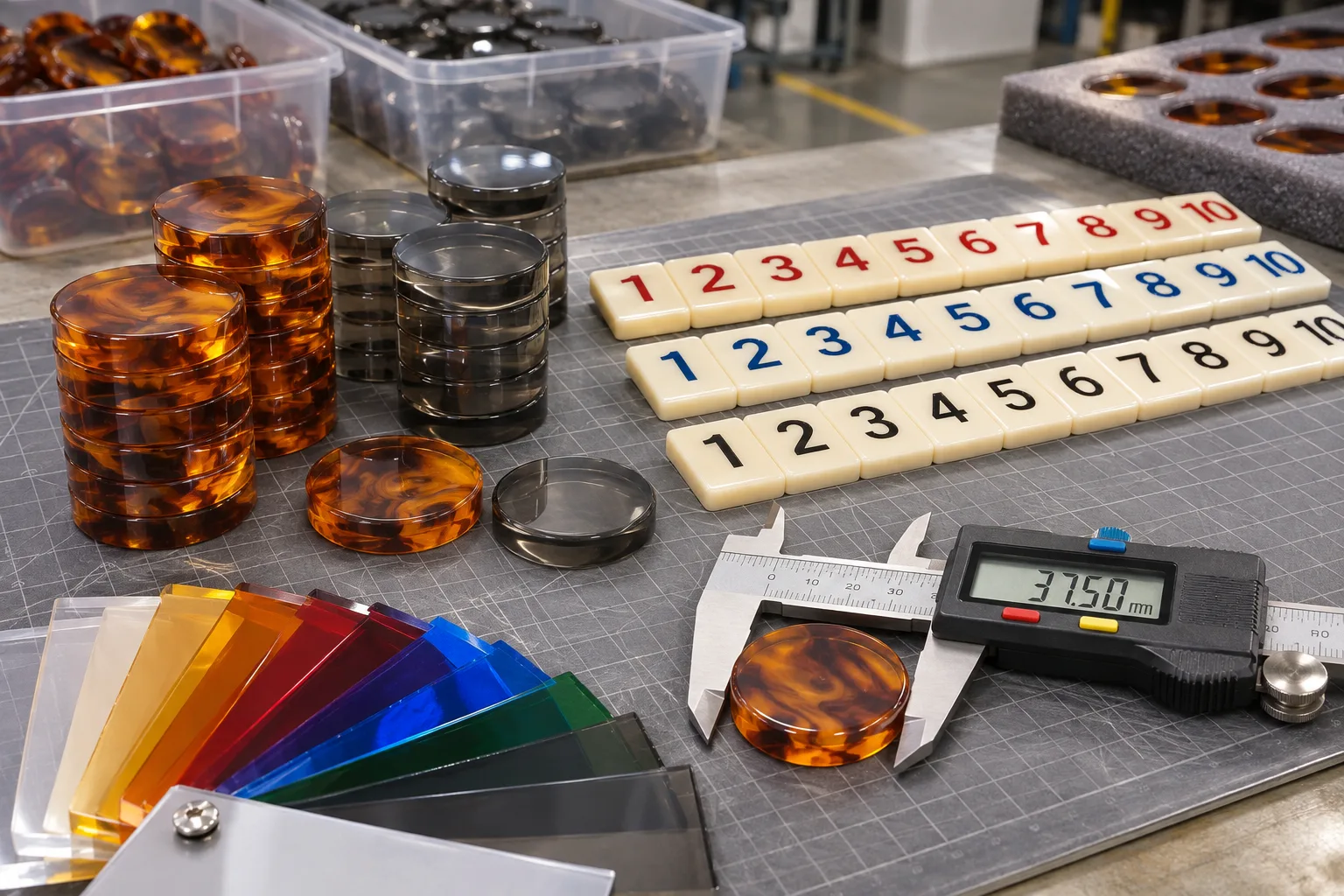
US boutique game brands increasingly specify amber tortoiseshell, smoked charcoal, cobalt, emerald, and translucent neon tints instead of plain clear acrylic. Those effect sheets carry higher visual value, but cast PMMA color saturation can shift noticeably between mill pours.
To prevent half your shipment from looking warmer or darker than the other half, specify single mill sheet-lot reservation on your purchase order:
- Confirm the physical chip on the paid sample — digital Pantone renderings look brighter on backlit screens than through 6–10 mm cast acrylic edges.
- Pull board rims, checkers, racks, and lids from the same lot — mixed lots show immediately when a checker rests directly on a matching rim wall.
- Budget extra sheet lead time for custom Pantone casts — stock cast tints cut immediately; custom-poured Pantone cast sheet requires mill casting time before fabrication starts, which we state upfront in the quote.
Thickness, Tolerance & Transit Packout Spec Sheet
Three structural lines separate a museum-grade boutique game set from an easily returned novelty:
- Wide-span deck & rim gauge: On a 450–500 mm (18–20 in) backgammon tray, pair a 5–6 mm cast PMMA base deck with 6–10 mm diamond-polished perimeter walls so the tray sits flat without flexing. See our acrylic thickness guide for span rules.
- Fit-critical CNC slots and magnets: Standard fabrication working tolerance is ±0.2 mm; fit-critical CNC features — such as stepped rummy rack channels, flush N52 magnet pockets, and sliding-lid tracks — are held to ±0.1 mm after drawing review.
- Zero-contact piece packout: Never ship loose acrylic checkers or 106 numbered tiles rattling inside a bare acrylic tray. Keep peelable protective film on every flat panel through assembly, and house loose pieces in die-cut charcoal EVA compartments or individual sleeves inside the rigid outer gift box.
Hardware, Piece Count & Packaging BOM Reference
Most quote delays happen when buyers send only a mood board without locking the piece count, rack geometry, or hardware finish. Use the reference bill of materials below when preparing drawings for a private-label backgammon or rummy tile quote.
| Component | Boutique acrylic backgammon set | 106-tile acrylic rummy game set | Key shop-floor tolerance or spec |
|---|---|---|---|
| Primary acrylic structure | 18–20 in open tray or hinged folding case (5–6 mm deck, 6–10 mm rim walls) | 4 stepped cast acrylic tile racks + sliding or magnetic storage case (3–5 mm) | Diamond-polished outer rims; flame or buff-polished inner dividers |
| Standard game pieces | 30 cast acrylic checkers (15 per color, typically 32–40 mm dia × 8–10 mm thick) | 106 cast acrylic tiles (1–13 × 2 in 4 colors + 2 wild tiles; single or 2-layer bonded) | Cut from same reserved mill lot; rounded/tumbled corners optional |
| Closures & hardware | Recessed N52 neodymium magnets, 304 stainless or brass barrel hinges, or 4 corner standoffs | Flush corner magnets on lift/travel lids, or CNC-routed finger notch on sliding lids | ±0.1 mm pocket depth on magnets so halves pull flush without proud metal |
| Accessory pack-ins | 4 standard dice, 1 doubling cube, 2 matching cast acrylic or leather-lined dice cups | 4 velvet/cotton tile pouches or individual polybags for racks + buyer rule sheet | All acrylic dice cups & trays checked for sharp interior burrs |
| Transit & retail packout | Rigid magnetic gift box with die-cut charcoal EVA trays + corner-protected export carton | Rigid gift box with separated 4-suit tile channels and wrapped racks, or compact travel mailer | Zero piece-to-board contact in transit; care card inside box |
Rack Lip Geometry & Tile Thickness for Rummy Sets
For 106-tile rummy sets, tile thickness and rack slot width must be paired on the same drawing. A 4–5 mm cast acrylic tile feels noticeably denser and more luxurious than injection-molded plastic, while a two-layer bonded tile (opaque white front laminated to a translucent colored back) typically runs 5–6 mm total thickness. On the rack, allow roughly 0.5–1.0 mm clearance in the stepped channel and angle the backrest at 15°–20° so 13 tiles lean securely without tipping forward when the table gets bumped.
Private-Label Branding & Trademark Hygiene
“Rummikub” is a registered trademark owned by a third party. Private-label gift and home brands sourcing custom 106-tile rummy sets should put their own original brand mark, colorway name, box artwork, and written game rules on all packaging and printed inserts. Wetop manufactures strictly from buyer-supplied artwork and drawings and never produces counterfeit or trademark-infringing retail packaging.
7-Point Sample Sign-Off & Pre-Shipment QC Checklist
Before releasing a 100- to 1,000-set bulk run, sign off on the physical paid sample against seven concrete checks — then hold the bulk shipment to the same inspection sheet:
- Single-lot daylight & warm-LED color check: Inspect checkers or tiles resting directly against matching rim walls or racks under both 5000K daylight and 3000K boutique lighting so shade drift is caught before cutting bulk sheets.
- Marking durability rub check: Slide a stack of acrylic checkers across 2nd-surface UV points and rub recessed color-filled numerals with a dry microfiber cloth to confirm clean edges and zero ink transfer.
- Complete piece & suit count audit: Verify 15 + 15 checkers (plus dice/doubling cube) on backgammon sets, and verify every single suit (
1–13 × 2across all four colors plus 2 wild tiles = 106 pieces) on rummy sets during 100% packout QC. - Hardware alignment & closure test: Open and close folding hinges and magnetic lids ten times to verify flush corner alignment, balanced magnetic pull, and zero adhesive haze near pockets.
- Rack and tray flatness check: Set the board and all four racks on a flat granite inspection table to verify zero corner rock or bowing.
- Transit shake test inside EVA packout: Close the gift box with all pieces seated in their die-cut EVA pockets and shake firmly; no checker, die, or tile should shift against a polished acrylic wall.
- Buyer care card verification: Include a short care insert instructing end customers to clean acrylic with a soft microfiber cloth and mild soapy water only — never alcohol, ammonia, or household glass sprays that cause surface crazing.
How Wetop Manufactures Private-Label Acrylic Game Programs
Wetop Acrylic manufactures custom game sets under one ISO 9001 roof in Shenzhen (since 2008) — 8 laser cutters, 4 CNC machines, dedicated diamond polishing, UV/silkscreen printing, engraving, and 100% pre-shipment inspection (including suit-by-suit 106-tile counts on rummy sets).
- MOQ: 100 complete sets per design (no stock or retail singles).
- Paid pre-production sample: USD 200–500, built in 3–5 days, paid separately and never credited to production.
- Bulk production: 15–20 days after physical sample sign-off, FOB Shenzhen (CIF, DDP, or blind drop-shipping available on request).
Ready to quote a line? Review specs on custom acrylic backgammon sets, custom acrylic rummy tile sets, or the full custom acrylic game sets hub, and send your drawings and piece list for a 24-hour factory quote.
Published price point
Get an OEM acrylic game set quote
MOQ 100 complete sets/design · Sample USD 200-500 (3-5 days)
Custom acrylic backgammon sets, 106-tile rummy sets, and board games are quoted per design from your drawings and piece list, FOB Shenzhen (production 15-20 days after sample approval).
Paid samples are quoted separately and are never credited to production.
Thank you!
We've received your inquiry. Our team will reply within 24 hours — usually faster.
Frequently Asked Questions
What is the typical MOQ for custom acrylic backgammon and rummy tile sets from China?
At Wetop Acrylic, custom acrylic backgammon sets and 106-tile rummy game sets start at 100 complete sets per design. Each unique board footprint, tile size, or structural box layout counts as one design; a paid pre-production sample set (USD 200-500, 3-5 days, paid separately and never credited) confirms fit and color before 15-20 day bulk production.
Which lasts longer on acrylic game pieces: laser engraving with color fill or UV printing?
Laser engraving with recessed pigment fill lasts longer on high-friction pieces like 106-tile rummy sets and dominoes because the color sits below the cast PMMA surface. Second-surface UV printing (printed on the underside of a clear board behind a white barrier) works best for multi-color backgammon points because checkers slide only on uncoated solid acrylic.
How do brands keep tortoiseshell, smoked, or neon acrylic colors consistent across 500 sets?
Require single sheet-lot reservation in the purchase spec. Cast acrylic pigments vary slightly between factory pouring batches; reserving enough virgin cast PMMA from one mill lot for the entire run keeps board rims, checkers, racks, and lids visually identical across every box.
What artwork files does an acrylic game manufacturer need to quote and sample?
Send dimensioned CAD or PDF drawings for the board, racks, and box plus outlined vector artwork (AI, EPS, or SVG, recommended minimum 0.4 mm stroke width for engraved color fill) and Pantone or physical color references. Wetop manufactures from buyer-provided files and does not provide game graphic design.
Spec'ing a private-label acrylic game line?
Send board dimensions, piece count, colorway, graphic method, packaging, and target quantity (MOQ 100 sets per design). Paid pre-production samples run 3-5 days (USD 200-500, billed separately and never credited).