



Acrylic Jumping Spider & Reptile Enclosures OEM
Exotic-pet brands win repeat orders by locking six mechanical lines before cutting a sample: door position, escape gap, bonded vs flat-pack joints, vent aperture, heat cutouts, and shared multi-SKU tooling.
Key Takeaways
- Jumping spider enclosures need mid-to-lower front-opening magnetic doors so daily misting and feeding never tear upper-corner hammock webs.
- Solvent-bonded 3-6 mm cast PMMA holds moist substrate and seals escape gaps (+/-0.3 mm sliders, 80% EPDM gaskets), while CNC-tabbed flat-pack kits cut ocean/FBA shipping volume by roughly 60-70%.
- Size ventilation to the smallest prey or sling: 0.8-1.2 mm laser micro-holes for fruit-fly retention on spiderlings, or swappable 12% tropical / 16% arid stainless mesh inserts on multi-species breeder bodies.
- Launching 3-4 sizes on one shared modular CNC base jig with interchangeable inserts cuts upfront fixture cost while keeping each SKU at Wetop's 100-piece MOQ.
On this page
- What 6 Engineering Specs Must Be in an Acrylic Enclosure OEM RFQ?
- Solvent-Bonded vs Flat-Pack Knock-Down Acrylic Enclosures
- Front-Opening Access & Micro-Ventilation Rules by Species Group
- Cast PMMA Gauge, Humidity Bowing & Thermal Clearance Rules
- 100% Pre-Shipment QC, Packing & Care Instructions
- What to Send in Your Enclosure RFQ for a 24-Hour Quote
- Multi-SKU Tooling Savings & Wetop’s Delivered Pet-Retail Proof
What 6 Engineering Specs Must Be in an Acrylic Enclosure OEM RFQ?
An OEM RFQ for custom acrylic jumping spider or reptile enclosures should specify six mechanical parameters upfront: (1) internal clear dimensions and substrate-dam height, (2) solvent-bonded watertight construction vs flat-pack CNC-tabbed kit, (3) door position and escape-gap tolerance (mid-lower magnetic front swing door for jumping spiders, or ±0.3 mm four-point inspected front sliders), (4) ventilation aperture or swappable mesh open area, (5) heat-mat or probe cutouts, and (6) quantity per SKU (MOQ 100 pcs/SKU).
Skipping any one of those six lines forces factories to guess — which is why generic wholesale terrariums suffer from torn spider webs, corner leaks, and escape complaints. For detailed airflow and ACH calculations, see our reptile enclosure ventilation engineering guide; this guide covers the structural OEM trade-offs behind custom acrylic reptile and jumping spider enclosures.
Solvent-Bonded vs Flat-Pack Knock-Down Acrylic Enclosures
Your choice between solvent-bonded and flat-pack construction directly sets both retail positioning and landed freight cost.
| Decision axis | Solvent-bonded cast PMMA (3–6 mm) | Flat-pack knock-down kit (3–4 mm) |
|---|---|---|
| Watertight substrate dam | Yes — optically clear bonded base holds moist substrate | No — tabbed seams with O-rings are not watertight |
| Escape-gap control | Highest — ±0.3 mm front sliders + optional 80% EPDM top gasket | Moderate — depends on O-ring tension and tab precision |
| Ocean & FBA shipping volume | Full assembled cube (higher dimensional weight) | Roughly 60–70% smaller carton volume |
| End-user assembly | Zero — unbox and add substrate | 3–5 minute peel-film and O-ring assembly |
| Best B2B application | Tropical tarantulas, snakes, geckos, specialty pet retail chains | Jumping spider DTC kits, Amazon FBA starter terrariums |
Front-Opening Access & Micro-Ventilation Rules by Species Group
- Jumping spiders (arboreal nano habitats): Place a magnetic swing door on the lower-to-middle front panel with a secondary rotary acrylic latch so keepers never disturb upper-corner hammock webs. Keep laser-drilled cross-vent holes at 0.8–1.2 mm (or fine stainless mesh) to prevent fruit-fly escape.
- Arboreal & Old World tarantulas: Pair 5–6 mm cast PMMA walls with ±0.3 mm four-point inspected front sliders and an 80%-compression EPDM top gasket where specified. Swappable rear stainless-mesh vent inserts (12% open area for tropical humidity vs 16% for arid species) let one body cover multiple species without tooling two shells.
- Terrestrial geckos & snakes: Separate internal clear dimensions from external dimensions on your drawing, explicitly calling out substrate-dam depth, front-slider overlap, and heat-mat / cable pass-through locations so fixtures do not overheat PMMA walls.
Cast PMMA Gauge, Humidity Bowing & Thermal Clearance Rules
Generic pet-supply enclosures often fail within 60 days of tropical misting because thin extruded sheet absorbs moisture asymmetrically and bows along the door track. Choosing the right virgin cast PMMA gauge prevents both warping and door binding:
| Enclosure span & build | Recommended cast PMMA gauge | Why this gauge matters in service | Thermal & humidity rule |
|---|---|---|---|
| Nano jumping spider cube (100–200 mm wide) | 3–4 mm virgin cast PMMA | Holds rigid flat-pack tabs or clean solvent seams without adding excess FBA weight | Keep ceramic/halogen bulbs off solid acrylic lids; vent with laser micro-holes or top mesh |
| Mid-size arboreal / breeder box (200–350 mm wide) | 4–5 mm virgin cast PMMA | Resists moisture bowing across high-humidity vertical panels so front magnetic doors stay flush | Specify top stainless mesh window if buyer mounts low-wattage LED or basking fixtures |
| Large terrestrial snake / gecko habitat (400–600 mm wide) | 5–6 mm virgin cast PMMA | Keeps front sliding-door rails parallel under substrate load and routine wiping | Call out bottom recessed heat-mat clearance or probe pass-throughs on drawing; PMMA softens above ~80–85°C |
Cast PMMA offers around 92% optical light transmission — clearer than standard green-tinted float glass — at roughly half the weight, which cuts freight breakage on e-commerce shipments. However, PMMA has a lower heat-deflection threshold than tempered glass. Whenever a retail brand pairs an enclosure with external heating pads, thermostats, or overhead domes, the brand’s drawing must specify the exact metal mesh window size, standoff air gap, or cable grommet cutout so no heated element contacts bare acrylic directly.
100% Pre-Shipment QC, Packing & Care Instructions
Exotic-pet buyers judge an acrylic brand in the first five minutes out of the carton: clear seams, tight door gaps, zero transit cracks, and zero chemical hazing. At Wetop, every custom enclosure run passes a five-step pre-shipment inspection protocol before cartons seal:
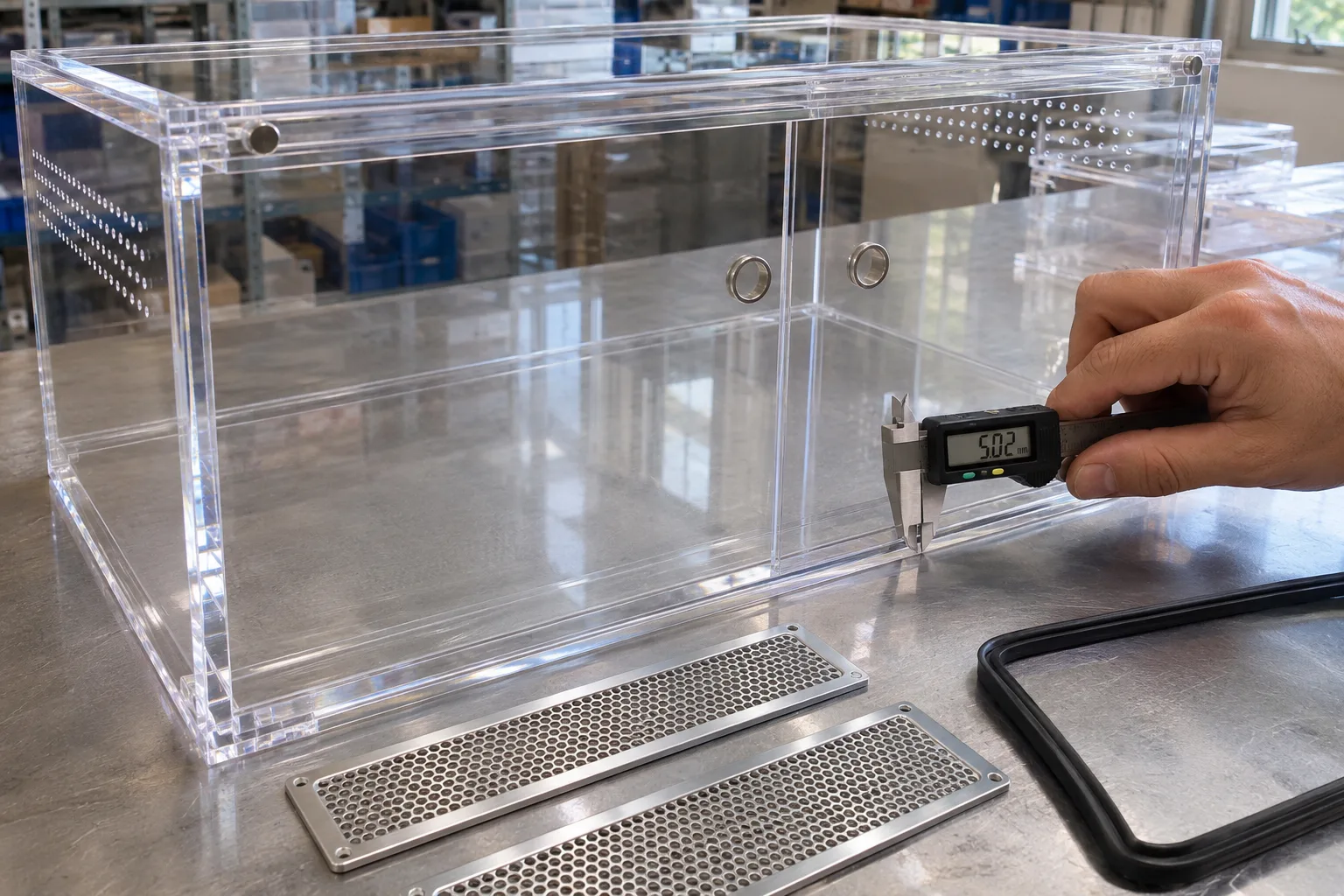
- Four-point door & slider gap gauge check: On sliding-door terrestrial builds, every unit is checked at top-left, top-right, bottom-left, and bottom-right against the approved ±0.3 mm gap spec (or your drawing’s tighter fit-critical tolerance). On magnetic swing doors, polarity and secondary latch engagement are verified 100%.
- Solvent-seam & substrate-dam inspection: Bonded walls and deep substrate bases are inspected visually for continuous optically clear joints with no dry corners or structural voids.
- Vent aperture & burr check: Laser-drilled micro-vent arrays and CNC-routed mesh frames are checked for complete hole punch-through and clean edges so fine feeder insects cannot squeeze through oversized slots and keepers do not snag fingers during cleaning.
- Export vs FBA packout protection: Every flat panel retains peelable PE protective film until final assembly (or stays filmed in flat-pack mailer kits with silicone O-rings bagged separately). Assembled bonded enclosures ship in foam-lined individual inner cartons inside double-wall master cartons engineered to survive courier parcel handling.
- Cleaning guidance for end-user manuals: Remind customers on your box insert to wipe acrylic enclosures using only a soft microfiber cloth with warm water or mild reptile-safe neutral soap — never rubbing alcohol, ammonia sprays, or abrasive pads, which cause permanent surface crazing on PMMA.
What to Send in Your Enclosure RFQ for a 24-Hour Quote
To get an accurate FOB Shenzhen unit price, tooling note, and sample timeline in one pass, include these seven lines in your inquiry:
- Target species format & count of SKUs (e.g., 3 graduated terrestrial sizes or 2 arboreal jumping spider sizes).
- Internal clear dimensions (L × W × H in mm or inches) and required substrate-dam height.
- Construction style: solvent-bonded watertight shell vs flat-pack knock-down kit.
- Door & closure spec: mid-lower front magnetic swing door with rotary latch, front dual sliders, or hinged top lid with EPDM gasket.
- Ventilation spec: hole diameter (e.g., 0.8–1.2 mm laser micro-holes) or perforated/woven 304 stainless mesh window dimensions.
- Cutouts & branding: cable/probe notches, recessed heat-mat foot height, and engraved or UV-printed brand logo location.
- Order quantity per SKU (minimum 100 pieces per SKU) and target shipping method (sea, air, or Amazon FBA-ready cartons).
Multi-SKU Tooling Savings & Wetop’s Delivered Pet-Retail Proof
Most exotic-pet brands need 3 to 4 graduated sizes rather than a single cube. Rather than paying for four separate CNC fixtures, Wetop designs one modular CNC base jig with interchangeable size inserts — proven across two delivered multi-SKU programs:
- 400-unit 4-SKU tarantula enclosure rollout: 2 arboreal + 2 terrestrial SKUs (100/SKU, plus a 100-unit repeat order in month 4) in 6 mm cast PMMA with ±0.3 mm front sliders, 80%-compression EPDM gaskets, and swappable tropical/arid vent inserts (~45% lower fixture cost via shared base jig).
- 300-unit 3-SKU snake enclosure family: 3 graduated retail sizes (100/size) on one modular CNC jig with bonded corners, drawing-defined heat-mat openings, and four-point slider inspection on every unit.
Every new OEM enclosure order starts at 100 pieces per SKU, with a 3–5 day paid pre-production sample (USD 200–500, paid separately and never credited) and 15–20 day standard bulk production from our ISO 9001 Shenzhen facility. Explore formats and request a drawing-based quote on custom acrylic reptile and jumping spider enclosures.
Published price point
Get an OEM acrylic enclosure quote
MOQ 100 pcs/SKU · Shared CNC base jigs for 3-4 SKU lines
Custom jumping spider, tarantula, and reptile enclosures are quoted from your drawings, FOB Shenzhen. Paid samples: USD 200-500 (3-5 days, never credited); standard production 15-20 days.
Paid samples are quoted separately and are never credited to production.
Thank you!
We've received your inquiry. Our team will reply within 24 hours — usually faster.
Frequently Asked Questions
Which is better for an exotic-pet DTC brand: solvent-bonded or flat-pack acrylic enclosures?
Solvent-bonded cast PMMA is mandatory when keepers pack damp coco fiber, hold high tropical humidity, or house escape-prone tarantulas and snakes. Flat-pack CNC-tabbed kits with silicone O-rings win on landed freight and FBA fees for dry or lightly misted jumping spider habitats. Many brands launch small spider kits flat-pack and larger reptile/tarantula sizes solvent-bonded.
How do brands prevent fruit flies and spiderlings from escaping through ventilation holes?
Specify laser-drilled micro-holes around 0.8-1.2 mm (verified against your smallest feeder insect) or CNC-routed windows fitted with fine stainless woven mesh. Always test the physical paid sample with your husbandry specialist before releasing bulk production.
Why should multi-SKU reptile enclosure lines share one modular CNC base jig?
Building separate jigs for three or four graduated sizes multiplies fixture charges. In our delivered 400-unit 4-SKU tarantula rollout and 300-unit 3-SKU snake rollout, a single modular CNC base jig with size-specific inserts reduced fixture setup by roughly 45% while preserving exact ±0.3 mm door tolerances across every SKU.
Does Wetop validate species husbandry or veterinary safety?
No. Wetop is a custom acrylic fabrication factory (ISO 9001, since 2008). Your brand or husbandry specialist owns species suitability, airflow targets, heating clearance, and escape-risk criteria; Wetop manufactures strictly to your approved drawing and signed physical sample.
Ready to sample a custom acrylic enclosure line?
Send target species format, internal dimensions, door style, vent spec, bonded vs flat-pack preference, and SKU quantities (MOQ 100 pcs/SKU). Paid samples ship in 3-5 days.