


Delivered project · Pet Retail · Multi-SKU
Acrylic Snake Enclosure Multi-SKU
A specialty pet retailer came to us for three sizes of acrylic snake enclosure.
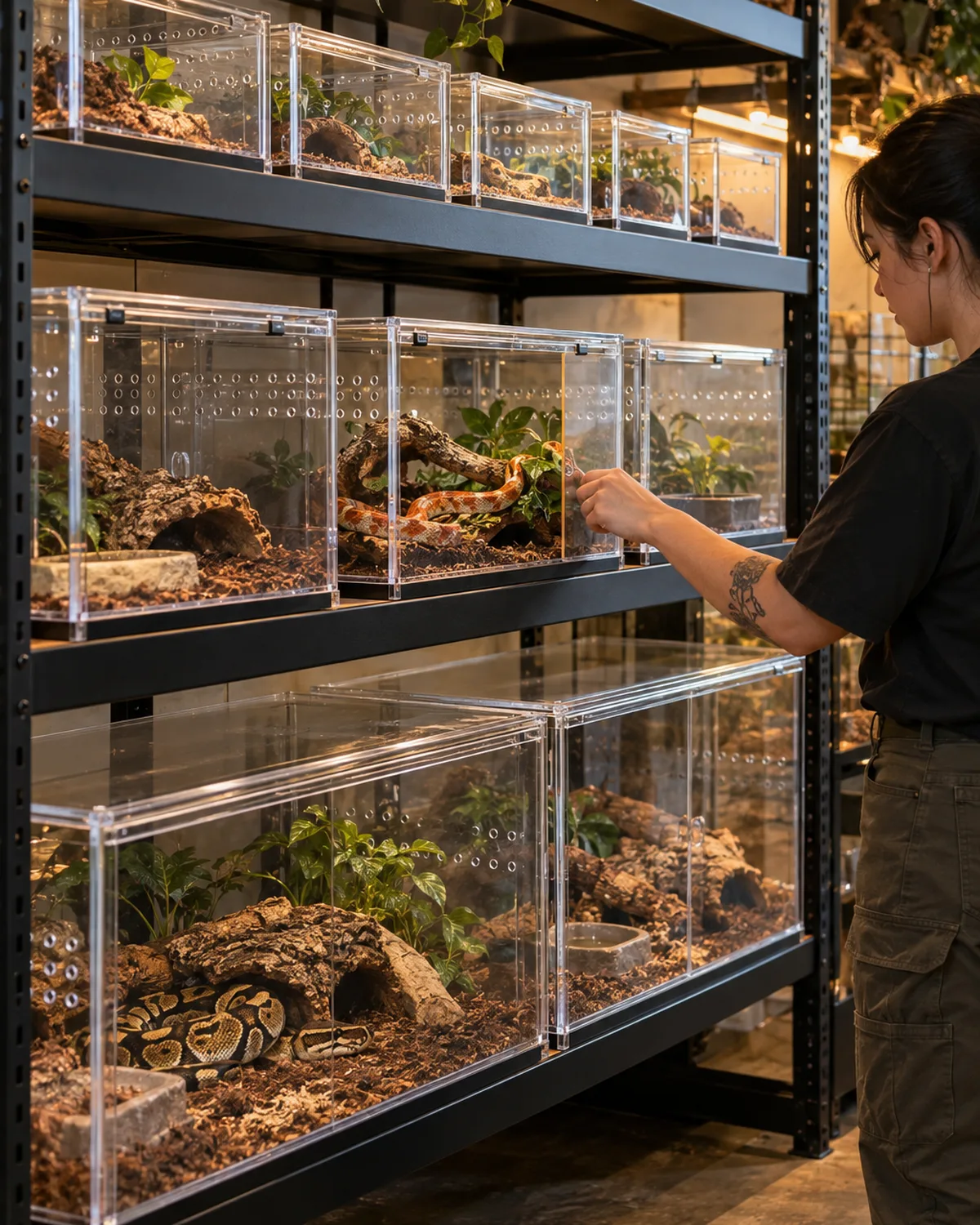
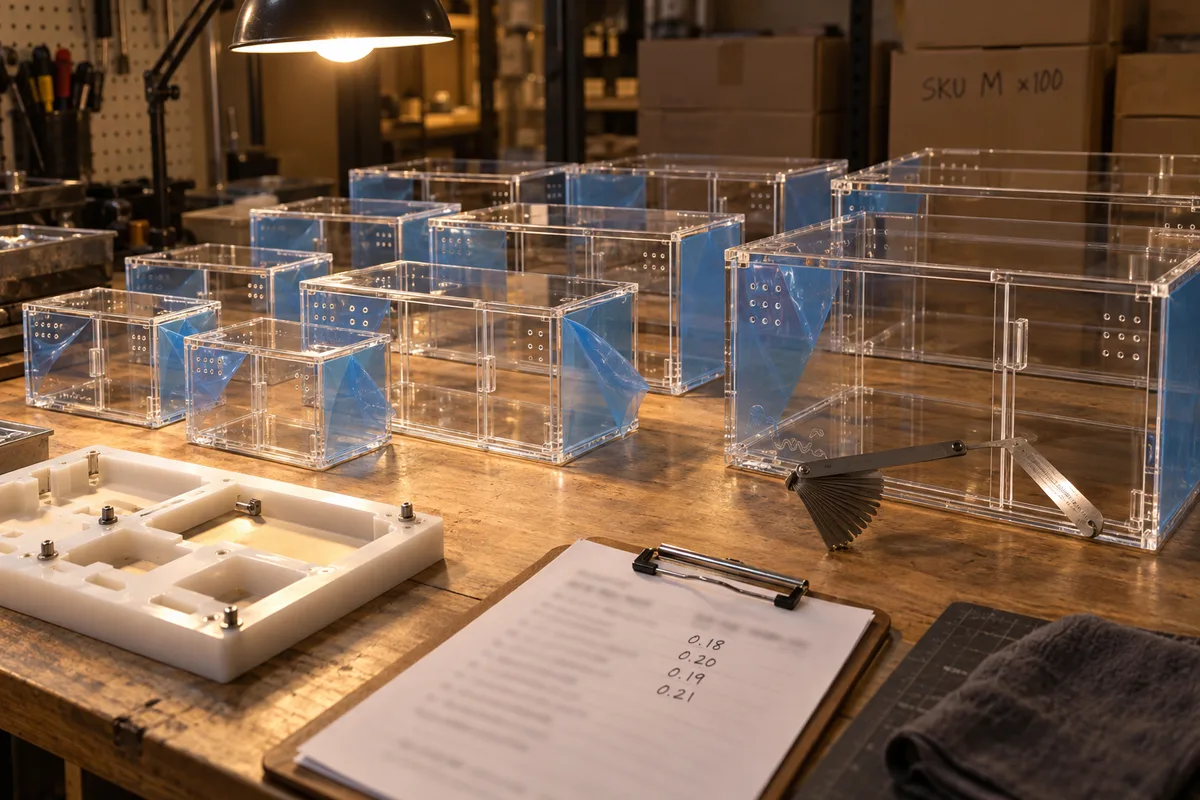
We built them as one family on a modular CNC jig, with solvent-bonded corners and front sliders, and released each size through a drawing and a physical sample the retailer approved before production began. Delivered: 300 enclosures, 100 per SKU, built to the retailer’s habitat inputs, with front-slider clearance measured at four points on every unit.
- SKU sizes
- 3
- field monitoring
- 90 days
Ordering a similar project
MOQ is 100 pieces per design. Paid samples normally take 3–5 days, are paid separately, and are never credited to production. Standard production takes 15–20 days after habitat inputs, drawings, material, hardware, sample, inspection plan, and packing are approved; Wetop responds to a complete brief within 24 hours.
Closest published price: this order was quoted per SKU from the drawings. The nearest public reference is a 150 × 100 × 100 mm magnetic-lid case in 3 mm clear acrylic at 500 pieces, listed from $6 per unit FOB Shenzhen on the acrylic cases hub. A live-animal enclosure prices above that compact display case; habitat geometry, ventilation, access, closure, heating interface, thickness, hardware, packing, quantity and destination set the final figure.
Key Takeaways
- A specialty pet retailer needed three enclosure sizes for its stores. We delivered 100 of each size, 300 enclosures, as one modular family on a shared CNC jig.
- We cut the three sizes on one modular CNC base jig with 3 size-specific inserts, which removed duplicated setup. The quote priced base tooling, inserts and units line by line.
- The retailer named the species, habitat conditions and heating equipment. We turned those inputs into drawing callouts for internal size, ventilation, slider, closure and the heat-mat opening.
- QC measured front-slider clearance at four points on every unit, checked bonded-corner load on full-production samples and verified the heat-mat opening against the drawing.
- Production began after the retailer approved the habitat spec and the sample.
The Challenge
The specialty pet retailer wanted three enclosure formats for its stores. A product name or species list does not give a factory enough to cut, so the retailer sent the intended species and life stage, habitat conditions, internal clearances, access method, ventilation target, heating equipment, substrate depth, cleaning routine, monitoring equipment, quantity split and destination.
Escape control and animal welfare were the retailer’s species-specific requirements. We built to their approved brief and sample. We did not borrow a slider tolerance, ventilation rate, heat opening or load value from another enclosure.
Habitat inputs turned into drawing checkpoints
We separated internal clear dimensions from external size, then put usable substrate depth, door opening, slider overlap, closure hardware, cable routes, ventilation locations and the named heating interface on the drawing as callouts. Our sample team and inspection team worked from that one reference.
The retailer set how ventilation, access and equipment fit would be approved. At sample review they installed their habitat equipment in the sample and recorded the acceptance criteria. We linked the signed sample record to the material, drawing revision, hardware schedule, inspection plan and packing instruction for each SKU.
Our Approach
We kept the shared production controls apart from the habitat-specific inputs. A modular base removed duplicated setup, and each SKU still got its own drawing, sample, inspection points and release.
Modular jig design across 3 SKU sizes
The panel relationships and processes of the three sizes overlapped, so we ran them on one CNC base with size-specific inserts. Our quote listed base tooling, SKU inserts, fixtures, samples and unit prices separately, which let the retailer compare the shared system with separate tooling for each size.
Drawing-defined front-slider clearance
The retailer approved the clearance and the measurement method for each SKU after checking them against their species and habitat requirements. Our inspection plan measured that clearance at four points on every unit.
Solvent-bonded corners with optically continuous seam
We chose solvent-bonded corners over mechanically fastened ones for the clear, continuous seam. The drawing, material, joint preparation, cure process and the approved sample defined acceptance, and we confirmed corner load on full-production samples.
Sample review as a complete enclosure
We reviewed the production-intent sample as a finished enclosure, not as separate panels. The retailer checked usable internal space with substrate and equipment installed, access for routine care, slider movement, closure security, ventilation layout, cable and heater interfaces, cleaning reach, edge finish, hardware and label position. We recorded the approved material, sheet thickness, joint method, hardware schedule, drawing revision and buyer-supplied components, and open items stayed on the sample record until both sides agreed the correction and how to inspect it.
The Results
We delivered 300 enclosures in three sizes, 100 per SKU. Each shipped against its own released package: internal dimensions, material and thickness, corner method, access, slider, closure, ventilation, heating interface, hardware, inspection, labels and packing.
Production began after approval. Before packing, QC measured front-slider clearance at four points on every unit, checked bonded-corner load on the agreed sampling plan and verified the heat-mat opening against the approved drawing. We corrected cosmetic edge issues before packing, and the signed inspection plan set the numerical limits for each SKU.
Each SKU had its own packing standard: removable parts, protective film, hardware bags, dividers, orientation marks, carton quantity and destination labels. In the mixed-size shipment every enclosure, accessory set and document stayed tied to its SKU code and drawing revision, so the retailer’s receiving team could check each carton against the approved sample.
The retailer rolled the enclosures out to a controlled store group first and logged slider security, breakage, corner condition, cleaning access and keeper observations at 30, 60 and 90 days. Feedback came back into the same revision loop: we recorded the SKU, habitat setup, observed condition, cleaning method and date before any design change, which separated a fabrication issue from a changed heater, substrate, animal life stage or handling routine.
What the jig did: the modular base let us run three enclosure sizes as one controlled family without paying for three unrelated tooling systems.
If You're Planning Something Similar
Settle the habitat criteria and SKU inputs before choosing tooling. A shared base jig also makes a later size easier to add: a fourth SKU becomes another insert, and only the new habitat geometry and first-off unit need approval. Keep revisions tied to the SKU they affect, and before a reorder reconfirm species and life stage, habitat equipment, quantity split, destination, labeling and cleaning method. Any new heater, monitor, substrate depth, access route or packing condition goes back through sample approval.
Panel thickness and the acrylic-versus-glass choice change weight, scratch behavior, structure, access, packing and price. Species suitability and husbandry stay with the buyer. See custom acrylic cases and the acrylic reptile and tarantula enclosure buyer guide.
Need a multi-SKU acrylic enclosure family?
Send us your species mix, store count, SKU range, adult body dimensions, ventilation preference, heating method and cleaning routine. We’ll reply with a jig and slider proposal, sample plan, inspection checklist, packing approach and unit pricing for each size.
Sample in 3–5 days · Production in 15–20 days after approval