Delivered Project · Corporate Awards · Australia
A Rush Acrylic Awards Order Sequenced to a 19-Day Clock
An event management agency in Australia placed a rush acrylic awards order for 400–450 laser-engraved, UV-printed square awards with a 19-day door-to-door commitment.

To make the date, the blanks were cut before the artwork mockup was approved and the finished cartons went by expedited air, which came to roughly half of the invoice. This page shows the sequence and what the buyer had to accept to get it. Project profile: 130 mm square class solid acrylic awards · laser engraving + UV-printed wordmark · individual inner boxes, 20 per carton · paid and shipped by expedited air.
- Project record · awards in one run
- 400–450
- Project record · door-to-door commitment
- 19 days
- Project record · of invoice was expedited air
- ~1/2
- Project record · inspected against the mockup
- 100%
Ordering a similar project
MOQ is 100 pieces per design. Paid samples normally take 3–5 days; sample fees are paid separately and never credited. Standard production takes 15–20 days after drawing, material, artwork, packing, and approval; Wetop responds to a complete brief within 24 hours. The 19 days door to door on this order depended on capacity that week, fast artwork approval and an expedited-air line the buyer accepted in writing.
Price on this order: the awards fell in a USD 6–9 per-piece band FOB Shenzhen at 400–450 pieces; expedited air was a separate line of roughly the same size as the goods. Size, thickness, engraving depth, print colors, packing, quantity and destination set the price of a new order; the acrylic awards hub lists the six cost drivers.
Key Takeaways
- The 19-day window held because the square blanks were cut on deposit, before the artwork mockup was approved; the buyer accepted that the size and thickness could not change after that point.
- Everything that touches the face waited for the mockup lock: laser engraving and the UV-printed wordmark ran only after written approval, so the artwork risk stayed with the artwork, not the blank.
- Expedited air came to roughly half of the invoice, close to the value of the 400–450 awards themselves, and it was booked with the order rather than after packing.
- Individual inner boxes and 20-per-carton packing were fixed with the quote, because a packing change after cutting would have cost days the schedule did not have.
- Rush changed the sequence, not the checks: every award was inspected against the approved mockup before it went into its box.
The Challenge
The brief arrived with the calendar already decided. An event management agency in Australia was producing an awards evening for a corporate client and needed 400–450 square acrylic awards in hand within a three-day window that started 19 days after the order. Each award had to carry a laser-engraved motif and a UV-printed two-color event wordmark on the same face, ship in its own plain inner box so the agency could hand them out without re-wrapping, and pack 20 to an export carton so the venue crew could move them on a trolley.
The arithmetic was the problem, not the product. Our standard production window is 15–20 days after approval, and that window assumes the artwork is already locked. Air freight from Shenzhen to Australia then takes several more days once customs and the last-mile leg are counted. Run the standard sequence end to end, with a mockup round at the front and freight at the back, and the earliest honest in-hand date lands after the event.
The agency was clear about the stakes in a way I appreciated. An awards evening has no partial credit: the trophies are either on the table when the names are read or they are not. It was also clear about what it could not give us. The event wordmark was still with the client's brand team when the purchase order was placed, so the artwork mockup could not be approved on day one. The size, the thickness, the finish, and the packing were already fixed. The face was the only open item.
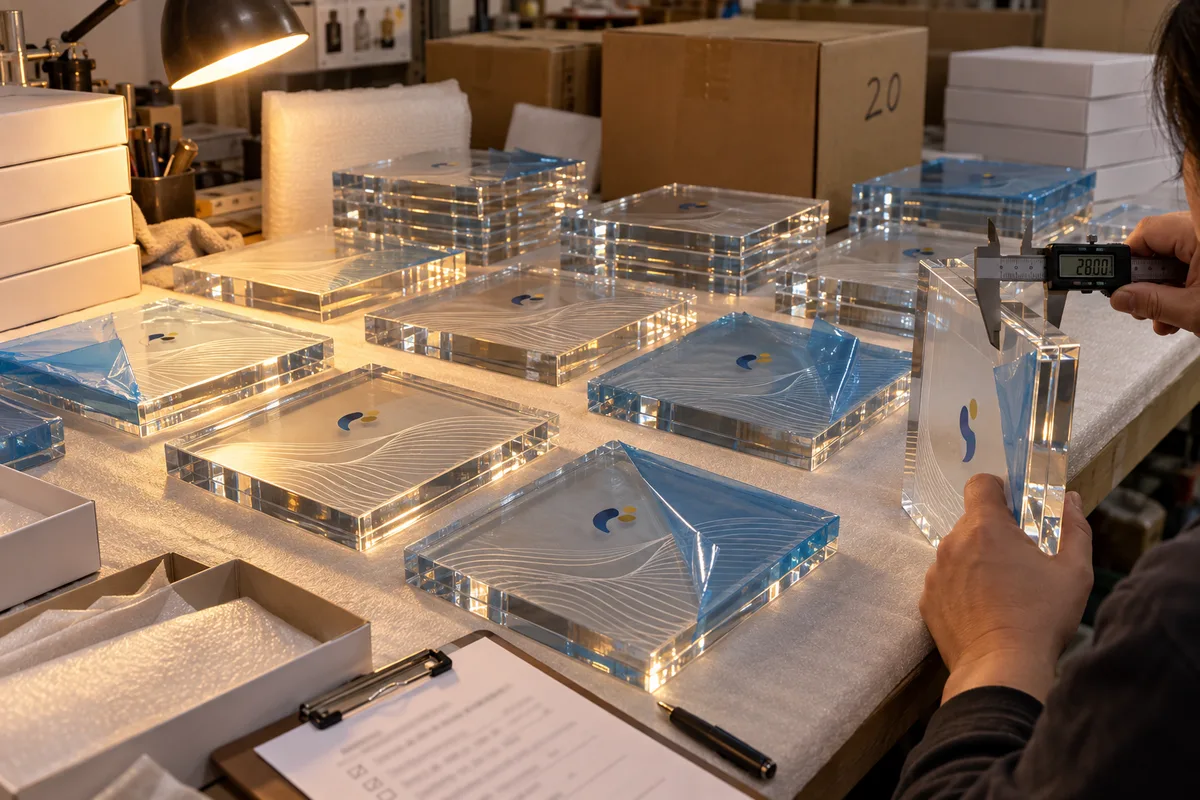
That split turned out to be the whole project. Everything the agency had already decided lived on the blank: a solid clear cast acrylic square in the 130 mm class, about 28 mm thick, diamond-polished on all four edges. Everything still in approval lived on the face: the engraved motif and the printed wordmark. If we could start the blank without the face, the mockup round could run in parallel with cutting instead of in front of it, and the schedule would recover the days it needed.
Our Approach
Three decisions made the 19 days possible, and the buyer had to sign off on each one before we released anything. None of them removed a manufacturing step. Rush, in this order and in every order I have run, is a sequencing decision paid for in freight and queue priority, not a permission slip to skip work.
Cut the blank on deposit; approve the face in parallel
The first decision was to release sheet cutting as soon as the deposit cleared, before the artwork mockup was approved. The blanks were defined entirely by the confirmed drawing: square format, thickness, edge treatment, corner condition. Nothing on the mockup could change any of those values, so nothing on the mockup needed to be approved before the saw ran. Cutting and edge polishing went ahead on day one while the agency chased the wordmark.
The buyer had to accept what that meant. Once the blanks were cut, the size and thickness were final. If the client's brand team had come back asking for a taller rectangle or a thinner profile, the cut material would have been scrap at the buyer's cost, and the calendar would have been lost anyway. We put that in writing on the order confirmation: cutting released against the signed drawing, artwork still open, dimensional changes after release are a new order. The agency agreed, because the shape had been approved by its client weeks earlier and the only thing still moving was the wordmark.
Splitting the approval into what decided the blank and what decided the face gave us back the days a full approval package would have cost at the front of the schedule. The drawing and the artwork had always been two separate documents; we treated them that way.
Spec at a glance
| Item | Project record | Who decided it, and when |
|---|---|---|
| Quantity | 400–450 awards, one design | Buyer, with the purchase order |
| Format | Solid clear cast acrylic, 130 mm square class, about 28 mm thick | Buyer drawing, before the order |
| Edges | Diamond polished, all four sides | Buyer drawing, before the order |
| Face | Laser-engraved motif plus two-color UV-printed event wordmark | Mockup approved after cutting had started |
| Packing | One plain inner box per award, 20 per export carton | Fixed with the quote |
| Unit price | USD 6–9 per piece band, FOB Shenzhen | Quote, before the order |
| Freight | Expedited air, about half of the invoice total | Quoted with the order, booked on day one |
| Schedule | 19 days door to door to the first day of the in-hand window | Agreed in writing with the sequence above |
The dimensions above are shifted from the original drawing to protect the buyer's design; the quantity, price, and freight figures are bands for the same reason. The sequence and the decisions are reported as they happened.
Engraving and UV print only after the mockup lock
The second decision was the mirror of the first. Everything that touched the face waited. The laser engraving program was prepared from the motif on the mockup, and the UV print file for the wordmark was set up with its white underbase, but neither machine ran on a production blank until the agency returned the signed mockup. That approval came back a few days into the run, while the blanks were already cut and polished and sitting on the rack with their masking film on.
Holding the face for approval is what kept the artwork risk with the artwork. Had the wordmark come back in a different color pair, we would have changed a print file, not a pallet of material. The engraving and print then ran as one continuous batch on blanks that were already dimensionally inspected, which is a cleaner setup than engraving pieces as they come off the saw. The acrylic plaques page explains why engraving on a flat polished face is the most economical decoration route; on this order it was also the fastest to release, because the motif needed no color decision.

Box and carton fixed with the quote
The third decision was made before the order and simply protected. Individual inner boxes and a 20-per-carton packout were in the quote, so the box supplier's order went out the same day as the sheet order. Awards are the product category where packing is most often changed late, usually because someone on the client side asks for a presentation box after seeing the first photo. On a 19-day clock that request would have added the box supplier's own lead time to ours. We told the agency on the order confirmation that the packing spec was frozen with the drawing, and that a presentation-box upgrade would be a second shipment, not a change to this one. It stayed with the plain inner box.
Freezing the packing early also fixed the carton count and the dimensional weight, which is what an expedited-air quote is actually priced on. The carton map, 20 awards with interleaf sheets and corner protection per carton, was drawn with the quote so the freight line could be quoted with it instead of after packing, when there is no time left to negotiate.
Freight booked on day one, and what it cost
Expedited air on this order came to roughly half of the invoice total, which put the freight line close to the value of the awards themselves. That is the honest price of a 19-day door-to-door commitment from Shenzhen to Australia, and the agency accepted it with the order rather than discovering it at packing. Booking on day one meant the pickup was slotted into the production plan as a fixed event; the cartons had to be sealed and labeled the evening before, and the last inspection had a hard finish time instead of a soft one.
I want to be direct about that ratio because it is the number buyers most often argue with after the fact. Sea freight would have cost a small fraction of it and arrived after the event. A split shipment, a few cartons by air and the balance by sea, only works when a partial quantity is useful on the date, and an awards evening needs every award. The freight line was not a surcharge we added; it was the cost of the transport mode the calendar required, quoted as its own line so the buyer could see it beside the goods.
The Results
The order record supports a plain statement: 400–450 square acrylic awards, laser engraved and UV printed, were invoiced, paid in full, and shipped by expedited air against a 19-day door-to-door commitment. The unit price sat in a USD 6–9 band FOB Shenzhen, and the freight line was about half of the invoice total. Every award was inspected against the approved mockup before it went into its inner box.
What the record does not include is just as important to state. This page does not report an arrival timestamp at the venue, a defect count, a reorder, or a customer quotation, because none of those are in the order file. The evidence is the invoice, the payment, the freight line, and the production sequence we ran. That is enough to say the order shipped as promised; it is not enough to claim more, and I would rather a buyer reading this trusts the part that is documented.
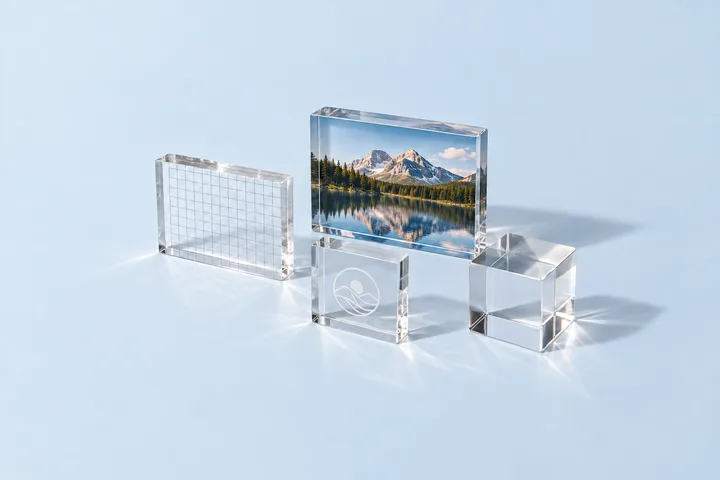
The images on this page are derivative designs generated for publication: the same product class, engraving and print processes, and palette as the order, with a fictional event wordmark in place of the client's artwork.
What the agency signed: cutting released against the signed drawing before the artwork was approved, the blank final from that hour, and the transport mode the date required paid as its own line.
If You're Planning Something Similar
Before asking how fast an awards order can go, sort each open item into what decides the blank (size, thickness, edge finish, packing) and what decides the face (motif, wordmark, print colors, recipient names). We can release cutting once the blank side is signed; if names are still changing, send them last. A paid sample takes 3–5 days plus courier time, so on a short clock you choose early between a physical sample and a signed mockup, and we write that choice into the order confirmation. Expedited air is priced on carton volume and dimensional weight, so we quote it as its own line beside the goods and you can weigh it against a later date by sea.
We make custom acrylic awards with laser engraving, UV printing, hot stamping and diamond polishing under one roof. See also the acrylic lead-time guide, our production process and the events and trade-show displays page.
Working against an awards-night date?
Send the event date, drawing, artwork status, quantity, packing, and destination. We will return the sequence that fits the date and the freight line it needs, in writing.
Sample fees paid separately and never credited · MOQ 100 pieces per design · Response within 24 hours