Delivered Project · Trading Cards · European Union
Thirteen Case Formats, One Invoice, Two Loadings
This multi-SKU TCG booster case program put 28,952 custom acrylic cases in 13 formats into one order for a European e-commerce reseller of trading-card display cases. The order opened on 27 April with seven formats, grew by six more on 15 May, and shipped by sea in two loadings on 30 June and 11 July, with French-market packaging versions of seven lines packed and counted separately.
- case formats
- 13
- cases invoiced
- 28,952
- largest single format
- 9,000
- sea loadings, 30 June and 11 July
- 2
Ordering a similar program
MOQ is 100 pieces per design. Paid samples normally take 3–5 days; sample fees are paid separately and never credited. Standard production takes 15–20 days after drawing, material, packing, and sample approval; a program of this size is planned in loadings. Wetop responds to a complete brief within 24 hours.
Price context for this project: unit prices ran from about USD 2 for a booster pack case to about USD 11 for an Ultra Premium Collection case, set by size and wall build at these quantities. The trading card display cases page lists current reference ranges; your formats get their own written quote.
Key Takeaways
- A European e-commerce reseller of trading-card display cases ordered 28,952 custom acrylic cases across 13 sealed-product formats on one invoice, with single formats ranging from 300 to 9,000 pieces.
- The order opened on 27 April with seven formats and 15,940 pieces; on 15 May the reseller added ten more lines, six of them new formats, for another 13,012 pieces on the same invoice and production plan.
- The program shipped in two sea loadings: the first on 30 June in one container shared with the account's previous order, the second on 11 July. Together they came to more than 2,000 cartons and about 126 cubic metres.
- Seven formats carried a French-market packaging version next to the standard one, 2,308 pieces in all, each packed and listed as its own carton line.
- Ordering a similar program still starts at 100 pieces per design, with a 3–5-day paid sample per new format that is paid separately and never credited, and 15–20-day standard production after approval.
The Challenge
The buyer sells acrylic display cases for sealed trading card products online across Europe. Its customers are collectors who keep booster boxes, booster bundles, premium collection boxes and tins sealed, and who want each one in a case that fits it. That makes the reseller's catalogue a list of formats, not a list of products, and every new set release can add a format to it.
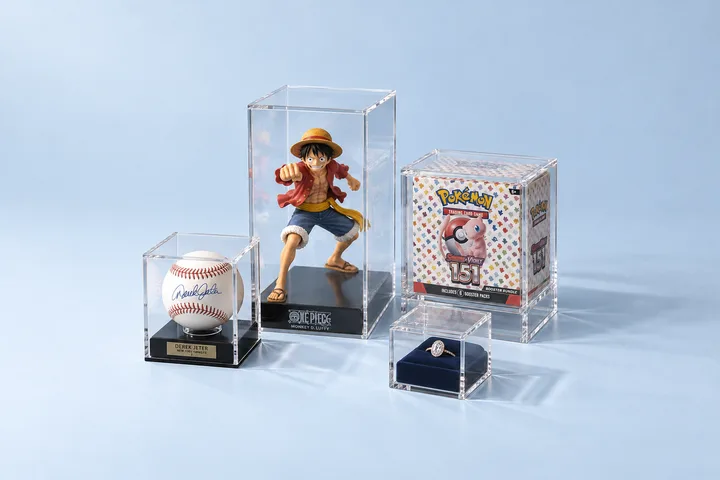
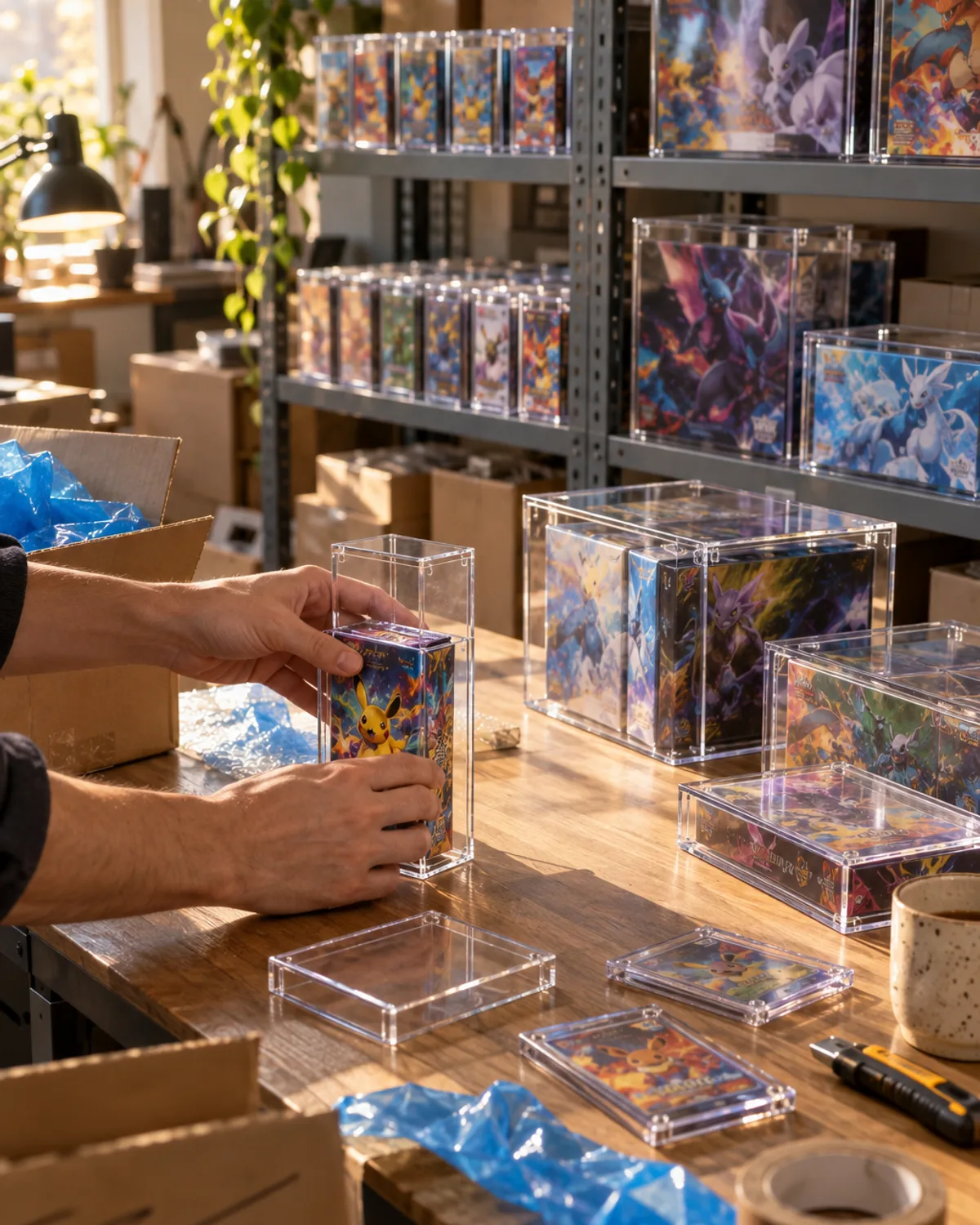
By spring the reseller needed its next restock across most of that catalogue at once: high-volume formats such as the 2026 booster bundle, mid-volume formats such as tins and One Piece booster boxes, and lower-volume ones such as a Yu-Gi-Oh! 24-pack booster box. Each format has its own dimensions. Some are slim, rounded cases holding one booster bundle; some are lidded retail displays big enough for a whole bundle display; some are layered flat cases for a single booster pack or a graded card.
Three things made the order harder than its quantity. The format list was not final when the order was placed, because new releases were still being confirmed. Part of the stock was going to the French market and needed French-language retail packaging, in quantities that differed format by format. And the reseller wanted the first formats on the water as soon as they were ready, not held back until the last format was finished.
Our Approach
We treated the order as 13 small programs that happen to share one invoice. Each format has its own drawing, its own wall build, its own approved sample and its own line on the packing list. That is what kept a 28,952-piece order manageable, and it is what let the order change without starting over.
Thirteen drawings, not one
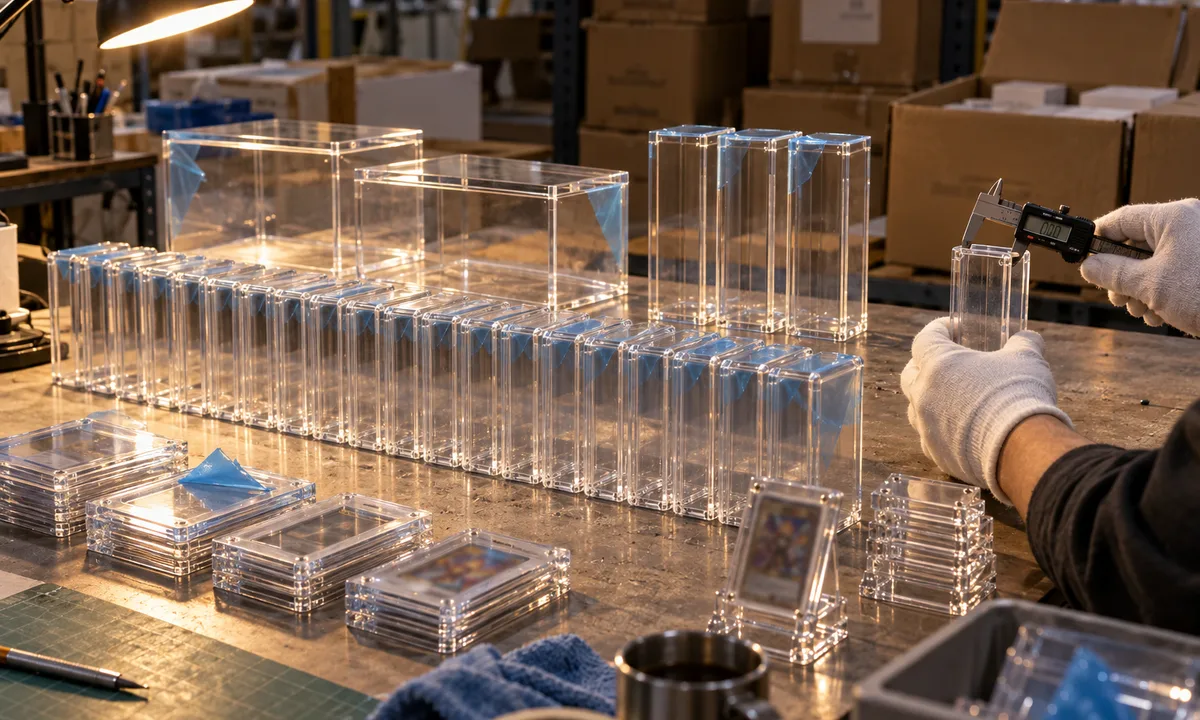
The formats differ in more than size. The booster bundle case is a slim enclosure with an inner size of 77 × 54 × 122 mm and rounded vertical edges, which feel better in the hand and look softer on a shelf than sharp mitred corners. The booster bundle retail display is a much larger box with an inner size of 259 × 158 × 125 mm and a round-edge lid. The booster pack case and the graded card display are flat, layered builds: a thicker centre sheet with a pocket cut into it, sandwiched between two thinner face sheets, 3 + 5 + 3 mm for the pack case and 3 + 8 + 3 mm for the card display. The 3-pack booster blister case uses the same idea at 198 × 180 mm. The Pokémon box case uses 5 mm walls on an 8 mm base.
Because each format was drawn and approved on its own, the 9,000-piece booster bundle line and the 300-piece Yu-Gi-Oh! line ran to the same standard. Each format is checked against its own approved sample, not against a general idea of what a case should look like. Our custom TCG booster box cases page explains how sealed-product cases are sized from the measured box, including ETB and booster box case programs for resellers; Elite Trainer Box formats were not part of this order.
The format list grew three weeks in
The first order on 27 April covered seven formats and 15,940 pieces. On 15 May the reseller added ten lines and 13,012 pieces: six new formats (the regular tin case, the One Piece booster box case, both Japanese booster box cases, the Pokémon box case and the Super Premium Collection case) plus more of four formats already on the order. We added them to the same invoice and the same production plan. Every added format had a confirmed size, so the add-on was a scheduling question, not a design question.
The scheduling answer was two loadings. Formats that were ready by the end of June shipped first; the add-on formats and the balance of the first lines followed eleven days later. The reseller's highest-volume lines left without waiting for the newest formats.
One container shared with the previous order
The first loading went into one container together with the account's previous order, on a single bill of lading from Yantian to Rotterdam, with a combined packing list and customs invoice showing which cartons belonged to which invoice. Sharing one container meant one booking and one set of import documents for both orders. Our guide to FOB versus DDP for acrylic orders explains how freight terms change who books and pays for that space.
French-market versions as separate lines
Seven formats had a French-market version alongside the standard one: 400 graded card displays, 400 booster pack cases, 408 regular tin cases, 200 of each Japanese booster box case, 500 booster bundle cases and 200 booster bundle retail displays, 2,308 pieces in total. We packed each version in its own cartons and gave it its own line on the packing list, so the reseller could send French stock to French customers without opening a carton to check. For formats that had already shipped in standard packaging, the empty French packaging went in the second loading on its own carton lines, marked as having no commercial value, for the reseller to repack locally.
Spec at a glance
Sizes are the order's own dimensions; quantities are the invoiced totals per format, combining the first order and the add-on where a format appears in both.
The Results
All 13 formats shipped within eleven days of each other. The first loading left on 30 June and was on board from Yantian to Rotterdam on 8 July; the second left on 11 July. The invoice, paid in stages as a deposit, a balance before shipment and a final share on 30-day terms, is settled in full.
For a reseller, the useful result is that the order grew by six formats three weeks in without a new quote cycle, a new sample round for formats already approved, or a delay to the formats already in production. That only works when each format is a separate, documented line. The same structure is what makes the next order simple: any of the 13 can be reordered alone, at its own quantity, from its own drawing.
Project note: A multi-format order is a set of small programs. Give every format its own drawing, sample and packing line, and the order can grow, split into loadings, and carry market-specific packaging without anyone losing count.
What This Means for Your Project
If you run a card shop, a TCG distribution business or an online store selling display cases, your catalogue probably looks like this one: many formats, very different volumes, and a release calendar that keeps adding to the list. Three points from this program apply to most orders like it.
Approve every format on its own. A case that fits a booster bundle tells you nothing about one that fits a tin. Send the measured box for each format, approve a sample for each new one, and keep that sample on file. Sample fees are paid separately and never credited; what they buy is a format you can reorder without re-checking. Our guide on UV-filtering acrylic for trading cards covers the material choice for cases that will sit in daylight.
Plan in loadings, not one big ship date. A multi-format order rarely finishes all at once. Decide up front which formats must go first, and let the rest follow in a second loading rather than holding everything for the slowest line.
Make each packaging version its own line. If some of your stock needs another language or a retailer-specific box, give it its own quantity and its own carton line before production starts. Splitting versions at the packing table is easy; splitting them in your warehouse is not.
We build custom trading card display cases and graded card display cases from 100 pieces per design, with a paid pre-production sample for every new format. For a single-format program from sample to bulk, see the magnetic PSA slab case project.
Common Questions
Three questions resellers ask most often when one order has to cover many case formats.
Can one acrylic case order cover many different TCG formats?
Yes, as long as each format has its own measured drawing and approved sample. This program covered 13 formats in one order, from a 140 × 88 × 11 mm booster pack case to a lidded booster bundle retail display, with 300 to 9,000 pieces per format. Each format still has to clear the MOQ of 100 pieces per design; the order as a whole does not average that out.
Can I add formats to an acrylic case order after it has started?
On this program the reseller added ten lines, six of them new formats, three weeks after the first order, and they joined the same invoice and production plan instead of becoming a second project. What made that possible was that every added format already had a confirmed size. The added lines shipped in a second loading eleven days after the first, so the early lines were not held back waiting for them.
How do you handle different retail packaging for different countries on one order?
We treat each packaging version as its own packing-list line. On this order seven formats had a French-market version alongside the standard one, 2,308 pieces in total, and each version was packed and counted in separate cartons so the reseller could route them without opening boxes. Empty French packaging for formats that had already shipped went with the second loading, marked as having no commercial value.
Restocking many case formats at once?
Send the format list with the measured box for each, the quantity per format, any market-specific packaging, and which formats must ship first. We will return a per-format quote, a sample plan for new formats, and a loading plan.
Paid samples in 3–5 days · Fees paid separately and never credited · Production in 15–20 days after approval · MOQ 100 pieces per design · Response within 24 hours