




Delivered Project · Consumer Appliances · Australia
A Reorder Where Nothing Was Allowed to Change
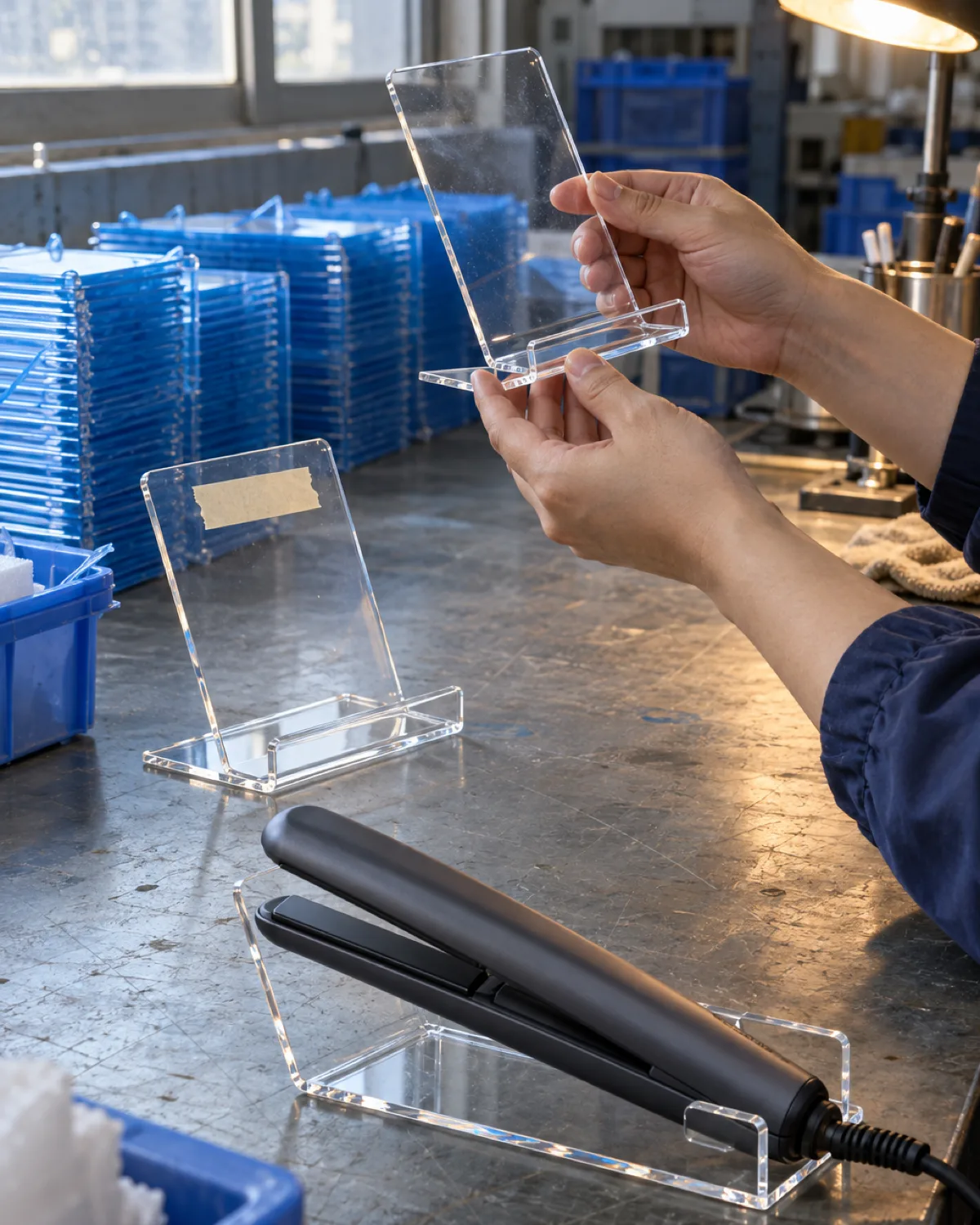
A consumer hair-appliance brand in Australia sent a one-line purchase order for another 800–1,200 clear 3 mm acrylic retail display stands for hair tools, built to the latest approved sample. We produced the run against the tagged sample-of-record, inspected every piece against it, and released the cartons Ex-Works to the brand's own freight forwarder in about 25 days.
- stands, one design
- 800–1,200
- clear cast acrylic
- 3 mm
- PO to Ex-Works release
- ~25 days
- spec changes accepted
- 0
Ordering a similar project
MOQ is 100 pieces per design. Paid samples normally take 3–5 days; sample fees are paid separately and never credited. Standard production takes 15–20 days after drawing, material, finish, packing, and sample approval. Wetop responds to a complete brief within 24 hours.
Named price reference: the acrylic display manufacturer page lists a 250 × 180 × 220 mm two-tier countertop stand in 5 mm clear acrylic with one-color UV branding at about $28 each at 100 pieces, $16 at 500, and $12 at 1,000, FOB Shenzhen. The stand on this page is a different format, thickness, and trade term; its USD 8–10 band is not a quote for yours.
Key Takeaways
- A reorder of 800–1,200 clear 3 mm acrylic retail display stands ran against the buyer's tagged sample-of-record, and the first-off unit was compared to that physical object before the line was released.
- The purchase order and our order file pointed at one product description and one approved sample, so nobody had to reconstruct the spec from photos or old emails.
- Change control worked by refusal: sheet lot, bend radius, film, and carton layout were each checked against the record, and any deviation would have reopened sample approval rather than being absorbed quietly.
- Ex-Works suited a brand that already runs its own freight through a forwarder; we released the goods at the factory door with carton data the forwarder could book against.
- Current ordering for a new stand still starts at 100 pieces per design with a 3–5-day paid sample and 15–20-day standard production after approvals.
The Challenge
The purchase order was one line long. Product description, quantity, the words "per latest approved sample", and a pickup instruction naming the brand's freight forwarder. No drawing attached, no artwork, no packing note. For a buyer who has ordered the same stand before, that is exactly what a repeat PO should look like. For the factory receiving it, that single line carries the whole risk of the job.
The brand sells hair straighteners, dryers, and curling tools through retailers across Australia. Each retail counter gets a clear acrylic stand that presents the tool where shoppers can pick it up, feel the weight, and put it back. The stand is not the product. It is furniture for the product, and the brand's merchandising team wants every counter in every store to look identical to the counter they approved on the previous order.
That is where a reorder quietly goes wrong. Between the first run and the next, a factory buys a different sheet lot, a bending jig gets rebuilt or re-set, a packer switches from one poly sleeve to another because the old ones ran out, or someone "improves" the carton layout. None of these feel like spec changes on the factory floor. All of them show up on the retail counter as a stand that sits a few millimeters lower, refracts light differently, or arrives with a scuff the first batch never had. The merchandiser notices before anyone at the factory does.
The buyer's real request, underneath the one line, was therefore simple to state and harder to execute: produce 800–1,200 more stands that are indistinguishable from the ones already on the shelf, do not ask us to re-approve anything, and have them ready for our forwarder on the agreed date. The brand did not want a new sample, did not want a design conversation, and did not want to manage freight from Shenzhen. It wanted the previous decision to hold.
I have watched repeat orders fail on precisely this point, and rarely because the factory could not make the part. They fail because "same as last time" was a memory rather than a record, and two teams remembered it differently. Our job on this order was to make sure the record, not anyone's memory, decided what got built.
Our Approach
A repeat order with a frozen spec is a discipline problem, not an engineering problem. We already knew how to make the stand. What we had to prove, to ourselves and then to the buyer, was that nothing about how we made it had moved since the approved run. We did that in four steps: pull the sample-of-record, tie the PO to one part description, run change control as a refusal process, and pack for a forwarder we do not control.
Sample-of-record, not sample-from-memory
Every approved sample at Wetop is tagged and shelved after the buyer signs it off, and it stays there for as long as the account is active. For this stand, the retained sample was the one the brand approved before its previous production run: 3 mm clear cast acrylic, bent to the approved profile, polished edges, and protective film applied the way the buyer wanted it. The invoice line for the new order pointed at that sample by reference, so the production file did too. When I walk a new buyer through our sample shelf, the tag on that shelf is the thing they photograph, because it is the first time anyone has shown them where their approved sample actually lives.
The first thing production did was pull the sample from the shelf and put it on the bench next to the current sheet stock. Before a single stand was bent, the operator confirmed the sheet grade and thickness against the sample, checked the bending jig against the sample's bends and angles, and ran one first-off unit. That unit went to QC alongside the sample-of-record. Not alongside a photo of it, and not alongside the drawing. The physical object is the reference because it captures the things a drawing never records: how the polished edge catches light, how the film releases, how the stand actually feels when a tool is set onto it.
Only after QC signed the first-off against the sample did the run start. This is the step buyers rarely see and often do not think to ask about. It is the difference between a reorder and a re-guess.
One part, one description, one reference
Part-number discipline sounds like a procurement nicety until a factory has three "hair tool stands" for the same brand on file and a PO that names none of them. We keep it simple: each approved design carries one product description on our side, and that description is what appears on the quote, the invoice, the sample tag, and the carton label. When the brand's PO arrived, purchasing matched its line to our description and the sample reference before the order entered planning. If the match had been ambiguous, the order would have stopped there with a question back to the buyer, not a best guess forward to production.
The brand, for its part, uses its own item reference on the PO. We record that next to ours. Two references for one object is fine; the discipline is that both point at the same sample-of-record. That is what lets a reorder be one line long without being dangerous.
Change control by refusal
On a frozen-spec order, change control does not mean managing changes well. It means not making any, and being able to show it. We split the order into the fields that could drift without anyone deciding to change them, and checked each against the record:
- Material. Sheet grade and 3 mm thickness confirmed against the sample, and the sheet lot noted in the order file so the next reorder can see what this one used.
- Geometry. Bend radii, angles, and overall footprint checked on the first-off unit against the sample-of-record before release.
- Finish. Edge polish and protective film type matched to the sample; the film is part of the spec because the brand's merchandisers peel it at the counter and want it to come off clean.
- Packing. Unit protection, separation inside the carton, and units per carton held to the previous order's packing record rather than whatever was on the packing bench that week.
- Process. No jig, tool, or supplier substitution on this part without a written note to the buyer, even if the substitute was "equivalent".
Had any of those checks failed, the rule was already set: reopen sample approval with the buyer rather than absorb the difference. That would have cost a paid sample and a few days. I would rather lose those days than explain a drifted counter to a merchandiser, and I have had to do the second thing often enough early in my career to know which one is cheaper. It did not come to that on this order, and the reason it did not is that the checks were run rather than assumed.
Packing for a forwarder we do not control
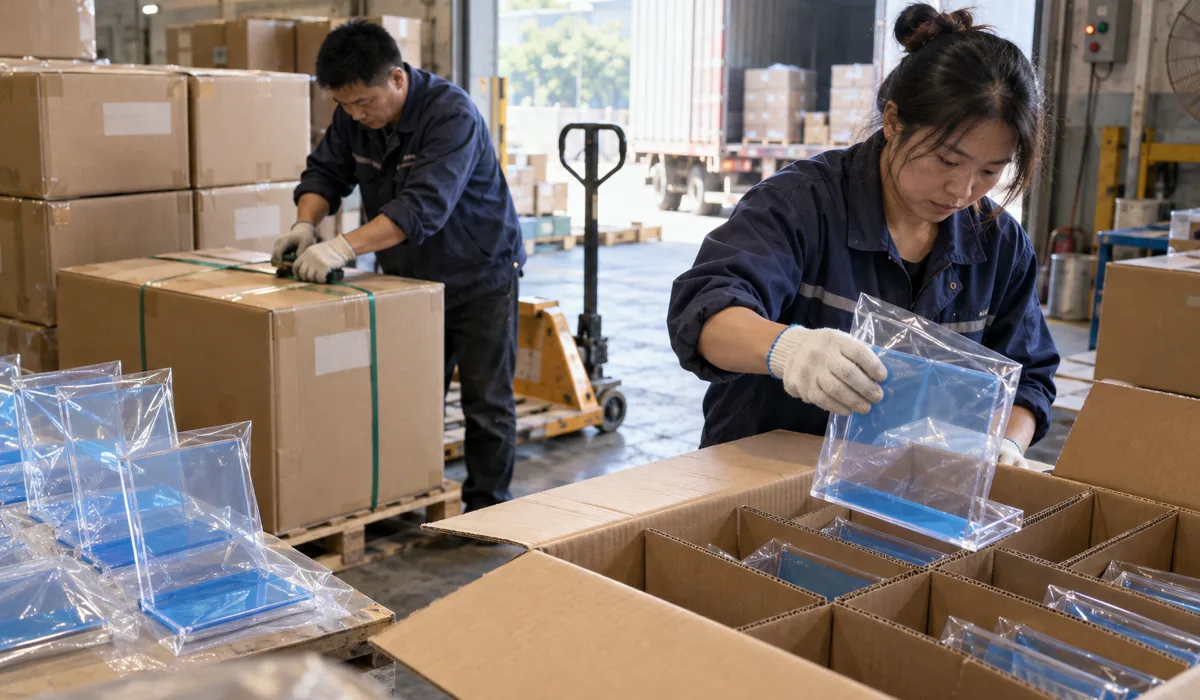
Under Ex-Works, the moment the cartons leave our door they belong to the buyer's logistics chain. We do not book the truck, we do not clear export, and we do not choose the vessel. What we do control is whether the cartons survive a chain we never see. So the packing on an Ex-Works order is, if anything, more conservative than on a shipment we book ourselves. My rule for the packing bench is that an Ex-Works carton has to survive a forwarder I have never met.
Each stand kept its protective film on and was protected individually inside double-wall export cartons, with carton quantities held to the previous order's record. Before release we sent the forwarder what it needs to book and collect: carton count, carton dimensions, gross and net weights, and how the cartons were stacked. The brand's forwarder collected at our door and ran the export and sea legs on the brand's own arrangements. Our involvement ended at the roller door, which is exactly how the buyer wanted it.
Spec at a glance
Quantities, prices, and dimensions on this page are shown as bands or omitted to protect the buyer's commercial detail. The underlying order is documented in our records.
The Results
The run of 800–1,200 stands was inspected piece by piece against the sample-of-record, packed to the previous order's record, and released Ex-Works to the brand's forwarder about 25 days after the purchase order arrived. The invoice was paid in full. No change request was recorded on either side, which on a reorder is the result that matters.
Two things about that timeline are worth reading carefully. First, about 25 days is this order's record from PO to release; our standard production baseline for a new design is 15–20 days after every approval is in hand, and the window on any specific order is set by the written quote, the first-off check, and current capacity, not by a headline number. Second, "released Ex-Works" is the point where our part of the job ends. The sea leg, import clearance, and delivery to the brand's warehouse ran on the forwarder's schedule, and we do not report transit or landed dates we did not control.
What the brand got was the thing it asked for in one line: another run of the same stand, with no meeting, no new sample, and no surprises at the counter. What it also got, without asking, is an order file that now records the sheet lot, the first-off check, and the carton record for this run, so the next PO can be one line long too.
Project note: On a frozen-spec reorder the useful output is not the stand. It is the proof that the stand did not drift: a tagged sample-of-record, a first-off unit signed against it, and a packing record the next order can copy.
What This Means for Your Project
If you manage retail merchandising for a consumer-appliance or beauty-tool brand, an acrylic retail display stand for hair tools is a small line item with a long life. It gets reordered every time a range refreshes, a new retailer comes on, or counters get damaged. The cost of the stand is minor. The cost of the stand looking different from the last batch is not, because it lands on the retail floor where your buyer sees it before you do.
Three habits make that reorder safe, and none of them require you to become an acrylic expert. I give the same three to every brand that asks me how to make a reorder boring, which is the correct ambition for a reorder.
Ask for the sample-of-record by name. When you approve a pre-production sample, ask your manufacturer to tag it, store it, and reference it on every future quote and invoice. Then reference it yourself on the PO. "Per latest approved sample" only works if both sides mean the same physical object. If your current supplier cannot tell you where your approved sample is, that is your answer about how the next reorder will go.
Freeze the fields that drift, not just the ones you drew. Sheet grade, film type, sleeve, divider, and units per carton are the fields that change without a decision. Ask that they be written into the order file next to the drawing, and ask that any substitution be reported before it happens rather than discovered on the counter. Our repeat-order change-control checklist lists the fields we track and the approvals each one reopens.
Pick the trade term that matches your logistics, not the cheapest-looking quote. Ex-Works made sense for this brand because it already moves cargo out of China through a forwarder it trusts; the stands went into that chain. If you do not have that setup, Ex-Works hands you export clearance and a China-side pickup you may not want to manage, and I have seen first-time importers take Ex-Works for the lower number and regret it, and FOB Shenzhen, where we clear export and load the container, is the friendlier default. Our FOB versus DDP guide walks through the handover points and what each one costs you in attention rather than dollars.
We build custom acrylic display stands for consumer-appliance, beauty, and electronics brands from 100 pieces per design, with a paid pre-production sample before the first run and the sample-of-record process described here on every run after it. The display stand manufacturing program page covers the drawing inputs, sampling gates, and published planning prices for a first order.
Common Questions
Three questions we answer most often when a buyer reorders a stand it has already approved.
Does a repeat order of acrylic display stands need a new paid sample?
Not when nothing changes. If the purchase order references the retained approved sample and the drawing, material, finish, and packing are unchanged, we build a first-off unit, compare it to the sample-of-record, and release the run. Any change to geometry, thickness, sheet, print, or packout reopens sampling; the sample fee is paid separately and is never credited to production.
Why did this buyer choose Ex-Works instead of FOB Shenzhen?
The brand already has its own freight forwarder handling its cargo out of China. Under Ex-Works the goods are released at our factory door and the forwarder handles pickup, export clearance, and ocean booking on the brand's existing arrangements instead of on a separate FOB booking. FOB Shenzhen remains our default for buyers who do not have that setup.
What does "per approved sample" actually freeze on an acrylic stand?
It freezes the geometry, sheet thickness and grade, bend radius, edge finish, protective film, and packing that the buyer signed off on, in physical form. The sample-of-record is stored, tagged, and pulled for every reorder so the first-off unit is compared against an object rather than a description. Anything not visible on the sample, such as carton quantity or label wording, is written into the order file next to it.
Reordering a retail display stand you have already approved?
Send the previous order reference, the quantity, your forwarder or preferred trade term, and any field you want changed. We will confirm the sample-of-record on file, the first-off check, and a written quote.
Paid samples in 3–5 days · Fees paid separately and never credited · Production in 15–20 days after approval · MOQ 100 pieces per design · Response within 24 hours