





Case Study · Optical Manufacturing · East Asia
400 Flocked Divider Trays That Carry Lenses Between Stations
An East Asian optical lens manufacturer was losing polished blanks to transit scratches between process steps.
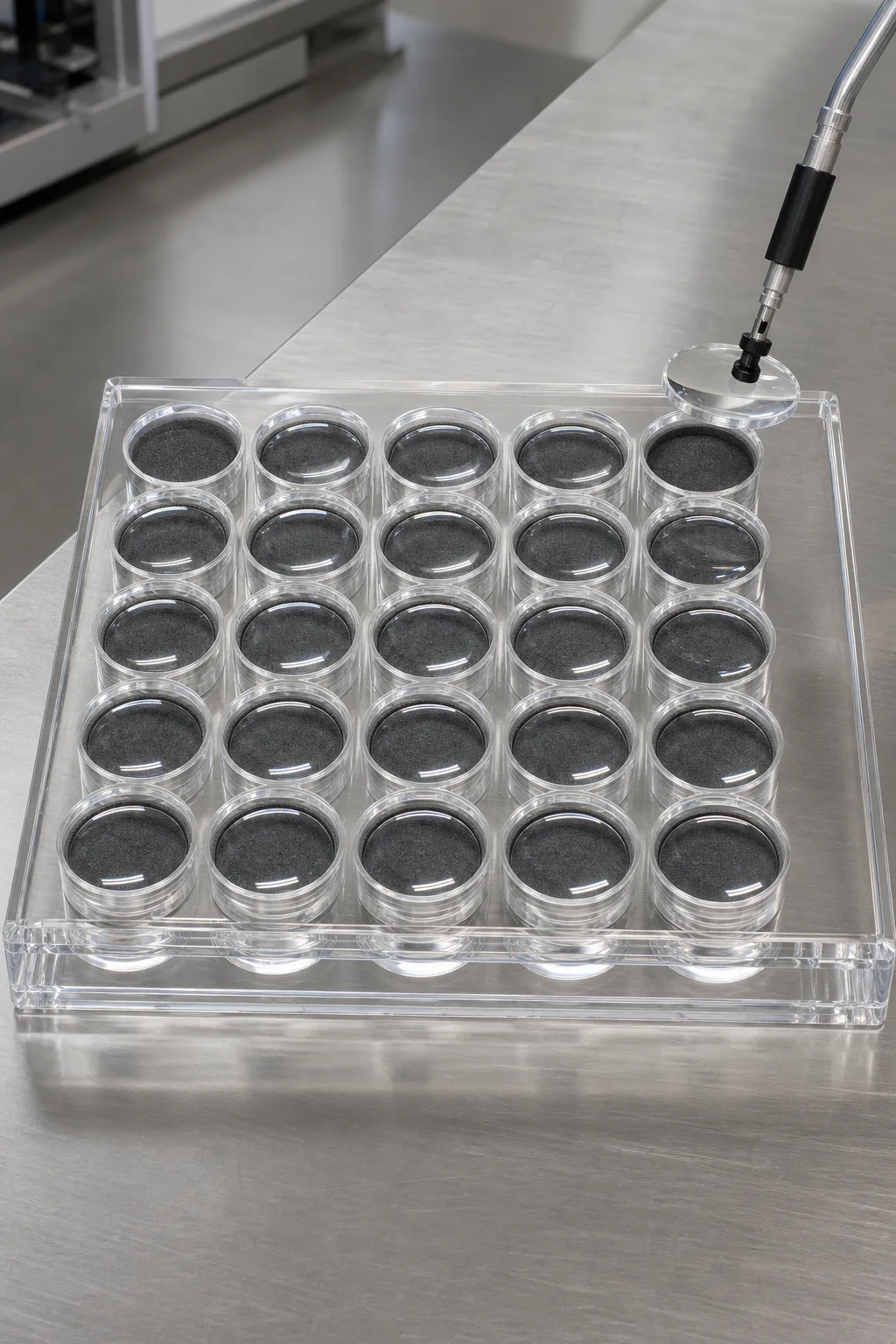
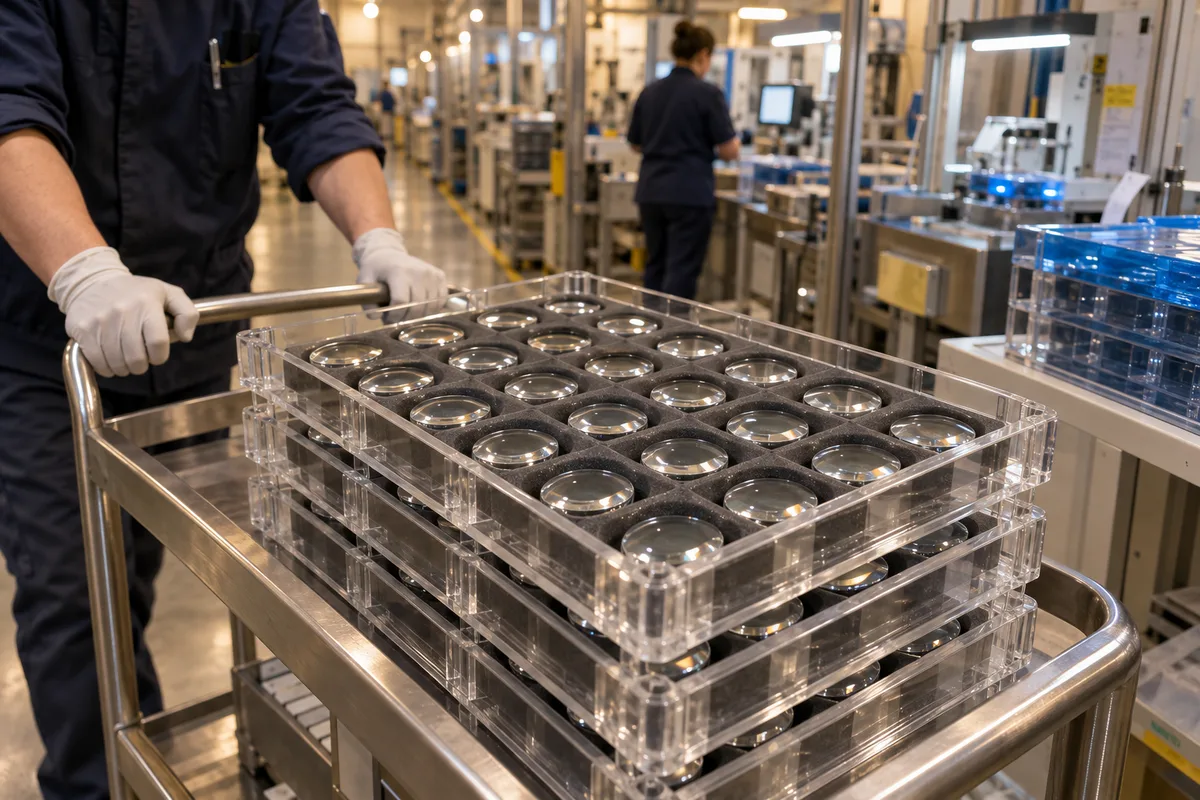
We built 400 flock-lined acrylic divider trays — 24 routed pockets per tray, about 1 mm of radial play around each 70 mm blank, 5 mm of stacking clearance above the lens crown — in 16 production days. A 250-tray add-on for the coating line followed at month 3.
- trays shipped
- 400
- lens pockets
- 9,600
- production time
- 16 days
- reorder month 3
- +250


Key Takeaways
- A lens blank scratched in transit between stations is scrapped at its most expensive moment — after grinding and polishing have already been paid for. The tray between stations is process equipment, not packaging.
- Flock lining beat foam inserts on the constraint that mattered: foam sheds particles as it ages, and particles are what a coating chamber cannot tolerate. Flock bonds into the routed pocket and stays put.
- Acrylic is triboelectric — we did not sell an "anti-static acrylic" claim. The honest mitigation is flock at the contact surfaces plus the buyer's damp-wipe protocol before trays enter the coating area.
- Pocket arithmetic: 74.0 mm routed pocket − ~1.0 mm flock pile per wall = ~72 mm effective opening, leaving ~1 mm radial play around a 70 mm blank — vacuum-pen loose, transport-cart tight.
- 400 trays (9,600 pockets) shipped in 16 production days, every tray inspected before packing; a 250-tray add-on for the coating line followed at month 3.
The Challenge
By the time a lens blank reaches final polishing, it has absorbed most of the cost it will ever carry — material, grinding, hours of machine time. A scratch picked up on a transport cart between stations scraps it at the most expensive possible moment. That was the line item driving this inquiry: an optical lens manufacturer whose weekly QC review kept surfacing transit damage between grinding, polishing, and coating.
The trays they were using told the story. Some were general-purpose trays with bare compartments — hard walls against polished glass. Others used foam inserts, which cushioned well on day one and then aged into a particle source, crumbs migrating onto lens surfaces headed for the coating chamber. The replacement had to clear three constraints at once:
- Soft contact without shedding. Whatever touches the lens must be softer than the polish and must not release particles as it wears — foam fails the second test, bare PMMA fails the first.
- Static, handled honestly. The coating team knew acrylic charges when handled and asked about it directly. Any supplier answer that hand-waved "anti-static acrylic" would have failed their process engineers on the spot.
- Pocket fit tied to real handling. Blanks are lifted with vacuum pens and travel on wheeled carts. Too tight and the pen fights the pocket; too loose and 24 lenses chatter in unison over every floor joint.
Our Approach
We scoped the tray as process equipment rather than packaging: a routed acrylic body sized to their cart shelving, a 6 × 4 pocket grid for 70 mm blanks, flock lining at every contact surface, and a stacking lip that lets full trays stack without anything touching a lens. The pocket geometry follows the same clearance logic laid out in ourtray insert and compartment design guide — this order is that playbook applied to optics, sized looser here because a vacuum pen, not fingers, does the lifting.
Flock lining, not foam — and why
Flock is a short fiber pile bonded into the routed pocket with adhesive. Against a polished lens edge it presents thousands of soft contact points, but unlike foam there is no crumbling matrix behind them — the fibers are anchored individually, so the lining wears by losing softness slowly rather than by shedding crumbs. For parts headed into a coating chamber, that distinction is the whole decision. We routed each pocket 2 mm oversize, applied the flock, and treated its pile thickness as a real dimension in the fit arithmetic rather than a soft afterthought.
The static answer their process engineers accepted
Acrylic is triboelectric. Rub a PMMA tray during handling and it will hold a surface charge and attract dust for a while — that is the material, and no coating we could print on it changes the physics enough to promise otherwise. So we did not promise otherwise. The mitigation we proposed was mechanical and procedural: flock at every lens contact point, so whatever charge the tray body carries has no bare surface acting on the blank, combined with the wipe-down protocol their coating area already ran — a damp lint-free wipe that dissipates surface charge as it removes dust. We also told them the boundary: a process that genuinely requires static-dissipative material needs a different substrate, not a relabeled acrylic. Their process engineers signed off on the combination, and the coating-line add-on order at month 3 suggests the answer held up in use.
Pocket arithmetic a vacuum pen agrees with
The numbers: pockets routed at 74.0 mm (+0.2 / −0 mm), flock pile averaging 1.0 mm per wall, leaving an effective opening of roughly 72 mm. Around a 70 mm blank that is about 1 mm of radial play — enough for a vacuum pen to lift the blank straight out without wrestling, not enough for the blank to build momentum on a cart. Pocket depth is 15 mm against a 10 mm blank, so every lens sits 5 mm below the deck; the stacking lip carries the next tray at deck height, keeping 5 mm of air above each lens crown.
| Spec | Value | Why it matters |
|---|---|---|
| Pocket grid | 6 × 4 (24 pockets per tray) | Matches their batch size per station |
| Routed pocket diameter | 74.0 mm (+0.2 / −0) | Oversize by 2 mm to absorb the flock pile |
| Flock lining | ~1.0 mm pile per wall | Soft contact, no particle shedding |
| Radial clearance on Ø70 mm blank | ~1.0 mm | Vacuum-pen loose, transport-cart tight |
| Pocket depth | 15 mm (blank sits 5 mm below deck) | Rims never proud of the tray surface |
| Stacking lip | 5 mm clearance above the lens crown | Full trays stack without touching glass |
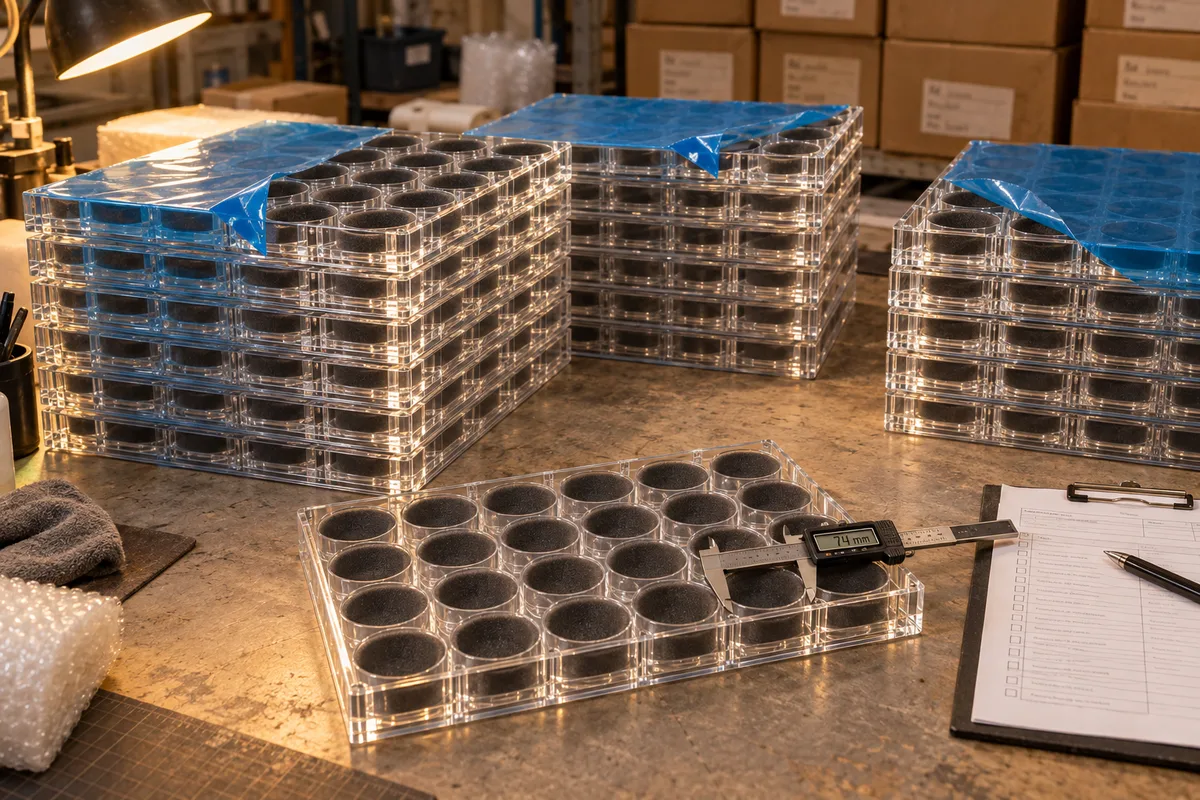
Fit was verified per batch with a 70 mm gauge disc — drop in, lift out with a pen, no fight either way — and flock coverage inspected pocket by pocket before packing. Two trays showed flock voids at final inspection and were replaced before the order shipped.
The Results
400 trays — 9,600 lined pockets — shipped after 16 production days from sample sign-off, with 2 trays pulled at inspection (0.5%) and replaced before packing.
The signal that mattered arrived at month 3: an add-on order of 250 trays, not for the original grinding-to-polishing route but for the coating line — the most contamination-sensitive station in the building, and the team that had asked the hardest questions about static and shedding. When the most skeptical department in the plant orders its own batch, the spec has passed its real audit.
"The flock pockets ended the transit scratches we had been writing off week after week. One millimeter of play means a vacuum pen lifts a blank straight out, and stacked trays never touch a lens surface. The 250-tray order for the coating line was an easy sign-off."
What This Means for Your Project
If your parts move between stations on trays — lenses, machined components, plated parts, anything where the surface is the value — the tray deserves the same spec discipline as the fixture that made the part. The two questions that shaped this project travel well: what touches the part(and what does that lining shed as it ages), and how much play does the pocket allow(measured with the actual pick tool in hand, not guessed). Both cost minutes to answer at the drawing stage and real money to discover on a QC report. Interprocess trays are quoted the same way as every othertray format we cut — one drawing, cutting files kept on file for the reorder.
The material honesty matters too. Acrylic brings real advantages to interprocess trays — it is rigid, dimensionally stable, easy to rout to precise pocket geometry, and you can see every part through it at a glance. It is not anti-static, and a supplier who claims otherwise is selling you a coating and a hope. Scope the tray around what the material actually does, add lining and protocol where it falls short, and custom acrylic trays hold up as process equipment — this buyer's month-3 reorder is the evidence we would point to.
Common Questions
Is acrylic anti-static? Will the trays attract dust?
Acrylic is not anti-static, and we did not sell it as such. PMMA charges triboelectrically — rub it during handling and it will attract dust for a while. The honest mitigation on this project was mechanical and procedural: flock lining where the lens contacts the tray, so charge has nowhere to act on the contact surfaces, plus the buyer's existing damp lint-free wipe-down before trays enter the coating area. A build that genuinely requires static-dissipative material is a different substrate, and we say so when asked.
Why flock lining instead of foam inserts for lens trays?
Foam inserts cushion well but shed particles as they age, and particles are exactly what a coating chamber cannot tolerate. Flock is a short fiber pile bonded into the routed pocket with adhesive — it presents thousands of soft contact points to the lens edge without a crumbling foam matrix. It also holds its dimension: the roughly 1 mm pile thickness is part of the pocket-fit arithmetic rather than a squishy variable.
How tight should a divider-tray pocket fit the part it carries?
Tight enough that the part cannot build momentum, loose enough that a tool can lift it straight out. On this order that meant a 74.0 mm routed pocket with about 1.0 mm of flock pile per wall, leaving roughly 1 mm of radial play around a 70 mm blank — enough for a vacuum pen, not enough to chatter on a transport cart. Terms were 30% deposit with the balance before shipment, FOB Shenzhen.
Moving delicate parts between stations?
Send us your part dimensions, your pick tool, and a photo of the tray you use today — we'll come back with a pocket-fit recommendation, a lining spec, and a quote.
Sample in 3–5 days · Production in 15–20 days · MOQ 100 pieces per design