

Case Study · Medical Devices · United States
New Artwork. Same Acrylic. Anatomy of a Program That Reorders Itself.
One of the longest-running repeat display programs on our books is also the shortest brief we receive: new artwork, same acrylic.
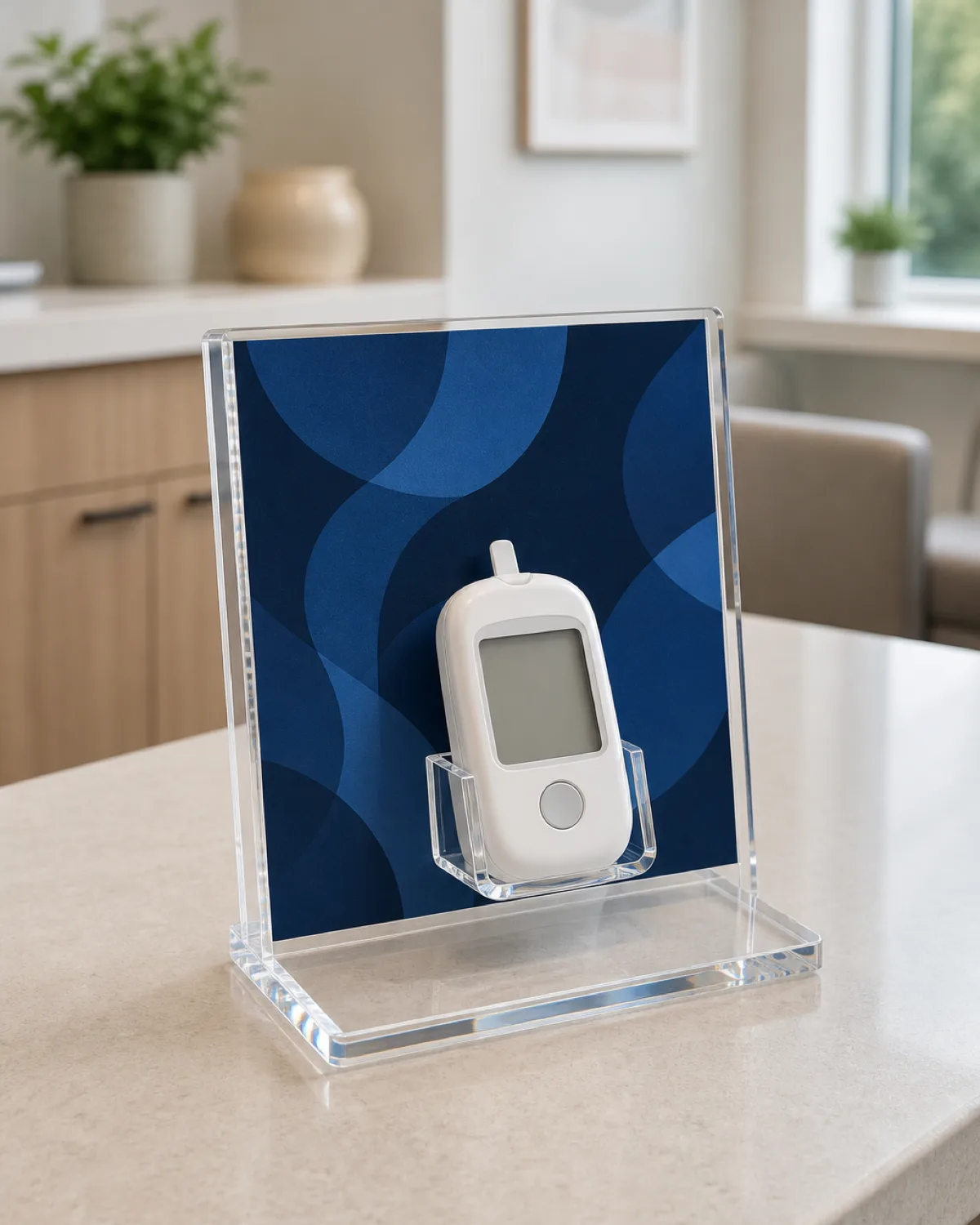
A US commercial printer resells our work to its medical-device client — one 6 x 6 in printed acrylic countertop display that has climbed from artwork revision C to revision H without the acrylic spec changing once. Across three production runs of 750, 1,500, and 1,500 displays, every artwork change was gated by physical proof samples, the unit price has held at $8.20 for 18 months, and the latest three-tier revision quote went out in two business days. As winter opened, Rev H was approved and the program rolled toward its next run.
- unit price held 18 months
- $8.20
- artwork revisions, one spec
- C to H
- displays across three runs
- 3,750
- to a 3-tier revision quote
- 2 days
Key Takeaways
- A US commercial printer has run one 6 x 6 in printed acrylic countertop display for its medical-device client through artwork revisions C to H — same acrylic, same fabrication, one spec — across nearly two years of orders.
- Every artwork revision passes the same gate: physical proof samples, client sign-off, then production. That gate caught a dark-blue-to-purple color drift at the sample stage, before a 1,500-unit run printed wrong.
- The Rev H revision quote covered 1,000 / 1,500 / 2,000 pieces at a flat $8.20 EXW, with air, expedited-sea, and standard-sea DDP freight priced side by side — delivered two business days after the request.
- The $8.20 unit price first quoted for the Rev G run held through the reorder and the Rev H quote 18 months later, through a new 10% tariff round the DDP terms absorbed.
- Repeat display programs get easier to run over time: no re-engineering, no new setup, material pre-ordered on request, and quotes written so a reseller can forward them to their client unedited.
The Challenge
The email that opens this case is five sentences long. Pricing for more product displays, please: 1,000, 1,500, 2,000. Will be Rev H — new artwork, same acrylic. Include air and sea freight and production time. Look forward to hearing from you.
A brief that short is not a small order. It is the visible tip of a repeat display program that has been running for nearly two years, and it only reads that way because everything underneath it has already been settled: the display, the material, the print method, the proofing routine, the freight lanes, the payment path. The buyer is a commercial printer in the United States. The end client — the company whose artwork is on the display — is a medical-device brand the printer has served for years. We build and print the displays; the printer manages the brand relationship; the brand approves every revision.
The product itself is deliberately unremarkable: a 6 x 6 in acrylic countertop display that stands the brand's device upright on a counter. What makes the program interesting is how the artwork behaves. Medical-device marketing does not tweak graphics casually — artwork moves the way engineering drawings move, under revision letters. This display carries a controlled part number, and over the life of the program its artwork has climbed from Rev C through Rev E, F, G, and now H. Each letter is a formal release: new files, new proof, new sign-off, and no production against anything older.
Three things made the program demanding in ways a one-off order never is:
- The artwork is the product. The acrylic has not changed since we standardized it. Every risk in the program lives in print: the wrong revision, a color that drifts, a file that will not separate cleanly. One earlier lot carried a printing issue the client did not forget — and it reset how every later run would be gated.
- Every approval travels two hops. We never speak to the medical brand. Samples go to the printer, the printer presents to the brand, feedback comes back down the same chain. A vague answer from the factory becomes a vague answer in front of the end client, so nothing we send can need translation.
- The program outlives its market conditions. Between the first run and the Rev H quote, raw acrylic prices moved, ocean freight moved, and a fresh 10% tariff round on Chinese goods was announced. A reseller cannot re-open its client pricing every time our side of the world shifts.
In other words, the job was never to win one order. It was to make a repeat display program so predictable that a five-sentence email is genuinely all the buyer ever needs to write.
Our Approach
Three habits carry this program: treating artwork revision letters with engineering-release discipline, quoting each revision in a form the printer can resell, and running the relationship at the reseller's pace instead of our own.
Treat the revision letter like an engineering release
When Rev F artwork arrived, the first thing our prepress check found was that the PDF was not a vector file — the previous revisions had been. We stopped and asked the printer's design team to re-export before we made anything. That is a one-day question, and it is much cheaper than discovering soft edges on a printed sample two weeks later. I would rather look pedantic at the file stage than apologetic at the proof stage.
Rev F itself was sampled — two physical demo units, shipped for review — and then never went to production: the brand updated the artwork again and the program moved to Rev G. That is the system working, not failing. A revision that dies at the sample stage costs a courier bill. A revision that dies after 1,500 units costs a production run.
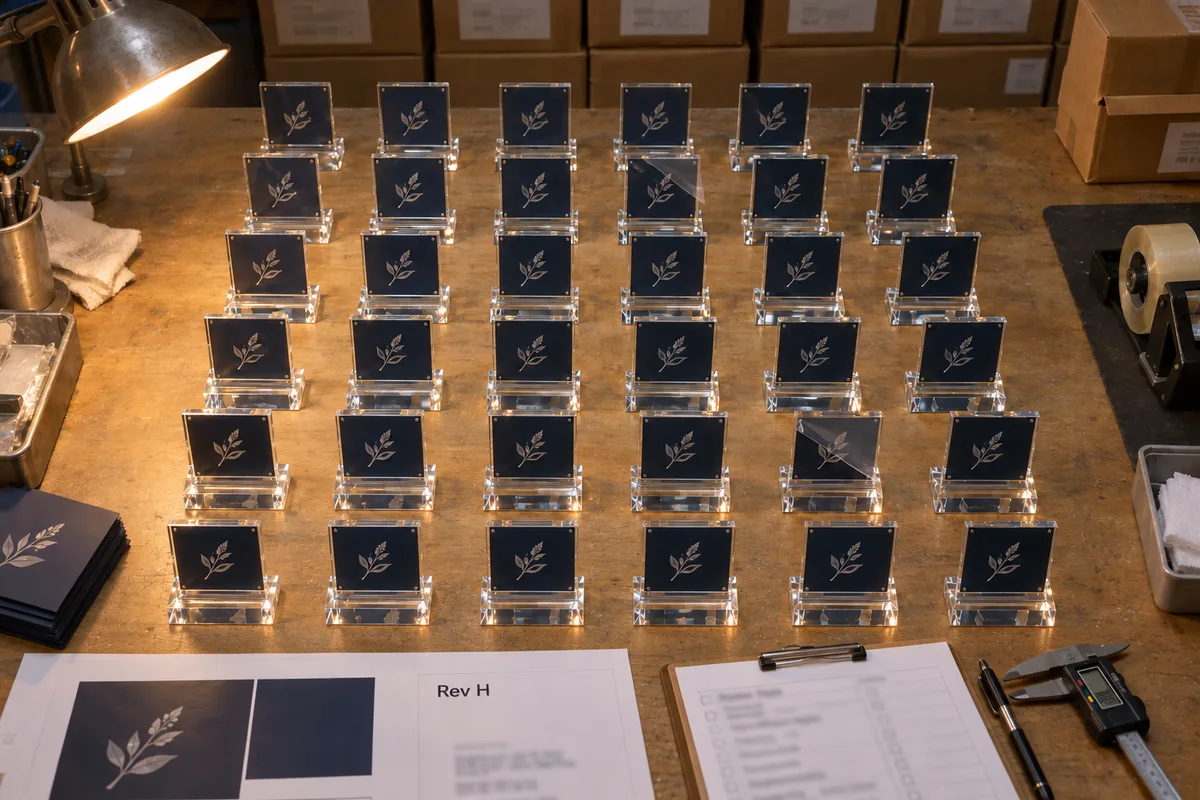
Rev G is where the discipline earned its keep. The first Rev G samples came back from the client's review reading more purple than the brand's dark blue — subtle in photos, obvious in person, and the client was comparing directly against printed lots from an earlier revision. We remade the samples against the earlier lot's color, shipped them, and got sign-off from the brand before the 1,500-unit run started. The drift was caught where it should be caught: on two sample pieces, not across a pallet of finished displays.
Since then the gate has applied to everything, including orders where the artwork did not change at all. When the printer came back for a straight Rev G reorder — same files, no revision — we still printed a sample for approval before running it, precisely because of that earlier printing issue. On the current Rev H order, the pre-production sample is again the first deliverable — sampling starts the moment the new artwork lands. If you resell printed work, this proof-gate choreography is the spine of the whole program — we wrote up the full routine in our pre-production sample approval checklist.
Quote the revision at three tiers, price the freight like a menu
The Rev H pricing request arrived on a Thursday, US time — the small hours of our Friday. The quote went back on Monday — two business days — and it is worth showing its anatomy, because a revision quote for a repeat program is a different document from a first-order quote.
| Quantity | Unit price (EXW) | Air freight (DDP) | Expedited sea (DDP) | Standard sea (DDP) |
|---|---|---|---|---|
| 1,000 pcs | $8.20 | $7,714 | $2,557 | $2,057 |
| 1,500 pcs | $8.20 | $11,142 | $3,542 | $2,900 |
| 2,000 pcs | $8.20 | $14,828 | $4,648 | $3,660 |
Two features of that table do the real work. First, the unit price is flat: $8.20 EXW whether the printer's client commits to 1,000 or 2,000 pieces. On a mature program there is no setup left to amortize — the cutting programs, jigs, and packaging spec were paid off runs ago, so at this size the 1,000-2,000 band sits on the flat part of the volume curve. We first quoted $8.20 for the Rev G run, held it through the reorder tiers, and held it again for Rev H a year and a half later. Why unit prices flatten as quantity bands mature — and where they do not — is exactly what our acrylic display stand cost guide at 100, 500 and 1,000 pieces walks through.
Second, the freight is a menu, not a number. Air lands in 11-13 days, expedited sea in 22-25, standard sea in about 35, and every option is quoted door-to-door DDP — duties and delivery included — at each quantity tier. The printer can put a complete landed-cost picture in front of its client in one forward, and choose speed against budget per order rather than per negotiation. We flag the one honest caveat on the quote itself: air rates move weekly, so the final air figure is confirmed one week before shipment rather than silently padded upfront.
Production for the Rev H run was quoted at 25-30 business days from artwork confirmation, longer than our standard 15-20 day window because this program's schedule carries the proof-sample gate and the printer's own approval round inside it. We also offered to pre-order the acrylic sheet ahead of the PO to compress the schedule — a low-risk commitment on our side, because the material spec has not changed since the program began.
Work at the reseller's pace, not ours
A reseller in the middle changes how a factory should communicate. Our buyer is not the user of the display, and our answers are rarely the final audience's answers — they get forwarded. So every substantive reply in this program is written to survive forwarding: complete sentences, numbers in context, no factory shorthand the printer would have to decode for its client. How proof approvals and revision letters should flow when a reseller sits between factory and brand is a discipline of its own, and this program treats it as part of the spec rather than an afterthought.
It also changes when we speak. When the 10% tariff round on Chinese goods was announced, I wrote to the printer before they asked: because the program ships door-to-door DDP with duties included, the agreed prices would not move, and if a genuinely extreme round arrived later we would work out how to share the burden rather than hand it over. The printer could forward that reassurance upstream as-is. When raw acrylic prices climbed sharply one spring, we flagged it early so a pending order could be confirmed against locked material pricing. And when a quote had been sitting quietly for three weeks, I sent a short status note; the reply came back within two hours — Rev H had been approved, the new artwork had reached the printer late the previous day, and the order details were being prepared that same day.
None of that is glamorous. It is scheduled attentiveness: nudge at decision points, absorb volatility where the terms allow it, and keep the payment path — invoice to the printer's accounting contact, deposit before production — identical from run to run. The printer owns its client relationship end to end; our job is to make the manufacturing layer so quiet that the brand never has a reason to ask who is behind it.
The Results
As winter opened, the printer's account team confirmed the outcome every supplier wants from a revision cycle: Rev H approved, artwork inbound, order to follow — the program's next run, on the same acrylic spec it started with.
The numbers that matter here are the boring ones. A unit price that survives 18 months, a tariff round, and a material-cost swing is not a discount strategy — it is what lets a reseller quote its own client without re-litigating margin every cycle. A two-business-day revision quote means the printer answers its brand while the question is still warm. And 3,750 displays across three runs, with every artwork change proofed on physical samples before production, is the track record that turned a complex first order into a five-sentence reorder email.
The color-drift catch deserves its own line in the ledger. Had those first Rev G samples gone straight to production, 1,500 displays would have shipped in a blue the brand would have rejected on sight — with a reseller's reputation, not just ours, attached to the pallet. The proof gate cost a remade sample and a few days. That trade is the entire argument for running repeat display programs on discipline instead of momentum.
"Rev C to Rev H on the same display, and Wetop confirms which revision is live before anything prints. New-rev quotes come back in two days with air and sea options priced out, and our client signs off on a physical sample before every run."
What This Means for Your Project
If your display program lives in a regulated or brand-controlled world — medical, pharma, finance, any client whose artwork moves under revision letters — the supplier question is not who quotes the lowest first unit. It is who still behaves well on revision six.
Two things are worth probing before you commit a program. First, ask what happens when the artwork revs: does the supplier confirm the revision letter before quoting, gate every change behind a physical proof sample, and check your files before printing from them — or does new artwork simply overwrite old artwork on a server? Every failure in this story's category — stale files, color drift, un-vectored art — is invisible until it is expensive, and all three were caught here at the sample or file stage. Second, ask whether their quote can travel. A reseller needs tiered quantities, freight modes priced side by side, DDP terms that absorb tariff noise, and language clean enough to forward. A quote that needs a cover letter of explanations is a quote that slows your own client down.
This program runs on our standard custom acrylic display fabrication — the same countertop formats, printing, and finishing we build for retail and showroom buyers — pointed at a client whose real requirement was procedural, not structural. If you are a printer, agency, or distributor carrying a brand's display program, that is the version of us you would work with: we stay in the manufacturing layer, you own the client, and the custom acrylic fabrication process starts from whatever your program already has — a controlled part number, a rev letter, and the words "same acrylic" are enough.
Running a display program that revs its artwork?
Send us the current revision — or just the part number, quantity tiers, and where it ships. We'll come back with a tiered EXW quote, a DDP freight menu, and a proof-sample plan before anything prints.
Proof samples in 3-5 days · Standard production 15-20 days · Air and sea DDP options on every quote