Delivered Project · Beauty & Fragrance · UK to US
Laser Etched Acrylic Perfume Trays for a Brand Agency
A UK brand agency needed 300 laser etched acrylic perfume trays for a fragrance client, built from 4 mm clear cast acrylic and shipped DDP by air to its US fulfilment office. The first quote went out in one day, the agency dropped the dividers and enlarged the tray six days later, two plain samples reached the UK before the artwork existed, the order was paid in full 20 days after the first email, and the trays left by UPS in six cartons 15 days after that.
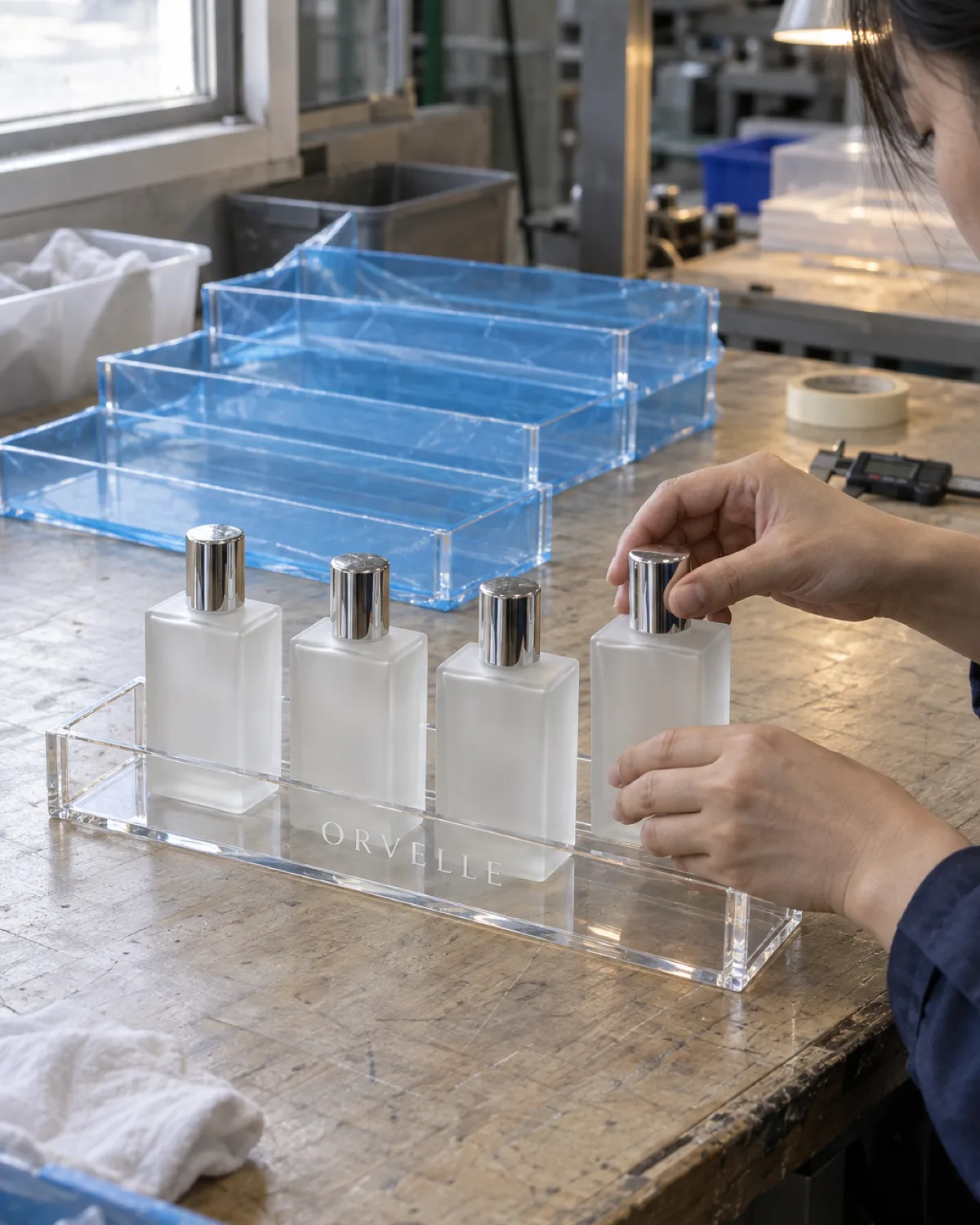
- trays shipped
- 300
- clear cast acrylic
- 4 mm
- inquiry to first quote
- 1 day
- inquiry to paid order
- 20 days
Current ordering baseline
MOQ is 100 pieces per design. Paid samples normally take 3–5 days; sample fees are paid separately and never credited. Standard production takes 15–20 days after drawing, material, artwork, packing, and sample approval. Wetop responds to a complete brief within 24 hours.
Price context for this project: the bare four-bottle tray quoted in the USD 2.5–3.0 per piece band, and the four-compartment version in the USD 3.0–3.5 band, at the agency's quantity. Those bands belong to this size, thickness, and artwork; a different tray gets its own written quote.
Key Takeaways
- Dropping the three bonded dividers took about 20% off the unit price and about 50 mm off the overall tray width, and left the bottle line-up free to change.
- Laser etching cost about USD 0.14 a piece more than one-color silkscreen on the final tray; the agency chose etching for depth and asked for it on one long face only, so front and back are unmistakable.
- Two plain, un-etched pre-production samples left the factory five days after the revised size and reached the UK two days later, so the agency could prototype its retail box while the artwork was still with the client.
- DDP air cost roughly 1.5 times the goods value against a sea quote near a quarter of it, but only air could reach the US office by the agency's early-October date.
- First inquiry to paid order took 20 days, the invoice was settled the same day the artwork arrived, and the 300 trays shipped by UPS in six cartons 15 days after payment.
The Challenge
The inquiry arrived through our quote form in late August from the project lead at a UK brand agency. The agency was building a launch for a fragrance client and needed a branded tray that would hold four bottles side by side, sit inside a retail box, and in the end ship not to the UK but to the agency's own fulfilment office in the United States. Each bottle measured about 60 mm wide, 45 mm deep, and 115 mm tall, and the first brief asked for a tray of roughly 240 × 55 × 40 mm inside.
The brief had three open questions, and the agency was honest about all of them. First, should the tray have three dividers so each bottle sat in its own compartment, or should it be a bare tray? They wanted a price for both. Second, they liked the look of a laser-etched logo on the front face but were open to other finishes if one made more sense. Third, they asked for quantity pricing from 200 to 350 pieces and whether a larger run would bring the unit price down.
What made the project tighter than a normal tray order was the calendar. The agency needed a physical sample in the UK by 4 September to prototype the retail box that the tray would sit in, and it needed the full quantity at its US office by early October for the launch. Those two dates, on two continents, drove every later decision about size, sampling, and freight. The artwork, meanwhile, was still with the fragrance client and would not be final until the last possible moment.
I see this shape of brief two or three times a month: a clear product, an unfinished logo, and a launch date that is not moving. The way to keep it on schedule is to separate the decisions that need the artwork from the ones that do not, and to quote every option on the same day so the buyer can decide in one sitting.
Our Approach
I quoted both constructions the next day, both from 4 mm clear cast acrylic with bonded, polished corners. The bare tray was priced in the USD 2.5–3.0 per piece band and the four-compartment tray, with three 3 mm dividers, in the USD 3.0–3.5 band. One unit price applied to the whole quantity range the agency had asked about, because on a tray this size the cost difference between 200 and 350 pieces is inside the rounding, and I would rather say so than invent a ladder. At that first size, laser etching and one-color silkscreen were offered at the same price, with a one-line explanation of what each looks like.
Spec at a glance
Bonded dividers or a bare tray
Dividers solve one problem and create two. They fix each bottle in position, which matters if the tray travels full or if the brand wants the bottles spaced exactly. But three bonded 3 mm dividers added about 25% to the unit price, and the compartment clearances pushed the overall tray about 50 mm wider than the bare version. A wider tray means a wider retail box, more board, and a bigger carton, so the divider cost does not stop at the tray line.
The agency's client also had not fixed its bottle line-up for good. A bare tray lets the brand swap a bottle shape next season without re-tooling the tray, while a divided tray locks the layout to the bottles it was drawn around. When the agency came back six days later with a revised brief, the dividers were gone and the inner size had grown from 240 × 55 to 264 × 65 mm to give the four bottles a little more air. We re-quoted the same day and the unit price stayed in the same band. The vanity-tray page covers thisbare tray, bonded divider, or removable insertchoice in general terms; this order is what it looks like on a real launch.
Laser etching on one face, not two
On the first tray size etching and silkscreen cost the same, and on the larger revised tray etching came in about USD 0.14 a piece higher, so the choice was mostly about how the mark reads. Laser etching removes a thin layer of acrylic and leaves a frosted, slightly dimensional wordmark that catches light and cannot wear off because there is no ink. One-color silkscreen sits on the surface and gives a sharper, flatter edge, which suits fine type. The agency chose etching for the depth, which is the answer most fragrance brands give when they see both on a sample.
When the artwork arrived we asked one question before cutting anything: one long face or both? The agency answered within the hour. One side only, because it wanted a clear distinction between front and back. A four-bottle tray is symmetrical, and if both long faces carry the mark, the person packing it has no way to tell front from back. One etched face makes the front obvious to the packer, the merchandiser, and the customer, at no extra cost. The logo file arrived from the client on 9 September at 74 × 28.5 mm, and we placed it centered on the front face with a safe margin from the rim. If you are weighing the same options, our guide to acrylic tray logo optionswalks through etch, print, and insert side by side.
A plain sample, sent before the artwork existed
The agency's first hard date was not the launch; it was the retail box. The box maker needed the tray's exact outer dimensions to cut the board, and the agency wanted to check by hand that the tray, four bottles, and box worked as one object before committing to the print run. None of that needs a logo. So instead of waiting for the client's artwork, we shipped two plain, un-etched pre-production trays by UPS express five days after the revised size was agreed, and they were in the agency's hands two days later, ahead of its 4 September date.
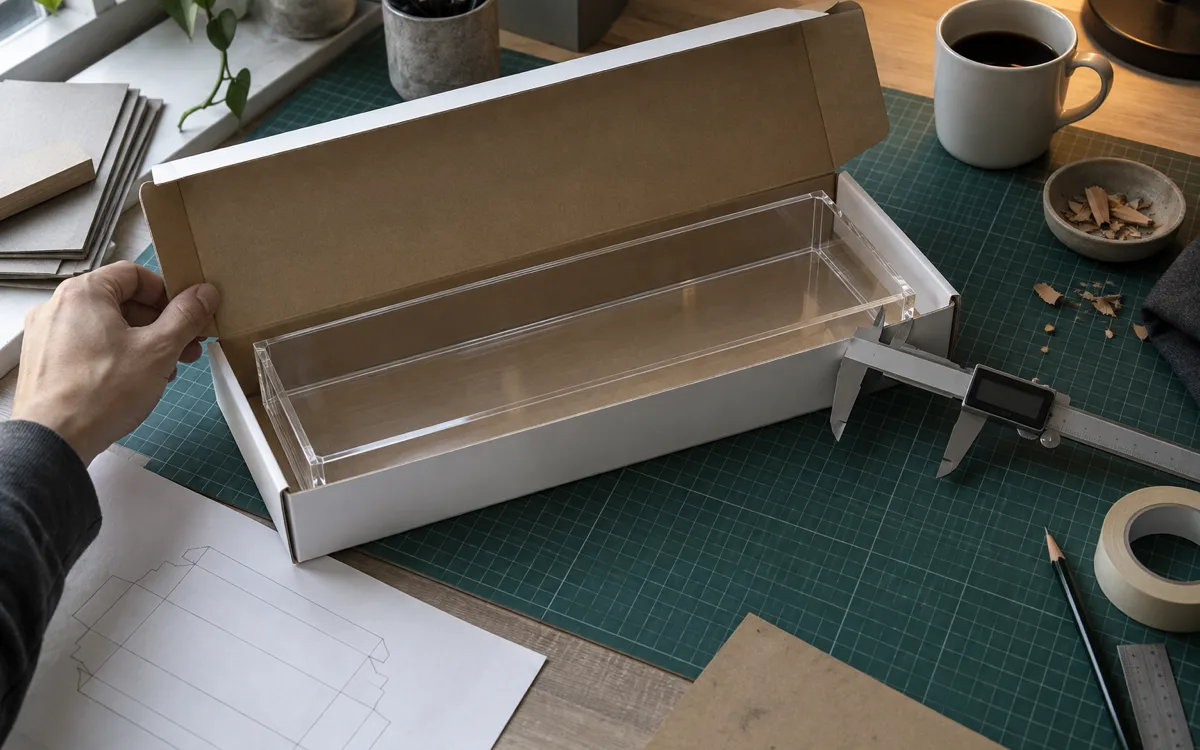
The agency's verdict on the plain samples was that they looked great and the team was "really impressed with the quality." It is worth being precise about what those samples proved: the revised inner size against the real bottles, the outer size for the box maker, and the polished edge quality the agency would show its client. What they did not prove was the etched mark. For that, we made an etched pre-production tray once the logo arrived and sent four photos, including a close-up of the logo. The agency approved them the same morning and the full run went ahead. Splitting the sample that way is what kept the September dates. Ourpre-production sample approval checklist lists the same checks in order.
A third idea we asked to see drawn first
Midway through, the agency floated a third design: a raised inner platform with four angled apertures that would tilt each bottle back toward the customer. It is a good-looking idea, and we did not turn it down. We asked for a dimensioned side view or a simple 3D file before pricing it, because the words "15 degrees" can mean the bottle leans back or the aperture is rotated in plan, and the two are built in completely different ways. The agency decided the bare tray already did the job and the platform did not move forward. Asking for the drawing cost one email and saved a quote that would have been wrong in one of two directions.
Sea to the UK, air to the United States
Freight on this order was quoted more than once because the destination changed once. The agency first asked for delivery to the UK, so we priced DDP sea to its door, duties included, at roughly a quarter of the goods value on a 50–60 day transit. Then it asked for an express option as well, and finally confirmed that the full quantity would go to its US fulfilment office by early October. Only air could make that date. DDP air to the US office came to roughly 1.5 times the value of the trays themselves, door to door in about 12–15 days.
The number that surprises buyers is not that air is expensive; it is that on a small, light, low-priced product the freight can be larger than the goods. That is normal, and it is not a reason to choose sea when the launch is fixed. It is a reason to get the freight quote at the same time as the product quote, so the total lands on the table once. If you are choosing between terms rather than modes, our guide onFOB versus DDP for acrylic orders explains who carries which cost.
The Results
Twenty days after the first email, the agency had approved the plain samples, received the client's logo, confirmed 300 laser etched acrylic perfume trays, and settled the invoice in full the same day. The etched pre-production tray was approved on photos six days later, and on 24 September the 300 trays left by UPS air in six cartons for the agency's US fulfilment office, where the goods-in team was told to expect them.
Two things in that table matter more than the quantity. The first is the sample gate: the tray that the box maker measured, the tray the agency showed its client, and the trays that shipped are the same drawing revision. The second is the payment pattern. A first-time buyer settling in full on the day the artwork arrives is the clearest signal an account manager gets that the quote answered every question, because there was nothing left to negotiate.
Buyer decision point: the agency approved the tray on a plain sample before the artwork existed, then approved the etched logo on pre-production photos, so neither approval waited for the other.
What This Means for Your Project
If you are an agency or a brand team specifying a branded tray for a fragrance or beauty launch, this order is a useful template because it separated the decisions cleanly. Size and layout were settled against the real bottles and the real box. Branding was settled on a proof once the artwork was ready. Freight was settled against the launch date, not against the cheapest line on the quote. None of the three waited for the others.
You can expect the same shape of quote from us: both constructions priced side by side, etching and silkscreen at their real prices, and sea and air on the same table with duties included, all within a day of a complete brief. Production starts from 100 pieces per design, and a paid pre-production sample normally takes 3–5 days, with the fee paid separately and never credited; on this order the plain samples went out five days after the revised size was agreed. If your tray is one part of a larger counter program with risers and tester stands, thecosmetics and perfume display page covers the vertical fixtures, and the custom acrylic trays hub covers every tray format we build.
What to send us to get the first quote right the first time: the tallest and widest bottle, the number of bottles per tray, whether the tray ships full or empty, whether a retail box has to fit around it, the destination address, the launch date, and the artwork status even if the file does not exist yet. With those seven items I can quote a tray like this one in a day and tell you honestly whether sea or air fits your calendar.
Common Questions
The answers below come from the decisions made on this order and apply to most four-bottle tray programs.
Should a four-bottle acrylic perfume tray have bonded dividers?
Only if each bottle must stay in a fixed position. On this project, three bonded 3 mm dividers added about 25% to the unit price and about 50 mm to the overall width, so the agency chose a bare tray and kept the freedom to change the bottle line-up later. Compare both constructions on the same size, material, branding, and quantity before deciding.
Is laser etching or silkscreen better for a logo on a clear acrylic tray?
On the first tray size the two methods priced the same; on the revised, larger tray etching came in about USD 0.14 a piece above silkscreen. So the choice is mostly visual. Laser etching removes material and leaves a frosted, dimensional mark with no ink to wear; one-color silkscreen gives a sharper, flatter edge. The agency chose etching on one long face only so the front and back of the tray are never confused.
How does air freight compare with sea on a 300-piece acrylic tray order?
On this order the DDP air quote was roughly 1.5 times the value of the trays, while DDP sea was near a quarter of it. Air ran about 12–15 days door to door against 50–60 days by sea. A fixed launch date decides the mode; if the calendar allows sea, the freight line drops to a fraction of the air figure.
Specifying a branded tray for a fragrance launch?
Send the bottle dimensions, bottle count, destination, launch date, and artwork status. We will quote the tray with and without dividers, etching and silkscreen, and sea and air on one table within a day.
Paid sample in 3–5 days, paid separately and never credited · Production in 15–20 days · MOQ 100 pieces per design