



Delivered Project · Print-on-Demand · Canada
Three Purchase Orders, Three Inspection Passes
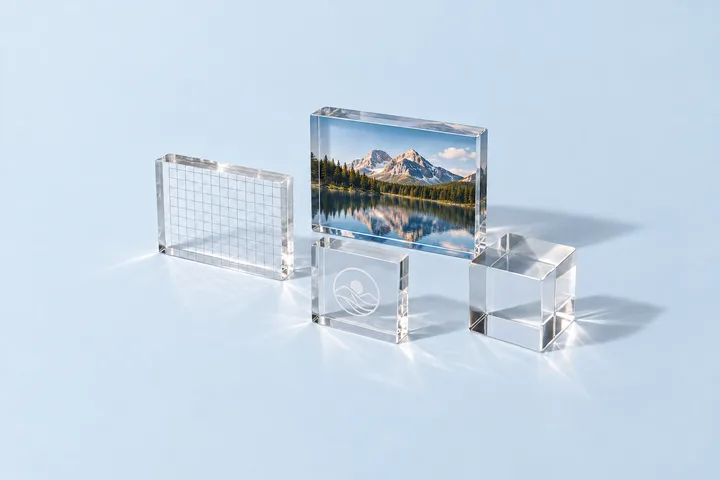
A Canadian print-on-demand platform buys blank acrylic photo blocks from us and prints customer photos on them at its own plant. Each order ships only after a third party inspection booked by the buyer passes. In 2026 we built 17,370 blocks in four sizes on three purchase orders. The independent inspector passed all three lots and found no critical or major defects.
- blocks on three POs
- 17,370
- third-party lots passed
- 3 of 3
- critical or major defects
- 0
- export cartons
- 771
Ordering a similar project
MOQ is 100 pieces per design. Paid samples normally take 3–5 days; sample fees are paid separately and never credited. Standard production takes 15–20 days after the size, thickness, tolerance, packing and sample are approved. Third-party inspection by the agency you appoint is welcome on any order. Wetop responds to a complete brief within 24 hours.
Key Takeaways
- A Canadian print-on-demand platform bought 17,370 blank acrylic photo blocks in four sizes, 4×4, 4×6, 5×7 and 6×6 in, on three purchase orders shipped in June, July and September 2026.
- Each lot left only after a buyer-booked final random inspection by an independent inspection agency passed: 200 blocks sampled under ANSI/ASQ Z1.4 level II, AQL 1.0 major and 4.0 minor, no critical defect allowed.
- Across 600 inspected blocks the inspectors recorded 0 critical, 0 major and 13 minor defects (3, 5 and 5 per lot) against an allowance of 14 minor per lot.
- The buyer's spec holds length and width to ±0.2 mm and accepts 23.5–26.5 mm in thickness; we sort every block into three labelled thickness bands on the master cartons.
- Order to export release took 24, 34 and 27 days. New photo-block designs start at 100 pieces per size, with a paid sample that is never credited to production.
The Challenge
The buyer runs an online photo-gift business with a print plant in Canada. Customers upload a photo, the plant prints it onto a clear acrylic block, and the block ships to the customer within days. The blocks reach the plant blank. Our job is the substrate: a polished 25 mm block in four sizes, made to a specification the buyer wrote and controls.
The buyer's procurement team wrote that specification. It fixes length and width to ±0.2 mm, sets a thickness window of 23.5 to 26.5 mm, gives a weight range for each size, and states how many blocks go in a carton, how heavy a pallet may be, and what a carton label must show: the buyer's name, PO number, batch number, weight, quantity and country of origin. The blocks go from the carton into the buyer's own print process, so the spec covers the carton as closely as the block.
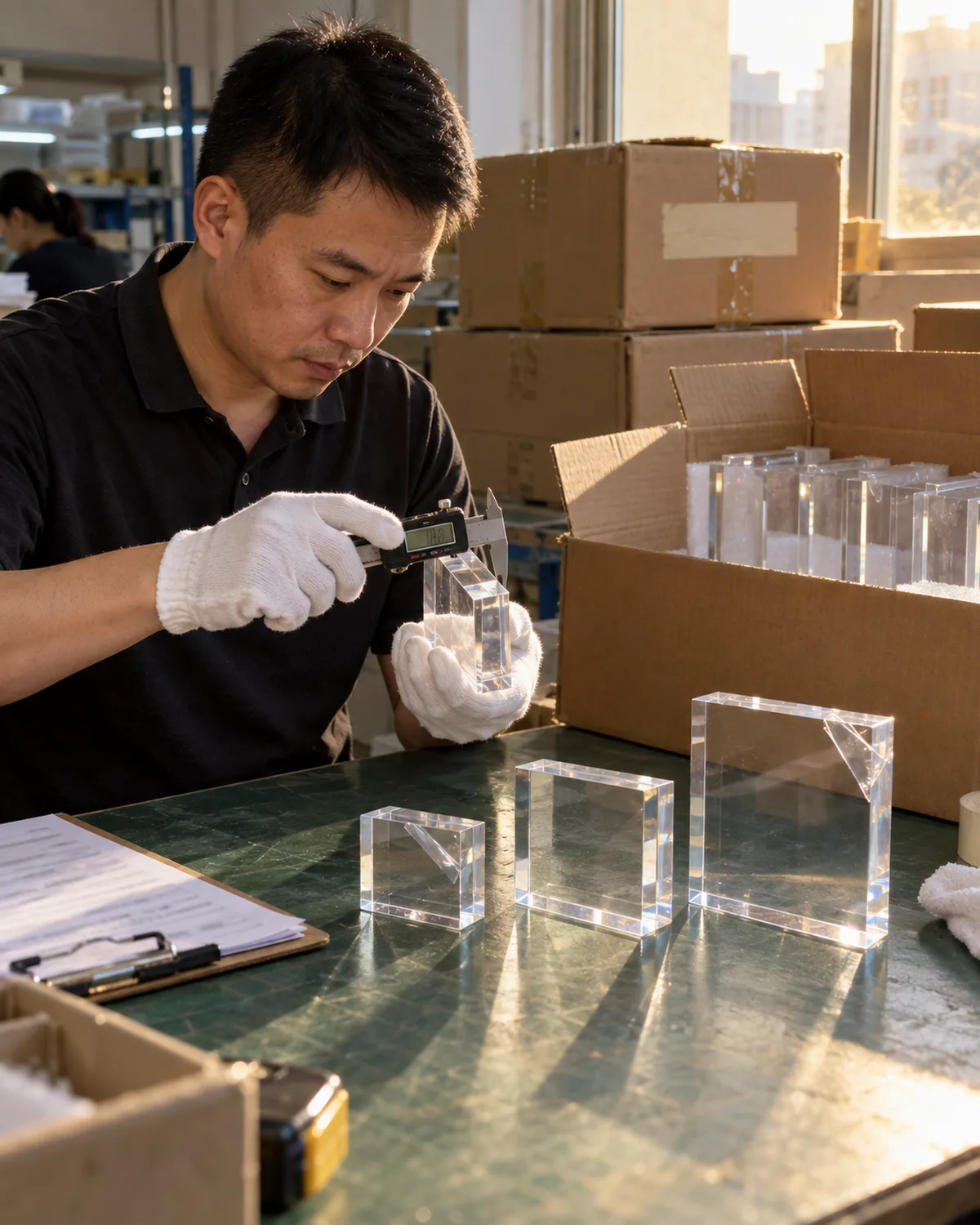
The buyer also does not take our word that a lot meets that spec. Before each purchase order can ship, the buyer books an independent inspection agency for a final random inspection at our factory. The inspector draws 200 blocks from randomly opened cartons and judges them under ANSI/ASQ Z1.4 at inspection level II. No critical defect is allowed, and the limits are AQL 1.0 for major defects and AQL 4.0 for minor ones. A failed lot does not leave. It is reworked, a new inspection is booked, and the sailing is missed. On three orders in four months, a single failure would have delayed that shipment.
Our Approach
We planned each lot so that by the time the inspector arrived, every question on the report had already been answered by our own final check, and the lot was packed exactly as the specification describes.
One spec on file, reused on every PO
The dimensional inspection specification for the four sizes was written for an earlier order in this program and approved by the buyer. All three 2026 purchase orders used it unchanged, along with the same carton counts and label layout. Nothing was re-described from memory or re-measured from a photo. When the third order was revised to 6,450 blocks four days after it was issued, only the quantity changed. The spec, labels and packing stayed the same. Our repeat-order change control checklist lists the fields that tend to drift between orders and which approval each change reopens.
Thickness sorted into labelled bands
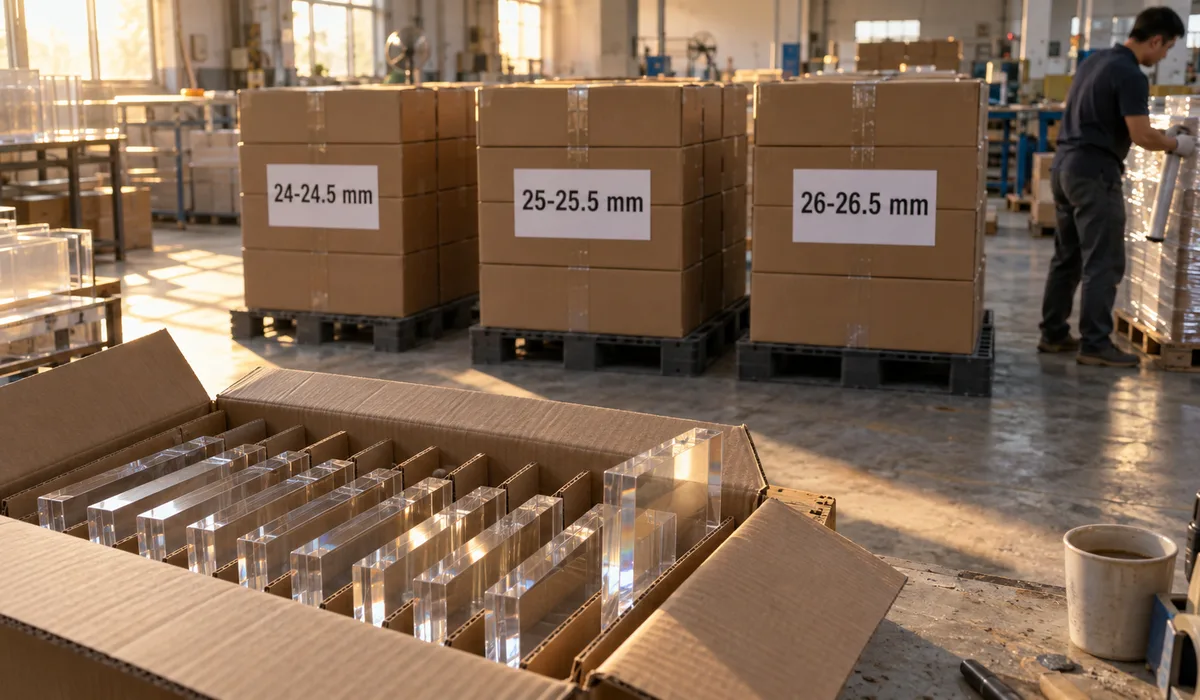
Cast acrylic block varies in thickness, so a nominal 25 mm block can measure anywhere inside the buyer's 23.5–26.5 mm window. Rather than ship a mixed carton, we measure and sort every block into one of three bands and mark the band on the master carton: 24–24.5 mm (blocks measuring 23.5 to 24.5), 25–25.5 mm (24.6 to 25.5) and 26–26.5 mm (25.6 to 26.5). A block measuring exactly 25.6 mm goes in the 26–26.5 mm band. The receiving plant knows the band of a carton without opening it. The inspector measures three blocks per label and per size, and finds each carton already matches what it says.
Our own check comes first
Every block passes our own final inspection before the third-party visit: polished faces and edges, surface marks, length, width and thickness, then carton count and label. A supplier audit carried out for this buyer in late 2025, before these orders, led us to revise our final-QC record format, and that record is filled in for every lot. The third-party inspector does not see it as a substitute for their own sample. It is the reason we can book the visit with confidence.
Book the visit when the lot is packed
For each PO we sent the buyer's booking form with the lot details and a date on which every block would be finished and packed. On all three visits the inspector found 100% of the quantity packed in cartons. That matters because a final random inspection only means something on the shipment as it will leave. The inspector chose which cartons to open (12, 19 and 18 cartons on the three visits), measured blocks and cartons, weighed them, and checked shipping marks, labels and assortment. Our pre-shipment inspection guide explains how to time and scope a visit like this on your own order.
Spec at a glance
The Results
All three lots passed their third-party final inspection on the first visit, and each shipment was cleared for export within two days of its inspection. In total the program shipped 17,370 blocks in 771 cartons.
A buyer reading an inspection report should know what "minor" means on an acrylic block, so here is the full list. Across 600 sampled blocks the inspectors recorded small black dots of about 1 mm on a block surface, a light surface scratch of 3 to 5 mm on two blocks, and a white mark of about 1 mm. Each lot was allowed up to 14 minor and 5 major defects. The lots came in at 3, 5 and 5 minor and none major. There is still something to improve on surface cleanliness, and we track it lot by lot.
For the print plant, the result is predictable stock: the same four sizes, the same carton counts, cartons labelled by thickness band, and a third-party report on file for every lot before it was loaded.
Project note: If the buyer books the inspector, our own final check has to be complete before the booking form goes out. Sort, count and label first, then let the third party confirm it.
What This Means for Your Project
If you buy acrylic photo blocks, or any acrylic part, against your own specification, and you release payment or shipment on a third-party report, this program is the pattern to ask for. You need three things from the factory.
A written spec that both sides reuse. Tolerances, weights, carton counts and label content belong in a document that every PO references. Then the repeat order is a quantity change and not a new description.
A plan for natural variation. Thick cast acrylic varies. Agree on the acceptance window and on what happens inside it, such as sorting into bands, before production starts.
Inspection timed to a packed lot. Book the visit for the day the shipment is complete and packed, and expect the factory's own inspection to come before it. Our guide on acrylic block defects and claims covers what counts as a defect on a block and how a claim is documented.
We make blank and printed custom acrylic photo blocks from 100 pieces per size, with a paid pre-production sample before the first run. The repeat print-lab photo block program shows a different buyer and a different freight plan, and the acrylic block range lists the other block types we build.
Common Questions
Three questions buyers ask when they plan a third-party inspection on an acrylic block order.
What does a third-party final inspection check on an acrylic photo block order?
On this program the buyer booked a final random inspection for each purchase order once every block was packed. The inspector drew 200 blocks from randomly opened cartons and checked them under ANSI/ASQ Z1.4, inspection level II, with no critical defects allowed, AQL 1.0 for major defects and AQL 4.0 for minor ones. The same visit measured block size and thickness, block and carton weight, carton size, shipping marks, labels, packing and the quantity per carton. All three lots passed with no critical or major defects.
Why sort acrylic photo blocks into thickness bands?
A 25 mm block is not exactly 25 mm. This buyer accepts 23.5 to 26.5 mm, and inside that window we sort every block into one of three bands and mark the band on the master carton: 24–24.5 mm, 25–25.5 mm or 26–26.5 mm. The receiving plant can see the band of a carton before opening it. Sorting happens at our final check, so the third-party inspector finds cartons that already match their labels.
Who books the third-party inspection?
The buyer. On this program the buyer appointed the inspection company and we filled in the booking form with the lot details and a date when every carton would be packed. You can do the same on any Wetop order: book the agency you trust, and we schedule the visit once production is finished and packed. Our own 100% inspection happens before that visit, so the third-party check confirms a lot we have already checked.
Buying photo blocks against your own spec?
Send your sizes, thickness and tolerance, carton and label requirements, and how you inspect before shipment. We will confirm what we can hold, how we sort and pack, and a written quote for a paid sample and the first run.
Paid samples in 3–5 days · Fees paid separately and never credited · Production in 15–20 days after approval · MOQ 100 pieces per design · Response within 24 hours