





Case Study · Lab Supplies · United States
600 Tube Racks, Three Hole Sizes, One Honest "No"
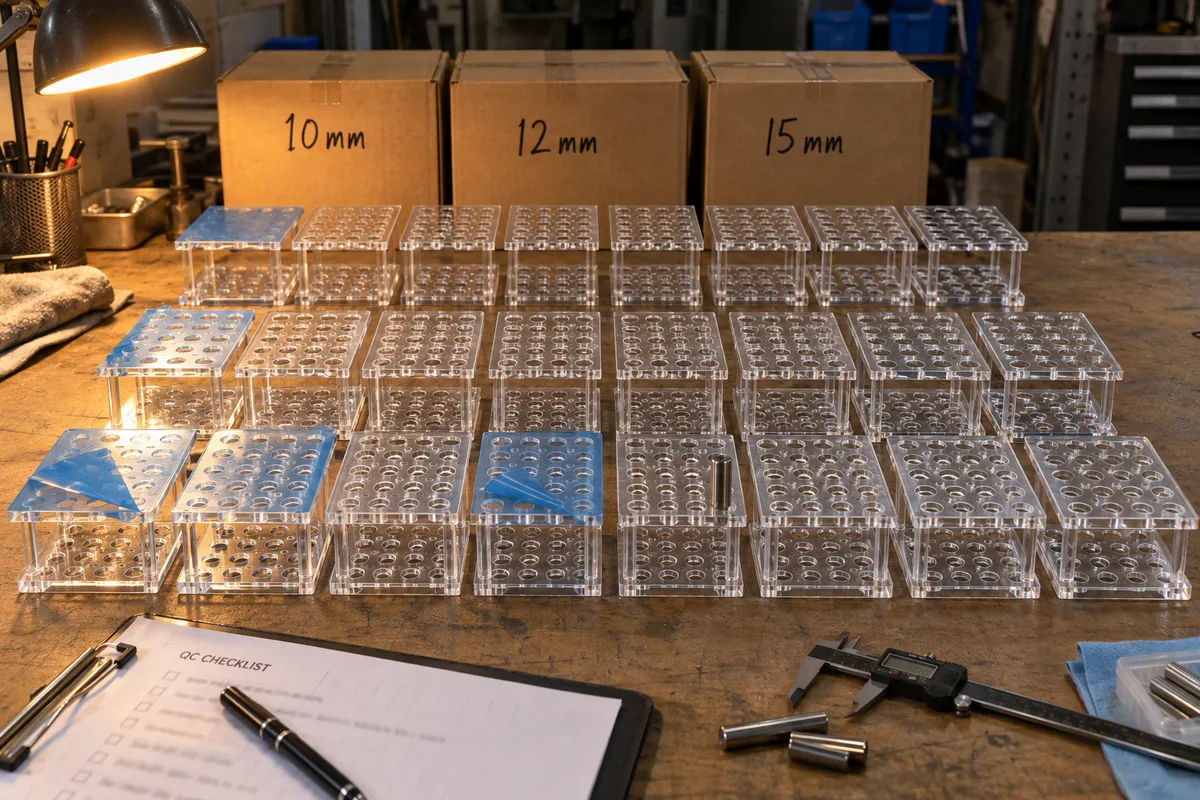
A US lab-supplies distributor ordered 600 custom acrylic tube racks for a private-label benchware line, in three hole sizes for 10, 12 and 15 mm tubes.
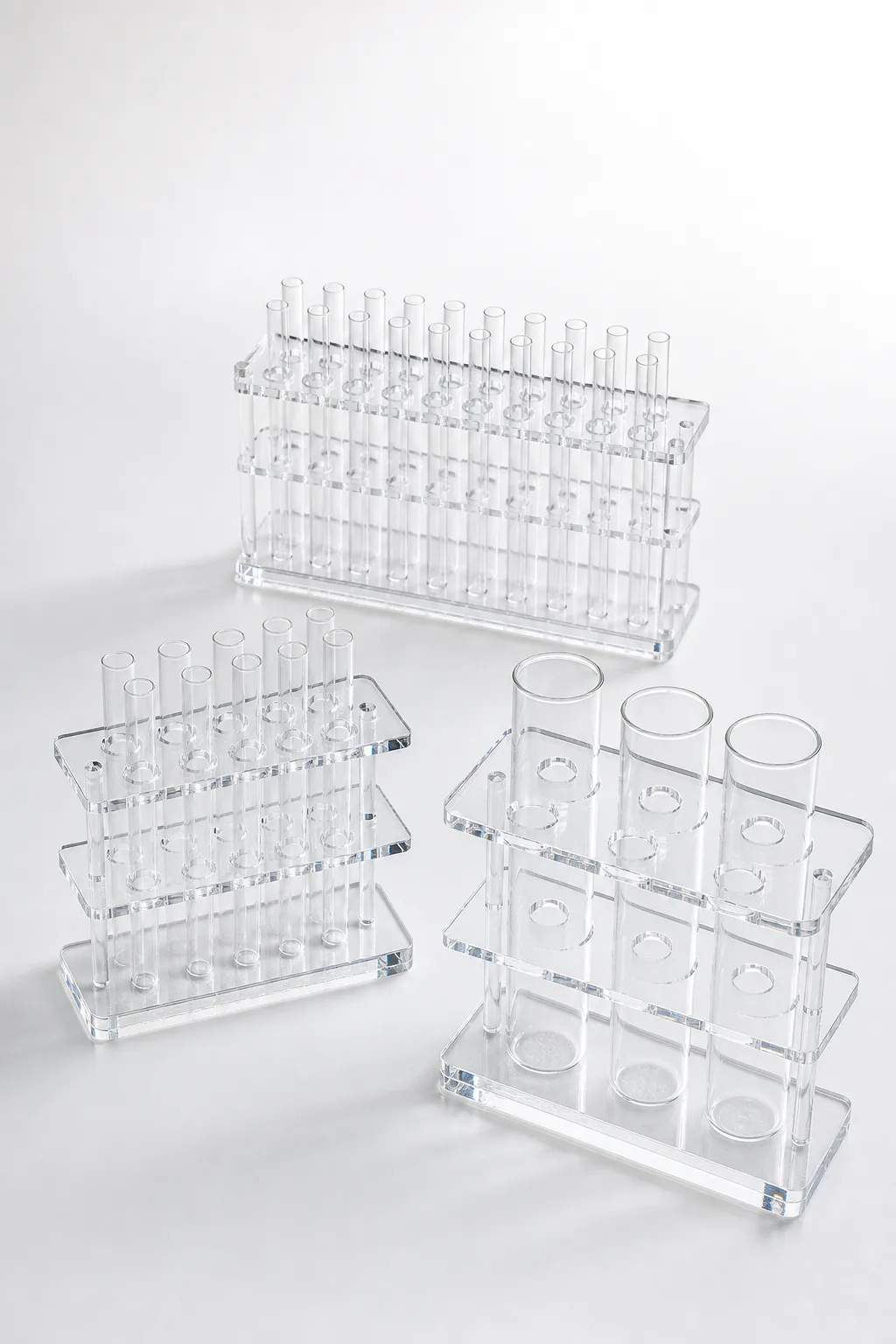
Slip-fit clearance widens with diameter; the run took 17 production days. The SKU we refused to build — an "autoclavable" acrylic rack — is the reason the repeat order for 600 more released at month 3.
- racks shipped
- 600
- hole-size SKUs
- 3
- production time
- 17 days
- repeat PO month 3
- +600
Key Takeaways
- An "autoclavable acrylic" SKU should be refused, not priced — PMMA softens around 100°C, below the 121°C cycle.
- Acrylic racks are for room-temperature benchwork and chemical-wipe disinfection (70% isopropyl, dilute bleach) — not steam sterilization, and not acetone, which crazes the surface.
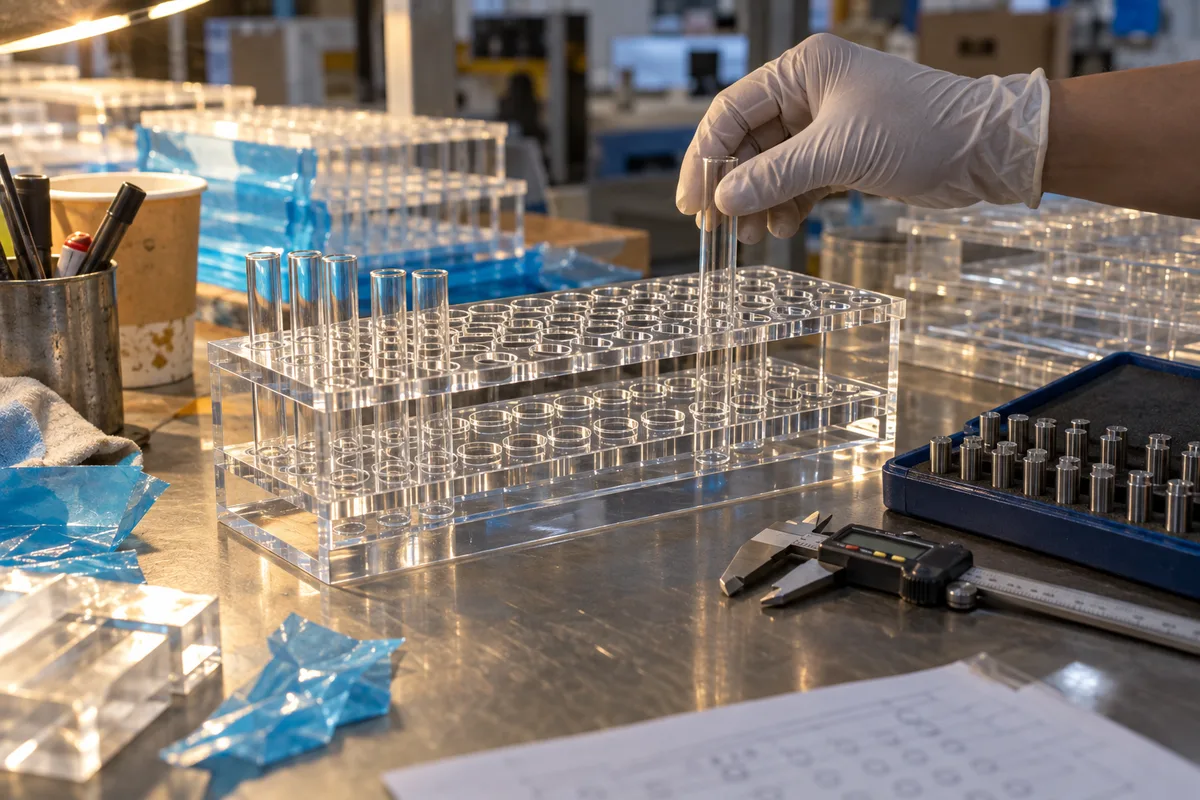
- Slip-fit clearance must widen with tube diameter because tube OD variation grows with size: 0.4 mm on 10 mm tubes, 0.5 mm on 12 mm, 0.6 mm on 15 mm, all cut at +0.1 / −0 mm.
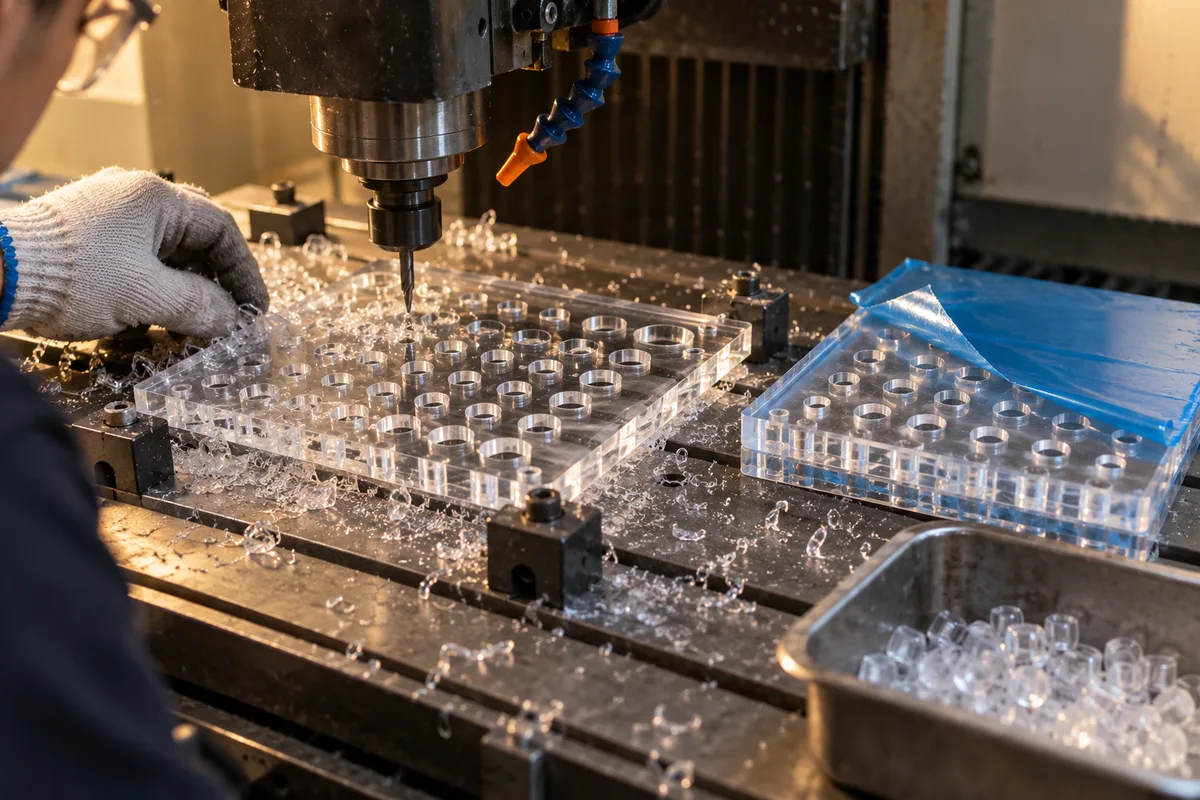
- Two drilled plates over a cemented base keep 50 tubes vertical per rack — the top plate guides, the mid plate registers, and the tube tip never scrapes a hard edge on the way down.
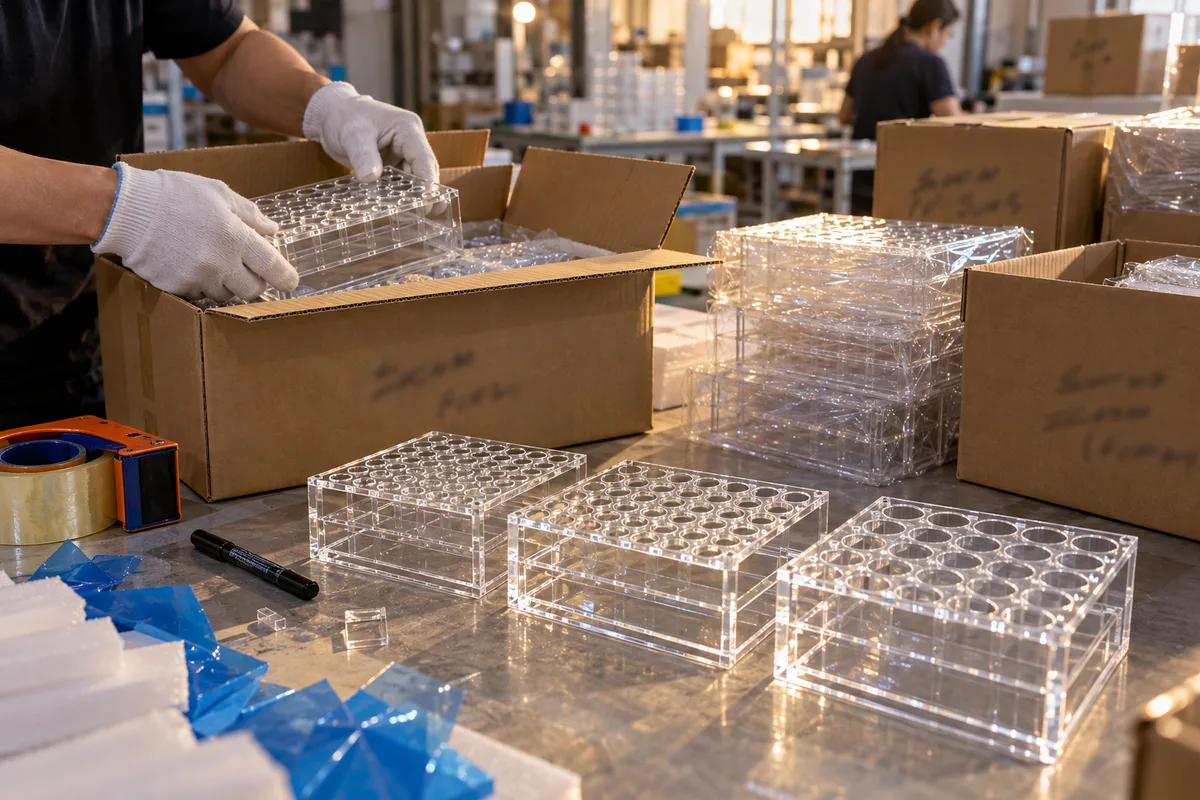
- 600 racks (200 per SKU) shipped in 17 production days, every rack inspected before packing; a repeat purchase order for 600 more released at month 3 against the same drawings.
The Challenge
The first substantive email we sent this buyer removed a quarter of the scope they had asked us to quote. Their RFQ listed four rack SKUs for a private-label benchware line, and the fourth was marked "autoclavable." Acrylic cannot honestly carry that word, so before pricing anything we wrote back and said so. More on that below — it turned out to be the deciding move of the whole program.
The distributor was rebuilding a benchware line after a rough experience with an imported batch of generic racks. Their support tickets told a two-sided story: small tubes rattled loosely enough that a full rack chimed when a bench was bumped, and large tubes stuck hard enough that pulling one lifted the rack off the bench. Same product family, opposite failures — which usually means one hole clearance was applied across every tube size. Their requirements:
- Three tube sizes, each with a fit that behaves. 10, 12, and 15 mm tubes, 50 positions per rack, no rattle at the small end and no stiction at the large end.
- A material claim they could print on a catalog page. After the import experience, the product manager wanted every durability and cleaning claim defensible line by line — including the awkward ones.
- Program economics, not one-off pricing. A restocking line needs repeat orders to release against fixed drawings without requalification each time.
Our Approach
We treated the program as three fit problems and one boundary problem. The fit problems were solved with arithmetic; the boundary problem was solved by refusing to pretend the material is something it is not.
The autoclave boundary, stated plainly
A standard autoclave cycle runs at 121°C under steam pressure. Cast acrylic begins to soften and deform around 100°C — a PMMA rack comes out of its first sterilization cycle warped, and it does not recover. There is no coating, thickness, or grade of acrylic that changes this; suppliers who mark acrylic racks "autoclave safe" are borrowing a claim from polypropylene, the material that actually holds it. We told the buyer exactly that, recommended they source the autoclavable SKU as polypropylene from a molder — we do not make it — and scoped our three SKUs to what acrylic honestly does: room-temperature benchwork with chemical-wipe disinfection. A 70% isopropyl or dilute bleach wipe is fine; acetone and strong solvent cleaners are not, because they craze the surface. The distributor printed that cleaning guidance on the catalog page almost verbatim.
A clearance gradient instead of one hole size fits all
The generic racks failed in both directions because they used one clearance everywhere. Tube outside diameters vary batch to batch — and that variation grows with tube size — so the clearance has to grow with it. Too little and the fat end of the tube tolerance sticks; too much and the thin end rattles. We set the gradient at 0.4 / 0.5 / 0.6 mm for the 10 / 12 / 15 mm SKUs, and cut every hole at +0.1 / −0 mm so the clearance floor is guaranteed: a hole can only ever be at-size or a tenth over, never under.
| SKU | Tube nominal OD | Hole diameter | Clearance | Positions |
|---|---|---|---|---|
| Rack A | 10 mm | 10.4 mm | 0.4 mm | 50 (10 × 5) |
| Rack B | 12 mm | 12.5 mm | 0.5 mm | 50 (10 × 5) |
| Rack C | 15 mm | 15.6 mm | 0.6 mm | 50 (10 × 5) |
| All holes cut at +0.1 / −0 mm — at-size or a tenth over, never under. Fit sampled per batch with gauge pins. | ||||
Two plates keep fifty tubes vertical
Each rack is built from two drilled plates bonded over a base: the top plate guides the tube in, the mid plate registers it 40 mm below, and the two-point support keeps 50 tubes vertical instead of splaying like a single-plate rack. Hole edges on both plates are chamfered so a glass tube tip never catches a sharp edge on the way down. The construction isCNC-cut, drilled, and solvent-bonded — no molds anywhere in the program, which made a historical 50-piece-per-design pilot workable without tooling fees. The bonding and edge-finishing steps are the same ones covered in ourcustom acrylic fabrication services.
The Results
600 racks — 200 per hole size — shipped after 17 production days, with 2 racks pulled at final inspection (0.3%) and replaced before packing.
The distributor's first restock cycle came and went without a single stuck-tube or rattle ticket — the two failure modes that had defined the previous import batch. At month 3, a repeat purchase order for another 600 racks released against the same drawings, no requalification, no revision loop. For a restocking product line, that is the entire point: the engineering conversation happens once, and every order after it is logistics.
"They were the only quote that told us acrylic won't survive an autoclave instead of dodging the question. All three hole sizes fit the way the drawings said they would — no rattle on the 10 mm, no stuck tubes on the 15 mm — and the repeat 600 released against the same drawings without a single change order."
What This Means for Your Project
If you are building a private-label line on custom acrylic, the supplier conversation that matters most is the one about what the material cannot do. Every substrate has a boundary — for acrylic it is heat and solvents — and a supplier willing to name that boundary before the deposit is a supplier whose other claims you can print in a catalog. The claims that survive scrutiny are what a distributor actually resells; the product is almost secondary.
The clearance gradient generalizes well beyond tube racks. Any time one product family holds parts of several sizes — tubes, vials, pens, bottles, dowels — the hole spec should scale with the part's own manufacturing variation rather than copying one clearance across the range. It costs nothing at the drawing stage, and it is the difference between a rack that feels engineered and one that generates support tickets in both directions. Racks, stands, andcustom acrylic organizers built this way ship against fixed drawings order after order — which is what a restocking program is really buying.
Common Questions
Can acrylic tube racks be autoclaved?
No. A standard autoclave cycle runs at 121°C under steam pressure, and cast acrylic begins to soften and deform around 100°C — a PMMA rack comes out of its first cycle warped and stays that way. Acrylic racks belong on room-temperature benches with chemical-wipe disinfection: 70% isopropyl alcohol or a dilute bleach wipe are fine, while acetone and strong solvent cleaners should be avoided because they craze the surface. If your workflow sterilizes racks in an autoclave, the right material is polypropylene — we don't make it, and we'll tell you so.
How much clearance should a tube-rack hole have over the tube?
Enough to guarantee a slip fit at the fat end of the tube's own manufacturing tolerance, and no more. On this program the clearance widened with diameter — 0.4 mm on 10 mm tubes, 0.5 mm on 12 mm, 0.6 mm on 15 mm — because tube outside-diameter variation grows with size. Holes were cut at +0.1 / −0 mm, so the clearance floor is guaranteed: no stuck tubes on the large end, no loose rattle on the small end.
What are the MOQ and terms for a private-label rack program?
MOQ is 100 pieces per design — each hole size counts as its own design, so this three-SKU program cleared the bar at 200 racks per SKU. Samples ship in 3–5 days, production runs 15–20 days, and there are no tooling fees because racks are CNC-cut rather than molded. Terms are 30% deposit with the balance before shipment, FOB Shenzhen, and repeat orders release against the same drawings.
Building a benchware line on custom acrylic?
Send us your tube sizes and your catalog claims — we'll come back with a fit recommendation, an honest list of what acrylic will and won't carry, and a quote.
Sample in 3–5 days · Production in 15–20 days · Zero tooling fees on CNC-cut racks