
Delivered project · Device Accessories
A Custom Device Stand from Drawing to Sample
A consumer electronics buyer came to us with a drawing, a rendering and the device itself, and needed an acrylic stand priced at 100, 250 and 500 pieces.
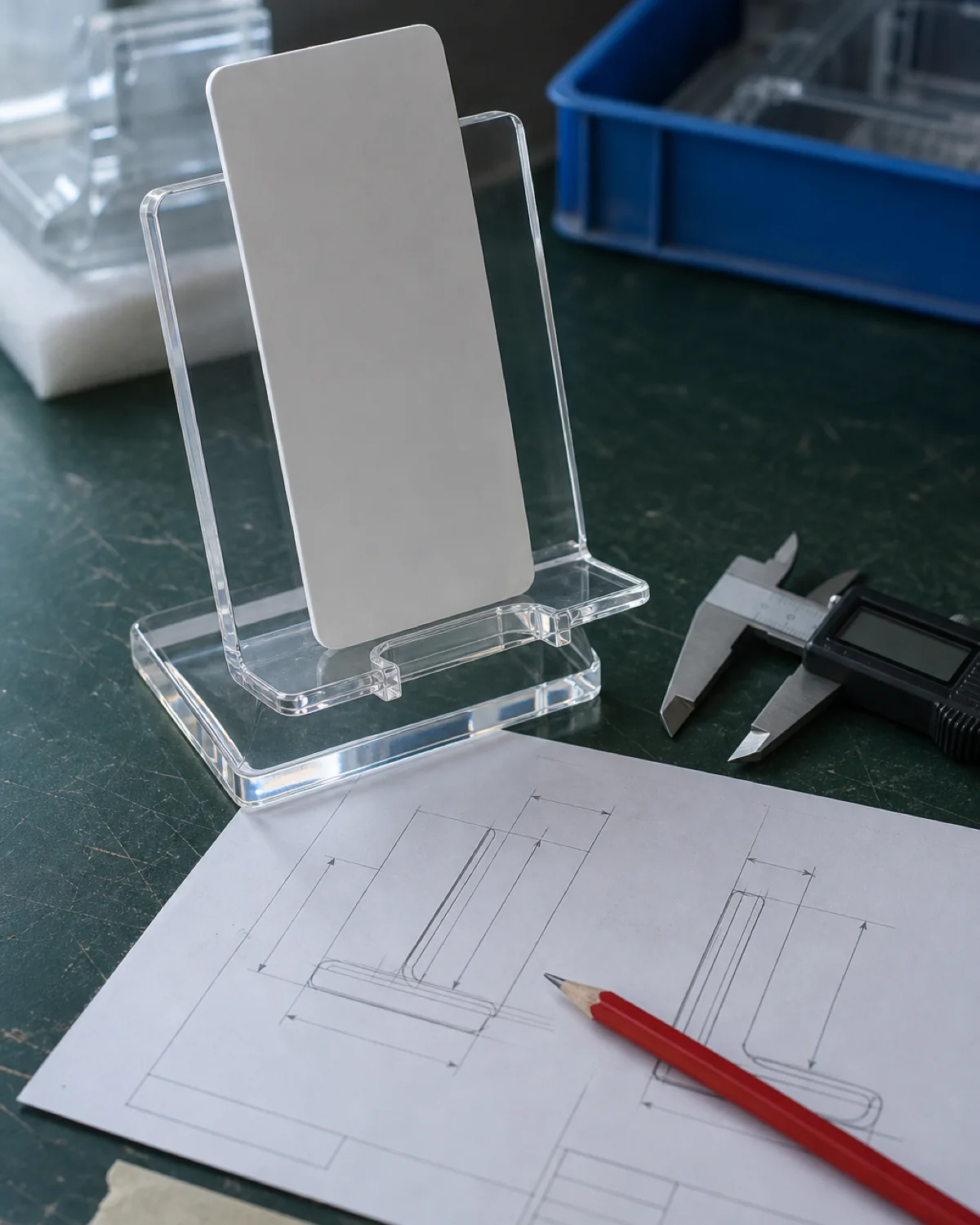
We turned the drawing into one production drawing, built a paid sample, had the buyer approve device fit, center of mass, cable clearance, finish and carton protection on it, and then released production.
Ordering a similar project
MOQ is 100 pieces per design. Paid samples take 3–5 days; sample fees are paid separately and never credited. Standard production takes 15–20 days after drawing, material, artwork, packing and sample approval. Wetop responds to a complete brief within 24 hours.
Closest published price: this stand was quoted from its own drawing. The nearest public reference on the acrylic display manufacturer page is a two-tier countertop stand 250 × 180 × 220 mm, 5 mm clear, one-color UV logo: $28 each at 100 pcs, $16 at 500, $12 at 1,000 (FOB Shenzhen, published reference).
Key Takeaways
- A consumer electronics buyer sent us a DWG and PDF drawing, a rendering and the physical device, and asked for one acrylic stand quoted at 100, 250 and 500 pieces.
- We checked the drawing against the real device and fixed the envelope, contact points, center of mass, viewing angle and cable clearance in one production drawing.
- The buyer loaded the device into the paid sample and approved fit, stability, cable path, finish, artwork and packout together.
- Any change after that became a new drawing revision, so only one revision was active when we released production.
- We released the run against that drawing, the retained sample and a first-off inspection.
The Challenge
The buyer's drawing package and the physical device did not yet add up to a stand we could produce. The rendering showed the look. It did not fix the device's real outside envelope, its contact points, center of mass, viewing angle, insertion path or cable clearance.
The buyer also wanted to compare 100, 250 and 500 pieces. That comparison only worked if all three tiers used the same material, construction, finish, inspection and packing, so we wrote one controlling specification first.
Drawing Review
We started by measuring the physical device against the DWG and PDF. Our production drawing then set the base, support angle, device contact zones, clearance, the cable or security interface the buyer reserved, the polished show edges, the artwork area and the carton envelope.
The rendering called for a bent support, so the drawing fixed the bend angle and inside radius. Bonded joints got a set location and visible boundary. We cut the pocket to the actual device for fit.
We made the non-electrical acrylic stand. The buyer's own electrical or security integrator handled the powered devices, cables, alarms, chargers and certification.
Sample and Acceptance
The paid sample used the production construction. The buyer loaded the actual device and checked viewing angle, stability on their surface, insertion and removal without scratching, cable path, show-surface finish, artwork position and packout. These were the checks the buyer signed off:
- The device fit without forced insertion or unstable movement.
- The stand stayed stable in the use position the buyer approved.
- Cable and security openings matched the buyer's hardware.
- Polished edges and joints matched the signed boundary sample.
- Artwork and labels matched the active proof and drawing.
- The packed stand stayed separated from loose hardware and abrasive surfaces.
Every change after that went out as a new drawing revision. We kept the approved sample with photos and an acceptance record noting the sample reference, active drawing revision and accepted deviations.
Quote and Cost Engineering
Our quote split out acrylic material, cutting or machining, bending or bonding, edge finishing, branding, hardware, inspection, packing, carton data and freight. We compared cost-saving options one variable at a time: a bent one-piece support against an assembled support, and a permanent print against a replaceable graphic. With the spec held constant, the 100, 250 and 500-piece prices could be compared line by line. We also separated our included factory packing from any buyer-side retail packing, labeling, consolidation or freight.
Production and Packout
We released production only after the drawing, material, artwork, sample, quantity split, packing, price and payment terms were approved in writing. A first-off inspection checked the production setup against that release, and we corrected any operation that did not match before the lot continued.
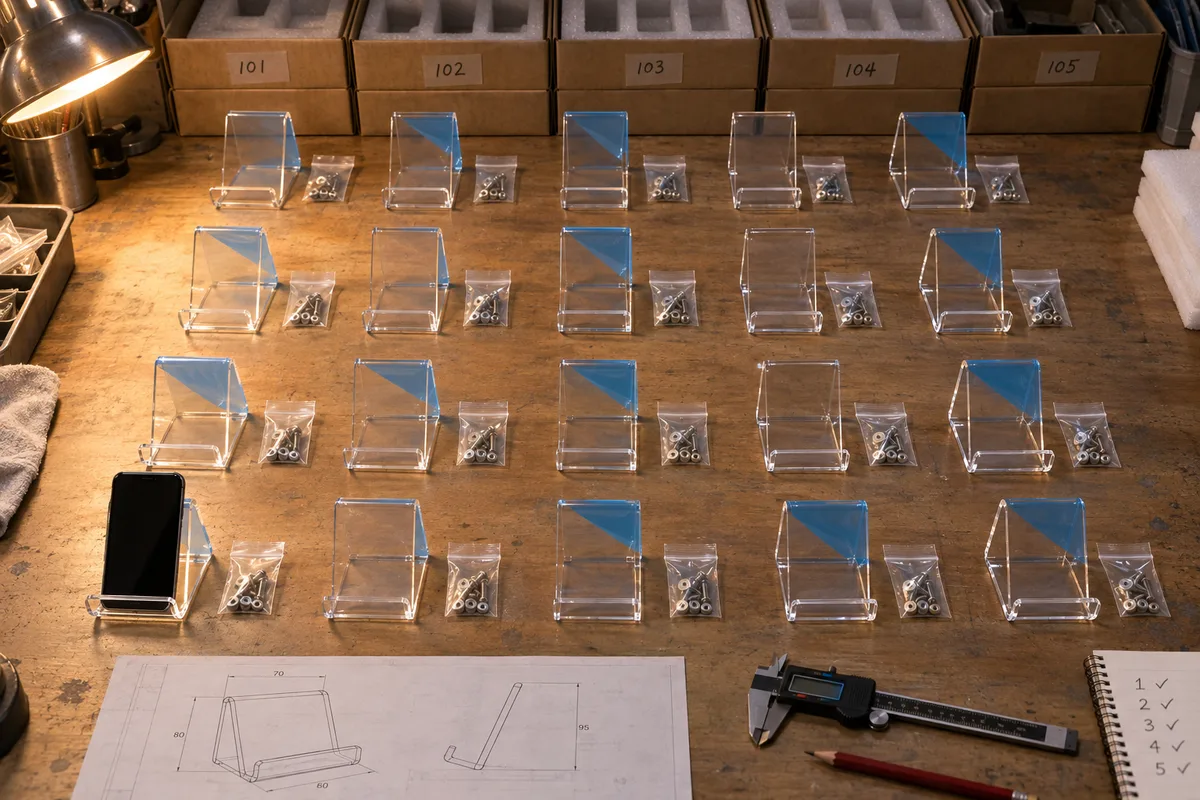
Packout was part of the released product: surface film, hardware bagged separately, a restrained cavity, clear orientation marks and a carton drop review agreed for the final packed weight.
Project Outcome
The buyer's procurement team got a release package it could review in one place: one active drawing, one approved sample reference, a quantity table by version, the acceptance checks, a packout specification and a written commercial offer. Production ran to that package, so there was nothing left to interpret between sample and bulk.
If You're Planning Something Similar
Send a dimensioned drawing or the device itself, not only a photo; we prepare the production drawing from it for your approval. You can split an order across versions or destinations when each physical design meets our per-design minimum, though small splits add proofing, labeling and packing cost. When comparing quotes, check that each one covers the same artwork setup, hardware, inspection and protective packing. See custom acrylic display stands and the acrylic first-article inspection checklist.
Need a stand built around your device?
Send the drawing, quantity by version, the device or a model, artwork, packing requirement, destination and timing. We will return the open questions and a written manufacturing quote.
One production drawing, one paid sample, one first-off inspection before bulk release