
Bulk Picture Frames: MOQ, Landed Cost and Factory Sourcing
Every bulk frame price is a stack of costs someone assembled.
Need this made?Custom acrylic frames →
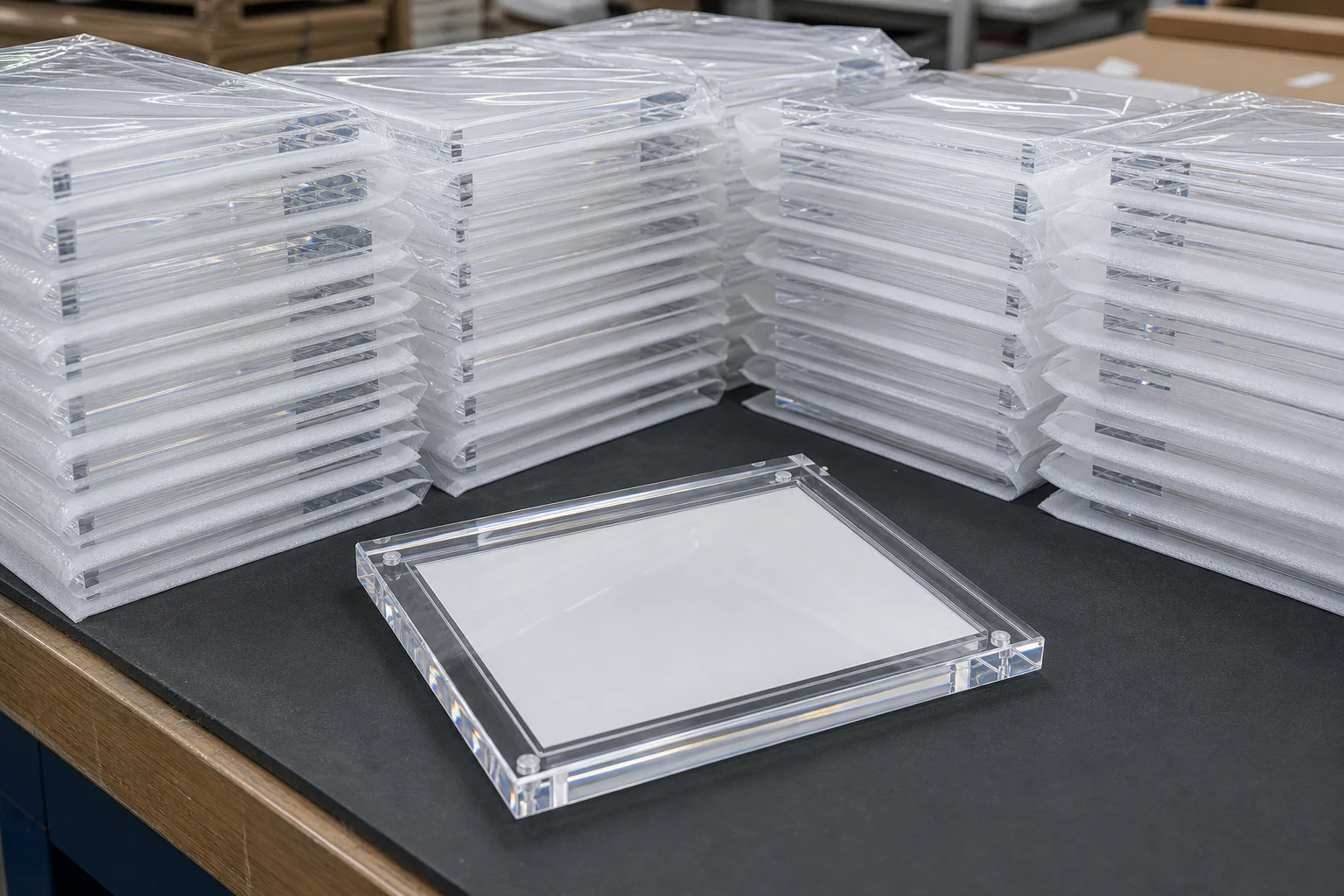
Here is the stack, layer by layer, from the factory end of the chain, where frames are made to order from 100 pieces per design.
Key Takeaways
- A distributor's bulk frame price usually stacks factory cost, export packing, ocean freight, duty, importer margin, domestic warehousing, and distributor margin. Factory-direct removes the middle layers — and moves freight and lead-time planning onto your side of the ledger.
- Factory-direct custom framing starts at a 100-piece MOQ with paid 3–5 day samples and 15–20 day production — program sizes most domestic distributors treat as too small to quote custom at all.
- Acrylic frames ship bulk safer than glass: cast PMMA runs about 1.2 g/cm³, roughly half the density of soda-lime glass, and it doesn't shatter in transit.
- Quote your landed cost, not the unit price: Incoterms (FOB vs DDP), the duty rate on your HTS classification, and freight mode all change the real per-frame number.
- A bid-ready factory quote line-items material, thickness, finish, print, packaging, and terms — a supplier who can't produce one will stall your procurement process later.
On this page
- Bulk Picture Frames: What the Unit Price Contains
- Distributor vs Factory-Direct: The Cost Layers
- Picture frame manufacturer types — trader, assembler, fabricator
- Why Acrylic Works for Bulk Custom Frame Programs
- MOQ and tier math — 100 / 200 / 1,000 units
- Freight, tariffs, and HS codes — landed-cost planning
- Formal quotes and procurement compliance — what a bid-ready quote includes
- Small-batch programs and referral trust — testing a factory before committing
- Sample-to-bulk workflow — approval gates that prevent rework
- Supplier verification — audits, ISO, and 100% inspection
Bulk Picture Frames: What the Unit Price Contains
We make bulk picture frames to order from 100 pieces per design. We are a manufacturer, not a wholesaler: we don’t hold stock, and every order is cut, polished, printed, and assembled to your spec. Buyers who search for “wholesale picture frames” usually end up comparing a factory-direct quote with a distributor’s catalog price. Pull either per-unit price apart and you get material, fabrication, printing or finishing, packaging, inbound freight, duty, and any distributor margin. Our frame formats, from floating to magnetic to certificate frames, are on the acrylic frames hub.
That framing matters because two quotes for the same frame can differ substantially while both being honestly priced; they are simply totals taken at different points in the chain. A domestic distributor’s price already contains ocean freight, duty, warehousing, and their margin. A factory’s FOB price contains none of those. Those lines transfer to the buyer’s spreadsheet.
I have been on the factory end of this chain since 2008, and the most common sourcing mistake I see is comparing those two numbers as if they were the same number. They aren’t. The only fair comparison is landed cost per frame — every layer counted, on both sides — and building that comparison is what this guide is for. We will walk the chain layer by layer: who adds what, which layers factory-direct removes, what the removal costs in planning burden, and how to read a quote so procurement doesn’t bounce it back later.
Our own quotes are built to make that comparison easy, because we learned the hard way that an opaque quote loses to a clear one even at a better price. When we quote a frame program, the fabrication lines are itemized, the Incoterms are named, and the freight and duty questions come with pointers to where the real numbers live. A buyer who assembles the full landed-cost picture and still chooses us is a buyer who reorders.
Distributor vs Factory-Direct: The Cost Layers
A distributor’s price and a factory’s price differ by the middle of the supply chain: the distributor has already paid the freight, cleared customs, warehoused the stock, and added margin for that work. Factory-direct removes those layers from the price and hands the coordination back to the buyer. Neither is universally cheaper. It depends on what is being bought.
The distributor layer pays for inventory already sitting in a warehouse: stock designs, fast dispatch, and no Incoterms to manage. It stops adding value when the frames need to be custom (specific dimensions, specific artwork, specific packaging), because then the distributor is quoting someone else’s factory with their margin on top, at MOQs set to protect their economics rather than the buyer’s program.
Factory-direct flips the economics for exactly that custom territory. The price drops to fabrication plus the logistics lines, and the spec conversation happens with the people holding the cutting files. When a buyer asks us whether the rebate can go 2 mm deeper, they get an engineering answer the same day, not a forwarded email. What it costs is calendar and coordination: samples, an ocean transit, a customs entry. The cost, lead-time, and tariff side of that trade is laid out in China vs USA acrylic manufacturing.
The margin spread between the two channels is real, but I won’t put a fake percentage on it; it moves with the product, the quantity, and the freight market. The structural point stands regardless: every layer you remove, you either pocket or spend on planning.
Picture frame manufacturer types — trader, assembler, fabricator
“Picture frame manufacturer” covers three very different businesses, and knowing which one is on the other end of the quote predicts most future problems. A trader owns no production; they broker the order to a factory the buyer never meets. An assembler buys pre-cut components and joins them. A fabricator cuts, finishes, prints, and assembles under one roof.
Traders are not automatically bad (good ones add language, QC coordination, and consolidation), but the buyer pays a hidden layer, loses direct engineering access, and when a spec dispute comes up, the trader is negotiating with a factory on the buyer’s behalf using the buyer’s money. Assemblers can be excellent at high-volume stock designs; their limits appear the moment a spec leaves their component catalog.
The tell is process specificity. Ask how the edges are finished and a fabricator answers in methods — laser versus CNC cut, diamond-polished versus flame-polished — because those are decisions their own floor makes daily. Ask a trader and you get “high quality” and a subject change. Video calls settle it fast: we walk buyers through our floor on request, from the 8 laser cutters and 4 CNC machines through the diamond polishing line to UV printing, which we brought in-house in 2020. Those questions and the rest worth asking any frame supplier are in our 22 supplier vetting questions.
For frames specifically, in-house UV print is the capability worth confirming hardest: a frame program almost always carries artwork, and a shop that outsources its printing adds a vendor hop to every reorder: lead time, tolerance drift, and a second finger to point when registration is off.
Why Acrylic Works for Bulk Custom Frame Programs
For bulk custom programs, acrylic frames solve the two problems that make glass-and-wood framing painful to ship at volume: weight and breakage. Cast PMMA runs about 1.2 g/cm³ — roughly half the density of soda-lime glass1 — and it does not shatter, which means lighter cartons, no breakage allowance baked into the order math, and none of the glass-handling packaging that eats carton space. The full weight and UV math behind that choice is in our acrylic vs glass picture frame comparison.
The customization economics are just as important. Acrylic fabrication is file-driven: a new frame dimension is a revised cut file, not new extrusion tooling or moulding dies. That is what makes a 100-piece custom run economically sane, and why acrylic frames production programs can carry custom sizes, magnetic closures, floating designs, colored or frosted variants, and UV-printed branding, usually without a tooling charge on the quote. Our full range (floating frames, magnetic closures, block frames, wall-mounted formats) is on the acrylic frames hub; deep frames for medals, jerseys and keepsakes are on our bulk acrylic shadow boxes page.
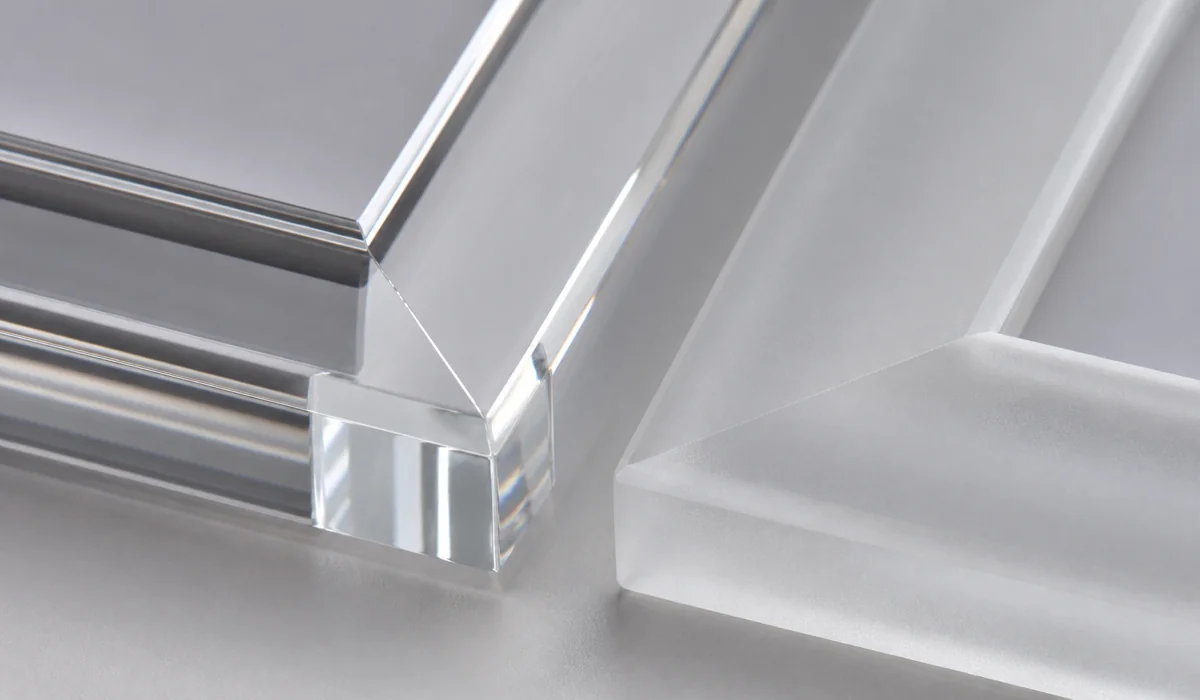
The build chain for a frame is short and entirely in-house on our floor, which is why frame lead times hold steady at 15–20 days regardless of how custom the spec gets. We cut the panels on laser or CNC depending on the profile, diamond-polish every exposed edge (on a frame, the edge is the product, since it frames the artwork at eye level), then UV-print any branding or backing graphics, fit the magnets or standoff hardware, and assemble. One drawing, one floor, one inspection at the end. When a frame program needs a variant such as a frosted edition, a deeper rebate for canvas board, or a colored back panel, we revise the file and run it, and the variant inherits the original’s QC standard.
The presentation argument closes the case for a lot of buyers: a polished acrylic frame reads modern and gallery-clean, with the artwork appearing to float between panels. It photographs well for e-commerce and holds up in transit photography disputes, with no cracked glass claims. A working example at program scale: the colored acrylic floating frames we built for art galleries, where the frame itself became part of the gallery’s visual identity.
MOQ and tier math — 100 / 200 / 1,000 units
Frame pricing steps down in tiers because three fixed costs amortize over the run: sheet utilization, machine setup, and packaging setup. Understanding which lever moves at which tier tells a buyer whether pushing for the next price break is worth the cash tied up in inventory.
At 100 pieces, our production MOQ for bulk picture frames, setup dominates. The cutting program, polishing fixtures, and print registration get built once and spread over a hundred units. This is the pilot tier: real production, real QC, small commitment. At 200 pieces, sheet utilization takes over: our engineers nest frame components across standard sheets, and a layout that wastes less off-cut drops material cost per frame in a way no negotiation can. This is also where packaging moves from stock cartons to a fitted spec worth engineering. At 1,000 pieces, labor rhythm and purchasing scale kick in: full sheets, full cartons, uninterrupted runs.
Buyers feel these breakpoints even when they can’t see them. The recurring negotiation in our inbox, some version of “the cost per frame could be lower,” is usually answered not by discounting but by moving the quantity to where the math actually changes, or by value-engineering the spec: a thickness step, a simpler hanger, a print area trimmed to the artwork. A typical frame intake for us is a low-hundreds run of a single format, which sits exactly in the territory where these levers matter most. For small programs, our custom acrylic fabrication process explains the paid-sample and production path.
Freight, tariffs, and HS codes — landed-cost planning
Landed cost per frame is the number that decides whether factory-direct beat the distributor: unit price, plus freight per unit, plus duty, plus entry and brokerage fees. Every one of those lines is knowable before you place the order. Most buyers just don’t ask for them early enough.
Freight is a volume game, and frames are dense cargo that stacks well — one reason acrylic’s weight advantage compounds. Sea freight is the default for frame programs, at roughly 4–6 weeks door-to-door (3–5 weeks port-to-port); air only makes sense for samples and genuine deadline rescues. Packed-carton dimensions and gross weights are supplied with the quote as standard, so your forwarder can price the move before you commit. Duty rides on classification: the Harmonized Tariff Schedule assigns different rates to plastic, wood, and metal frames, and the operative rate is set by the 10-digit code your customs broker lands on. Don’t take a supplier’s word for the rate, including ours. Look it up directly in the official HTS database2 and confirm the classification with your broker before comparing quotes.
Incoterms decide whose spreadsheet these lines live on. Our default is FOB Shenzhen: you own the goods at the port, and freight, duty, and entry are your lines. EXW, CIF, and DDP are all available; DDP folds the entire logistics stack into our price and lands the frames at your door with customs cleared. HS-code and import-fee questions are among the most common pre-order questions we get from North American frame buyers, and the answer is always the same arithmetic: quote both terms, fill in every line, and compare totals, not unit prices.
I encourage that question early, not late, because I have watched the alternative play out too many times: a buyer builds a retail price around the FOB number, discovers duty and drayage at entry, and the program’s margin quietly halves before the first frame hangs on a wall. Tariff conditions also move; rates that held for years can change between your pilot and your reorder. Build the landed-cost sheet once, keep it updated against the official schedule, and every future quote from any supplier drops into it in minutes. It is the least glamorous spreadsheet in your sourcing file and the one I would keep closest.
Formal quotes and procurement compliance — what a bid-ready quote includes
If your purchase runs through a procurement process — corporate buying, government or institutional bids, retail vendor compliance — the quote document matters as much as the price on it. A one-line “USD X.XX/pc” email will stall in any compliance review, and re-papering a quote after award is slower than demanding the right document up front.
A bid-ready factory quote line-items the physical spec and the commercial terms separately. On the spec side: material and grade, thickness, dimensions with tolerances, edge finish, print method and coverage, hardware, and packaging spec. On the commercial side: unit price per quantity tier, Incoterms with named port, payment terms (ours are 30% deposit, 70% before shipment), quote validity window, sample and production lead times, and the certification documents behind the factory’s claims (for us: ISO 9001, SGS, ROHS, attached on request).
We produce quotes in this format because buyers taught us to. The requests come from procurement teams who need a document their compliance process can file: formal quotation, itemized, on letterhead, sometimes with supplier registration forms alongside. If a supplier hesitates at that request, treat it as data. A factory that cannot paper a quote properly will not paper a claim properly either. Need one for a frame program you’re pricing now? Send the spec and quantities and we’ll return a formal, tiered quote you can put in front of any review.
Small-batch programs and referral trust — testing a factory before committing
Nobody should commit a five-figure program to an unproven overseas supplier, and the good news is that the frame category makes proving cheap: a 100-piece pilot at 15–20 day production is a complete, low-stakes rehearsal of the entire relationship: communication, sampling, QC, packing, freight, and what the frames actually look like out of the carton.
A pattern I notice in how frame work arrives: a striking share of it comes through referrals. A buyer sees frames we built for someone else and asks for the same design with their own artwork. That doesn’t surprise me anymore; referrals became our best marketing channel in the earliest years of the business, and many of our first customers are still placing orders today. A finished frame in someone’s office is a better salesman than anything we could write.
The referral pattern is worth copying deliberately even without a referral in hand. Order the pilot as if it were the referral object: same spec discipline, same QC checklist, same packaging standard as the eventual program. The pilot then does double duty. It validates us, and it becomes your physical reference standard for every reorder.
The reorder mechanics reward the approach. Once a first run ships, your cut files, print artwork, packaging spec, and QC checklist stay on file. Reordering the same frame with new artwork, the most common frame reorder we see from galleries, media companies, and awards programs, skips straight past engineering to print proof and production. Second runs quote faster, ship faster, and carry price continuity, because the setup cost that MOQ exists to amortize was already paid.
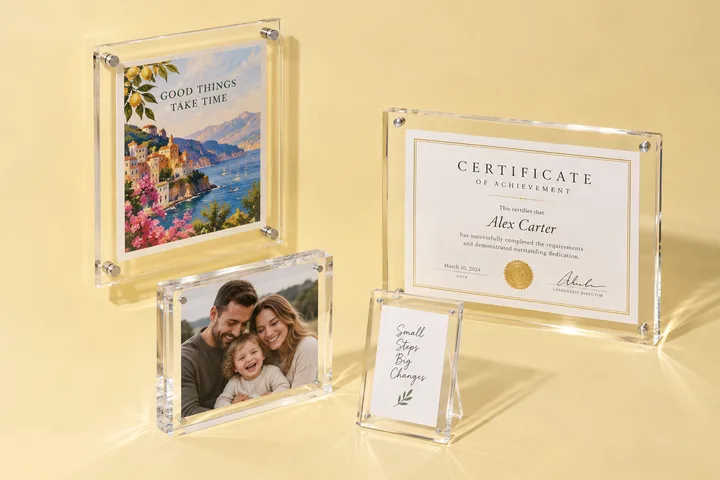
Certificate and award frames deserve a specific mention here, because they generate the steadiest small-batch pattern in the category: an organization frames a recognition program once, then returns each season with the same frame and a new honoree list. We treat those as standing programs rather than repeat one-offs; the formats are on our acrylic certificate frames page. The engraving or print layer changes, the frame does not, and the order cycle becomes an email rather than a project.
Sample-to-bulk workflow — approval gates that prevent rework
The sample loop is the cheapest insurance in the entire sourcing chain: 3–5 days and a sample fee of USD 200–500 depending on complexity (quoted exactly with your RFQ), against a bulk run’s worth of rework. What separates a useful sample from a decorative one is what gets locked at approval.
Three gates, in order. The print proof: before any sample is printed, artwork gets a pre-production proof (color, placement, registration) so the sample tests the real graphic, not a placeholder. The physical sample: measured against the drawing, loaded with the actual artwork or insert, checked for edge finish and hardware fit. Frame-specific detail worth testing here: insert the artwork and hang the frame, because rebate depth, hanger position, and how the frame sits against the wall only reveal themselves assembled. The written sign-off: the approved sample plus a short QC checklist becomes the acceptance standard the bulk run is inspected against.
From sign-off, production runs 15–20 days, and every finished frame passes our 100% piece-by-piece inspection, a standard we’ve run since 2018, against that same checklist before packing. The workflow exists because rework across an ocean is miserable for everyone; the approval gates are how both sides make sure the only surprises in the bulk cartons are good ones.
I will add one piece of hard-won advice: never let a deadline compress the proof gate. In eighteen years, the sample problems I remember all trace to the same shortcut: artwork “final enough” to sample with, finalized after. The frame is the artwork’s container; sampling a container around placeholder contents tests nothing. We hold production starts on artwork lock for exactly this reason, even when the calendar complains, because a week saved at proof stage has a way of costing three at the receiving dock.
Supplier verification — audits, ISO, and 100% inspection
Verification is the last layer of the sourcing decision, and the frame category needs it as much as any other. The supplier list online is thick with traders presenting stock photos of other people’s factories. Three checks separate substance from listings quickly.
Certification, read properly. ISO 9001 certifies a quality management system (documented processes, traceability, corrective action), not product quality directly3. Its real value in vetting: ask for the certificate, check the scope covers the factory actually making your frames, and verify the certificate number with the issuing body. A trader waving a factory’s certificate fails that check in minutes.
Inspection regime. Ask what percentage of finished units gets inspected and against what standard. “AQL sampling” is a legitimate answer at commodity volumes; for custom programs we run 100% piece-by-piece inspection against the approved sample’s checklist, because a custom frame has no commodity tolerance to hide behind.
Direct evidence. Video walkthroughs, live production photos of your actual order, and references in your vertical. Over 2,000 projects across 25+ countries, most of them for buyers in the USA and Europe, means we can usually produce a reference close to any frame buyer’s use case. A supplier who resists showing you the floor is answering your question anyway.
If I had to compress what I have learned since founding Wetop in 2008 into one signal, it would not be the certificate or the price. It would be responsiveness under an awkward question. Ask something specific and slightly inconvenient: which polishing method, what happens if the bulk run misses the checklist, who pays for a second sample round. The supplier who answers plainly and fast is showing you what a problem at week three of production will feel like. That test costs you one email, and I have never seen it mislead.
How we sourced this guide: cost-chain structure and channel comparisons are described directionally — no invented margin percentages; Wetop-specific figures (MOQ 100, samples 3–5 days, production 15–20 days, 30/70 payment terms, 100% inspection since 2018, ISO 9001/SGS/ROHS, 2,000+ projects across 25+ countries, market split) come from our production records and company documentation; buyer-question patterns come from anonymized inquiry archives.
Footnotes
-
MakeItFrom — PMMA (Acrylic) material properties — publishes the cast acrylic density figure (~1.2 g/cm³) behind the acrylic-vs-glass shipping-weight comparison. ↩
-
Harmonized Tariff Schedule of the United States (hts.usitc.gov) — the official USITC database for looking up current duty rates by classification, including the plastic-frame codes discussed in the landed-cost section. ↩
-
ISO 9001 — Quality management systems — the standard itself, cited for what certification does and does not attest when vetting a frame supplier. ↩
Frequently Asked Questions
What is the minimum order for bulk picture frames from a factory?
Our MOQ is 100 pieces per design, with paid samples in 3–5 days and production in 15–20 days after approval. Sample fees are paid separately and never credited to production. That threshold exists because sheet cutting, polishing setup, and print setup amortize over the run — below it, setup dominates the unit price. Most domestic distributors quoting custom work want commitments several times larger.
Can we start with a small batch before committing to a bigger frame program?
Yes — a 100-piece pilot is a normal first order, not an exception. Many of our frame programs start exactly that way, often on a referral, then reorder the same frame with different artwork or sizes. Once your first run is approved, the cut files, print artwork, and QC checklist stay on file, so reorders quote and ship faster.
Can you provide a formal quote that satisfies procurement and bid compliance?
A formal, bid-ready quote is standard from us. It line-items the material and thickness, finish, print method, hardware, packaging spec, and unit price per quantity tier, and states Incoterms, payment terms (30% deposit, 70% before shipment), quote validity, and lead times. Certification documents — ISO 9001, SGS, ROHS — attach on request.
How do tariffs and HS codes affect the landed cost of picture frames?
Duty is charged as a percentage of the customs value, and the rate rides on the HTS classification your broker assigns — plastic frames classify differently from wood or metal ones. Check the current rate for your code at hts.usitc.gov before comparing quotes, and confirm whether a quote is FOB (duty is your problem) or DDP (it's priced in).
Are acrylic picture frames cheaper to ship than glass ones?
Per protected frame, almost always. Cast acrylic is roughly half the density of soda-lime glass, so cartons come in lighter, and it doesn't shatter — which removes the breakage allowance and the heavy protective packing glass programs carry. Lighter cartons also stack more frames per pallet, which compounds across an ocean shipment.
Have specs in hand? Get a quote for your specific project.
Send us your drawings, reference photos, or a description of what you're making. We reply within 24 hours with a material recommendation, thickness, fabrication method, and a per-unit quote.