Delivered project · Higher Education · United States
University Acrylic Diploma Frame
A US university alumni program came to us for standoff acrylic diploma frames that had to arrive before commencement.
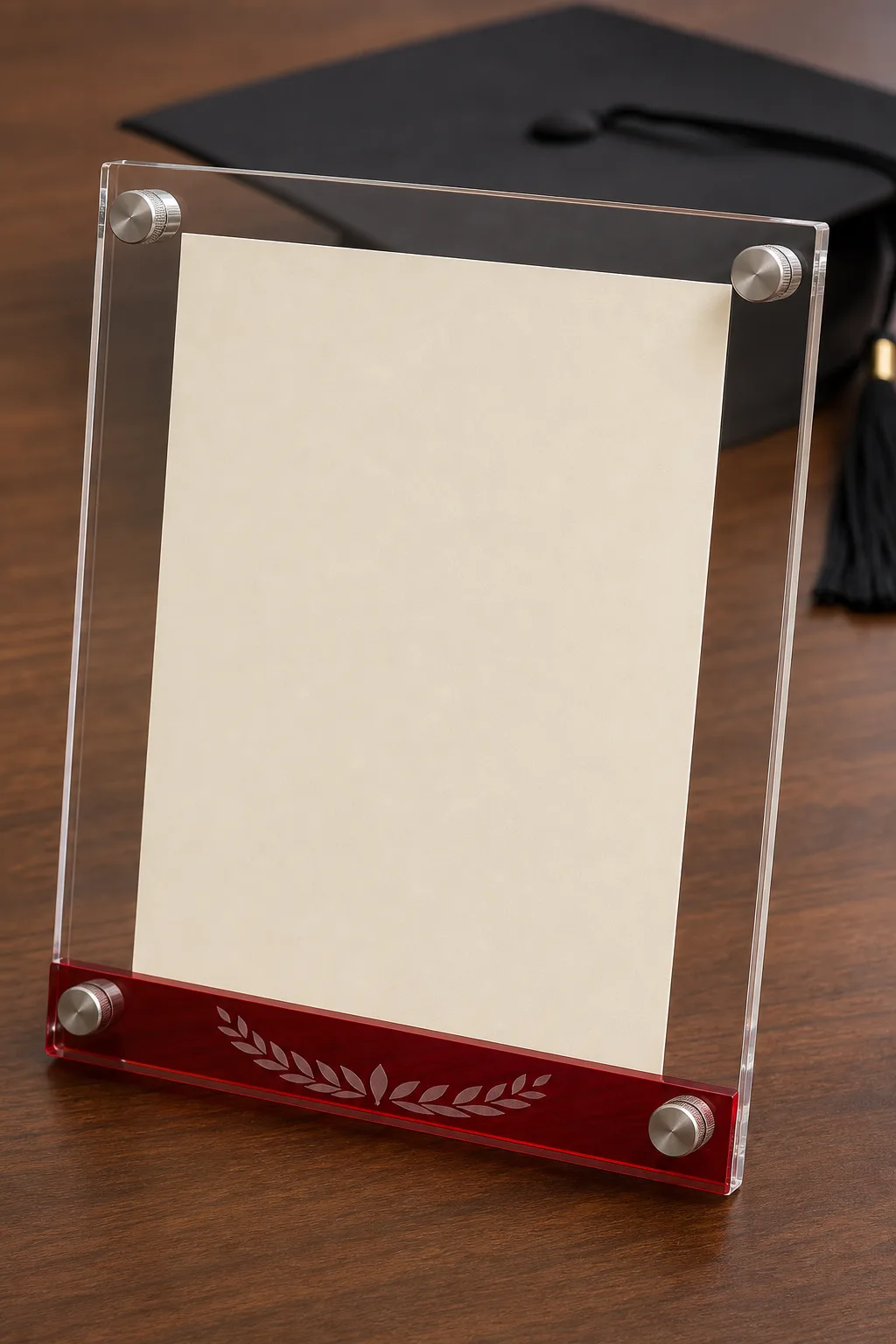
We built them from the actual diploma: two clear panels, removable corner hardware, etched registration corners and a school-color accent. The university signed one physical sample on campus against a real diploma, and we produced the order to that approval.
Ordering a similar project
MOQ is 100 pieces per design. A paid sample normally takes 3–5 days, is paid separately and is never credited. Standard production is 15–20 days after approvals, and a complete brief normally receives a response within 24 hours.
Closest published price: this order was quoted from the approved drawing. The nearest public reference range is a 100-piece 8.5 × 11 certificate frame at $8–16 per unit FOB Shenzhen. Standoff hardware, the school-color accent, etching, packing and quantity set the final figure.
Key Takeaways
- A US university alumni program needed diploma frames at its campus warehouse ahead of commencement, and we scheduled the order backward from that date.
- We sized the clear opening, margins, hole positions and loading access from the actual diploma and the approved drawing.
- The university supplied and approved all licensed seals, names, colors and class-year artwork; we reproduced only marks it had authority to use.
- One signed physical sample, checked on campus with a real diploma, fixed the acrylic appearance, accent, hardware and assembly before production began.
The Challenge
A US university’s alumni program came to us with an actual diploma, the institution’s identity rules, a decision on who would load the documents and a fixed commencement date. Three constraints shaped the order:
- Who loaded the diploma. The university supplied an actual document and approved clearance, registration, retention and the loading method on a physical sample.
- Licensing every protected mark. The university gave written approval for seals, names, colors and class-year artwork before we reproduced any of them.
- The required date. Sample approval, production, packing and freight each had a milestone and a buffer agreed with the university, which owned the event date.
Our Approach
The frame was a standoff design with two acrylic panels and removable corner hardware. We took the final dimensions, thicknesses, margins and hole locations from the actual diploma and the approved drawing. Sizing for certificate formats is covered in our acrylic frame size and spec guide.
Tool-free loading with etched registration corners
Loading used removable caps and etched registration marks. The university approved the hardware, opening sequence, document clearance and retention, and we checked the approved sample with one of its own diplomas.
School color in the material, licensed seal left to the licensee
The school-color accent followed the construction on the approved drawing, and we sent a production-material sample for visual approval. We described no finish as scratch-proof or fade-proof, and we priced color matching, setup and material availability for this order.
We released artwork only after the university confirmed its right to use it. The drawing marked a reserved clear zone for the seal, which stayed with the university’s licensed vendor. Whether the abstracted motif needed licensing approval was the institution’s decision, not ours.
Back-planned from the buyer's required date
The university gave us its required arrival date, and we worked backward from it with current sample, production, packing and freight times. Production started only after the commercial, drawing and sample approvals named in the quote, and we confirmed freight timing on the booked route.
| Milestone | Timing | Notes |
|---|---|---|
| Deposit received · sample ordered | Set by the university | Commercial terms and design inputs complete |
| Physical sample approved on campus | Sample lead time + transit | University signed the sample against the actual diploma |
| Production complete | Standard production lead time | Ran after all approvals |
| FOB Shenzhen | Confirmed in the quote | Packing and shipment release complete |
| Campus warehouse delivery | Confirmed on the booked route | University reviewed freight terms and buffer |
| Commencement | Set by the university | University owned the event schedule and acceptance |
The Results
We delivered the frames with a full release record: approved dimensions, licensed-artwork record, named material, signed physical sample, inspection checklist and packing specification. The university chose the schedule buffer from its own event risk and freight route.
The controlled files stay on record for the next cohort. A reorder is a new release: the university confirms artwork rights, quantity, current material, hardware, packing and schedule; a changed material lot or document gets a new sample; and we quote fresh before production.
“The actual diploma, the approved artwork and one signed frame sample gave the university a record it can reuse. Each new cohort still goes through its own release and quote.”
If You're Planning Something Similar
Send a scan and one physical diploma, say who loads it and whether the frame stands or hangs, and include vector artwork with written authority for each seal or wordmark. Leave room between your event date and the ex-factory date for transit, receiving inspection and a buffer. See ourcustom acrylic certificate frames.
Need diploma frames for your institution?
Send the physical document dimensions, approved artwork and color references, mounting method, required date, quantity, and packing brief. We will reply with drawing and sample questions plus a written quote within 24 hours; the institution retains authority over licensed marks and event scheduling.