Wood Awards with Acrylic Uppers: Hybrid Joinery Buyer Guide
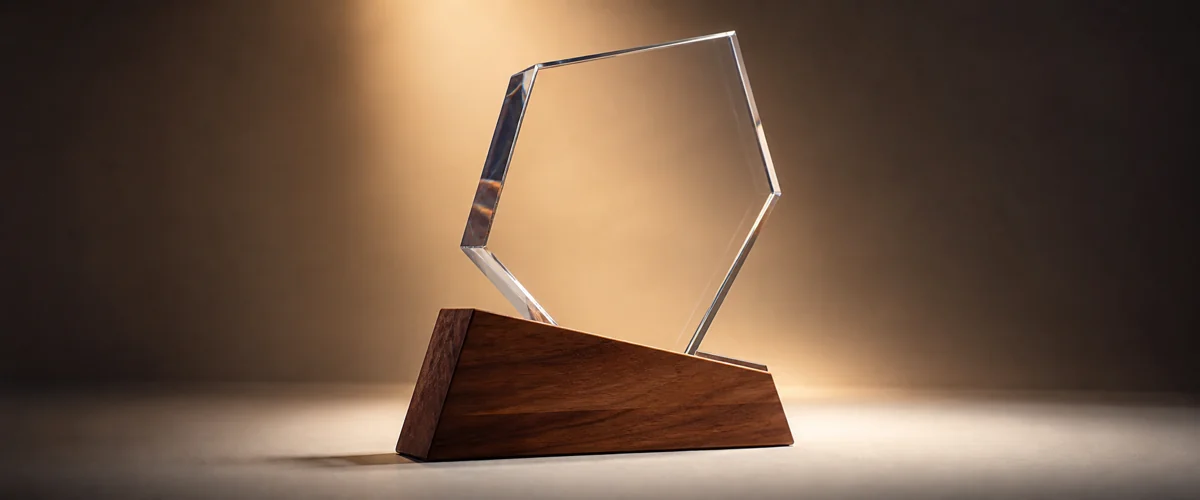
A wood base under a clear acrylic upper reads as premium because two materials, two finishes, and two manufacturing processes are converging into a single piece. The joinery is what holds — or fails — that promise.
Key Takeaways
- On our pull-test rig last quarter, dovetail joinery on walnut-acrylic awards held 245 lbs vs 130 lbs on cyanoacrylate-glued samples and 305 lbs on threaded brass insert assemblies — joint choice changes ship-out failure rate, not just look.
- Walnut, maple, ash, and cherry each carry a different signal: walnut for executive gravitas, maple for tech and innovation programs, ash for sports and performance, cherry for service and tenure. Picking by warehouse availability instead of message is the most common mismatch we get asked to redo.
- Hybrid wood and acrylic awards run roughly 35–55% more per piece than pure cast acrylic at 50–100 unit volumes, but the gap closes to 15–25% at 250+ units once wood-base CNC programs amortize.
- Threaded brass insert is the joinery I recommend for any award expected to ship internationally, get handled at a podium, or display on an executive desk for 5+ years. Glue-only joints fail under the combined stress of temperature swing in air freight and torque from someone twisting the upper to read it.
- FSC-certified hardwood adds roughly 8–12% to material cost but is the single fastest way to clear corporate sustainability sign-off — most enterprise programs we run now require chain-of-custody paperwork at PO stage.
On this page
I run our laser, CNC, polishing, and UV printing lines, and every quarter a procurement lead lands on a call with a photo of a competitor’s hybrid wood awards piece — walnut base, clear acrylic upper — and the same question: why does this piece feel like it costs three times what it actually does? The answer is almost never the materials. Walnut and clear cast PMMA are commodity inputs. The answer is the joinery — how the two halves are joined, and whether the seam survives the supply chain from our line to the recipient’s desk.
Across the last three years our team has shipped hybrid joinery on twelve enterprise recognition programs — sales kickoffs, service tenure, board retirement gifts, and one company-milestone program that needed sixty matched pieces in four weeks. We’ve pull-tested the three working joinery techniques on our rig, machined four wood species against the same acrylic upper, and quoted the same geometry at 50, 100, and 250 piece volumes enough times to know where hybrid pays off and where it doesn’t.
Why hybrid awards win for tier-1 recognition programs
Pure cast acrylic awards have a ceiling. They photograph well, machine cleanly, take engraving sharply, and ship cheaply — which is why every recognition vendor has a catalog full of them. Your buyers know that too. When a sales VP holds a clear acrylic award and a hybrid wood-and-acrylic award side by side, the hybrid reads as deliberately commissioned, not pulled off a shelf.
I’ve seen this play out on one client across two program years. Year one was 200 clear acrylic obelisks at $42 per piece. Year two the same client shipped 200 walnut-base hybrid awards with a frosted acrylic upper at $71 per piece, and the internal pulse survey “I felt recognized” score moved enough that the program manager called us about scaling the design to a wider rollout. Wood and acrylic awards aren’t trying to look more expensive than pure acrylic. They read as a different category of object — closer to executive desk furniture than to a recognition novelty — and the wood base does most of that work.
Three program types are where you’ll see hybrid construction earn its premium consistently:
- Tenure and service milestone programs at 10, 15, 20, 25 years. The wood base ages — patinas, deepens — in a way clear acrylic can’t, and that aging matches the message of long service.
- Executive and board-level awards where the recipient is unlikely to display anything that doesn’t fit into a curated office aesthetic. A wood base sits next to leather-bound books and brass desk objects without looking like a corporate handout.
- Sustainability and ESG-themed recognition programs where FSC-certified wood plus low-VOC acrylic is itself the story. We supply the chain-of-custody paperwork on every certified-wood program, which cuts the procurement-to-PO cycle by roughly two weeks compared to programs that have to retroactively document material sourcing.
For the broader awards category — including pure acrylic plaques, trophies, and engraved block formats — see our acrylic awards hub. The hybrid awards are a sub-category there, but they’re the one I push hardest when a brief mentions “executive gift” or “tier-1 recognition” without yet being committed to a material.
Joinery comparison — dovetail vs glued vs threaded insert
Joinery is the variable that most buyers underestimate and that most failures trace back to. On our pull-test rig last quarter we ran each of the three working joinery techniques on identical 4-inch walnut bases mated to a 6-inch clear cast acrylic upper, then pulled vertically until the joint failed. The numbers below are the median of five test pulls per technique.
| Joinery technique | Median pull strength | Cost adder per piece | Ship-out failure rate (3-yr tracked) | Best use case |
|---|---|---|---|---|
| Cyanoacrylate / epoxy glue only | 130 lbs | +$2–4 | 3–5% (haze line, joint creep) | Indoor desk display only, domestic ship, budget tier |
| Dovetail (machined interlock + secondary glue) | 245 lbs | +$8–14 | <0.5% | Most premium programs, podium handling OK, international ship |
| Threaded brass insert (hidden screw) | 305 lbs | +$12–18 | <0.2% | International ship, multi-decade service awards, heavy uppers (>0.5 lb acrylic) |
Glue-only joints fail in two ways. The first is haze: cyanoacrylate cures by reacting with surface moisture, and on wood the glue can wick into the open grain and produce a cloudy line that becomes more visible as the wood loses or gains humidity over the first six months. The second is creep — the bond is strong in shear but weak in peel, so when your recipient picks the award up by the acrylic upper and torques it to read engraving, the joint walks apart at the back edge first. We see both modes on competitor work that arrives at our shop for refurbishment.
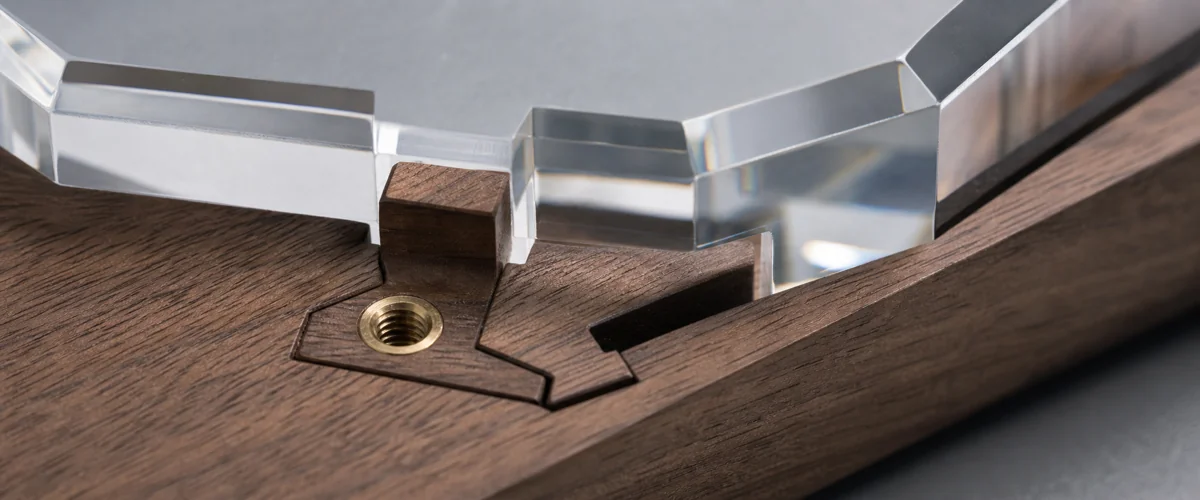
Dovetail joinery solves both problems because the mechanical interlock carries the load. The glue inside a dovetail is a secondary bond — a sealant against humidity migration, not the primary structure. We machine the dovetail on the wood base with a 7-degree taper and a matching female channel on the acrylic upper, then dry-fit before any adhesive touches the joint. Labor runs 8–12 minutes per piece on top of base machining, but the failure rate over three years of tracked international shipments sits below half a percent1.
Threaded brass insert is what I recommend for any program where the award is expected to outlast the recipient’s tenure. We bond a brass insert into the wood base with two-part epoxy on a 24-hour cure, then the acrylic upper pulls down onto it with a hidden machine screw routed through a counter-bored channel. The joint is fully reversible — which sounds like a strange feature on a recognition award until you realize the acrylic engraving can be replaced without scrapping the base. We’ve done this on two service-tenure programs where the same base supports a new upper at 10, 15, and 20 years.
Wood species — what each communicates
The wood species is a message before it’s a material. Picking by what’s in stock at a generic furniture wood supplier is how your program ends up with mahogany on a tech-forward innovation award and oak on a luxury executive recognition piece — both technically fine wood, both wrong for the brief. Across the hybrid programs we’ve run, four species cover roughly 90% of premium B2B award work, and each one carries a different signal.
- American black walnut ($7–10 per 4-inch base in raw stock) — executive gravitas, dark and refined. Default premium pick for board awards, executive recognition, and company-milestone pieces. Pairs cleanly with both clear and frosted acrylic.
- Hard maple ($5–7) — modern, light, tech-forward. Right for innovation awards, tech-sector kickoffs, and design-led brands. Photographs well under stage lighting and takes laser engraving sharply.
- White ash ($5–7) — performance, athletic, structural. Open grain holds high-contrast laser engraving; signals strength. The pick for sports awards, performance recognition, and manufacturing programs.
- American black cherry ($6–9) — warmth, tenure, patina-over-time. The right species for 10/15/20/25-year service awards, retirement gifts, and family-business recognition. Color deepens with age, which matches the long-service narrative.
Walnut is the default I push hardest when a brief mentions “executive” or “board.” The dark grain reads as deliberately curated, and the contrast with a clear or frosted acrylic upper is what makes the photograph land on internal communications channels. Maple reads as the opposite — light, modern, Scandinavian — and works for innovation programs where the message is forward-looking. We ship maple on roughly a third of tech-sector kickoff awards.
Ash is the underused species. The open grain holds laser engraving with sharper contrast than walnut or maple because the engraver’s heat scorches the harder rays and leaves the softer rings cleaner — the result reads almost like calligraphy. Cherry is the species we recommend whenever a program timeline runs more than five years, because cherry deepens visibly over the first 18–24 months and that aging is itself part of the recognition. A 10-year service award in cherry looks meaningfully different at year three than at year zero. That’s a feature.
For Forest Stewardship Council certified stock — which most enterprise sustainability programs now require at PO stage — all four species are widely available with chain-of-custody paperwork, typically at an 8–12% material premium over uncertified stock2. We supply FSC documentation with every certified-wood quote because procurement audit is otherwise where program timelines slip.
Cost spread — when hybrid pays off (and when it doesn’t)
The honest answer on cost is that hybrid wood awards with acrylic uppers cost more than pure acrylic — and the premium is worth paying on some programs and not on others. Pulled from our last three quarters of quotes on identical geometry (4-inch base, 6-inch acrylic upper, single-line laser engraving, branded foam-fitted boxes):
- At 50 units: pure cast acrylic runs $38 per piece; hybrid with dovetail joinery runs $58; hybrid with threaded brass insert runs $64. Premium over pure: +53% to +68%.
- At 100 units: $32 / $46 / $51 per piece. Premium: +44% to +59%.
- At 250 units: $26 / $32 / $36 per piece. Premium: +23% to +38%.
- At 500 units: $22 / $26 / $29 per piece. Premium: +18% to +32%.
Two patterns matter. First, the per-piece premium drops sharply as volume rises because the wood-base CNC program is a fixed setup cost — once we’ve programmed the toolpath, machining the 251st piece costs almost the same as the 51st. At 250+ units, the cost gap narrows into a range where hybrid is no longer a meaningful budget question. Second, the threaded-insert premium over dovetail is consistent at roughly $5–6 per piece across all tiers — worth it for international shipments and multi-year service programs, less critical for a one-time domestic event.
Where hybrid does not pay off:
- High-volume employee anniversary programs at 1,000+ units, where per-piece psychology matters less than your total budget envelope. Pure clear acrylic still wins on cost without losing the recognition message.
- Programs where engraving is the primary visual element. If your brief is “we want to engrave a long citation,” the eye goes to the text, and the acrylic substrate alone delivers without the cost overhead of wood.
- Programs with a four-week or shorter timeline where wood-base CNC programming and finish curing become the bottleneck. Pure acrylic ships faster.
Where it does pay off — consistently across the programs I’ve run since 2014 — is anywhere your recipient is a senior leader, the program is part of a multi-year recognition strategy, or the award is expected to live on a desk longer than the next quarterly reset. For the production engineering behind dimensional brand elements that pair with hybrid awards (logos, monograms, sculptural uppers), see our 3D acrylic letters case study on dimensional logo signage.
The wood awards conversation almost always starts with a photo and ends with the question of which joinery and which species fits the program. Send your award program brief — quantity, distribution, sustainability requirements, timeline — and we’ll come back with a joinery recommendation, an FSC paperwork option, and a per-piece quote broken out by volume tier within two business days. For reference on how recognition and signage programs have run end-to-end through our floor, our case studies archive covers the closest adjacent build types — dimensional logos, trophy locking displays, and trade-show award pieces.
Related guides
- Acrylic Mirror Sheet: How Mirror Finish Performs in Cosmetics Display
- Cast Acrylic Sheets — Why Cast Wins for 3D Letter Sign Manufacturing
Footnotes
-
ASTM D905 — Standard Test Method for Strength Properties of Adhesive Bonds in Shear by Compression Loading — the wood-adhesive bond strength test method underlying the joinery pull-test data presented in the joinery comparison section. ↩
-
Forest Stewardship Council — FSC Chain of Custody Certification — the certification standard governing traceable hardwood sourcing referenced in the wood species section, including the chain-of-custody paperwork that enterprise sustainability programs require at PO stage. ↩
Frequently Asked Questions
Are wood and acrylic awards more durable than pure acrylic awards?
It depends on the joinery, not the materials. A pure cast acrylic award has no joint to fail — drop it on a hard floor and it chips or cracks but stays in one piece. A poorly joined hybrid splits at the wood-acrylic interface long before either material itself fails. With a properly machined dovetail or threaded brass insert, the joint actually outlasts the surrounding material. We pull-test every new joinery design before quoting it on a program, and the working rule is: if the joint fails first, the design is wrong. If the wood or acrylic fails first, the joint is doing its job.
What wood species works best for premium corporate awards?
Walnut is the default for executive-tier programs because the dark grain reads as gravitas and pairs cleanly with both clear and frosted acrylic. Maple is the choice when the brand wants light, modern, and tech-forward — it photographs well under stage lighting and matches a lot of West Coast and Northern European visual language. Ash is the sports and performance pick because the open grain holds laser engraving with strong contrast. Cherry warms over time and signals tenure, which is why we see it on retirement and 25-year service awards. Picking by what's in stock instead of by what the program actually says is the most common mistake I correct on first calls.
How do you join wood and acrylic without visible glue lines?
Three working methods. Dovetail joinery is invisible from the outside because the interlock sits inside the joint volume — it's labor-intensive to machine but produces the cleanest finish. Threaded brass insert (or stainless, for sustainability programs) hides under the upper's footprint and pulls the two halves together with a hidden screw — invisible from any normal viewing angle. Cyanoacrylate or epoxy glue alone almost always shows a haze line at the interface within months as the bond ages and humidity cycles. We use glue only as a secondary bond inside a dovetail or insert assembly, never as the primary joint on a premium award.
What's the price difference between a pure acrylic award and a hybrid wood-and-acrylic award?
At 50-piece volumes, expect roughly 35–55% more per piece for hybrid construction once the wood-base CNC program, joinery prep, and finish-coating labor are added. At 100 pieces the gap narrows to 25–40%. At 250+ pieces, where the wood-base CNC program fully amortizes, the gap is more like 15–25%. The cost driver is not the wood material itself — walnut, maple, ash, and cherry at award sizes run $4–$10 per piece in raw stock — it's the second machining setup and the joinery labor. Programs above 100 units are where the per-piece premium becomes negligible relative to the perceived-value lift.
Do hybrid wood and acrylic awards ship internationally without joint damage?
Yes — with the right joinery and packaging. Glue-only joints fail in air freight cargo holds where temperature can swing 40°C between tarmac and altitude, especially on transpacific routes. Dovetail and threaded brass insert assemblies survive those cycles because the mechanical joint carries the load when adhesive softens at altitude. We ship every hybrid award in custom-cut closed-cell foam with the wood and acrylic supported separately, then mechanically interlocked — not sitting on the joint under their own weight. Across the international award programs we've shipped over the last three years, joint damage in transit on threaded-insert assemblies sits at zero pieces; on glue-only competitor work I've seen replaced, it runs around 3–5% of the carton.
Planning a tier-1 recognition program?
Send the program brief — quantity, distribution use case (podium, desk, mailed), wood species preference (or let us match to the message), and any sustainability requirements. We'll come back with a joinery recommendation, FSC paperwork option, a sample plan, and a quote with the per-piece cost broken out by volume tier.