How to Buy an Acrylic Box With Lid That Fits
The phrase names a shape, not a spec. The box that works is decided by four choices the phrase hides — lid format, fit clearance, wall thickness, and how often the lid comes off.
Key Takeaways
- Pick the lid by opening frequency, not by looks: lift-off for occasional access, sliding or hinged for daily access, magnetic when the opening moment is part of the presentation — dust protection and convenience pull in opposite directions.
- A lift-off acrylic lid runs on roughly 0.3–0.5 mm of clearance per side: cut tighter it binds when temperature and humidity move the panels, cut looser it rattles and sits crooked.
- Wall thickness follows box size, and the lid follows the wall: 3 mm suits boxes under about 200 mm, 5 mm is the workhorse for retail sizes, and any box over about 450 mm on a side should step to 8 mm or thicker.
- Hinged and magnetic lids add hardware plus assembly labor; lift-off and sliding lids are cut geometry only — on a tight budget, spend on wall thickness before closure hardware.
- For bulk orders, the MOQ is 100 pieces per design, samples ship in 3–5 days, and the sample is where lid fit gets confirmed before the 15–20 day production run.
On this page
Buyers ask for a lid; the quote needs a format
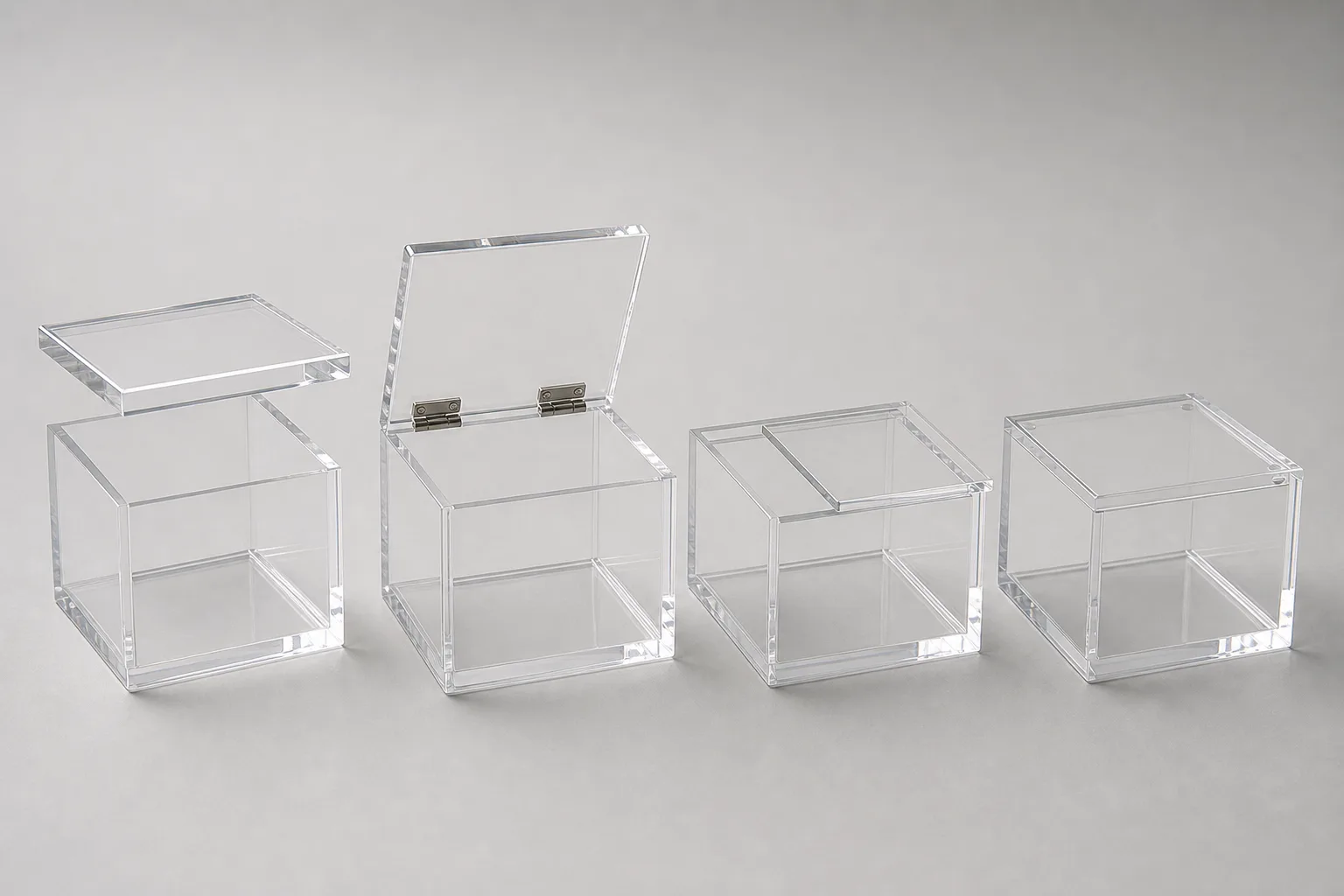
An acrylic box with lid is any clear PMMA box closed by a removable or attached top, and the phrase covers four different builds: lift-off, hinged, sliding, and magnetic. Buyers who ask for “a box with a lid” are really choosing among those four — and the right one is decided by how often the lid comes off.
A lidded-box RFQ can reach my line with the size and the color fully specified and still be missing the piece that decides the build: what the lid actually does in use. “Acrylic box with lid” is the most common phrasing we see, and it is a shape, not a spec: it does not say whether the lid comes off ten times a day or twice a year, whether it must keep dust off archived product or open one-handed at a sales counter, or whether the unboxing is part of a gift moment. Each answer points at a different build, a different fit, and a different price.
This guide is the decision path, not the catalog. It walks the four lid formats and what each is for, what “fits well” means in millimeters, the dust-versus-access trade that actually drives the choice, how to pair box size with wall thickness, and what changes when you buy 500 instead of 5. If you want the cost mechanics of every closure variant — including snap-fit, lockable, and gasketed builds — our acrylic box lid and closure types guide prices each one; this page is about choosing.
The four lid formats, compared
The four standard formats for an acrylic box with lid are lift-off, hinged, sliding, and magnetic. Lift-off is the simplest and lowest-cost; sliding keeps the lid captive without hardware; hinged and magnetic add hardware and assembly labor in exchange for one-handed opening and a premium feel.
| Lid format | How it works | Best for | Access pattern | Cost logic |
|---|---|---|---|---|
| Lift-off | Loose lid with a lip or rabbet seating over the walls | Display covers, collectibles, storage | Occasional, full open | Lowest — a second cut part, no hardware |
| Sliding | Lid panel slides in grooves cut into two walls | Counter boxes staff open daily, dispensing | Frequent, partial open | Low — groove machining only, lid never leaves the box |
| Hinged | Lid bonded to metal or plastic hinges at the back edge | Presentation cases, counter service, POS | Frequent, one-handed | Medium — hinge hardware plus alignment and bonding labor |
| Magnetic | Embedded magnet pairs inset into lid and wall | Gift boxes, retail unboxing, premium kits | Moderate, presentation-first | Medium-high — magnets inset and bonded during assembly |
If you want the shortcut version: three questions collapse the table to one row. Does the lid come off more than a few times a day? If yes, sliding or hinged — a lift-off lid that gets set down forty times a shift will be scratched by Friday. Is the opening moment part of what you are selling — a gift, a subscription kit, a jewelry presentation? If yes, magnetic, because the soft pull-and-release close is the point — the hidden magnetic-catch builds on our acrylic gift boxes page are where that unboxing moment gets specified. Neither? Lift-off, and put the savings into wall thickness or edge polish, where a customer can actually see them.
Two production notes that change how you read the table. First, acrylic cannot form a one-piece flex hinge the way a polypropylene case can — PMMA is a rigid material with an elongation at break around 4%, so a section thin enough to fold cracks instead of flexing.1 Every hinged acrylic box therefore uses attached hardware, which is why the hinge column carries real cost. Second, sliding lids are the underrated middle option: the lid stays captive (nothing to set down, lose, or drop), yet the build is pure machining with no hardware — on my lines it prices much closer to lift-off than to hinged.
Fit and clearance: what “snug” means in millimeters
A lift-off lid on an acrylic box runs on roughly 0.3–0.5 mm of clearance per side. That number is the compromise between two failure modes: cut tighter, the lid binds when temperature and humidity move the panels; cut looser, the lid rattles, sits crooked, and feels flimsy the moment a customer touches it.
Clearance is where lidded boxes are won and lost on my production floor, because acrylic is not dimensionally frozen. Panels expand and contract with temperature and take up small amounts of moisture, and sheet stock itself arrives with thickness variation inside the manufacturer’s published tolerance band. A lid machined to a perfect zero-gap fit in a 22°C workshop is a lid that sticks in a 35°C warehouse in July. The working clearance absorbs all of that movement while staying small enough that the lid self-centers instead of slopping.
Sliding lids tighten the requirement further: the groove must clear the lid panel’s real thickness — including that sheet-stock variation — across every piece in the run, which is why groove dimensions come from measuring the actual production sheet batch, not from the nominal number on the order. The practical takeaway for a buyer is simple: state what the fit must feel like (“lid seats with light friction, no rattle”) and confirm it on a physical sample. Our samples ship in 3–5 days, and on lidded boxes the sample exists mostly to answer exactly this question before 500 units inherit the answer.
Dust protection vs access: the real trade
Every acrylic box with lid sits somewhere on one axis: sealed against dust at one end, instantly accessible at the other. You cannot maximize both — every step toward a tighter, more protective closure adds friction to opening, and every step toward easy access opens a path for dust. Pick your point on the axis first; the lid format follows.
Think in terms of what the box actually protects and how often a hand goes in. A collectible or memorabilia piece under a display cover might be touched twice a year — protection wins, so a close-fitting lift-off lid (or a fully closed five-sided cover) is right, and the slight ceremony of lifting a lid costs nothing — that pattern is the lidded end of our clear acrylic boxes range, where optical clarity is the reason the cover exists at all. A counter box that staff reach into forty times a shift flips the math: a sliding or hinged lid that opens one-handed and can never be set down somewhere and scratched is worth far more than a marginally better dust seal.
One mismatch has repeated more than any other since I began running production in 2014: a beautiful tight-sealing box specified for a high-traffic counter. The samples get approved because a snug lid feels like quality in the hand — and three weeks after delivery the store staff have simply stopped putting the lid back, because a two-handed, careful-alignment closure loses to a busy shift every time. The box then protects nothing. If real people open it many times a day, an easy lid that gets used beats a tight lid that gets left off — spec for the shift, not for the showroom.
Two honest limits are worth naming. First, no standard lid format is airtight — a well-fitted lid stops settling dust, which is what display and retail use needs, but the hairline gap that makes a lid liftable also passes air, humidity, and fumes. Contents that need sealed protection need a gasketed build, requested explicitly. Second, the trade shows up in cleaning: boxes opened rarely accumulate fingerprints on the outside, not the inside, so an occasional-access box mostly needs its exterior wiped — one more reason the simple lift-off format dominates display work.
Pair the size with the wall thickness
Wall thickness follows box size, and the lid follows the wall. As a working rule: 3 mm walls suit an acrylic box with lid under about 200 mm on its longest side, 5 mm covers the retail and display range up to about 450 mm, and boxes beyond that step to 8 mm or more. An undersized wall shows up as bowing; an undersized lid shows up as flex every time it is handled.
The physics is on the buyer’s side here, because panel stiffness rises with the cube of thickness — a 5 mm panel is roughly 4.6 times stiffer than a 3 mm panel of the same span, for a material cost increase that is only linear. Acrylic sheet’s flexural modulus of about 3,350 MPa is what those stiffness numbers are computed from.2 In practice that cube law means the 3-to-5 mm step is the best value-per-dollar upgrade on any box that flexes, and it is almost always lower-cost than adding reinforcing geometry. For the full span-deflection math and per-thickness cost curves, see our acrylic box wall thickness guide.
The lid deserves the same arithmetic, and one specific warning: a lid spans the box’s full opening with no supporting walls under it, so it is often the least stiff panel in the build even at the same thickness. Matching the lid to the wall thickness is the floor; on wide lift-off lids (anything past roughly 350 mm of unsupported span), stepping the lid one gauge above the walls keeps it from oil-canning when lifted by one corner. A lid that flexes reads as fragile even when it is not — and on a presentation box, the lid is the one part every customer handles.
Finishing and branding: the lid is the billboard
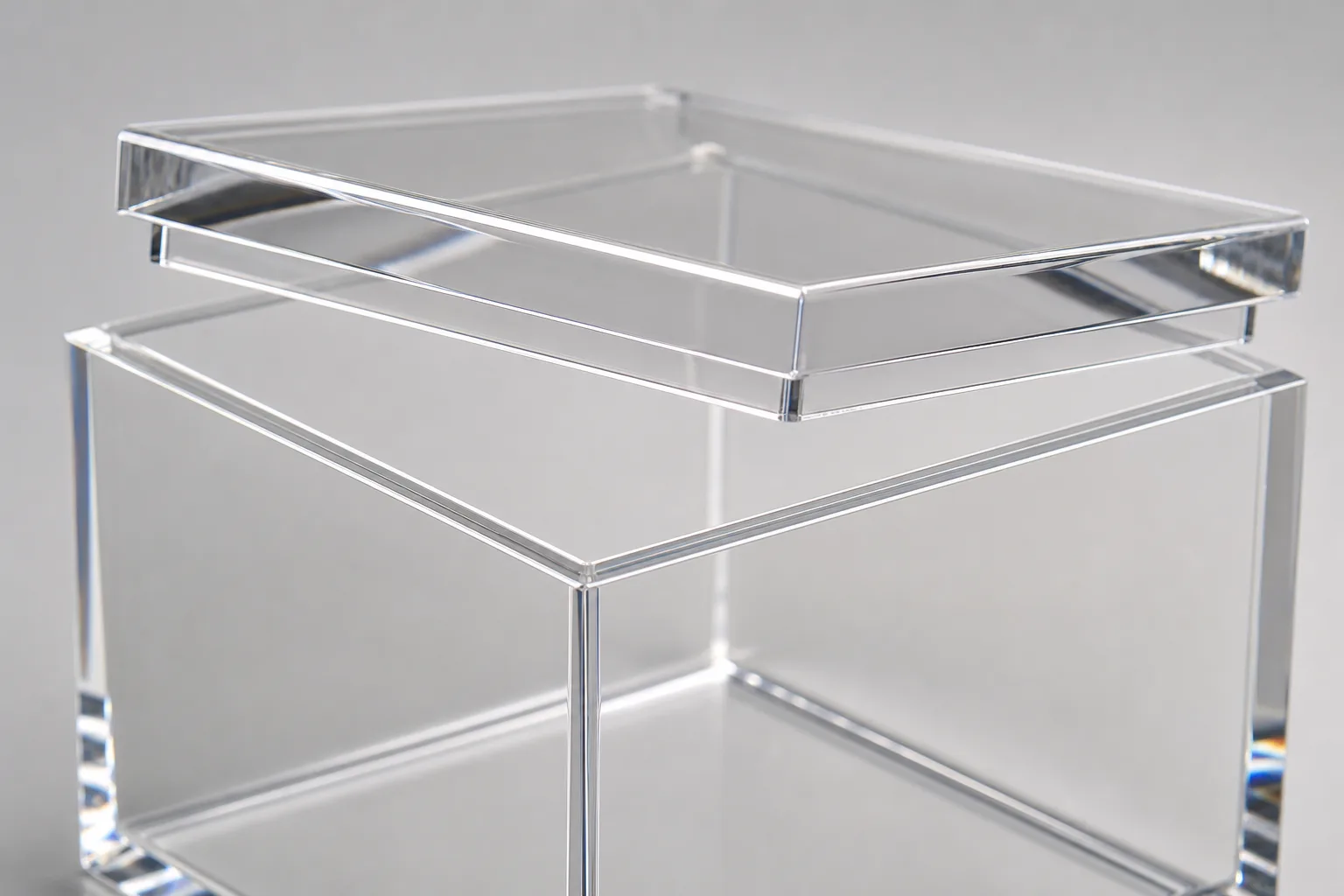
On an acrylic box with lid, finishing decisions concentrate on two surfaces: the edges, which decide whether the box reads as premium or as a plastic bin, and the lid face, which is where logos and artwork live because it is the surface a customer sees first and touches most.
Edges first, because they are non-negotiable on clear material. Every visible edge on a lidded box is a cut edge, and a cut edge ships in one of three states: saw-cut (frosted, visibly toolmarked — acceptable only where hidden), flame-polished (heat-glossed, clean and cost-effective for straight runs), or diamond-polished (machined optically flat, the standard for gift and presentation work). On a lift-off lid the lip’s lower edge sits at eye level on a counter, so it is worth naming the polish level for that specific edge in your RFQ rather than writing “polished edges” and hoping.
Branding rides the lid. UV printing puts full-color artwork directly on the acrylic — logos, patterns, edge-to-edge graphics — while laser engraving cuts a permanent frosted mark that cannot scratch or peel, and works beautifully backlit or against dark contents. Colored and frosted sheet, tinted lids over clear bodies, and custom Pantone-matched colors (a one-time $200–300 match per color) all run in the same production flow. The one production caution I give every buyer: print and engraving happen on flat panels before assembly, so artwork must be locked before bonding starts — a logo change after assembly means remaking parts, not reprinting them. The full menu of printing, engraving, and color options is on our customization page.
Buying in bulk: what changes at 50, 500, 5,000
Bulk changes three things about an acrylic box with lid: the price curve, the consistency requirement, and the packaging. The MOQ is 100 pieces per design with no tooling fees at any volume — acrylic boxes are CNC- and laser-cut, not molded — so volume savings come from sheet nesting and setup amortization, and lid fit must repeat across every unit in the run.
Consistency is the bulk-specific engineering problem. One lidded box that fits well is craftsmanship; 2,000 that fit identically is process control — sheet batches measured before grooves are cut, fixtures holding lid geometry constant across the run, and a 100% inspection where lids are seated on their own boxes before packing (we run every order through that check in our ISO 9001 system). This is why the approved sample matters more on lidded boxes than almost any other product: it freezes “correct fit” as a physical standard the entire run is judged against. The boutique gift-box manufacturing plan maps a prospective magnetic-lid program from drawing and sample approval through inspection and packing release.
Packaging is the last line to spec, and lids give it a twist: a loose lift-off lid shipped seated on its box will micro-scratch against it in transit unless the two are interleaved with paper or film. State whether units ship assembled or with lids packed separately, and whether the box needs retail-ready packaging of its own. Standard terms run 3–5 days for samples, 15–20 days for production, and 30% deposit with the balance before shipment. When you are ready to spec one, start from our custom acrylic boxes hub — or go straight to clear acrylic boxes if optical clarity is the point of the build — then send us your dimensions, lid format, and quantity; we quote within 24 hours.
Footnotes
-
Polymethylmethacrylate (PMMA / Acrylic) material properties — MakeItFrom — material database entry showing PMMA’s elongation at break of 4.0%, the rigidity figure behind why acrylic boxes use attached hinge hardware instead of one-piece living hinges. ↩
-
OPTIX general purpose acrylic sheet — Plaskolite product data sheet (PDF) — Plaskolite OPTIX acrylic sheet product data sheet — flexural modulus 3,350 MPa (ISO 178), the stiffness value the wall-thickness and lid-span guidance in this guide is computed from. ↩
Frequently Asked Questions
Which lid type is best for an acrylic display box?
Match it to access. A box opened rarely — collectibles, memorabilia, dust covers — wants a lift-off lid: simplest, lowest-cost, and the full opening makes occasional access easy. A box staff open daily wants a sliding or hinged lid so the lid never leaves the box and never gets set down. A gift or retail unboxing wants magnetic: clean look, soft close, no visible hardware.
How tight should an acrylic box lid fit?
For a lift-off lid, about 0.3–0.5 mm of clearance per side is the working range we cut to. Acrylic panels move slightly with temperature and humidity, so a zero-clearance lid that feels perfect in the factory can bind in a hot warehouse; more than about 1 mm and the lid rattles. Fit-critical lids are confirmed on a physical sample before bulk production.
What wall thickness does an acrylic box with lid need?
Scale it to the longest side: 3 mm for boxes under about 200 mm, 5 mm for typical retail and display sizes up to about 450 mm, and 8 mm or more beyond that. Stiffness rises with the cube of thickness, so the 3-to-5 mm step buys far more rigidity than it costs. The lid should match or exceed the wall — a thin lid on a thick box flexes first.
Do acrylic boxes with lids keep dust out?
A well-fitted lid blocks settling dust, which is what matters for display use — but no standard lid format is airtight. A lift-off or sliding lid leaves a hairline gap by design; that stops falling dust, not humidity or fumes. If contents need sealed protection, that is a gasketed build you should request explicitly, and it trades away the easy access that lids exist to give.
What is the minimum order for a custom acrylic box with lid?
100 pieces per design. Because custom acrylic boxes are CNC- and laser-cut rather than molded, there are no tooling fees at any volume — a 100-piece pilot of a lidded box carries no setup penalty beyond the unit price. Samples ship in 3–5 days, production runs 15–20 days, and the approved sample is the fit standard the whole run is inspected against.
Explore Custom Acrylic Products
Browse product categories to compare formats, materials, and customization options before choosing the closest fit for your project.