Delivered project · Corporate · Brand-Integrated Furniture
200-Piece Acrylic Coffee & Logo Side Table Rollout for a Silicon Valley Tech HQ
A Silicon Valley tech company's facilities director needed 100 clear acrylic coffee tables and 100 logo side tables for a new headquarters campus, with the logo readable from every seat.
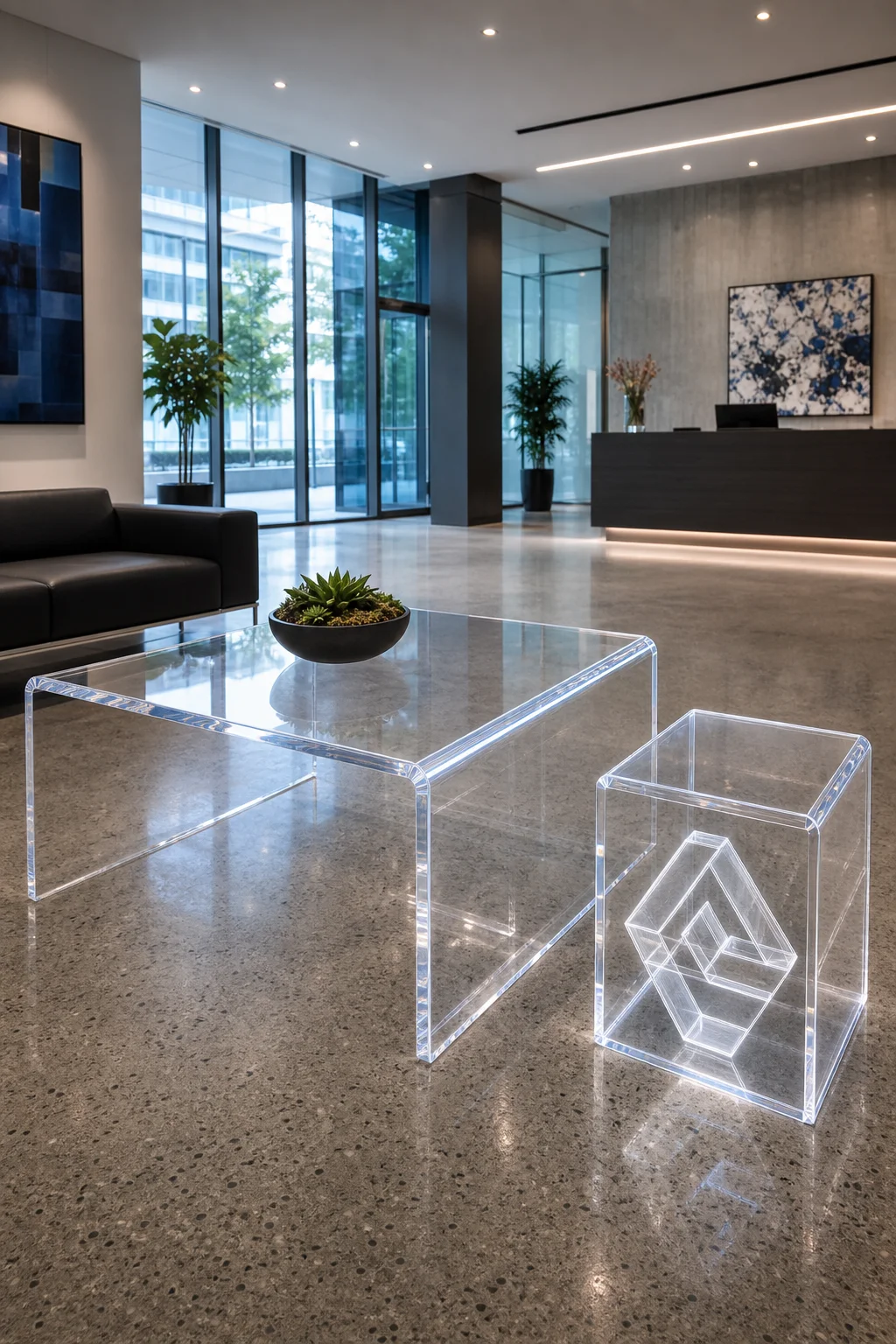
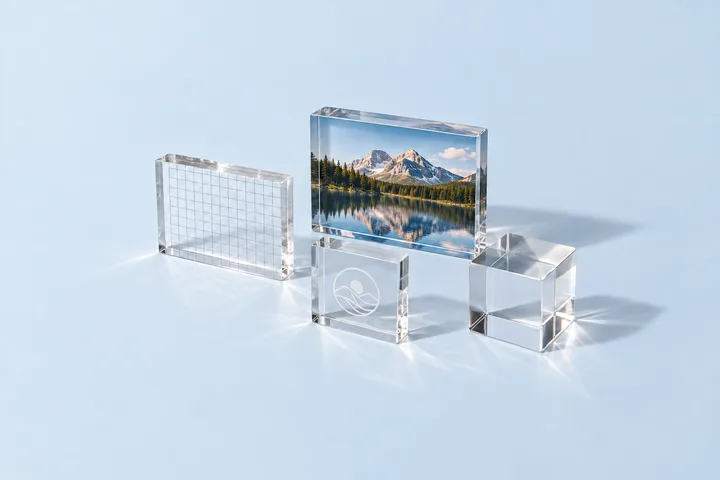
We engraved the logo 5 mm inside 18 mm cast PMMA, added an anti-static coating for the carpeted office, and shipped FOB Shenzhen 20 days after design approval. Six months later we made 100 more side tables for its satellite offices in 14 days. Delivered: 200 pieces with subsurface logo engraving and anti-static coating, a full-size sample approved before production, and a 100-piece reorder from the archived files.
- cast PMMA
- 18 mm
- engrave depth
- 5 mm
- to FOB Shenzhen
- 20 days
Ordering a similar project
New orders start at 100 pieces per design. The paid sample is billed separately and never credited to production. Standard production takes 15–20 days after sample approval.
Key Takeaways
- A Silicon Valley tech company fitting out a new HQ needed 100 clear acrylic coffee tables and 100 logo side tables for the lobby, meeting rooms and breakout lounges of its new campus, with the logo readable from every seat.
- We engraved the logo 5 mm inside 18 mm cast PMMA, so surface wear cannot reach it. Surface engraving in a busy lobby loses edge definition in 12-18 months; the subsurface logo is built to hold for 5+ years.
- We engraved before the final diamond polish, which removed the laser haze around the logo, and finished with an anti-static coating that cut dust by 85% in the carpeted office.
- The order shipped FOB Shenzhen 20 days after design approval. Six months later a 100-piece satellite-office reorder ran 14 days, because we had kept the tooling, laser calibration file and coating spec.
The Challenge
The buyer was the facilities director for a Silicon Valley tech company fitting out a new headquarters. The reception lobby, the meeting rooms and the breakout lounges across three floors each needed acrylic coffee tables and logo-integrated side tables — 100 of each design, 200 pieces total. The company logo had to be visible from every seating angle, which ruled out surface engraving and surface-applied vinyl immediately. Surface engraving collects dust in the grooves and loses edge definition within 12-18 months in a high-foot-traffic lobby; vinyl peels. The spec called for subsurface laser engraving at 5 mm depth inside 18 mm clear cast PMMA — so the logo sat inside the material, out of reach of surface wear.
Two constraints made this harder than a standard furniture order. First, the CEO used these pieces on company tours for investors and press. That meant an executive-level finish: no visible seams, no micro-scratches, no haze around the engraved logo. Second, the office had high-traffic carpet throughout, which builds static charge. Uncoated acrylic on carpet attracts dust within hours of cleaning, and it was the facilities team's #1 maintenance complaint about their old furniture. The buyer asked for an anti-static coating rated for office conditions.
Our Approach
Three production decisions shaped this order: the laser calibration, the anti-static coating, and the order of operations on the line.
Subsurface laser engraving calibration
The laser had to focus exactly 5 mm below the polished surface and ablate material inside the sheet without cracking or hazing the layers above. We ran a power/speed/depth matrix on 18 mm cast PMMA samples: 12 combinations across 3 power levels (40 W, 50 W, 60 W) and 4 speed settings. The winning combination — 50 W at 120 mm/s — produced clean internal ablation with no visible entry-point marks on the surface. Higher power cracked the surrounding material; lower power left incomplete ablation that read as blurry from oblique angles. The calibration file was saved and reused on the satellite-office reorder 6 months later, which cut setup time from 2 days to 4 hours.
Anti-static nano-coating
We applied a permanent anti-static nano-coating (surface resistivity 10⁹–10¹¹ Ω/sq) that dissipates static charge before it can attract dust. Measured after 6 months of use, the tables collected 85% less dust than uncoated acrylic furniture in the same carpeted rooms. The coating is optically clear, so it did not change light transmission or the look of the engraved logo. It bonds to the PMMA during application and held up to the buyer's cleaning routine (microfiber cloth + isopropyl alcohol).
Production sequence: engrave before polish
We ran laser engraving before diamond polishing. Ablation at 5 mm depth leaves a micro-debris haze on the surface. Engraved after the final polish, that haze stays; engraved before it, the polishing pass removes it and the area around the logo stays clear. The difference is visible at arm's length under lobby lighting. The full sequence was: CNC cutting → edge bonding → subsurface laser engraving → diamond polishing → anti-static coating → QC → packaging. The anti-static coating goes on last because it needs a fully polished surface to bond correctly.
Production took 20 days from approved design to FOB Shenzhen: CNC + bonding 6 days, laser engraving 4 days (calibration front-loaded on day 1-2, production engraving days 3-4), diamond polishing 4 days, anti-static coating application + cure 3 days, QC + packaging 3 days. Ocean freight to the US West Coast added 14 days.
Results and the Satellite-Office Reorder
The CEO used the reception coffee tables on an investor tour 3 days after installation. The facilities team reported zero dust-related cleaning escalations in the first 6 months — down from weekly complaints on the uncoated acrylic furniture the tables replaced. The anti-static coating held its 85% dust-reduction performance across both dry winter months (indoor humidity 25-30% RH) and humid summer conditions (55-60% RH), which showed the coating does not depend on humidity the way topical anti-static sprays do.
Six months later the company ordered 100 more logo side tables for its satellite offices. We reused the approved CNC tooling, logo proof, laser calibration file and surface-treatment spec, checked the first-off engraving, and shipped the reorder in 14 days instead of 20. The buyer did not pay to rediscover the same settings.
Project notes: The logo had to read from every seat in the reception area, and the finish had to survive a high-traffic carpeted lobby. We proved both on the full-size sample before production started.
If You're Planning Something Similar
For a logo in clear furniture that sees daily traffic, subsurface engraving outlasts surface engraving and vinyl. Engrave before the final polish: even a shallow 2 mm engraving leaves enough debris to haze a polished surface. A 5 mm engraving needs 18 mm cast PMMA, because the laser needs at least 10 mm of clear material below the focal point; 12 mm stock limits the depth to 3 mm, which reads less well from an angle. On hard floors static matters less, and you can skip the anti-static coating to save cost.
See our custom acrylic coffee tables for sizes and options, and the acrylic furniture design guide for material and thickness selection.
Need brand-integrated acrylic furniture for a corporate space?
Send us your vector logo, furniture dimensions, viewing angles, quantity, room lighting, floor material, cleaning method, destination and installation deadline. We’ll review engraving feasibility and come back with a full-size sample proposal, surface-treatment options, packing and a production schedule.
Full-size sample timing confirmed after drawing review · Production in 15–20 days after approval