


Delivered project · Restaurants · Multi-Location Furniture
Fine-Dining Restaurant Chain — 12-Location Acrylic Furniture Rollout
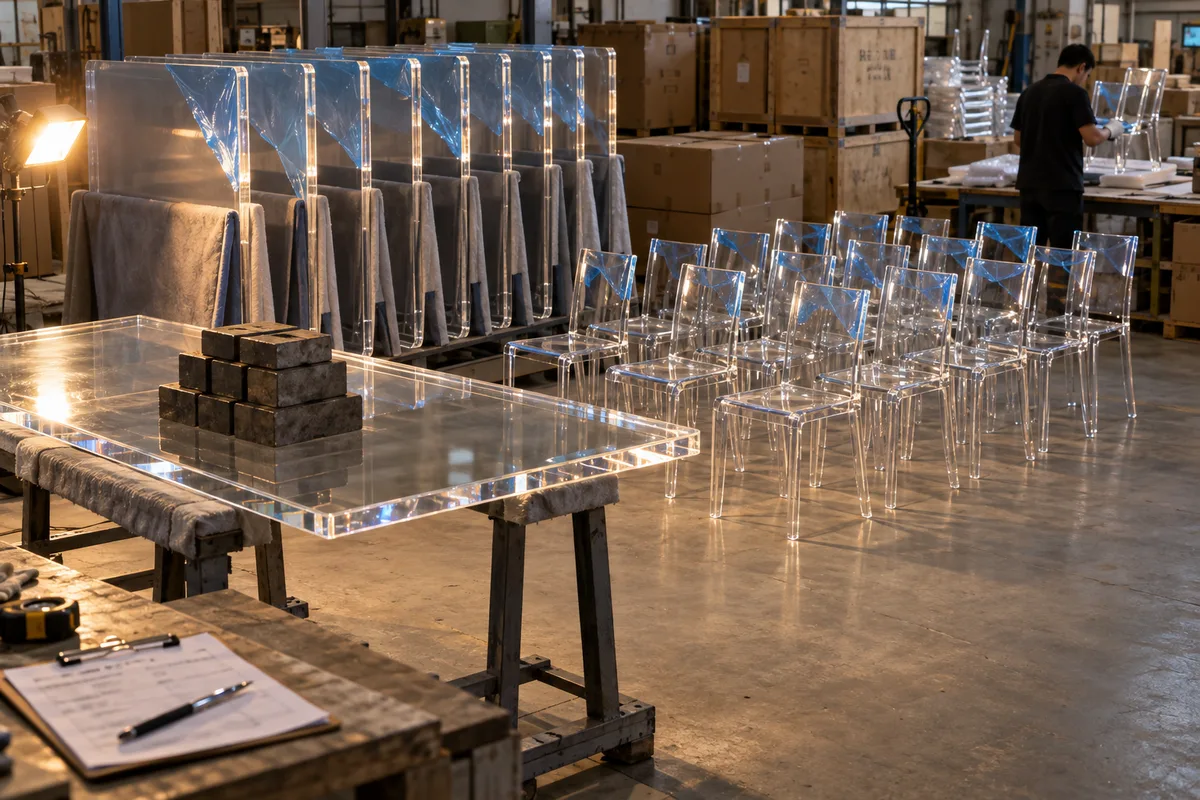
A US fine-dining restaurant group opening 12 locations needed 100 dining tables and 400 chairs in its signature clear acrylic after glass tabletops failed.
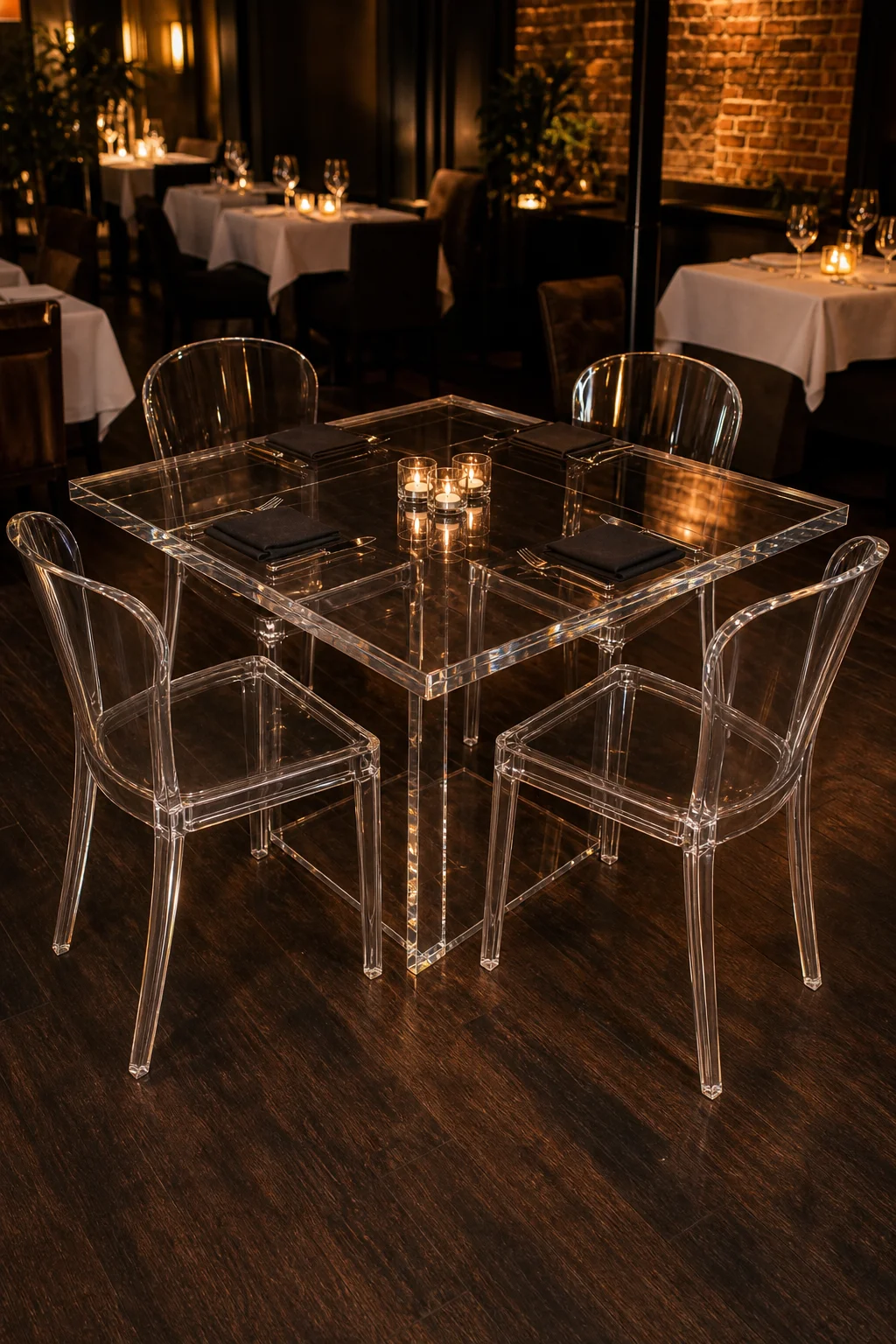
The glass had proved too heavy and cracked in service, and the openings ran on a staggered construction schedule. We built all 500 pieces from one shared tooling library, with 20 mm cast PMMA tops and flame-polished edges, and shipped them in three batches of 180, 160 and 160 pieces timed to each opening. Delivered: 500 pieces for 12 locations in three batch releases, with load, finish and carton checks before each release.
- pieces delivered
- 500
- locations
- 12
- batch releases
- 3
- tabletop vs 23 kg glass
- 5.8 kg
Key Takeaways
- A US fine-dining group opening 12 locations over 3 months needed 100 tables and 400 chairs that matched in every room. We delivered all 500 pieces in 3 batches (180, 160 and 160 pieces), 10 days apart, timed to the construction schedules.
- We replaced the group's 23 kg glass tops with 20 mm cast PMMA tops rated for 200 lb+ center load, enough for guests who lean on, stack plates on and sometimes sit on table edges.
- Every edge got a ≥3 mm radius and a flame polish, so no square edge was left to trap food residue.
- One shared tooling library for all 100 tables and 400 chairs cut per-unit cost by 22% compared with building each location as a separate custom order.
The Challenge
The buyer's operations team was opening 12 fine-dining locations across the US on a staggered construction timeline — 4 locations per month over a 3-month window. Each restaurant needed 8 four-top dining tables and 32 chairs, and the flagship added a private dining room with 4 more tables and 16 chairs, all in the same transparent acrylic aesthetic that had become the brand's signature interior element. That added up to 100 tables and 400 chairs: 500 pieces total, all visually identical across locations.
Their previous attempt used tempered glass tabletops. Two problems killed the glass approach inside the first 3 locations. Weight: a 1200 × 800 mm glass top at 12 mm thickness weighed 23 kg, making table rearrangement for private events a two-person job. Breakage: 6 tabletops cracked during the first 14 months of service — thermal shock from hot plates placed directly on cold glass, plus edge chips from chair contact during nightly floor resets. Replacement lead time ran 4-6 weeks per table because the glass supplier couldn't hold inventory for a custom size.
The switch to acrylic had to solve both problems while adding a third constraint: food-contact safety. Square-edge acrylic creates micro-abrasion points that trap food residue and resist standard sanitization — unacceptable in a fine-dining environment where health inspectors audit surface finish. Every edge on every piece needed ≥3 mm radius with flame-polished finish. And the delivery schedule had to match 12 different construction timelines, not a single bulk shipment.
Our Approach
Three engineering decisions shaped this order: load capacity, food-safe edges, and batch scheduling across 12 staggered delivery windows.
Load engineering — 200 lb+ table, 250 lb chair
Restaurant tables take abuse that home furniture never sees: guests lean on edges, stack plates, set down handbags and sometimes sit on corners. We made the tabletops from 20 mm cast PMMA at 1200 × 800 mm, rated for 200 lb+ center load against the BIFMA X5.5 commercial dining standard. The thickness-to-span ratio gave a 3.2× safety factor over the rated load, enough headroom for the edge loads that cause failures in service.
The acrylic chairs needed a different load profile. We built them for 250 lb static capacity with a 15 mm seat pan and leg-to-seat joints reinforced with solvent-bonded cradle brackets. The chairs gave 2-3 mm under full load — enough to feel natural without triggering the "is this going to break" anxiety that rigid acrylic chairs sometimes create. For the structural engineering principles behind these load ratings, our acrylic legs load engineering guide covers the math in detail.
Food-safe edge treatment
Every edge on every piece — table perimeters, chair armrests, seat edges, leg bottoms — received ≥3 mm radius routing followed by flame polishing. The radius eliminates the micro-abrasion pockets that square-edge acrylic creates at the material boundary, where food residue collects and resists wipe-down cleaning. Flame polishing after routing seals the surface to optical clarity, producing a finish that passes the cotton-swab drag test health inspectors use for food-contact surfaces.
The edge work added 12 minutes per piece compared with square-cut-and-polish, 100 extra hours across 500 pieces. The buyer accepted that cost because its restaurants are audited on surface finish.
Batch scheduling — 3 runs synchronized to construction
A single 500-piece production run would have been more efficient on the factory floor, but the buyer's 12 locations weren't opening simultaneously. Shipping all 500 pieces to a warehouse and redistributing would have added handling damage risk and $8,000-$12,000 in domestic logistics. Instead, we split production into 3 batches of 180, 160 and 160 pieces (4 locations per batch; the first batch also carried the flagship's private-dining set), 10 days apart. Each batch shipped by ocean freight on a 21-day sailing and arrived 3-5 days before those locations' soft openings.
The shared tooling library made this practical. All 100 dining tables and 400 chairs used the same CNC jig set — table routing jig, chair seat mold, leg-bending template. Building the tooling library once and running it across 3 batches reduced per-unit cost by 22% compared to treating each location as an independent custom order. We archived the tooling library at our facility, and the buyer has since used it twice for replacement pieces at 2 locations. Replacements run 10-12 days, against the original 30-day production run.
Results Across 12 Openings
Before each batch left, we recorded structural-load results, joint condition, surface finish, edge condition and carton integrity. The buyer logs damage and maintenance by location against that record.
Weight reduction changed the operational workflow. Each 1200 × 800 mm acrylic tabletop weighs 5.8 kg vs 23 kg for the glass equivalent — a 75% reduction that turned table rearrangement from a two-person lift into a one-person slide. The buyer's floor managers reported that private-event reconfigurations dropped from 45 minutes to 15 minutes per dining room, which directly freed staff labor on their highest-revenue service nights.
Project notes: We tracked load checks and per-location counts for every batch as closely as the buyer tracked its 12 construction schedules.
If You're Planning Something Similar
For restaurant furniture, settle load and edges first. Tables that take less than a 200 lb+ center load, or chairs under 250 lb static, tend to show their first structural failure within 8-12 months of daily service. Square-edge acrylic looks clean in a showroom but fails the cotton-swab drag test, so budget for the radius and flame polish. Catalog specs assume home use; ask for a load test report based on your own table dimensions and use.
For several locations, build the tooling once and run it across batches. See our custom acrylic dining tables, and our custom acrylic fabrication process, which starts from your load profile and works back to thickness and joints.
Rolling out acrylic furniture across multiple restaurant locations?
Send us your location count, table and chair dimensions, expected loads, floor and cleaning conditions, destinations and construction milestones. We’ll come back with a structural sample proposal, edge specification, shared-tooling quote, batch schedule, packing method and per-unit pricing.
Full-size sample timing confirmed after drawing review · Production in 15–20 days per approved batch