Case Study · Trade Shows & Exhibitions · North America
Acrylic Trade Show Display for CES: 14-Day Rush for a Series B SaaS Startup
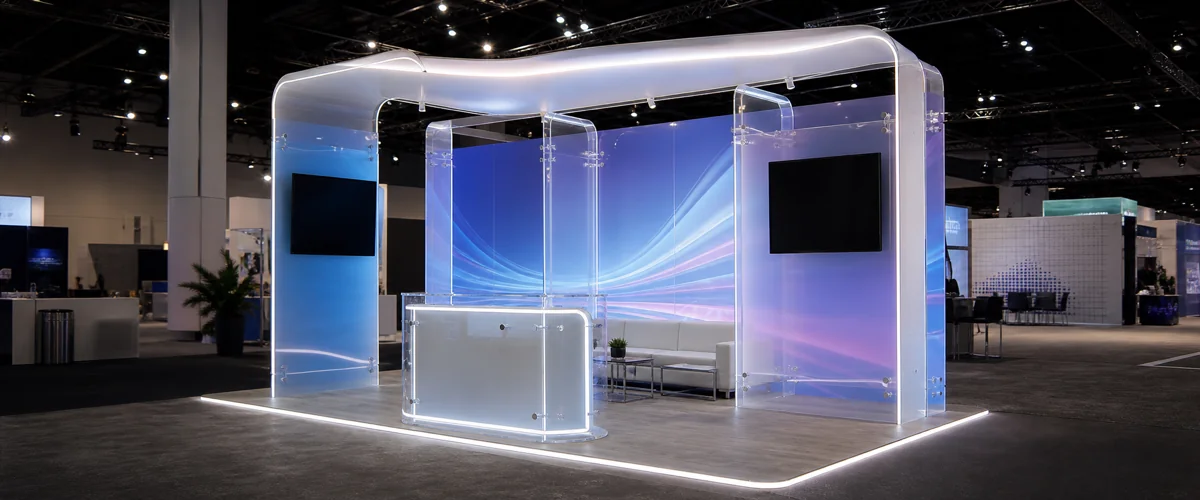
A first-time CES exhibitor — a Series B B2B SaaS startup — needed a brand-grade acrylic trade show display on a 14-day clock and a budget that had to stretch across three shows. We engineered a modular flat-pack: 8mm cast-acrylic LED-edge ribbon, tool-less aluminum cammed joinery, back-printed brand panel. One freight crate. 38 minutes on the floor. Three shows planned.
- rush production
- 14 days
- freight crate
- 1
- on-site assembly
- 38 min
- reuse plan
- 3 shows
Key Takeaways
- Modular flat-pack reduced freight from $4,200 (custom-fabricated booth in 3 crates) to $980 (single crate, air freight) — 77% freight savings before considering reuse value.
- Tool-less aluminum-cammed joinery let 2 booth crew assemble the entire stand in 38 minutes on the CES floor — vs 4–6 hours for the typical fabricated booth in the same square footage class.
- 8mm cast acrylic over 5mm extruded for the LED-edge ribbon panel: extruded would have shown visible ripple under direct LED, ruining the brand-panel aesthetic that anchored the booth.
- Brand panel back-printed (vs front-applied vinyl): survived 3 days of CES traffic without smudge or scratch — front-applied vinyl typically requires same-show touch-up by mid-day 2.
- 3-show reuse plan locked in before CES install — startup is taking the same flat-pack to SaaStr (May) and Web Summit (October) on a single rebrand-panel swap.
The Brief
The buyer reached out 16 working days before CES move-in. They were a Series B B2B SaaS startup, first-time CES exhibitor, with a 10×10 booth on the show floor and a Series B announcement they wanted the booth to carry. The original plan had been a fabricated wood-and-laminate custom booth from a US exhibit house — quoted at the booking deadline, then quietly delayed out of the schedule when the design house couldn't hold the install date.
By the time the buyer reached us, three things had narrowed the choice:
- 14 calendar days from PO to crate-on-truck. CES move-in waits for nobody, and their backup plan was a generic table-top pop-up that wouldn't carry the Series B story.
- Budget across 3 shows, not 1. Marketing had locked CES, SaaStr (May), and Web Summit (October) into one fiscal-year line. The booth had to amortize across all three — single-use fabricated wasn't viable.
- Brand-grade finish, not "trade show grade." They were announcing a $48M Series B. The booth had to look like a product page, not a job-fair table. According to TSNN's most recent booth-budget benchmarks, first-time tech exhibitors at CES spend a median of $185–$240 per square foot on fabricated 10×10 booths — and most of that is freight, install, and dismantle, not the materials a buyer ever sees.
The brief, as we wrote it back to them on the kickoff call: "A modular trade show display the founder is willing to be photographed in front of, that two booth crew can put up without tools, that fits in one crate, and that we can ship by air."
My Recommendation
we walked the buyer through three options on the kickoff call: ship the original fabricated design through a partner exhibit house (impossible at 14 days), spec a rental modular system from a CES-floor rental company (fast but generic — same booth their three nearest competitors would also be renting), or build a custom modular flat-pack acrylic stand we'd engineer in-house for tool-less assembly and air freight.
we recommended the third — and was direct about why. We've shipped trade show display stands to CES, NRF, and ISA for several years now, and the pattern is consistent: the buyers who regret their booth on day 3 are the ones who optimized for "looks like the render" without accounting for assembly time, freight cube, and reuse. The buyers who don't regret it chose a system, not a sculpture.
Modular flat-pack over custom fabricate
A custom-fabricated booth is built to one floor plan and one brand. When it ships, it ships in 2–3 crates because the panels are pre-laminated and rigid. When it installs, it needs tools, a level, and 4–6 hours of two-crew labor. When the show ends, it goes back into 2–3 crates and ships home — assuming nothing was scratched in dismantle.
Modular flat-pack inverts every one of those constraints. Panels ship flat, joinery is tool-less, and the rebrand cost between shows is a single back-printed panel swap rather than a re-fabricate. For a 3-show plan on a Series B budget, the modular flat-pack wasn't just the fastest option — it was the only option that respected the marketing budget.
Tool-less aluminum cam joinery
The joinery decision was where we pushed back hardest on the buyer's first instinct. They'd seen aluminum tube-and-fitting systems at other booths and assumed that was the modular standard. It is — for rental booths. For a custom flat-pack you only assemble three times, tube-and-fitting is wrong: too much hardware, too many small parts to lose on the floor, and a finish that reads "cheap rental" up close.
We specified hidden aluminum cam locks (the same family of joinery used in high-end flat-pack furniture) recessed into the back face of every acrylic panel. Two booth crew align the panels, twist a half-turn cam at each joint with a fingertip, and the panel locks. No drill, no Allen key, no screws.
Back-printed brand panel
Brand finish was the third call. Front-applied vinyl is what most fabrication shops will quote because it's fast and the file handoff is simple. It also smudges, scratches, and peels under three days of CES floor traffic — and the booth crew typically has to touch it up by mid-day 2.
Back-printed (printed on the reverse face of a clear acrylic panel, with the print viewed through the front of the sheet) is the right call for a 3-show reuse plan. The printed surface never gets touched. The viewing surface is just polished cast acrylic, which wipes clean with a microfiber.
Spec Breakdown
Here's the spec we built. Every dimension was driven by either the freight crate envelope or the CES booth's 10×10 footprint — not by what looked good in a render.
| Component | Material / Method | Why this, not the alternative |
|---|---|---|
| Brand panel (2400 × 1200 mm) | 8mm cast acrylic, back-printed | Cast over extruded — extruded shows ripple under LED; back-print over front vinyl — survives 3 shows untouched |
| LED-edge ribbon (perimeter 4.8 m) | 8mm cast acrylic with edge-polished channel + 24V LED tape | Cast acrylic edge-polishes to optical clarity; extruded leaves visible cutter marks under LED light |
| Side panels (2 × 900 × 2400 mm) | 10mm cast acrylic, back-painted brand color | 10mm holds rigid against accidental crew lean; thinner needs cross-bracing that breaks the flat-pack envelope |
| Joinery (16 nodes total) | Recessed aluminum cam locks | Tool-less; 38-min full assembly; survives 3+ assemble/disassemble cycles per spec |
| Freight crate | Single 1300 × 1100 × 320 mm wood crate, foam-lined | Fits standard air-freight pallet envelope; one crate vs three for fabricated equivalent |
we went 8mm cast on the LED-edge ribbon panel, not 5mm extruded, and it's worth saying why plainly: extruded acrylic, even premium-grade, has microscopic surface ripple from the die extrusion process. In ambient room light you don't see it. Push a 24V LED strip into the edge of an extruded sheet at a CES booth and that ripple becomes visible banding across the entire face. We've seen it ruin booths that looked fine in the warehouse.
Cast acrylic is poured between glass plates and has no extrusion ripple. The LED-edge ribbon reads clean from any angle on the show floor. The same cast-sheet spec is what we run across our acrylic display stands range, and the cast-vs-extruded decision itself is unpacked in our cast vs extruded acrylic guide.
Production and Flat-Pack Engineering
14 days for a custom modular trade show display is tight, and we don't pretend otherwise. Here's how we held the line. The day-zero kickoff call locked the spec, the panel sizes, and the LED color temperature in 90 minutes. I refused to leave the call until those three were signed off — every hour of spec ambiguity in the first 48 hours costs a day at the back of the schedule.
Day 1–3 we cast and cut all four primary acrylic panels in parallel: brand panel, two side panels, and the LED ribbon perimeter. Day 4 was edge-polishing on the ribbon (this is the step most rush jobs cut — and it's the step most visible to the buyer's eye on the show floor). Day 5–7 was back-printing the brand panel; we use a dye-sub-style ink set with a 24-hour cure window before the protective backing goes on.
Day 8–10 we machined the 16 cam-lock nodes into the panel back faces. This is the step that makes the booth tool-less, and it's the step where rush jobs go wrong: if the cam-lock recess is off by even half a millimeter, the panels won't seat flush at the joint and the booth reads visibly crooked from across the aisle. We jig every cam-lock node and inspect each one before it leaves the bench.
Day 11–12 was dry-fit assembly in our warehouse. Two of our QC team (not the production team — fresh eyes, simulating the buyer's booth crew) put the booth up and took it down twice. Both runs came in under 45 minutes. Day 13 was crating, foam-cutting to the panel profiles, and an air-waybill handoff to our forwarder. Day 14 the crate was on a Hong Kong–LAX freighter and arrived at the buyer's booth on the CES move-in window.
CES Install and 3 Days on the Floor
Move-in day, two booth crew (the buyer's marketing manager and one contractor) opened the crate at 8:14 a.m. and locked the last cam at 8:52 a.m. — 38 minutes start to finish, with a 4-minute pause to read the install card. For comparison, the booth directly across the aisle was a custom-fabricated 10×10 from a CES exhibit house: four-person crew, drills, ladders, and they were still working it at 11:20 a.m.
Three days on the floor stress-tests a booth in ways the warehouse never does. Lanyards catch on edges. Visitors lean on side panels to read product literature. Booth crew brush past the LED ribbon a hundred times a day. Cleaning crew run microfiber over the brand panel every evening.
The post-show debrief on day 3 was the data I was waiting for. The brand panel showed no visible smudge, scratch, or wear — exactly the hypothesis behind back-printing. The LED ribbon ran the full 26-hour show window without a flicker. The cam-lock joints were as tight on tear-down as they'd been on assembly. The buyer's marketing manager dismantled the booth in 31 minutes — faster than the 38-minute install — and the entire stand crated back into the original air-freight crate without re-cutting any foam.
"Halfway through day 1, our CFO walked the booth and said it looked more expensive than the budget I'd shown her. That was the moment I knew the modular call was right. 38-minute setup, one crate home, and we're taking it to SaaStr next month."
The Numbers
Three numbers matter on a trade show display stand of this class: how long it took to produce, how long it took to install, and what it cost to move. All three landed where we modeled them on the kickoff call.
The 77% freight-cost savings deserves a footnote: $4,200 was the buyer's quote from the original exhibit house for 3-crate fabricated-booth air freight Hong Kong–LAX. $980 was the actual single-crate air-freight cost we paid on their behalf. The savings repeat on every show. Across the three-show plan (CES, SaaStr, Web Summit), freight savings alone recover most of the modular tooling premium versus a single-use fabricated booth.
Lessons and SaaStr Prep
If I'm advising another first-time CES exhibitor on a 14-day clock, three lessons from this project carry. First, the spec call is the schedule. Locking panel size, panel count, and LED temperature on the kickoff call protects every downstream day. Buyers who try to "decide that later" lose 2–3 days inside the first week and never get them back.
Second, the freight envelope is the design constraint. We didn't draw the booth and then try to crate it. We drew the crate first — 1300 × 1100 × 320 mm to fit the standard air-freight pallet — and laid the booth out inside that envelope. Every panel size, every joinery position, every LED segment length is a function of that crate.
Third, the reuse plan is part of the spec, not an afterthought. The cam-lock joinery is rated for 3+ assemble/disassemble cycles before any fastener wear. The back-printed brand panel is replaceable in isolation, so a SaaStr or Web Summit rebrand costs one panel and one shipping cycle — not a re-fabricate.
The buyer is taking the same flat-pack to SaaStr in May with a single rebrand-panel swap (we're producing it now, on a comfortable 18-day timeline this round). Web Summit in October will use the same hardware again. By the end of 2026, the modular tooling will have amortized across three shows, and the per-show booth cost will read closer to a rental than a custom — without ever looking like one.
Planning a trade show display stand on a tight clock?
Send us your booth footprint, your install date, and your reuse plan — we'll come back with a DFM review, a flat-pack envelope, and a freight-aware quote.
Rush production from 14 days · Single-crate air freight · Reusable modular tooling