
Delivered project · Pharmacy Retail
Pharmacy OTC Locking Acrylic Display Case Study
A pharmacy retailer asked us for locking acrylic display cases for its OTC products.
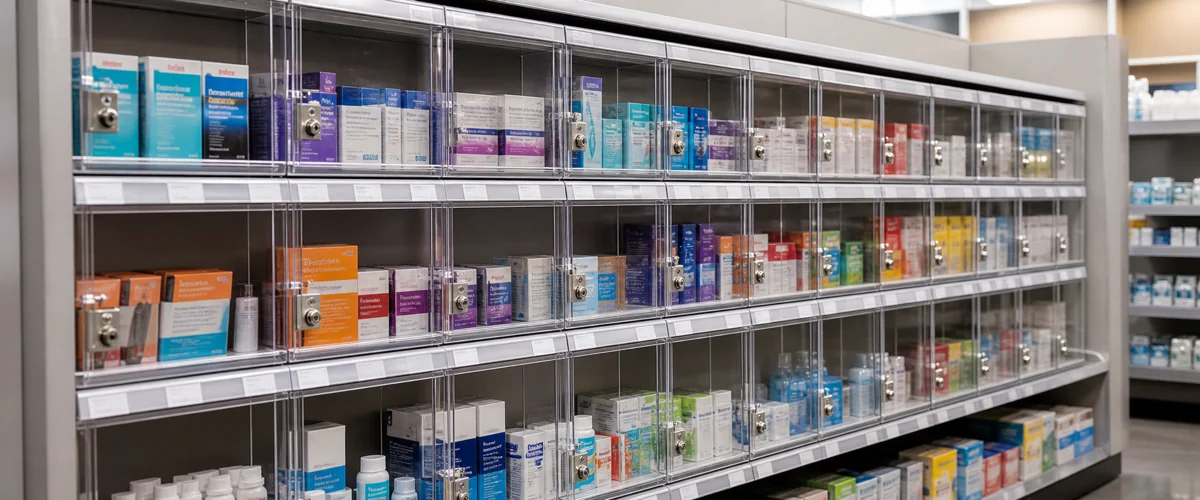
We built the cases around the lock, keying, hinge and label file the pharmacy chose, proved staff access on one paid sample, and moved into production once the sample, key operation and packing were approved.
Ordering a similar project
The minimum order is 100 pieces per design. Paid samples take 3–5 days; sample fees are paid separately and never credited. Standard production takes 15–20 days after approvals. Wetop responds to a complete brief within 24 hours.
Closest published price: this order was quoted from its own drawing. The nearest public reference on the acrylic cases hub is $6 per unit FOB Shenzhen at 500 pieces for a 150 × 100 × 100 mm, 3 mm clear case with a magnetic lid. A pharmacy case with a lock, hinged door and label pocket is a heavier construction and was priced line by line.
Key Takeaways
- A pharmacy retailer needed locking acrylic display cases for its OTC products. We built them to its chosen lock, keying scheme, hinge and label file.
- The pharmacy and its local counsel approved access, labeling, placement and category rules; we fabricated to those approved files and made no compliance or theft-resistance claim.
- One paid sample, made in 3–5 days, proved key operation, door and hinge movement, product access, label fit, cleaning and packing before release.
- We ran no forced-entry simulation on this order; sourced lock and hinge hardware kept their own supplier documentation rather than a rating transferred to the finished acrylic assembly.
The Brief
The pharmacy's brief named the product category, package dimensions, restocking path, customer-access policy, store fixture, cleaning method and local approval authority. Those inputs set the case geometry and hardware; the words "OTC display" alone would not have.
- Fixture geometry. The buyer sent the shelf or counter opening, product envelope, access side, available clearances and the approved mounting pattern.
- Label authority. The buyer and local counsel sent the approved wording, dimensions, language, placement and change-control process for labels and warnings.
- Staff workflow. Pharmacy operations defined who opened the case, how staff handled keys or codes, how often the case was restocked and which side stayed customer-facing.
Our Approach
We kept the acrylic body, the sourced security hardware and the buyer-owned label file as separate items. Our quote named the lock model, keying scheme, hinge, door direction, label holder, material grade, dimensions and packing, and the pharmacy approved that combination for its products and stores.
Lock selection followed the buyer's access policy
Cam, tubular and combination locks lead to different key-control and access routines. We put the buyer-specified mechanism and alternative options on the sample for review, and the pharmacy chose the lock that fit its staffing, product category and local rules. The purchase order stated the keyed-alike, keyed-different or master-key requirement, and we recorded the hardware line and key count in the packing specification. Key custody passed to the pharmacy on receipt.
Hinge and closure checked as one assembly
A lock only controls the opening it is built around, so the hinge, door overlap, strike position, fasteners and surrounding acrylic shared one drawing. We checked operation and workmanship on the approved sample. A tamper-evident seal went in where the buyer named the seal and its handling process; it records an opening under the buyer's procedure and does not prove theft prevention or compliance.
Replaceable labeling under buyer control
A replaceable label pocket let the pharmacy update approved inserts without changing the acrylic body. The drawing set the insert size, loading direction, visible area, retention and cleaning method. We fabricated to the approved file; the pharmacy and its counsel wrote the warnings and kept responsibility for wording, product classification, store placement and later updates.
Spec Breakdown
The manufacturing file listed each component and who approved it. The pharmacy's product, fixture and access policy set the final dimensions.
| Component | What we built | How it was approved |
|---|---|---|
| Acrylic body | Named PMMA grade, gauge, finish and approved dimensions | Buyer approved appearance and cleaning compatibility on the sample |
| Frame | Buyer-approved frame or acrylic-only construction | Drawing recorded hinge, strike, fasteners and service access |
| Lock | Named lock model and keying scheme | Buyer approved staff access and key-control procedure |
| Hinge | Named hinge, door direction and buyer-specified seal | Sample checked movement, alignment and closure |
| Labeling slot | Buyer-supplied size, wording, visible area and loading direction | Buyer and local counsel approved content and placement |
The drawing also recorded product clearances, restocking access, the shelf or counter interface, label visibility, cleaning exposure, protective film, carton orientation and destination labels, so the pharmacy's procurement team could compare quotes field by field.
Production and Security Testing
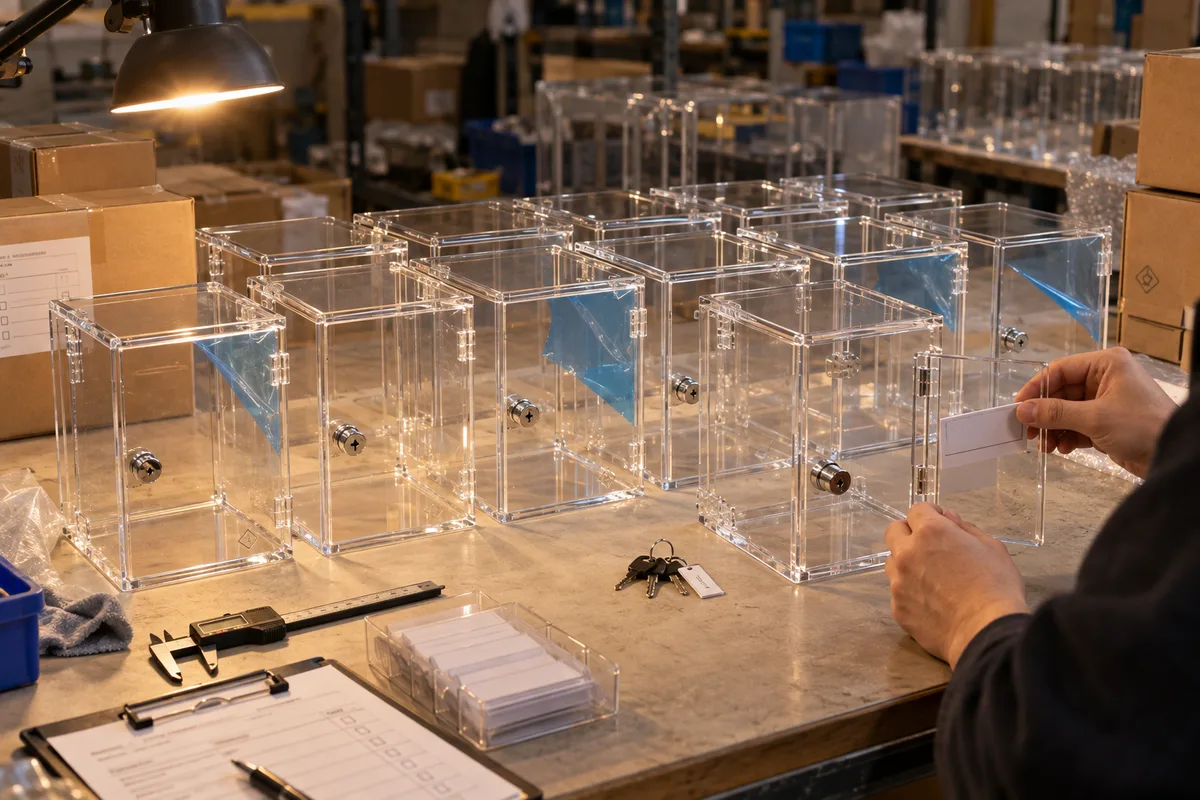
The buyer approved one sample with its real product package and label insert, supported by a key-operation video and a packing photo. Standard production then took 15–20 days. We inspected the lock model, keying line, door movement, hinge alignment, label fit, surface finish, dimensions, protective film and packing against the released file.
We ran no forced-entry simulation on this order and claim no security rating. Sourced hardware kept its supplier documentation, and we did not transfer a cylinder or hinge rating to the finished acrylic assembly. A security test would have needed the buyer's method, acceptance criteria, specimen count and reporting format before quotation, and could require an independent lab.
Install and Handover
We released production once the buyer approved the case geometry, lock, hinge, label system, product access, cleaning method, inspection plan and packing. On arrival, the pharmacy's receiving inspection compared the purchase order with the case dimensions, hardware, keying line, label holder, door direction, protective film and carton marks before the cases went to stores.
Installation, staff training, key custody, customer-access policy, store monitoring and any assessment over the first 90 days belonged to the pharmacy. We did not collect store loss data, and our fabrication alone does not support a theft-reduction figure.
What was approved: the exact lock, access, label, cleaning method and packing on one physical sample, with local pharmacy and legal approval in hand before production.
If You're Planning Something Similar
Send the product envelope, fixture opening, access policy, lock preference, approved label requirements, quantity, cleaning method, destination and packing requirement. If you want a staged deployment, you set the store selection, controls and success measures; we quote the paid sample and the production run. Repeat orders reuse the same files only when the product category, dimensions, access, hardware, label holder, artwork and packing stay the same; a different lock or label layout counts as a new design and is quoted separately.
The anti-theft display specification guideseparates the acrylic structure from sourced hardware and store-side controls, and ourcustom acrylic cases page shows the case formats we make.
Need locking acrylic cases for your pharmacy?
Send the product envelope, fixture dimensions, access policy, lock preference, approved label file, cleaning method, quantity, and destination. We reply within 24 hours with a manufacturing review and quote.
Sample fees are paid separately and never credited.