Case Study · Weddings & Events · United States
A Card Box Built for a Hundred Receptions, Not One
A US wedding-stationery brand expanding into decor rental needed a slot-top acrylic card box in the warm white of their paper suites, tough enough for weekly venue moves.
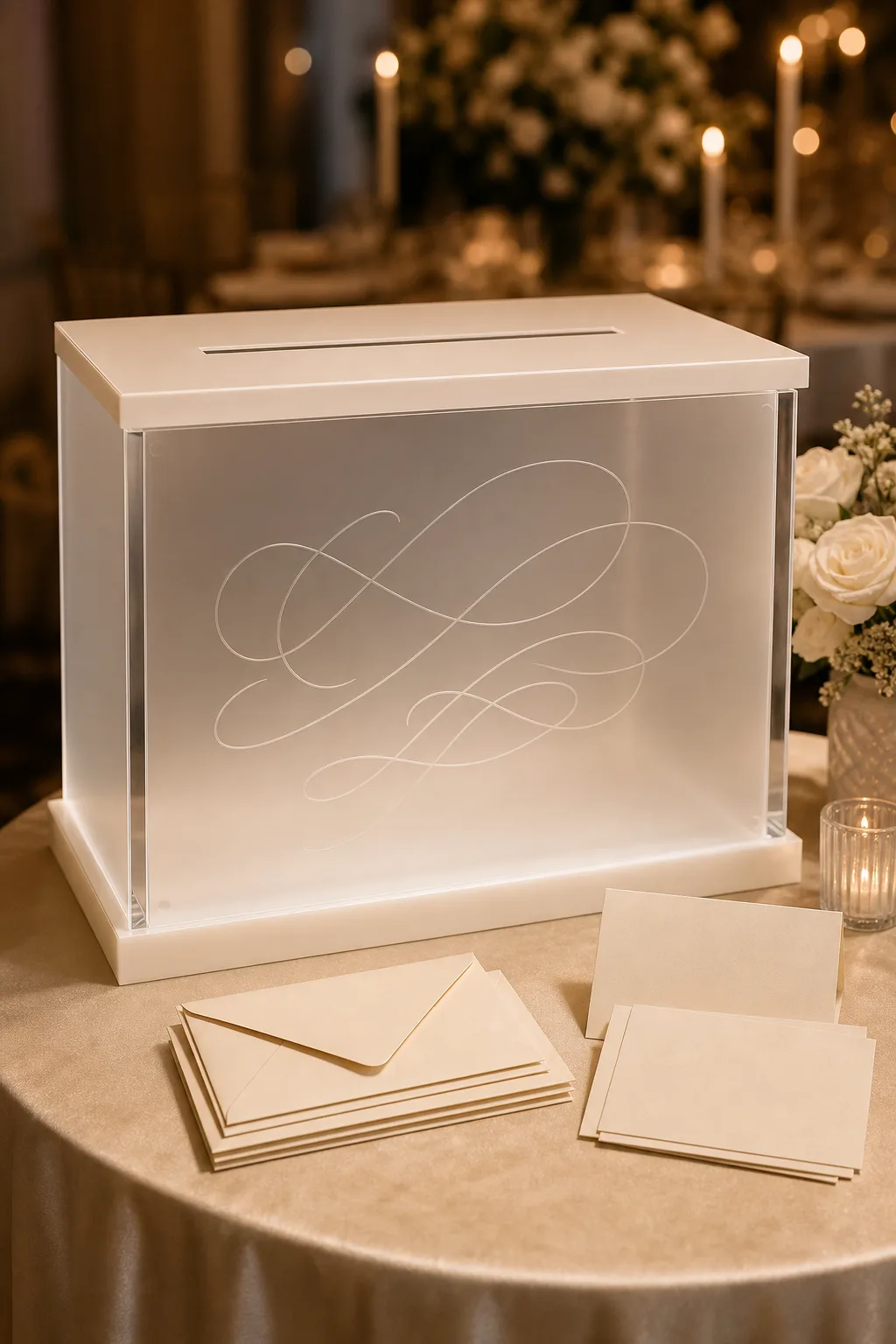
We built 100 boxes in an 18-day run — 5 mm walls, a flame-polished 19 cm envelope slot, a laser-engraved retail variant and a swappable-panel rental variant on one cutting file — with every box passing 100% inspection against the approved sample. The tooling stays in our library, so their reorders skip sampling and run in about 15 days; the second run was booked before the first wedding season ended.
- boxes, first order
- 100
- production time
- 18 days
- rental-grade walls
- 5 mm
- reorder production
- 15 days
Key Takeaways
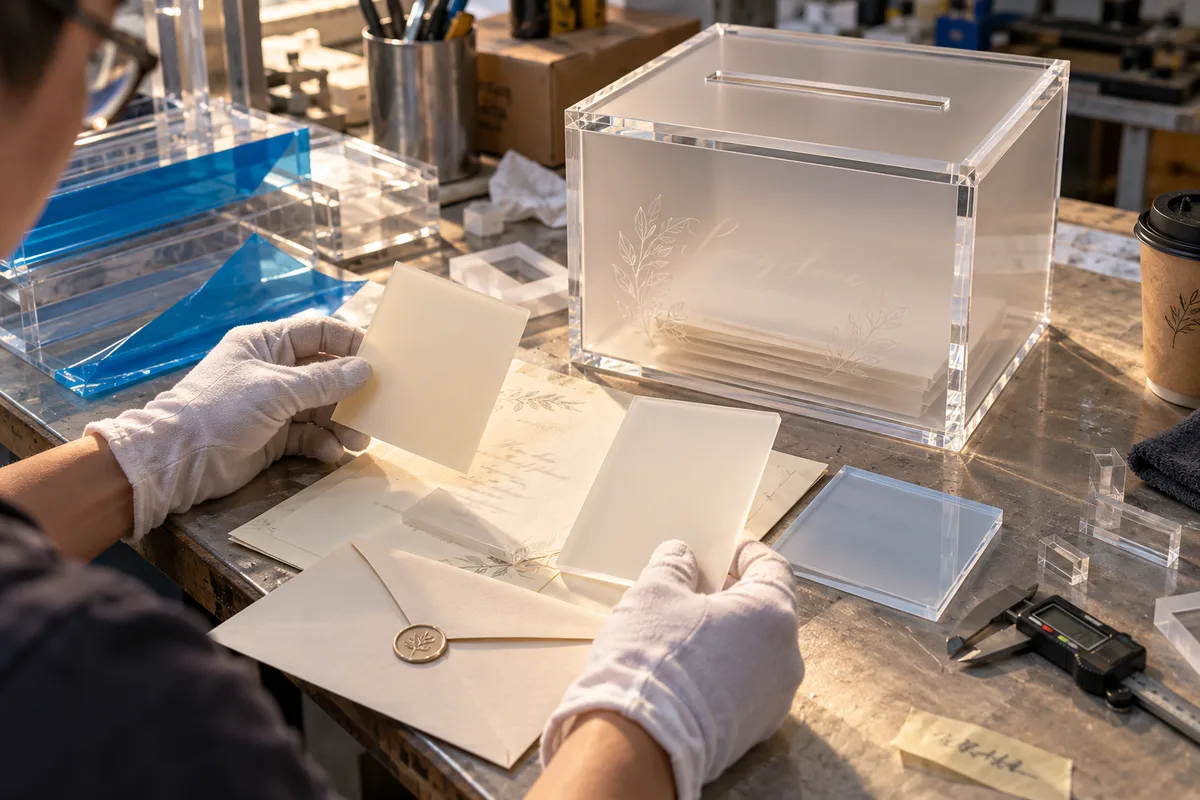
- White is not one color: the brand's warm cotton-white stationery made stock "white" acrylic read blue next to it, so the program started with physical swatch chips matched against their printed suite — one round, sign-off in 4 days.
- Rental-grade means 5 mm walls, bonded seams, a recessed lift-off lid, and a flame-polished 19 cm slot with radiused corners — the failure points of 3 mm single-event boxes, engineered out.
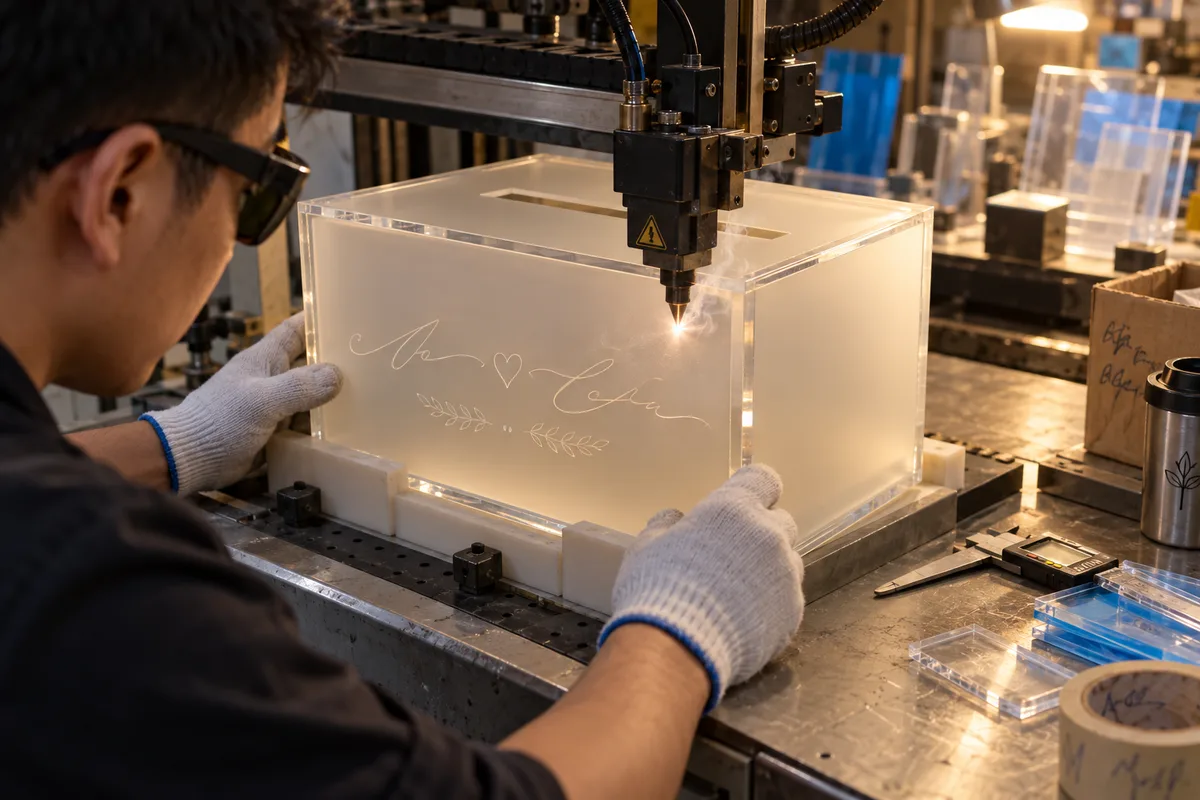
- One cutting file serves two variants: retail boxes get names and a date laser-engraved on the front panel; rental-fleet boxes get a swappable printed panel so the same box works a wedding one weekend and a gala the next.
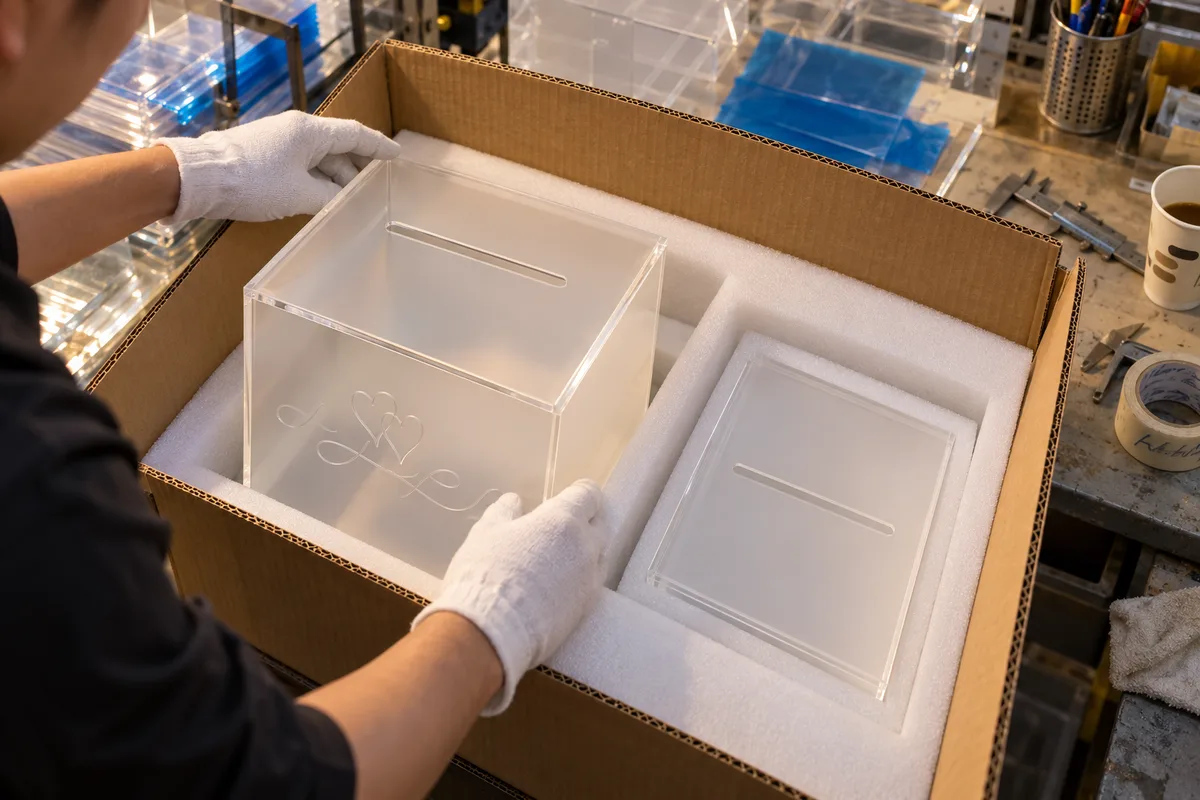
- Each rental unit ships in a fitted foam tray inside a double-wall carton built for repeat open-and-repack cycles — for a rental fleet, the carton is part of the product.
- The cutting files, engraving templates, and approved sample are retained in our tooling library, so reorders skip sampling and run in about 15 days.
The Challenge
The brand built its name on paper: invitation suites, day-of signage, place cards, all in a warm cotton white their clients recognize. The rental side of the business grew out of a practical observation — couples kept asking where to get a card box that matched the stationery — and the brand kept renting out a stock acrylic box that almost did. Almost was the problem. Stock "white" acrylic runs cool and blue; next to their warm paper it read as a mismatch in every gift-table photo, and photos are how a stationery brand gets its next client.
The durability problem was quieter but more expensive. Consumer-grade card boxes are 3 mm acrylic built to survive one reception. A rental unit gets loaded into a van, set up, packed down, wiped clean, and shipped again — every weekend of a season. On thin boxes the damage always starts in the same places: cracks spreading from the square-cut corners of the envelope slot, seams opening at the base, and lids scuffing where they slide loose in transit. Replacing rental stock mid-season costs more than the box; it costs a booked wedding.
And the program had a third requirement: a retail variant. Couples who didn't want to rent wanted to buy a keepsake box with their names and wedding date on it — which means per-order personalization on top of a standing production spec, without turning every retail sale into a custom project.
Our Approach
We scoped this as a program, not an order: one box engineered once, two variants cut from the same files, and a tooling library that makes the second run faster and lower-cost than the first. Three decisions carried it.
Matching the brand's white with physical swatches
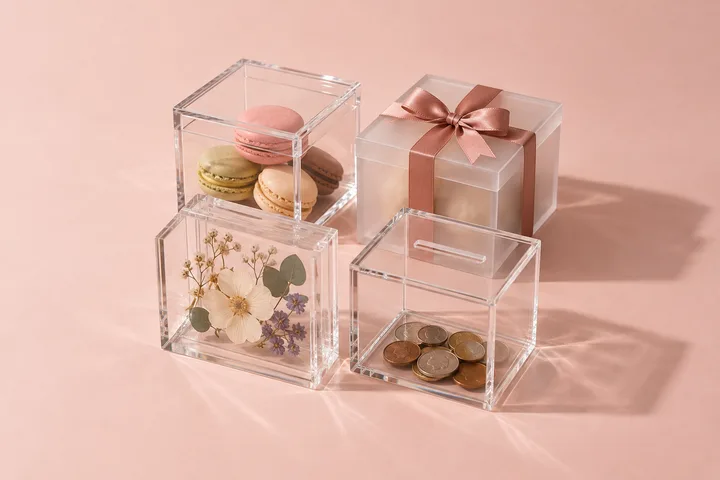
You cannot pick a white from a screen, because the mismatch the brand was fighting only exists in physical light. We asked them to mail two of their printed suites, then cut swatch chips from candidate white acrylics and photographed and couriered the chips against their paper under warm, reception-style lighting. One round was enough: a warm opaque white for the base and lid trim, signed off in 4 days. The box body itself is frosted acrylic rather than opaque — a deliberate functional choice, because a frosted body shows the envelope fill level as a soft silhouette, so venue staff can see when the box needs attention without opening it in front of guests.
Rental-grade construction, not single-event construction
The rental spec is a different product from a one-reception box, even when the two look identical in a photo. The differences are all at the failure points:
| Spec point | Single-event box | This rental build |
|---|---|---|
| Wall thickness | 3 mm | 5 mm — stiffer panels, seams carry transit loads |
| Envelope slot | Square-cut, sharp edges | 19 cm slot, radiused corners, flame-polished — no crack initiation points |
| Lid | Loose lift-off | Recessed lip — cannot slide off or scuff in the van |
| Packaging | Retail giftbox, used once | Fitted foam tray in a double-wall carton — built for repeat open/repack cycles |
The slot detail deserves the emphasis. A card slot is a long internal cutout, and in acrylic every sharp internal corner is a place where stress concentrates — flex the panel a few hundred times in transit and a hairline crack starts exactly there. Radiusing the slot corners and flame-polishing the cut edge removes both the stress riser and the micro-scratches a crack needs to begin. It is a small machining decision that is the difference between a fleet that lasts seasons and one that dies at the corners.
Two variants, one cutting file
Both variants — retail and rental — run from the same CAD and the same jigs. Retail boxes take the couple's names and wedding date laser-engraved into the front panel: permanent, frosted-etch lettering that catches candlelight, applied per order from a fixed template so a personalized box is a production step, not a redesign. Rental boxes leave the front panel clean and take a swappable printed panel instead, so the same physical box serves a wedding one weekend and a corporate event the next. One tooling set, two price points, no forked inventory — the full option set is on ouracrylic card boxes page.
The Results
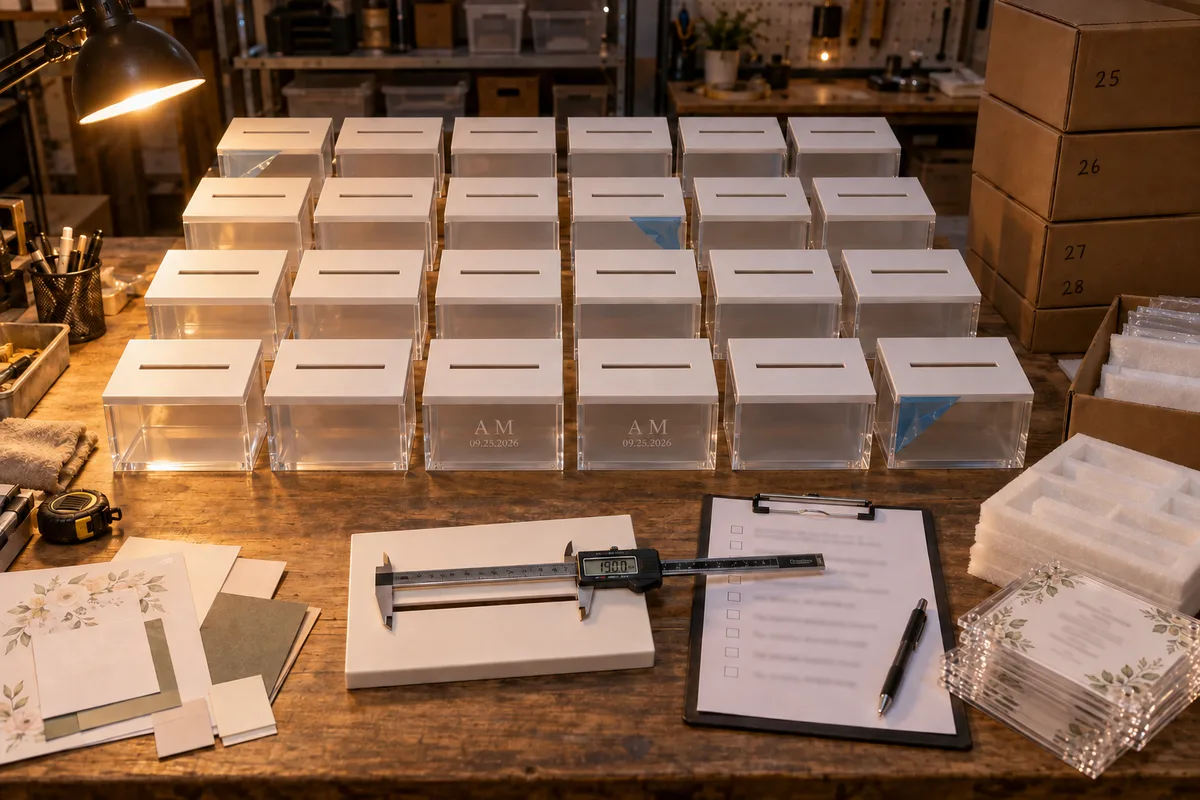
All 100 boxes shipped from an 18-day production run, every unit inspected against the approved sample — slot edges, seam bonds, lid fit — before packing.
The result that makes this a program rather than a purchase is the last row. The cutting files, the engraving template, the white-match recipe, and the approved sample all stay in ourtooling library under the brand's name. Their reorder is one email — and no second color-matching round, no risk that batch two reads a different color than batch one on a gift table. Reorders run in about 15 days — the low end of our standard window — because every decision was already made and paid for the first time. The brand booked their second run before the first season closed, sized on actual rental bookings instead of a forecast.
That is the quiet economics of custom acrylic: because our boxes are CNC-cut rather than molded, there is no tooling fee to amortize and no minimum tied to a mold — the "tooling" we retain is files, jigs, and the golden sample, and holding it costs the buyer nothing.
"The whites finally match our paper — that was the thing no stock box ever got right. The rental units have been through a full season of weekends and the slots still look new. And reorders go straight to production, which is what makes the rental math work."
What This Means for Your Project
If your product will be reused — rental fleets, venue inventory, retail display stock — spec it against its whole service life, not its first appearance. The questions that matter are mechanical: What thickness are the walls? Are internal cutout corners radiused or square? Does the lid locate positively or sit loose? Does the packaging survive being opened forty times? A box that costs less per unit and fails mid-season is the most expensive box on the market.
And if brand color is part of your spec — a white, an ivory, a signature tint — insist on physical swatches against your actual materials before production. Every acrylic supplier will tell you their white is white. The only proof is a chip sitting next to your paper, your fabric, or your existing fixtures under the lighting your customers will see. One swatch round cost this program 4 days; skipping it would have cost the exact mismatch the brand came to us to fix. We run the same swatch-first, tooling-library process for boxes of any format — see the full range on ourcustom acrylic boxes hub.
Building a card box line for your brand or rental fleet?
Send us your size, your brand color references, and how the boxes will be used — we'll come back with a spec recommendation, a swatch plan, and a quote across quantity tiers.
Sample in 3–5 days · Production 15–20 days · Reorders from your tooling library in ~15 days · MOQ 100