Delivered Project · Retail Tile Case
Sliding-Lid Acrylic Mahjong Cases for a Designer Label
A US designer label selling American mahjong sets online needed one clear retail case per 160-tile set, shipped individually to its own customers.
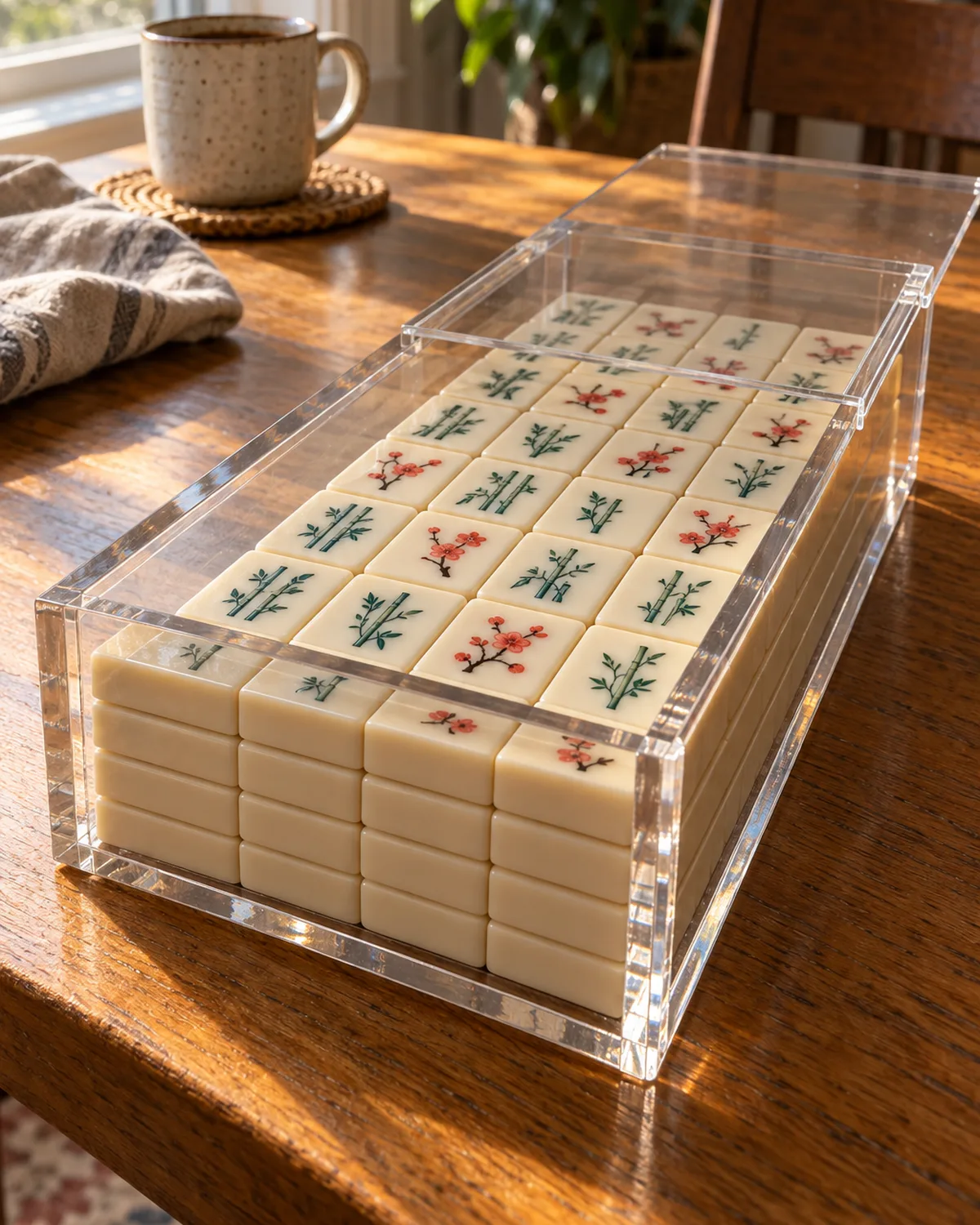
The label’s tiles were already printed in the US; what it lacked was a sliding lid acrylic mahjong case that looks right on a table and survives being reshipped one set at a time. Five paid samples came first, and the fit was finalized in a second sample round against the buyer’s measured tile block and a signed dimensioned drawing. Project profile: 50–100 cases, first run · 8 mm clear cast acrylic, sliding lid, no seal · 10 × 4 tiles per layer, 4 layers · about 18 days from order to air DDP shipment.
- cases, first run
- 50–100
- tiles per case
- 160
- clear acrylic walls
- 8 mm
- order to air shipment
- ~18 days
Key Takeaways
- The fit was finalized from the buyer’s measured tile block, not the nominal tile size: 10 tiles across, 4 deep, 4 layers, with about 1 mm of clearance per side.
- A dimensioned drawing showing tile orientation and clearance was signed off before the second sample round was cut.
- We recommended 8 mm walls over 6 mm for a case that is reshipped on its own, and a sliding lid with no seal, because a seal makes the lid hard to open.
- Felt layer pads were tried on the samples and dropped for production at the buyer’s call, which took about 4 mm off the case height.
- After approval the order was paid in full, made in about 13 days and shipped by air DDP about 5 days later, 10 cases to an export carton.
The Challenge
The buyer is a small American mahjong label run by a designer, selling complete sets online. Its tiles were printed in the US. What it did not have was packaging that matched the product: a clear case that shows the tiles off, holds exactly one 160-tile set, and survives being reshipped on its own from the label’s stock to each customer’s door.
The brief was short and specific. Tiles lie flat, 10 across and 4 deep, stacked 4 layers high. The lid had to be easy for an end customer to open, and the designer did not want a magnetic closure. The case had to arrive clean after a domestic parcel trip. And because the label was testing demand, the first run had to stay small.
Building the Sliding Lid Acrylic Mahjong Case
The web inquiry received a priced quote about nine hours after it arrived. The buyer paid for five samples on day 5, and we used them to settle three construction decisions before any production price was fixed.
8 mm walls, a sliding lid and no seal
We recommended 8 mm cast acrylic over 6 mm. The lid runs in grooves cut into the two long side walls, so the wall has to carry the groove and still leave solid material at the bonded corners of a case that travels alone in a parcel. A sliding lid met the designer’s no-magnet preference. When a seal came up, we advised against it: on a sliding lid, a seal makes the lid hard to open, and the person opening it is the label’s customer, not a packer.
Felt pads between layers, tried and dropped
We set out the trade-off between felt and silicone pads between tile layers, and the samples were built with felt so the designer could judge them in hand. With the samples on the table, the buyer found the pads unnecessary. Production left them out, and the case height came down by about 4 mm.
Fitting the case to the real tile block
The first samples were photographed on day 15 and shipped by air on day 18 so the designer could try them with the finished tiles. In hand, the fit needed tightening. We asked one question before cutting anything else: would the tiles go into the case loose or shrink-wrapped? That changes the space the set needs. The buyer measured the actual tile block, we set about 1 mm of clearance per side, and we sent a dimensioned drawing showing tile orientation for sign-off. The second-round samples shipped about 11 days later and arrived 3 days after that.
The dimensioned drawing is now part of every case sample we make: the buyer signs off internal dimensions and tile orientation on paper before a sample is cut. The buyer approved the second-round samples about 12 days after delivery.
Order size and landed cost
We suggested starting with about 50 cases to test demand before committing to a larger run. For this specification the price was about USD 10–11 per case ex-works at 50–75 pieces and about USD 9.50 at 100. Landed by air DDP (duties and taxes paid to the door), a 50-case run came to about USD 20–21 per case. Above 100 pieces the fabrication price for this design barely moves, so a larger second run lowers the landed cost per case mainly through freight.
The Results
The buyer placed the order two days after approving the samples and paid in full. Production took about 13 days, and the cases shipped by air DDP about 5 days later with tracking, packed 10 cases to an export carton with protective packing suited to onward parcel shipping inside the US. Order to shipment took about 18 days.
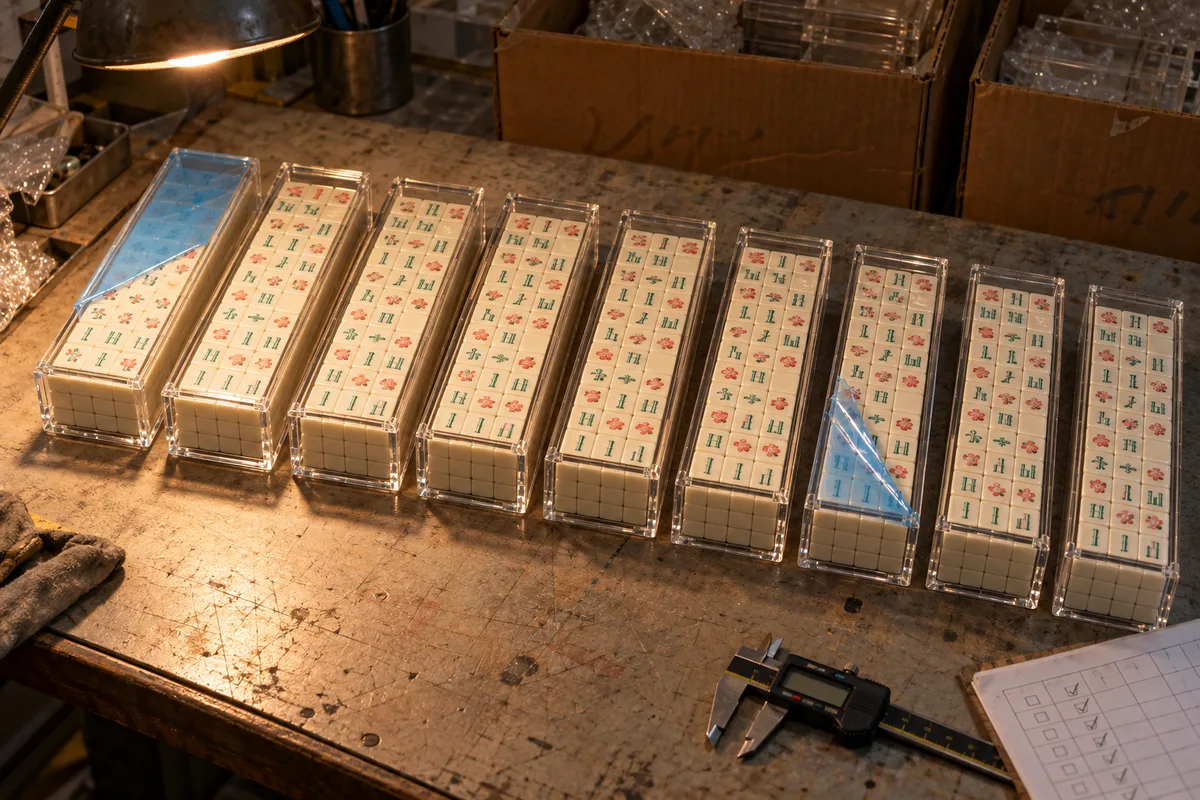
The two sample rounds took about a month of calendar. The production run itself went through without changes, because every dimension that mattered had been measured on the buyer’s real tiles and signed off on paper first.
The case’s design and size suit how we use it, and the felt pads between layers turned out not to be needed.
What This Means for Your Project
If you are specifying a case for tiles you already own, send a measurement of the real tile block, not the nominal tile size, and say whether the tiles will go in loose or shrink-wrapped. Then ask for a dimensioned drawing that shows tile orientation and clearance before any sample is cut. That one sheet of paper is what keeps the production run free of surprises.
Decide the closure early. A sliding lid keeps the case simple and needs no hardware; a seal on a sliding lid fights the person opening it. Pads between layers are worth trying on a sample, but let the sample decide. Custom acrylic cases start at 50 pieces per design, with samples paid separately and never credited to production. The acrylic mahjong cases page covers what to put in a case brief, and the case engineering guidegoes deeper on wall thickness, clearances and closures. If the tiles are still to be made, thecustom American mahjong program quotes tiles, racks, mats and cases in one brief.