Acrylic Supplier Audit Checklist — Key Questions to Ask
An audit that only checks paperwork is theater. A real supplier audit answers one question — will this factory ship what they promised, on the date they promised, at the quality they quoted.
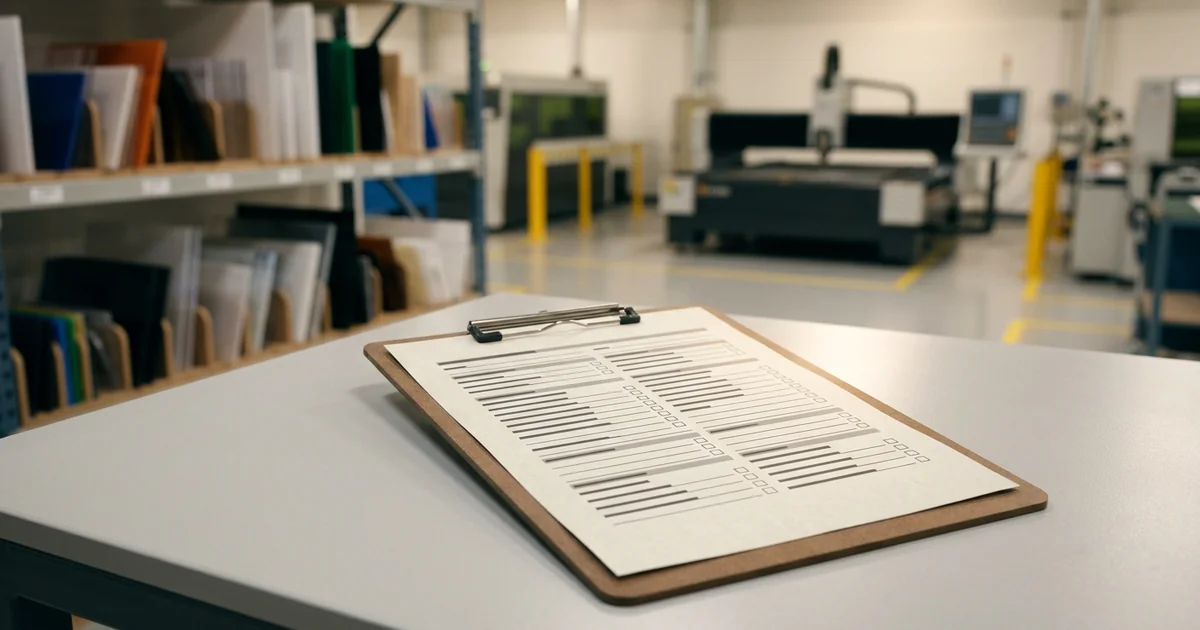
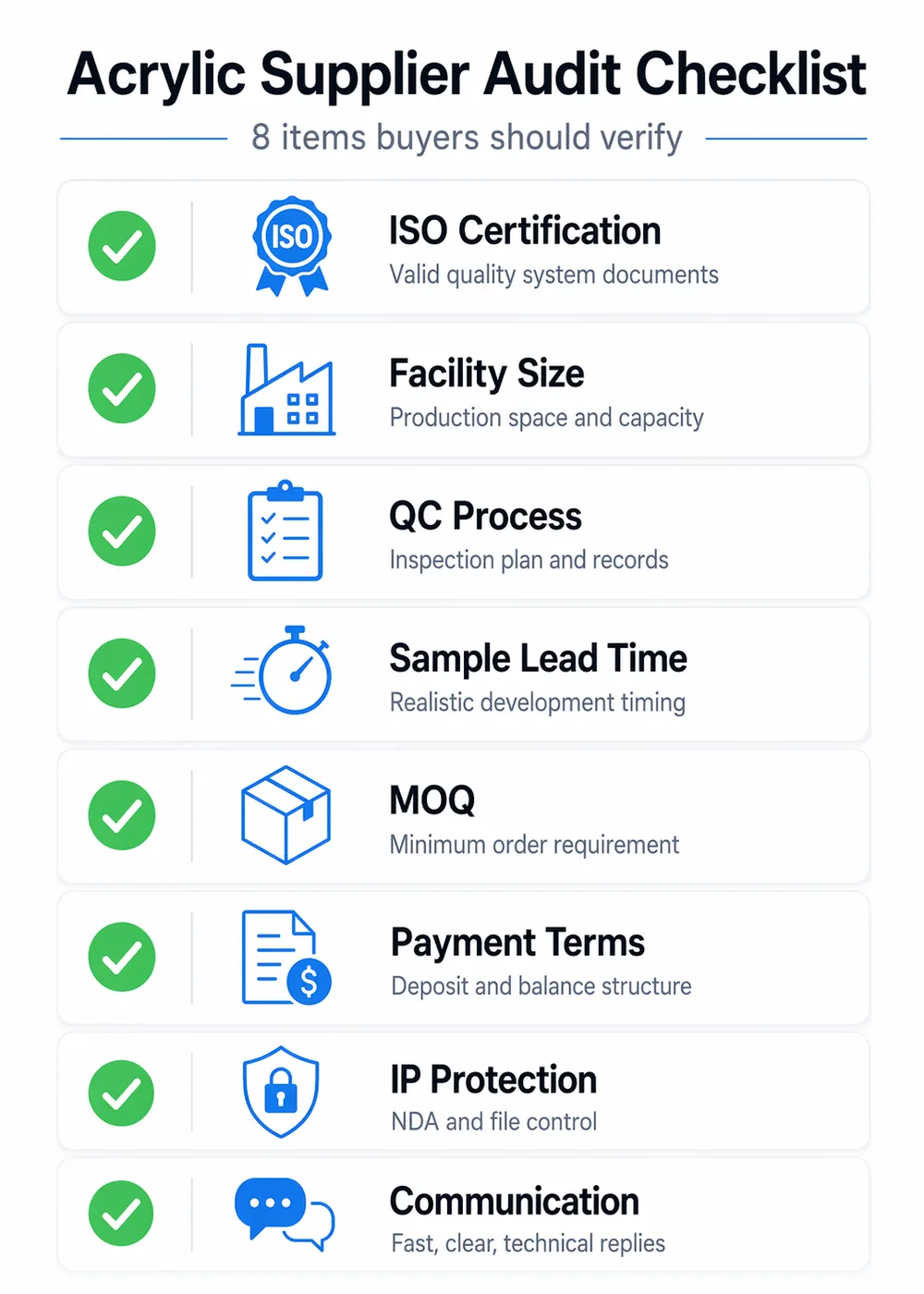
Key Takeaways
- Effective supplier audits follow 5 stages in order — pre-qualification, capability, quality system, compliance, and ongoing monitoring. Skipping any stage shifts risk to shipment time, when it's expensive to fix.
- 80% of supplier fit decisions can be made from pre-qualification documents before you spend on a site visit — business license, ISO certificate legitimacy, capability samples, and 3 verifiable customer references.
- On a capability audit, look at equipment utilization and in-process inventory, not just the equipment list. A factory with 20 machines sitting idle is different from a factory with 10 machines running 2 shifts.
- Third-party inspection agencies (SGS, Bureau Veritas, TÜV) cost roughly $300–$800 per pre-shipment inspection and $500–$1,500 per day for on-site capability audits — worth it for first orders above $20K where independent verification catches issues internal inspection may miss.
- The three audit red flags I watch for first: ISO certificates without a legitimate certification body, single-customer revenue concentration above 40%, and refusal to provide 3 US/EU customer references. Any one of these ends the qualification conversation.
On this page
- What a Real Supplier Audit Checklist Actually Verifies
- Stage 1 of the Supplier Audit Checklist: Pre-Qualification
- Stage 2 of the Supplier Audit Checklist: On-Site Capability
- Stage 3 of the Supplier Audit Checklist: Quality System
- Stage 4 of the Supplier Audit Checklist: Compliance
- Stage 5 of the Supplier Audit Checklist: Ongoing Monitoring
- The Red Flags I Watch For First
- When to Use Third-Party Inspection Agencies
- Which Supplier Audit Checklist to Use for Your Next Qualification
What a Real Supplier Audit Checklist Actually Verifies
A supplier audit checklist that works follows five stages in sequence: pre-qualification, capability audit, quality system audit, compliance audit, and ongoing monitoring. Each stage filters out suppliers who would fail at a later stage, and skipping any stage pushes the failure into production or shipment, which is exactly when it’s most expensive to discover.
Each stage has its own documents, deliverables, and go/no-go decision points. Pre-qualification covers business legitimacy, ISO verification, samples, and references. Capability covers equipment, capacity, and process walk-through. Quality system covers AQL protocols, reject rates, and traceability. Compliance covers social, environmental, and product-safety audits. Ongoing monitoring covers first-article, pre-shipment, and quarterly scorecard review.
In 10+ years of quality audits and buyer qualification calls at Wetop, I’ve seen the same pattern repeat: buyers who run the full 5-stage framework before placing orders rarely have quality or delivery issues; buyers who short-circuit to price negotiation on round one often discover issues on first shipment that the audit would have caught. This guide walks through each stage the way I walk it with buyers on our side — what to verify, what to ask for, and which documents actually matter versus which are audit theater.
Stage 1 of the Supplier Audit Checklist: Pre-Qualification
Pre-qualification is the document-and-sample phase, typically 1–2 weeks, that filters 80% of supplier fit decisions before you spend time or money on a site visit. Five core verifications happen here, each independently disqualifying, all five required.
Business legitimacy verification. Request the factory’s business license, registration certificate, tax registration, and export license. For China-based suppliers, verify the business license number on the National Enterprise Credit Information Publicity System (gsxt.gov.cn) — the license should show consistent registered business scope matching the stated products, legitimate registered capital, no “abnormal operation” flags, and registration age of at least 3 years for serious custom manufacturing work. A factory registered less than 18 months has too much execution risk for custom orders above $10K. ISO certification verification. Verify the certification body on IAF.nu — IAF-accredited bodies like BSI, SGS, TÜV, Bureau Veritas, or DNV are the only legitimate issuers. Our ISO 9001 acrylic manufacturer guide covers the full verification workflow, including what the certificate scope statement should specifically cover for custom acrylic fabrication.
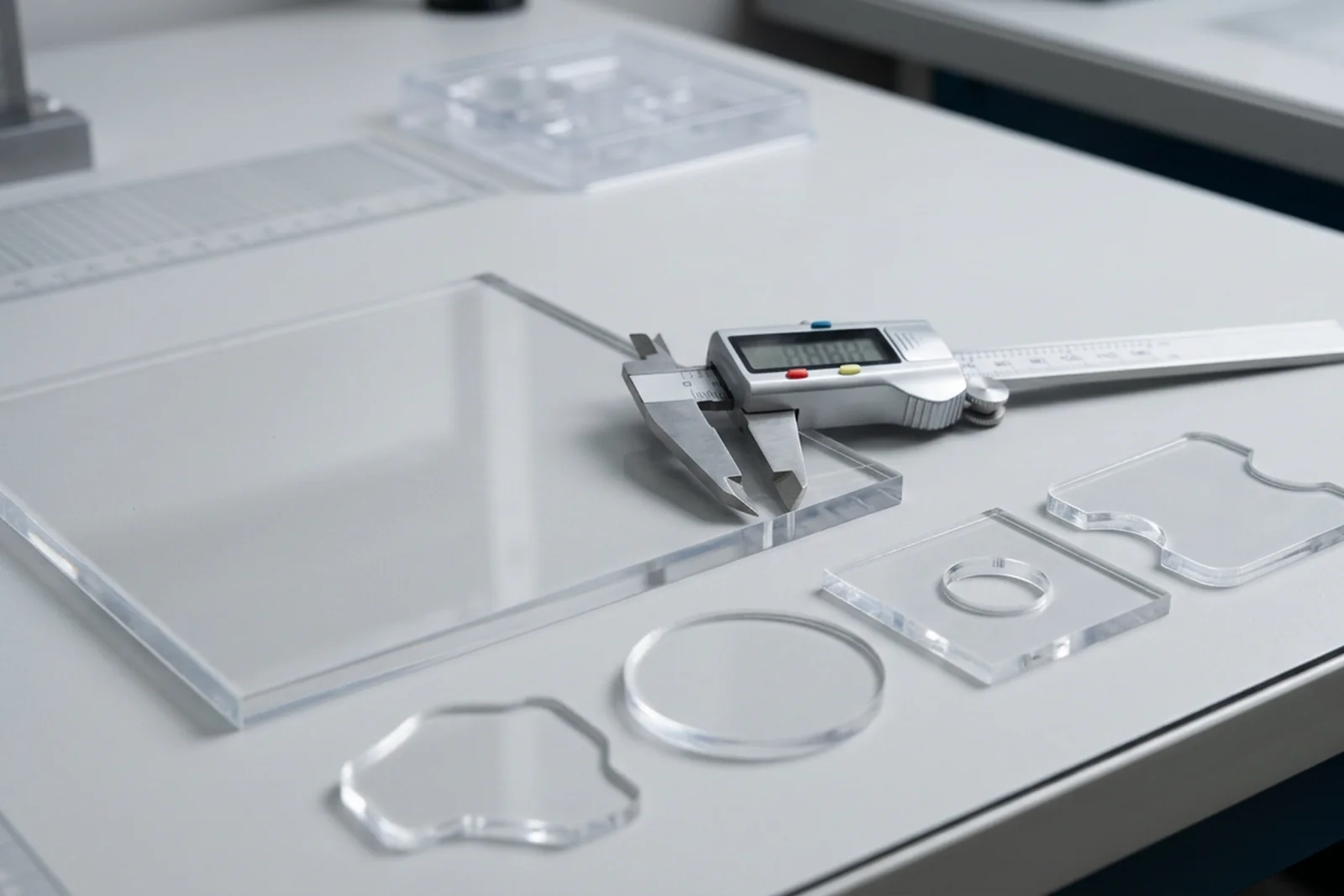
Capability samples. Request 3–5 physical sample pieces representing the quality level the factory claims to deliver, not their best pieces, but typical production output. Inspect edge finish (diamond polished, flame polished, laser cut), bonding quality (solvent-welded joints should be optically clear with no bubbles or haze lines), surface finish (no scratches, no visible tool marks), and dimensional accuracy (measure against spec). For thickness-sensitive work see our acrylic thickness guide. Customer references. Request 3 verifiable US or EU customer references, ideally brand names you can search and confirm. A serious export-capable factory should provide references readily. Hesitation or vague references (“we have many US customers but can’t share names due to NDA”) is a qualification-ending red flag. Capacity and lead time. Request monthly production capacity data (units per month at your expected order volume) and current lead time. Match against your order timeline with a 20% buffer for unexpected issues.
Stage 2 of the Supplier Audit Checklist: On-Site Capability
The capability stage of the supplier audit checklist verifies that the factory can actually produce what they claim to produce, at the volume they claim, with the quality they claim. This is the stage that most first-time buyers underinvest in, and it’s where the biggest surprises happen if you skip it. In 10+ years of hosting buyer qualification visits on our end, I’ve watched a common pattern repeat: the audits that caught issues early were the ones where the buyer walked the production floor in order, not the ones that stayed in the conference room reading certificates.
Equipment list verification, not inventory tour. Request the full equipment list in writing — brand, model, quantity, and year for each major machine (lasers, CNC routers, polishing stations, UV printers, thermoforming ovens, bonding booths). Then verify the list during the site visit or third-party inspection. The pattern to watch for: a factory claiming 10 CO2 lasers but only 4 actually operational during the visit. Idle equipment isn’t always a problem (newer machines waiting for operator training, older machines kept as backup), but it changes capacity math meaningfully. Equipment utilization check. Look at whether machines are running and whether in-process inventory is stacked appropriately around each station. A factory with 20 machines sitting idle is different from a factory with 10 machines running 2 shifts. The second factory usually delivers more reliably because the production line is actually proven at the claimed capacity.
Process walk-through in production order. Walk the factory floor in the sequence a real order would follow: raw material storage → sheet cutting (saw or CNC) → fabrication (laser, CNC, bending, forming) → bonding and assembly → polishing → printing → QC inspection → packing. At each station, verify the operator has a clear work instruction, in-process inspection records are visible, and reject bins show legitimate reject activity (empty reject bins are sometimes worse than partially filled ones; empty often means rejects are being hidden rather than documented). Capacity math reality check. Calculate maximum monthly capacity from the verified equipment list and compare against the claim. A factory claiming 50,000 units/month from 4 laser cutters needs to show how that math works: laser cut time per unit × operational minutes per machine per day × 30 days. Claims that don’t math out are signals the factory oversells capacity, which means your order will be squeezed by larger customers.
Raw material sourcing verification. Ask to see the acrylic sheet storage area and verify sheet brands against the MTRs (material test reports) provided in pre-qualification. Premium custom work typically uses Plaskolite, Evonik PLEXIGLAS, or Mitsubishi Chemical cast acrylic; budget work often uses generic Chinese cast or extruded sheet. Our guide on cast vs extruded acrylic explains why this material sourcing matters for the final product.
Stage 3 of the Supplier Audit Checklist: Quality System
The quality-system stage of the supplier audit checklist verifies that the factory has documented, followed quality protocols, not just ISO paperwork. Three elements matter most: AQL-based inspection discipline, documented reject rates, and non-conformance handling.
AQL (Acceptance Quality Limit) sampling protocol. Request the factory’s documented AQL standard for inspection — most export-grade custom work uses AQL 2.5 for major defects and AQL 4.0 for minor defects under ISO 2859-1 sampling standards. Premium work uses tighter AQL 1.5 (major) / 2.5 (minor). Ask which AQL tier they apply to your product category and request sample inspection records from recent orders — the records should show sample sizes pulled per ISO 2859-1 tables, specific defects found by category, and accept/reject decisions. When my inspection team opens a finished order for final QC, the sample size we pull is dictated by the AQL tier we committed to at the RFQ stage, not picked on the spot. Factories that cannot produce actual inspection records from recent orders are running quality as theater, not system. Documented reject rates. Ask for reject rate data across the last 12 months, trending up, down, or flat. Expected range for quality custom acrylic: 2–5% first-pass reject rate, with 0.5–1.5% escaping to customer. Factories that claim 0% reject rates are either lying or not measuring. Factories that can’t produce numbers at all are not operating a quality system.
Non-conformance handling process. When a defect is found in production, what happens next? A mature quality system has a documented process: non-conformance report opened, root cause analysis initiated, corrective action assigned, effectiveness verified, record closed. Factories that simply rework defective pieces without investigation repeat the same defects on future orders. Ask to see 2–3 recent non-conformance records and follow the workflow documentation. Traceability to raw material batch. For any finished piece, can the factory trace back to the specific cast acrylic sheet batch used? Premium work requires this — it’s how you diagnose systemic issues when they appear. Budget work often lacks traceability, which is fine if you’re buying commodity parts but problematic for custom premium work. For related thinking on ISO 9001-specific verification, see our earlier ISO 9001 acrylic manufacturer guide — the two guides complement each other.
Stage 4 of the Supplier Audit Checklist: Compliance
The compliance stage of the supplier audit checklist verifies that the factory meets social, environmental, and product-safety standards appropriate for your market. Three compliance domains matter for most B2B custom acrylic buyers.
Social compliance audit. For buyers selling into US or EU markets, a SMETA 4-Pillar audit (from Sedex) or BSCI audit (from amfori) is the standard verification, covering labor standards, working hours, wages, health and safety, and environmental management. Audit reports should be less than 12 months old, conducted by an accredited audit body (SGS, Bureau Veritas, TÜV, Intertek), and show no major non-conformances or should document corrective actions for any non-conformances found. Retailers like Walmart, Target, and major UK/EU buyers typically require SMETA or BSCI for suppliers in their supply chain. Environmental compliance. ISO 14001 certification covers environmental management system maturity. For custom acrylic specifically, verify adhesive and solvent disposal practices (bonding solvents are regulated), VOC emissions from UV printing operations, and acrylic scrap recycling protocols. Factories without documented environmental practices are increasingly disqualifying for brands with sustainability commitments.
Product-safety compliance. Specific to your market and product category. Children’s products require CPSIA (US) or EN 71 (EU) compliance with documented testing. Food-contact acrylic requires FDA 21 CFR 177 (US) or EC 10/2011 (EU) verification. California products require Prop 65 labeling compliance. Medical or regulated industry acrylic work requires the specific compliance documentation for that category. Request testing certificates from accredited labs (SGS, Intertek, Bureau Veritas) — certificates from non-accredited labs are not defensible.
Stage 5 of the Supplier Audit Checklist: Ongoing Monitoring
The final stage of the supplier audit checklist is monitoring: supplier qualification is not a one-time event. The five activities that keep supplier relationships on track after the initial audit:
First-article inspection (FAI). On the first production unit of any new order, 100% inspect against spec — dimensions, surfaces, edges, bonding, graphics, assembly, packaging. Document the inspection with photos. Address any deviations before production continues. Pre-shipment inspection (PSI). Before the order ships, inspect a sample pulled per AQL tables against your quality specification. Either your own QA team, the factory’s documented inspection, or a third-party agency (SGS, Bureau Veritas, TÜV) conducts PSI. For orders above $20K, third-party PSI ($300–$800 per inspection) is typically worth the cost — independent verification catches issues internal inspection may miss. Shipment documentation review. Verify commercial invoice, packing list, bill of lading, and any required compliance certificates (CoC, CE, REACH, etc.) before the container departs.
Quarterly scorecard review. Track four metrics per supplier: on-time delivery rate, quality reject rate at incoming inspection, response time on issues, and unit cost trend. Share the scorecard with the supplier quarterly. Suppliers who see their own metrics improve faster than suppliers who don’t. Annual re-audit. Every 12 months, refresh the pre-qualification documents (business license may have changed, ISO may be due for renewal, ownership may have shifted) and spot-check one production run against current audit standards. For the subset of your supply base that represents the most spend, consider a re-audit site visit or third-party refresh audit.
The Red Flags I Watch For First
Seven supplier red flags end qualification conversations in my experience. Any one of these is enough to disqualify a supplier regardless of price or capability claims.
1. ISO certificates without a legitimate certification body. The certificate should list an IAF-accredited body. If you can’t verify the body on IAF.nu, the certificate is not credible. 2. Single-customer revenue concentration above 40%. Means the factory’s priorities are committed elsewhere and your order will be secondary. Ask directly what percentage of revenue comes from their largest customer. Honest factories answer; evasive ones signal the problem. 3. Refusal to provide 3 verifiable US/EU customer references. Usually signals either limited export experience or unhappy existing customers. Serious export-capable factories provide references readily. 4. Business registration under 3 years old for custom complex work. Custom acrylic fabrication has too many variables for a new factory to execute reliably at production volume. Exceptions exist but require deeper verification.
5. Machines that don’t match the capacity claim. If the factory claims 50,000 units/month but has equipment that mathematically delivers 15,000, you’re being sold capacity they don’t have. 6. Samples that look different from production. Request that samples be pulled from a real production run, not fabricated as demo pieces. If samples look consistently better than production output in later orders, the factory has a sampling-vs-production quality gap. 7. Pricing that undercuts the market by 30%+ with no explanation. Sustainable pricing reflects real cost structure. Suppliers offering 30%+ below market are usually cutting corners somewhere — labor, raw materials, quality, or sustainability — that will surface in the relationship later.
When to Use Third-Party Inspection Agencies
For most B2B buyers, third-party inspection agencies (SGS, Bureau Veritas, TÜV, Intertek) are the right investment at two points in the qualification process.
First-order verification above $20K order value. Hire a third-party agency to conduct the on-site capability audit and pre-shipment inspection on your first order. Cost: roughly $500–$1,500 per day for the on-site capability audit plus $300–$800 for pre-shipment inspection, with photo and video documentation and independent verification against your checklist. This adds a layer of verification beyond what the factory’s own QC provides and catches issues that internal inspection may not surface. Ongoing PSI on orders above $20K. Once a supplier relationship is established, spot-check every 3rd or 5th order with third-party PSI to maintain quality discipline on the supplier side. Most factories improve their in-process quality when they know third-party inspection is in the mix — the agency relationship is cheap insurance for consistent quality.
For smaller orders (under $20K) or repeat orders from qualified suppliers, internal QC + your own pre-shipment samples are usually sufficient. The math shifts when order value is high enough that a single quality incident costs more than an annual third-party inspection budget.
Which Supplier Audit Checklist to Use for Your Next Qualification
For the vast majority of B2B custom acrylic buyers, the 5-stage supplier audit checklist in this guide is the correct approach — adapt it to your specific product category, regulatory environment, and supplier tier. The template checklist items below are the ones I use internally on our QC side.
Pre-qualification documents to request (all suppliers): business license (verified online), ISO 9001 certificate (verified via IAF.nu), ISO 14001 if environmental compliance matters, production capacity statement, 3 verifiable customer references, 3–5 physical samples, MTRs for raw materials. Capability audit checklist (first order + annual refresh): verified equipment list vs claim, utilization check (machines actually running), process walk-through in production sequence, raw material storage and sourcing verification, capacity math reality check. Quality system checklist (all suppliers): documented AQL standard + recent inspection records, 12-month reject rate trend, non-conformance handling documentation, raw material batch traceability. Compliance checklist (market-dependent): SMETA or BSCI audit for US/EU retail, ISO 14001 for environmental commitments, product-specific safety testing (CPSIA, FDA 21 CFR, Prop 65, REACH, RoHS).
For acrylic-specific verification beyond the general supplier audit checklist, our ISO 9001 acrylic manufacturer guide covers what an ISO-certified acrylic factory should actually document, and our how to choose an acrylic manufacturer guide walks through the broader manufacturer-selection decision. For RFQ discipline that works well with a structured supplier audit checklist, see our custom acrylic RFQ guide — consistent RFQ structure makes supplier-to-supplier comparison much easier.
If you’re qualifying a custom acrylic supplier and want a second opinion on red flags in a specific supplier’s documentation, send us the documents you’ve received — I’ll review them from the QC side and give you direct feedback on what I see, no sales pitch. Email inquiry@wetopacrylic.com.
Frequently Asked Questions
What is a supplier audit checklist?
A supplier audit checklist is a structured verification document used by B2B buyers to qualify a new supplier before placing production orders. It typically covers five domains: business legitimacy (license, registration, ownership), production capability (equipment, capacity, process control), quality management system (ISO certification, inspection protocols, defect rate), regulatory compliance (social, environmental, product safety), and financial stability. For custom acrylic buyers, the checklist should specifically verify cast vs extruded sheet sourcing, laser/CNC capability, finishing processes, and AQL-based inspection discipline.
How do you audit a factory in China?
Follow a 5-stage framework: pre-qualification (documents, samples, references, typically 1–2 weeks), capability audit (equipment list verification, process walk-through, capacity math, typically via site visit or third-party inspection), quality system audit (ISO certification verification, AQL protocols, reject rate data), compliance audit (social audit like SMETA or BSCI, environmental certifications, product safety testing), and ongoing monitoring (first-article inspection, pre-shipment inspection, quarterly scorecard review). First orders above $20K typically justify hiring SGS, Bureau Veritas, or TÜV for on-site audit (roughly $500–$1,500 per day) plus pre-shipment inspection ($300–$800 per inspection).
What should I look for when auditing an acrylic factory?
Five acrylic-specific checks on top of standard factory audit items: first, raw material sourcing — ask which cast acrylic brands they source (Plaskolite, Evonik PLEXIGLAS, Mitsubishi Chemical) and request MTRs (material test reports); second, fabrication equipment — verify CO2 laser wattage, CNC bed size, polishing methods (diamond vs flame), UV printer brand; third, edge finish quality samples across thicknesses (3mm, 6mm, 10mm, 15mm); fourth, bonding discipline — solvent cement for optical joints or adhesive-bonded; fifth, inspection protocol — AQL 1.5 or tighter for premium custom work, with documented reject rates.
Do I need to visit the factory in person?
Not for first qualification — 80% of supplier fit decisions can be made from pre-qualification documents plus a third-party inspection report. In-person visits add value once you've narrowed to 1–2 final candidates, or once an initial order has shipped successfully and you want to deepen the relationship. Third-party agencies (SGS, Bureau Veritas, TÜV) run on-site audits against your checklist for roughly $500–$1,500 per day, or pre-shipment inspections for $300–$800 per inspection, document with photos and video, and flag issues you might miss. Reserve in-person visits for relationship-building after the vetting is complete.
What are the biggest supplier audit red flags?
Three red flags end supplier qualification conversations in my experience: first, ISO 9001 certificates without a legitimate certification body (the cert should list an IAF-accredited body like BSI, SGS, or TÜV — not a name you can't verify online); second, single-customer revenue concentration above 40%, which means the factory's priorities are committed elsewhere and your order will be a secondary priority; third, refusal to provide 3 verifiable US/EU customer references, which usually signals either limited export experience or unhappy existing customers. Any one of these is enough to disqualify a supplier regardless of price.
Want to run this audit on us?
Send us the documents your procurement team requires — ISO certificate, recent SGS reports, sample QC reports, factory photos. We'll respond with everything you need to qualify Wetop as a supplier, plus a quote on your project if you have specs ready.