---
title: "What Is Acrylic Fabrication? A Founder's Plain Answer"
description: "What is acrylic fabrication? The process, the people who buy it, and how to tell a custom acrylic fabricator from a stock supplier — explained by a 18-year shop founder."
category: "Manufacturing"
author: "William Cho"
authorCredential: "Founder of Wetop Acrylic — building custom acrylic in Shenzhen since 2008, 2,000+ B2B projects shipped across 25+ countries"
datePublished: 2026-04-29
dateModified: 2026-04-29
primaryKeyword: "what is acrylic fabrication"
url: https://wetopacrylic.com/guide/what-is-acrylic-fabrication/
---
## What Is Acrylic Fabrication? The 30-Second Answer {#short-answer}
Acrylic fabrication is the process of turning flat acrylic sheet — PMMA (polymethyl methacrylate), commonly sold under the brand names plexiglass and Perspex — into a finished custom product by cutting, edge-finishing, printing, bending, bonding, and inspecting. It is sheet-based subtractive fabrication, not melted-pellet molding, and it is the right method for custom B2B work in the 50-50,000 piece quantity range.
When I walk a new buyer through our 5,000 m² facility in Shenzhen, the first thing I get asked is almost always some version of "so what is acrylic fabrication, exactly, and how is it different from buying acrylic from a catalog?" Most procurement teams have heard the word but conflate acrylic fabrication with extrusion, injection molding, or simply "buying acrylic boxes." Those are three different things. This guide settles the definition of acrylic fabrication, walks through the six fabrication steps that run on every custom project, and gives you a clear rule for when fabrication is the right method versus when you should buy stock or commission an injection mold.
---
## Where the Word "Acrylic" Comes From, and Why It Matters for Fabrication {#etymology}
Before we go deeper into what is acrylic fabrication on the shop floor, the language is worth pinning down. Acrylic is the everyday name for polymethyl methacrylate (PMMA)[^pmma-wikipedia], a clear thermoplastic first commercialized in the 1930s. PMMA is the technical polymer name; "acrylic," "plexiglass," and "Perspex" are the trade and consumer names that stuck. All four words refer to the same material that shows up at an acrylic fabrication shop as flat sheet stock.
The polymer was developed independently in the early 1930s by Otto Rohm in Germany (sold under the trade name Plexiglas, later PLEXIGLAS) and Imperial Chemical Industries in the UK (sold under the trade name Perspex). Both companies brought it to scale during the Second World War for aircraft canopies and gun turrets, where they needed something glass-clear, lighter than glass, and impact-resistant. After the war the material moved into civilian use — automotive lenses, signage, display cases, and eventually nearly every retail and brand-merchandising application you see today. In the United States the everyday word is "plexiglass" (often written as one lowercase word, though the original Rohm trademark is Plexiglas with one s); in the United Kingdom and Commonwealth markets it is "Perspex"; technical specifications and material datasheets all use PMMA. When buyers ask whether plexiglass and acrylic are different materials, the answer is no — same polymer, different names by region and brand.
For a deeper material-grade comparison within the acrylic family, see our guide on [cast vs extruded acrylic](/guide/cast-vs-extruded-acrylic/) — the two manufacturing routes for the sheet that fabrication then turns into your finished part.
---
## The 6 Core Steps of the Acrylic Fabrication Process {#six-steps}
The acrylic fabrication process runs the same six core steps on every custom project, regardless of end product: cut, edge-finish, print or decorate, bend or thermoform, bond or assemble, and inspect. Some projects skip a step (a flat sign skips bending; a raw-edge component skips printing). None of them skip cutting or inspection. For a deeper technique-by-technique breakdown — equipment, tolerance, finish, and cost driver — see our companion guide on the [six core acrylic fabrication techniques](/guide/acrylic-fabrication-techniques/).
Cut, edge-finish, print, bend, bond, inspect. The order is fixed; the inclusion of steps 3 and 4 depends on the part.
**Step 1 — Cut.** Sheet stock is loaded onto a CO2 laser cutter (for clear cuts on cast acrylic) or a CNC router (for thicker stock, internal pockets, and parts that need machined edges). The cutter follows a vector file from the design — DXF, AI, or PDF — and produces flat blanks that match the design within roughly +/- 0.2 mm. **Step 2 — Edge-finish.** The cut blank has a raw edge that needs treatment. Laser-cut cast acrylic comes off the bed with a flame-polished, glass-clear edge ready for visible-edge work. CNC-cut edges are matte and require either diamond polishing (mechanical, optical-grade) or flame polishing (heat treatment, lower cost) depending on the spec.
**Step 3 — Print or decorate.** If the part carries a logo, color, or graphic, this is where it goes on. The three common methods are UV printing (full-color, photographic detail), silk-screen (flat color, durable), and laser engraving (permanent, etched-into-surface). **Step 4 — Bend or thermoform.** Flat sheet does not naturally curve. Strip-heating bends a single line for a sign holder or a brochure stand; thermoforming softens the whole sheet over a male or female mold for compound curves and dome shapes. **Step 5 — Bond or assemble.** Multi-part products — display cases, lid-and-base boxes, tiered risers — are joined either with solvent cement (the joint chemically welds and reads as optically continuous) or with mechanical fasteners. **Step 6 — Inspect.** Every piece is checked against the approved sample for dimensional accuracy, optical clarity, edge quality, and print registration before it is packed. We run 100% piece-by-piece inspection on every order, certified to the ISO 9001 quality management standard[^iso-9001].
For a deeper walk-through of how this six-step flow runs on our specific factory floor, see [our manufacturing process page](/about/process/).
---
## Who Buys Acrylic Fabrication Services {#who-buys}
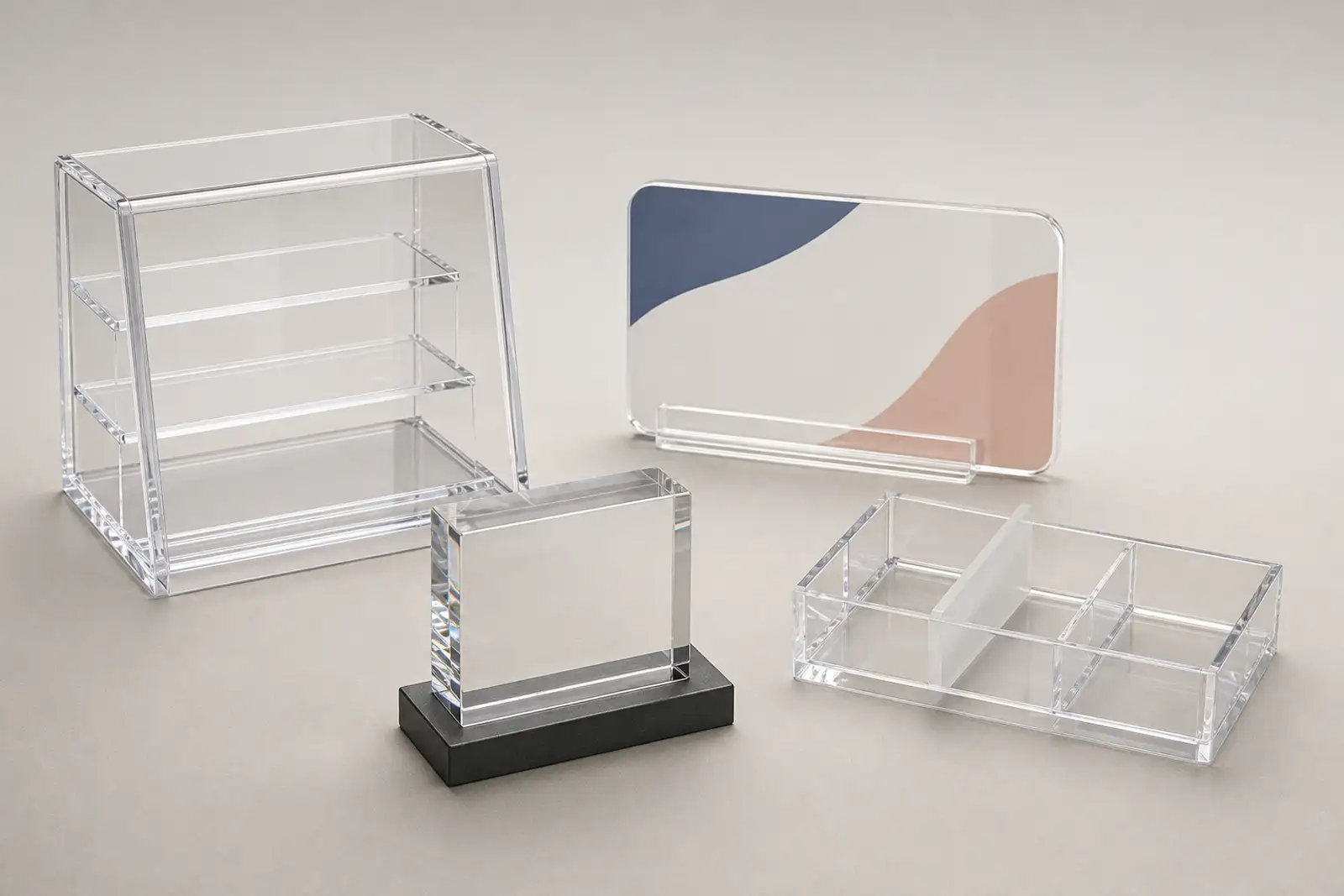
The buyers we ship to fall into four broad categories: retail and brand-merchandising teams, packaging and gifting brands, signage and wayfinding companies, and award and trophy makers. Each category has slightly different priorities, but the fabrication process underneath is the same.
The four buyer categories we ship most often: retail display cases, brand signage, awards, and brand organizers and gift boxes. All four come out of the same six-step fabrication process.
**Retail and brand-merchandising teams** buy custom point-of-purchase (POP) and point-of-sale (POS) displays — countertop stands, floor units, in-aisle headers, shelf-edge sign holders, brand zone displays at trade shows. The brand owns the design; the fabricator builds it to match every store the chain rolls out to. Optical clarity, brand-color accuracy, and consistency across hundreds of identical units are the priorities. See our [POP and POS displays application page](/applications/pop-pos-displays/) for the specific work we run for this segment. **Packaging and gifting brands** buy clear acrylic boxes, gift presentation cases, and product display containers — cosmetics packaging, watch boxes, premium-product gift sets. They want the box to read as more luxurious than the cardboard alternative; that means polished edges, solvent-bonded corners, and zero visible seams.
**Signage and wayfinding companies** buy laser-cut acrylic letters (3D dimensional letters for storefronts and lobbies), backlit acrylic signs, and wayfinding panels. Edge quality and lettering precision drive perception — a 0.5 mm gap in a backlit "M" reads as cheap, even from across a lobby. **Award and trophy makers** buy custom acrylic blocks, plaques, and embedded-image awards — corporate recognition pieces, sports awards, industry awards. Optical clarity through the block matters because the engraved or printed image is viewed through the acrylic. In my 18+ years building this business, the one consistent thread is that all four buyer types eventually ask the same question: "can you build it exactly to our spec, on schedule, with quality that matches the sample?" The answer is the value proposition of fabrication itself. Browse [our full acrylic product catalog](/products/) to see which categories we run most often.
---
## Acrylic Fabrication vs Injection Molding vs Glass vs Metal {#vs-other}
Acrylic fabrication is one of four common methods to produce custom transparent or display-grade hard parts. The decision between acrylic fabrication, injection molding, glass fabrication, and sheet-metal fabrication turns on quantity, geometry, and the role optical clarity plays in the finished product. Understanding the contrast is the fastest way for a buyer to confirm that acrylic fabrication is actually what the project needs.
| Method | Tooling cost | Economical quantity | Best when... | Not great when... |
|---|---|---|---|---|
| **Acrylic fabrication** | Near zero | 50 - 50,000 pcs | Custom geometry, optical clarity, low-mid volume | Quantity above 100,000 with frozen design |
| **Injection molding** (PMMA pellets) | USD 15,000-80,000 per mold | 50,000+ pcs | Frozen design, very high volume | Low volume; tooling does not amortize |
| **Glass fabrication** | Near zero | Any | Highest scratch resistance, premium feel | Weight, breakage risk, shipping cost |
| **Sheet metal fabrication** | Near zero | 50+ pcs | Structural strength, no transparency needed | Anywhere optical clarity matters |
**Acrylic fabrication vs injection molding.** Both end with a PMMA part, but the route is different. Injection molding melts pellets and forces the molten polymer into a closed steel mold — high tooling cost, high speed once running, frozen geometry. Fabrication starts with cured sheet and removes or reshapes material — near-zero tooling, slower per-piece, fully flexible geometry. The break-even crossover for a typical custom part sits somewhere between 30,000 and 100,000 pieces, depending on part complexity and mold cost. Below that, fabrication is cheaper end-to-end. Above it, molding wins on per-piece cost once tooling amortizes.
**Acrylic fabrication vs glass fabrication.** Glass is heavier (roughly 2.5x by weight at the same dimensions), more brittle, and more expensive to ship internationally because freight insurance accounts for breakage. Acrylic fabrication wins on weight, impact resistance, and shipping economics for retail displays and signage; glass wins where scratch resistance, premium feel, or specific high-temperature environments dominate. **Acrylic fabrication vs sheet metal fabrication.** Metal carries structural load that acrylic cannot, and it is the correct choice for chassis, brackets, and load-bearing fixtures. The moment optical clarity, lightweight, or no-corrosion behavior matters — retail displays, lit signage, brand-zone work — acrylic fabrication is the better fit. Hybrid metal-and-acrylic fabrication is common, and we run it routinely on lit retail fixtures with metal frames and acrylic faces.
---
## Common Buyer Mistakes When Briefing an Acrylic Fabricator {#mistakes}
Five mistakes show up often enough when buyers brief an acrylic fabricator that they're worth flagging directly. Each one has cost a buyer time, money, or both — and each is preventable with a 10-minute conversation before the RFQ goes out.
**1. Sending a part designed for injection molding.** Injection-molded plastic parts often have undercuts, draft angles, internal ribs, and zero-radius internal corners — geometries that come from a closed steel mold and that fabrication cannot reproduce. When a buyer sends us a CAD file pulled from a previous injection-molding supplier and asks us to "fabricate the same part," we have to redesign the geometry to match what fabrication can build. Send a fabrication-friendly design: flat panels joined at clean angles, generous internal radii, no undercuts. **2. Not specifying the acrylic grade.** "Acrylic, 5 mm thick" is not a complete spec. Cast and extruded acrylic look identical on a quote line but behave differently in fabrication, optical clarity, and chemical resistance. Specify cast or extruded (and brand-tier when it matters — Plaskolite[^plaskolite], Evonik PLEXIGLAS, Mitsubishi Chemical) on visible-edge work.
**3. Confusing fabrication with stock supply.** Some "acrylic suppliers" are actually distributors who buy stock parts from a fabrication shop and re-bill at fabrication margins. The tell is that they cannot answer technical questions about edge polish, bonding method, or thickness tolerance — they have never run the process. A real fabricator owns the equipment and can walk you through every step. **4. Skipping the sample.** Fabrication has dozens of small judgment calls — exact polish gloss, exact bend radius, exact print color — that show up in the finished sample but not on the quote. Approve a sample before production. Every reputable acrylic fabricator should offer a paid or sample-cost-credited sample within 3-5 days. **5. Ordering at wrong-side-of-MOQ quantity.** Custom fabrication makes economic sense above roughly 50 pieces. Below that, a fabricator either declines or charges a setup fee that makes per-piece cost unattractive. If your project is truly 5-20 pieces, look at stock parts customized with aftermarket vinyl or print; if it is genuinely custom geometry, batch with a future order to clear MOQ. Our minimum is 50 pieces, and we will explain that on the first reply.
---
## When Do You Need a Custom Acrylic Fabricator vs a Stock Supplier? {#fabricator-vs-stock}
You need a custom acrylic fabricator the moment any of these is true: the dimensions are not in a catalog, the shape is not a standard rectangle, the part needs your branding, the part needs a specific edge or surface finish, the part needs to integrate with another component (LED, magnet, hinge, mounting hole), or the project will be reordered with consistent specifications. If none of those is true, a stock supplier is faster and cheaper, and an acrylic fabricator is the wrong tool for the job.
In practice, almost every B2B project I see is custom — the brand wants its logo on the box, the retailer wants the display in its exact store dimensions, the trophy maker wants a specific block thickness and a custom engraving. Stock acrylic genuinely shines in three narrow cases: generic protective shields and sneeze guards in standard sheet sizes, sign holders in catalog dimensions where branding goes on a printed insert rather than on the holder itself, and cleanroom or laboratory parts where the spec is dictated by a standard rather than by the buyer. Outside those three cases, fabrication is the path. Since founding Wetop in 2008 I've watched the industry shift heavily toward fabrication as brands have figured out that the per-piece premium over stock is small, and the perceived-quality lift is large.
When you decide to brief a fabricator, lead with three things: **end-use** (retail display, gift packaging, award, signage, etc.), **optical-clarity expectation** (glass-clear visible edges, or hidden internal structure where finish doesn't matter), and **quantity** (50, 500, 5,000, 50,000). Those three answers steer everything downstream — material grade, thickness, edge spec, finish method, packaging, and price. We respond to every inquiry within 24 hours, and on most projects we can return a line-item quote and a 3D rendering within 48 hours. If you have a project brief or a CAD file, send it through to inquiry@wetopacrylic.com or through the form on our [customization page](/customization/) and I'll personally review the first quote — that's been my routine since the beginning, and 18+ years in, I haven't found a reason to change it.
[^pmma-wikipedia]: [Poly(methyl methacrylate) — Wikipedia](https://en.wikipedia.org/wiki/Poly(methyl_methacrylate)) — PMMA polymer history and trade-name lineage (Plexiglas, Perspex) cited in the etymology section.
[^iso-9001]: [ISO 9001 quality management](https://www.iso.org/iso-9001-quality-management.html) — quality-system standard cited in Step 6 (Inspect) for our 100% piece-by-piece QC certification.
[^plaskolite]: [Plaskolite](https://www.plaskolite.com/) — major cast PMMA producer named in the brand-tier list under buyer mistake #2 (specify the acrylic grade).