---
title: "Shadow Box Frame Guide: Depth, Acrylic & Mounting"
description: "What a shadow box frame is, how deep it should be for jerseys, medals, and dried flowers, acrylic vs glass fronts, and when a box beats a frame."
category: "Buyer Guide"
author: "Dillion Chen"
authorCredential: "Production Manager at Wetop Acrylic — running laser, CNC, polishing, and UV printing lines since 2014, 1,500+ custom projects personally overseen"
datePublished: 2026-07-15
dateModified: 2026-07-15
primaryKeyword: "shadow box frame"
url: https://wetopacrylic.com/guide/shadow-box-frame-guide/
---
## A shadow box frame is a picture frame with a stage {#what-is}
A shadow box frame is a deep display frame: a clear front panel, a fabric-lined backing, and 3-8cm of enclosed space between them. That depth is the entire point — it holds three-dimensional objects a flat picture frame physically cannot close over: folded jerseys, medals, dried flowers, memorabilia.
The name comes from what the depth does visually. An object sitting in open space behind the front panel throws a soft shadow on the backing, and that shadow reads as importance — the same trick a museum vitrine plays. A picture frame presses its contents flat against glazing; a shadow box frame gives its contents a stage. Everything else about the product — depth, front material, backing, mounting — is a variable you choose around the object going inside.
The market splits the same object into two builds, and it helps to know both names. Frame-style shadow boxes look like a thick picture frame: a visible border profile around a shallow recess, usually for flat-ish objects given room to breathe. Box-style shadow boxes are what we build most at Wetop — five bonded acrylic walls and a clear face, with the fabric backing panel closing the back — which reads cleaner at larger sizes and deeper recesses. Both hang on a wall; both answer to the same depth math. This guide covers the decisions in the order they should be made: depth first, front material second, frame-versus-box third, then how the object mounts inside and how the whole thing mounts to the wall.
---
## Choose the depth from the object, not the catalog {#depth}
Depth is a measurement, not a style choice: take the object's tallest point off the backing and add 1-2cm of clearance so nothing touches the front panel. That lands at 3cm for medals and pressed flowers, 5cm for flat-folded jerseys and dried bouquets, and 8cm or more for draped jerseys and helmets.
Three shadow box frame depths at one scale. The rule is mechanical: object height off the backing plus 1-2cm of clearance sets the recess — 3cm for medals, 5cm for a flat-folded jersey, 8cm for anything draped or dimensional.
Both failure directions cost money. Too shallow and the object touches the front panel — a jersey pressed against acrylic wicks a faint contact mark into view within weeks, and a bouquet loses petals to every vibration of the wall. Too deep and the display reads hollow: a flat medal in an 8cm recess looks like it's at the bottom of a well, and the order has paid for material, freight volume, and wall projection it didn't need.
| What you're framing | Height off backing | Recess depth | Typical frame size |
|---|:---:|:---:|---|
| Medals, coins, patches, pressed flowers | Under 2cm | 3cm | 20x20 to 30x40cm |
| Flat-folded jersey (name and number showing) | 2-4cm | 5cm | 60x80cm |
| Dried wedding bouquet, invitation set | 2-4cm | 5cm | 40x50cm |
| Draped jersey, full-front display | 4-7cm | 8cm | 80x100cm |
| Helmet, ball, multi-item arrangement | 5cm+ | 8-10cm+ | Sized to layout |
One production note from my side of the process: depth changes the build more than buyers expect. When my operators bond a 3cm frame, the side walls behave like an ordinary frame profile. Past 5cm the walls become structural panels — they carry the front, resist racking, and show every bonding flaw at eye level — which is why deeper frames also get thicker walls in the construction section below.
---
## Acrylic front vs glass front {#acrylic-vs-glass}
For a shadow box frame front, acrylic beats glass on the two specs that matter most at size: weight and failure mode. Cast acrylic runs about 1.18g/cm³ against roughly 2.5g/cm³ for soda-lime glass — about half the panel weight — and it flexes instead of shattering when a frame drops.
Weight compounds with everything else in this product. A surprising number of incoming shadow-box RFQs still specify glass on the front-panel line out of habit — and drop it the moment the panel weights are side by side. A shadow box frame front is large — a 60x80cm jersey format is already 0.48m² — and the frame it sits in must be lifted, shipped, and hung. Halving the front panel's weight[^makeitfrom] against the equivalent glass sheet[^imetra] lightens the whole assembly, downgrades the wall-anchor requirement, and takes real cost out of international freight. Shatter behavior is the second argument: a wall-hung frame lives above furniture, beds, and retail floors, and when a glass-front box lets go of its hook, the result is a hazard as well as a loss. Acrylic's remaining weakness is surface hardness — it scratches more easily than glass — which is managed with the protective film we ship on every panel and microfiber-only cleaning, not a different material.
| Spec | Acrylic (cast PMMA) front | Glass front |
|---|---|---|
| Density | ~1.18g/cm³ | ~2.5g/cm³ |
| 60x80cm x 3mm panel weight | ~1.7kg | ~3.6kg |
| Failure mode | Flexes; no shatter | Shatters into shards |
| UV protection | UV-filtering grade available | Standard glass: minimal; UV glass: costly |
| Scratch resistance | Lower — film + microfiber care | Higher |
| Clarity | ~92% light transmission | Comparable |
UV deserves its own sentence because shadow box contents are usually irreplaceable. Signed fabric, certificate ink, and dried botanicals all fade under light exposure — the Library of Congress's framing guidance is blunt that light damage to displayed originals is cumulative and irreversible[^loc] — so for anything signed or sun-exposed we quote UV-filtering acrylic as the front panel. The full glazing comparison, including the picture-frame side of the argument, is in our [acrylic vs glass picture frame guide](/guide/acrylic-vs-glass-picture-frame/).
---
## Frame-style or box-style — and when you want neither {#frame-vs-box}
Pick frame-style when the object is flat and the look should read as framing: a floating border, minimal profile, art-gallery language. Pick box-style when the object is genuinely three-dimensional and needs a fabric backing, pins, or compartments. Pick a display case instead when viewing is from multiple sides.
The frame-style build shines on flat and near-flat pieces — textile fragments, embroidered art, invitations, a single pressed arrangement — where the modern treatment is a floating presentation: the piece held between panels or against a back panel with a clear border of open acrylic around it. That's the construction behind our [acrylic floating frames](/products/acrylic-frames/acrylic-floating-frames/), and it pairs naturally with magnetic closures for pieces that rotate. The full frame family — floating, magnetic, certificate, and poster formats — lives on the [acrylic frames](/products/acrylic-frames/) hub.
The box-style build takes over as soon as the object has real depth or real weight. Five bonded walls, a velvet or felt backing panel, and interior mounting hardware make an 8cm-deep, 80x100cm jersey display rigid enough to hang for years — a border-profile frame at that depth would look like a crate. Our [acrylic shadow boxes](/products/acrylic-boxes/acrylic-shadow-boxes/) page covers the box-style formats, backing options, and jersey layouts in detail.
And sometimes the honest answer is neither. If buyers will walk around the object — sneakers, helmets, model cars on a counter or pedestal — a wall-view shadow box frame is the wrong product; a freestanding display case with 10cm-plus depth and hinged or lift-off access serves the viewing pattern the wall never can.
---
## Mounting the object inside {#mounting-inside}
Objects mount to the backing, never to the front: stainless pins and T-pins for fabric, sewn or magnetic strips for jerseys, wire cradles for hardware, and pressure or magnet systems for paper art. The front panel stays a window — nothing adheres to it.
Fabric is the forgiving case. A jersey pins to a velvet backing invisibly, and velvet's nap hides pin entry points; cork backing takes pins directly for medal groups that may be rearranged. Rigid objects — a game ball, a champagne flute, a piece of hardware — get formed acrylic cradles bonded to the backing so the object rests in shaped support instead of hanging from a fastener.
Delicate flat art is the demanding case, and it's a request I see from museum and fine-art buyers a few times every quarter: original paper or embroidered pieces that cannot be glued, taped, or pierced. The working method is mechanical, reversible hold — the piece sits against the backing and a magnet system through the backing panel holds mounting strips, or the front assembly applies gentle even pressure through a mat border. Two numbers make the floating look work: leave a 3-5cm clear border of open backing around the piece so it reads as floating, and keep magnet positions clear of the artwork itself so nothing presses the original. For a fragile piece, that's precisely what the pre-production sample is for — we mount a stand-in of the same weight and size and photograph the result before the original is ever committed. We ran this exact border-and-magnet engineering at gallery scale in our [colored acrylic floating frames for art galleries case study](/case-studies/colored-acrylic-floating-frames-art-galleries/).
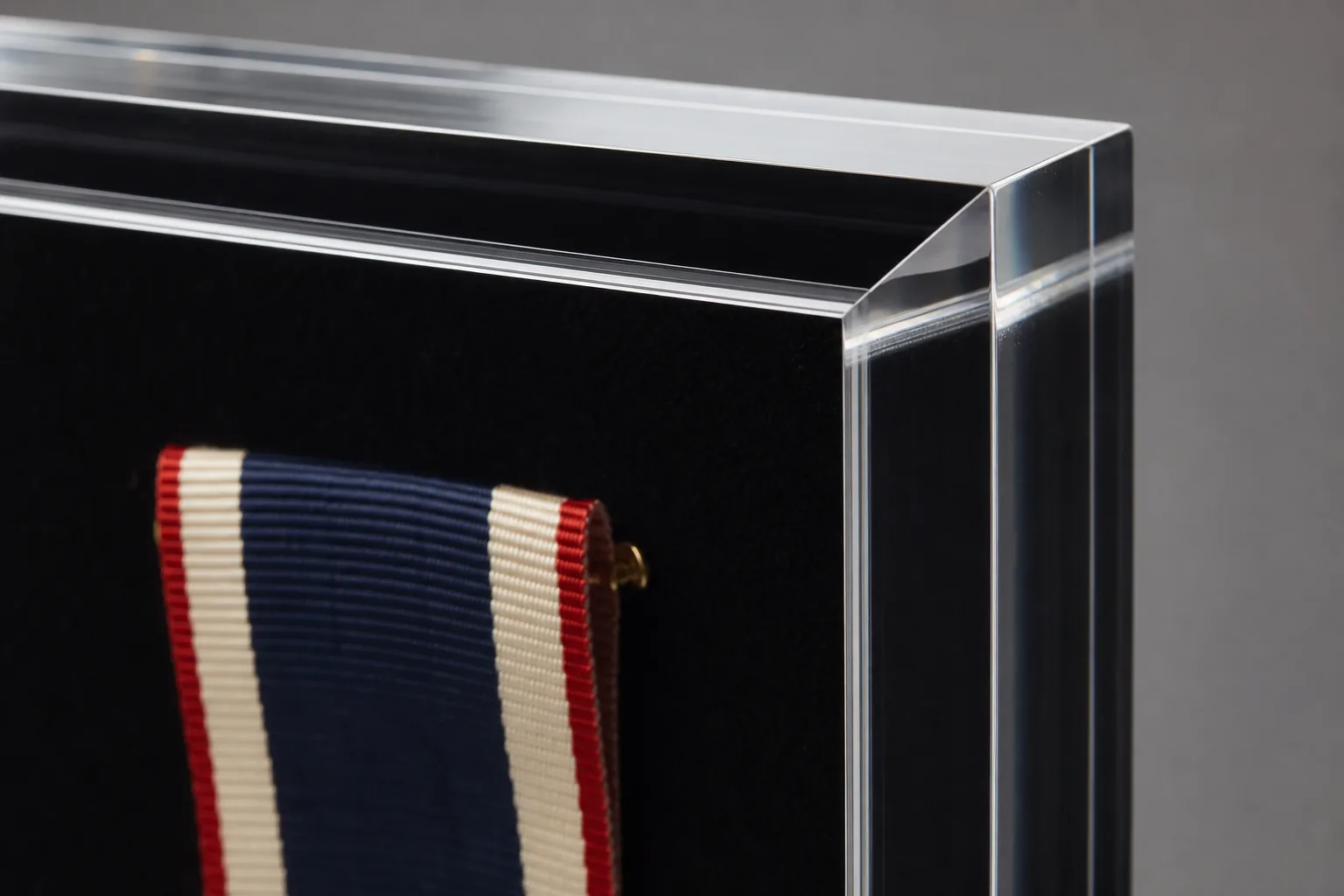
The anatomy at the corner: polished acrylic front, structural side wall, and a velvet backing that does the actual holding. The front panel is a window — everything mounts to the back.
---
## Hanging it: wall hardware is a load spec {#wall-mounting}
Match the hanger to the finished weight: keyhole slots for frames under 3kg, French cleats for anything heavier — rated in our builds to 15kg — and standoff bolts when the design calls for a floating off-the-wall look. Weight sneaks up: a large jersey shadow box frame easily passes the keyhole limit.
Run the estimate before choosing hardware, not after. When my line preps mounting hardware for an order, the cutoff is mechanical, not aesthetic: under 3kg gets keyholes, anything over gets a cleat. An 80x100cm box-style frame sums to about 1.9m² of panel — 0.8m² of front, 0.8m² of backing, and roughly 0.3m² of side wall from the 3.6m perimeter at 8cm deep. Built in the 8mm stock the construction section calls for at this size (~9.5kg/m²), that's around 18kg of panel — past the working limit of a single French cleat, which is why builds this size get two cleats or direct-to-stud anchors, not margin on one. The cleat still brings its second benefit: it spreads load across a wall-length rail and forgives imperfect stud placement, which matters when a retail rollout hangs fifty of these across fifty differently built store walls. Keyholes stay the right answer for the small end — a 30x40cm medal box at under 2kg hangs flush with the simplest hardware there is. Standoffs trade load capacity for looks: the frame floats 15-20mm off the wall on polished bolts, ideal for lobby and gallery presentations at small-to-mid sizes.
Every frame we ship includes hardware matched to its weight, plus a drilling template in the carton — a small thing that saves an installer per store, which a program buyer multiplies by every location.
---
## Construction specs that keep a shadow box frame flat {#construction}
Standard construction is a 3mm acrylic front with 5mm side walls and a 3mm backing panel. Past 60cm on the long edge, or past 500g of mounted object weight, step to a 5mm front and 8-10mm walls so the frame stays flat and rigid on the wall for years.
Depth is what separates this from ordinary frame engineering. The side walls of a deep frame are beams: they hold the front panel parallel to the backing across the whole span, and any bow in them telegraphs to the front as visible distortion. Twelve years of running these builds have settled me on a simple discipline — thickness follows the long edge, not the nominal size class. A 40x50cm bouquet box is comfortable at standard spec; a 60x80cm jersey frame gets the 5mm front; an 80x100cm draped display gets 8-10mm walls without discussion. Bonded joints follow the same logic: full-length solvent-welded seams rather than spot bonds, because a wall-hung frame is a permanent static load test that never ends. The span-versus-thickness math generalizes across products — our [acrylic thickness guide](/guide/acrylic-thickness-guide/) works the numbers if you're speccing an unusual size.
Backing choice finishes the spec: black velvet for contrast and pin-friendly mounting, colored felt for team and brand palettes, cork for re-pinnable medal groups, and mirrored acrylic when the back of the object matters. UV-filtering front grade, engraved nameplates, and UV-printed graphics ride along in the same production run.
---
## Ordering shadow box frames in bulk {#bulk-ordering}
Bulk shadow box frame orders start at 50 pieces per design, with samples in 3-5 days and production in 15-20 days. Send the object's dimensions — or a photo with a ruler in frame — plus quantity and backing preference, and you get a full spec and quote within 24 hours.
The sample stage matters more here than on most products because the object is usually one-of-a-kind. We build the frame around a stand-in first: you confirm depth clearance, backing color, and mounting method on the sample, then the production run repeats it fifty or five hundred times under 100% inspection in our ISO 9001-certified factory. Team programs, memorabilia retailers, florists preserving wedding bouquets, and award programs all run on the same cadence — one approved sample, then repeatable volume, FOB Shenzhen with CIF and DDP available.
Start with the object: measure its footprint and its tallest point, decide flat-fold or draped if it's fabric, and [send us the numbers](/contact/). We'll answer with depth, thickness, backing, and mounting specs already filled in — the decisions this guide just walked through, applied to your piece.
[^makeitfrom]: [Polymethylmethacrylate (PMMA / Acrylic) material properties — MakeItFrom](https://www.makeitfrom.com/material-properties/Polymethylmethacrylate-PMMA-Acrylic) — independent materials database listing PMMA density (≈1.2 g/cm³ rounded; industry datasheets run 1.18-1.19), the value behind this guide's front-panel weight comparison.
[^imetra]: [Soda-lime glass material properties — Imetra](https://www.imetra.com/soda-lime-glass-material-properties/) — engineering reference displaying soda-lime glass density of about 2.5g/cm³, anchoring the roughly 2:1 weight ratio between glass and acrylic shadow box fronts.
[^loc]: [Preservation Guidelines for Matting and Framing — Library of Congress](https://www.loc.gov/preservation/care/mat.html) — national preservation guidance stating that light exposure causes permanent, irreversible fading and discoloration in displayed paper-based materials, the basis for recommending UV-filtering front panels over signed and printed contents.