---
title: "Retail Display Stands — Material, Lifespan & Cost Math"
description: "Compare retail display stands across acrylic, wire, wood, and cardboard — unit price logic, lifespans, and the cost-per-selling-week math that flips the pick."
category: "Buyer Guide"
author: "William Cho"
authorCredential: "Founder of Wetop Acrylic — building custom acrylic in Shenzhen since 2008, 2,000+ B2B projects shipped across 25+ countries"
datePublished: 2026-07-04
dateModified: 2026-07-04
primaryKeyword: "retail display stands"
url: https://wetopacrylic.com/guide/retail-display-stands-buyer-guide/
---
## What retail display stands cost — the 30-second answer {#short-answer}
Retail display stands price in a stable order. At around 100 countertop units, cardboard is the cheapest stand per unit by a wide margin, wire and acrylic occupy the middle in the tens of dollars, and wood sits at the top once its shipping weight is priced in. Lifespan runs the other direction: cardboard is built for one 8–12 week promotional cycle, while acrylic, metal, and wood run for years.
I have watched a lot of retail rollouts age in real time since 2008, and the failures repeat: cardboard floor units collapsing in week nine of a twelve-week program that quietly became a six-month program, wire racks blooming rust at the coastal stores, wood displays arriving beautiful and costing multiples of every other bid in freight. Almost none of these were manufacturing defects. They were stands specced for the wrong calendar.
Those two rankings, price per unit and weeks of service, are the whole decision, and they point in opposite directions. The rest of this guide walks each material, then puts them on the same axis: cost per selling week. Throughout, we will use one transparent worked example (a 100-unit countertop program with stated prices) rather than pretending there is a universal market rate, because there isn't one. Custom work is quoted on dimensions, thickness, print coverage, and packaging; the example exists so you can rerun the arithmetic with your own quotes.
## The 6 stand formats and where each earns its keep {#formats}
A retail display stand is a freestanding or mounted fixture that presents product at the point of sale, and it comes in six working formats: countertop, floor, wall-mounted, tiered, spinner, and endcap. Format is decided by the store location you have negotiated and the product's size and weight; material comes second. Each format also has a default material that dominates it for good structural reasons, and that default is worth knowing before you fight it.
**Countertop stands** live at registers and service counters where impulse conversion is highest. Small footprint, light product loads: this is where acrylic dominates, because at checkout distance the buyer is close enough to notice edge quality and print sharpness. Shop! Association, the industry body formerly known as POPAI, put in-store purchase decisions at 76% of the total in its Shopper Engagement Study[^shop-popai] — which is exactly why the counter position is fought over.
**Floor stands** carry volume — case-stacked product, multi-shelf loads. Cardboard owns the short-cycle promotional floor stand; wire and wood own the permanent one. **Wall-mounted stands** trade floor space for vertical real estate; wire grid and slatwall-compatible acrylic share this category. **Tiered stands** step product upward so every SKU faces the shopper — acrylic risers are the default in cosmetics and collectibles. **Spinners** put four faces on one footprint and are almost always a wire or metal core, sometimes with acrylic pockets. **Endcaps** are the aisle-end battleground: high traffic, chain-controlled, and usually a mixed build — a durable body with a swappable graphic header.
Format choice is also where we catch the most fixable brief mistakes. The one I flag most often: a countertop stand specced for a floor-stand product load, because the planogram changed after the brief was written. Format first, then load, then material, in that order, keeps the rest of this guide's decisions clean.
If the program is a CPG launch with a defined promotional window, the format taxonomy overlaps with point-of-purchase planning. The guide on [custom POP display design and cost](/guide/custom-pop-displays-design-cost/) covers that launch-specific context, including its own material matrix. This guide stays on the store-fixture side: programs measured in months and years, not weeks.
## Acrylic display stands — clarity, print, and the mid-range price {#acrylic}
Acrylic earns its position as the mid-priced material by doing two things no competitor does at once: it disappears around the product, and it carries photographic-grade branding. Cast PMMA transmits light the way glass does at roughly a third the weight of an equivalent glass fixture (the material's density is about 1.19 g/cm³[^azom-pmma]), and it takes UV print directly on the surface at full color.
That combination is why acrylic dominates wherever the shopper stands close: cosmetics counters, jewelry cases, phone and electronics stands, collectible walls. The product appears to float; the brand color sits exactly where the artwork file put it. We run UV printing in-house, which means graphics and fabrication happen under one roof instead of a stand shipping between vendors. That is one reason acrylic lead times stay predictable at 15–20 days.
The fabrication chain matters more than buyers expect, because it is where quotes for "the same stand" diverge. We laser-cut and CNC-route the panels, diamond-polish every exposed edge, UV-print the graphics, then bond and assemble. Each of those steps has a cheap shortcut a lower quote might be hiding: flame polishing instead of diamond polishing leaves a wavy edge that reads clearly under store lighting, and skipped annealing before printing invites crazing lines around bonded joints months later. When we quote a display program, the edge finish and print method are named line items precisely so a buyer can compare bids on the same physical spec instead of on a rendering.
The limits: acrylic scratches more easily than glass or steel (though scratches polish out, which chipped paint never does), and it is not the material for 200 kg of case-stacked beverage. For weight-bearing floor work, metal wins. For presentation-grade work at arm's length, acrylic is usually the answer, and it is the core of what we build — the full range is on our [acrylic display stands](/products/acrylic-displays/) hub.
For a sense of what the material does at retail scale, the mirror-finish stands we built for a footwear brand are a useful reference — the [acrylic shoe display case study](/case-studies/acrylic-shoe-display-mirror-finish-footwear/) shows polished PMMA doing the job wood was originally specced for, at a fraction of the freight weight.
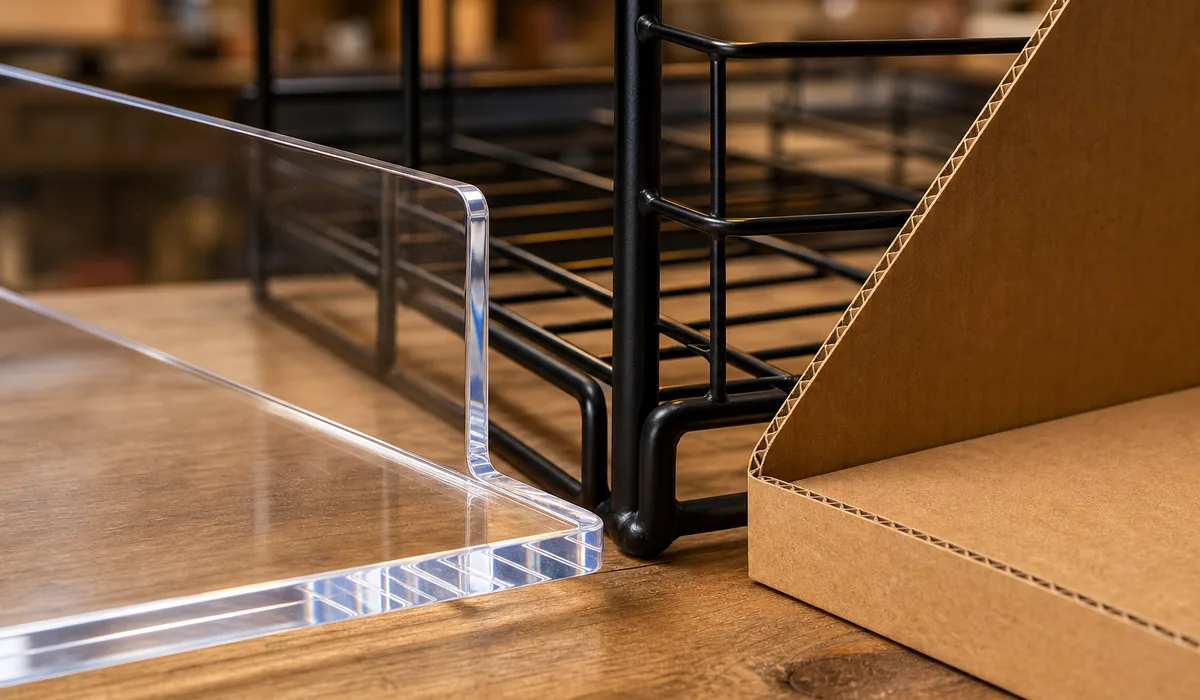
Where the materials meet: a diamond-polished acrylic edge next to a powder-coated wire junction. The acrylic edge is the finish; the wire junction is a weld that the coating has to hide.
## Wire and metal stands — when strength-per-dollar wins {#wire-metal}
Wire and metal stands buy more load capacity per dollar than any other material. A welded wire floor rack carries case-stacked product that would crack acrylic and crush cardboard, and a powder-coated steel frame shrugs off the restocking abuse that store life actually delivers: cart impacts, dragged repositioning, the daily bumps.
The trade is presentation. Wire looks like infrastructure, because it is. Branding options are limited to a printed header card and the coating color; there is no surface for photographic graphics, and every shopper has seen ten thousand identical wire racks. Powder coating also has a service life: chips at the welds open a path for rust, and in coastal or high-humidity stores I have seen racks bloom orange inside a year, one of the recurring failure patterns that started this guide.
Where metal earns its keep: back-of-store and utility positions, heavy product (beverage, hardware, bagged goods), spinner cores, and the hidden skeleton inside mixed-material builds. Where it loses: any position where the fixture itself is part of the brand statement. The pragmatic pattern I see from experienced buyers is metal where the shopper doesn't look and acrylic where they do, often in the same store set and sometimes in the same stand. We build to that pattern regularly: our acrylic bodies bolt onto steel bases we source against the same drawing, so the strength lives at the floor and the presentation lives at eye level.
Tooling matters here too. Wire fabrication is jig-based, so first orders carry setup work and design changes mean new jigs. Acrylic fabrication is file-driven (a dimension change is a revised cut file, not new tooling), which is part of why acrylic sampling runs days rather than weeks.
## Wood stands — warmth, weight, and the freight penalty {#wood}
Wood is the material buyers reach for when the brand brief says "premium," "natural," or "craft" — and at the aesthetic level, the brief is right. Stained plywood and solid-timber stands deliver a warmth that no print file reproduces, which is why they persist in wine, cosmetics-adjacent wellness, and heritage food brands.
The penalty arrives on the freight invoice. Wood stands are routinely the heaviest bid in a program by a wide multiple, and for an import program that weight compounds: heavier cartons, fewer units per pallet, more pallets per container. I have seen wood quotes where the ocean freight line exceeded the unit manufacturing cost; the stand was cheaper to build than to move. If your program ships to 200 stores from one origin port, weight is not a detail. It is a second unit price.
Wood also asks for maintenance that stores rarely give it. Edges chip, moisture swells particleboard cores, and a scratched stain finish cannot be buffed back the way a polished acrylic face can. None of this makes wood wrong. It makes wood a deliberate choice for flagship counts, not fleet counts. The pattern that actually works at fleet scale is keeping the wood *look* while losing the wood *mass*, which is where mixed-material builds come in below.
## Cardboard stands — the 8–12 week lifespan math {#cardboard}
Corrugated cardboard stands are the cheapest retail display stands per unit, print beautifully across their entire surface, ship flat, and are engineered around a single promotional window: call it 8 to 12 weeks of store duty. Inside that window, nothing beats them. A national launch that needs 5,000 units in stores for one quarter is a cardboard program, full stop.
The failures start when the calendar stretches. Corrugated board is a structural material only while it stays dry and undisturbed: humidity softens the flutes, restocking abrasion rounds the load edges, and a stand designed for a 10-week cycle starts leaning in month four. The mid-program collapse (a loaded floor stand folding in the aisle) is the single most visible display failure a brand can have, and in my experience it almost always traces to a consumable unit quietly promoted to permanent fixture because "it was still standing."
So treat cardboard as what its own engineering says it is: a consumable with a superb cost-per-week inside its design cycle and a terrible one outside it. If a promotion might be extended, price the replacement units into your program from day one, or run the lifecycle arithmetic in the next section and see whether a durable stand was the cheaper program all along.
We do not fabricate corrugated (our lines are acrylic), and I include it in this comparison anyway because it is the correct answer often enough that pretending otherwise would make the rest of the guide untrustworthy. A meaningful share of the briefs we receive describe a one-quarter promotion, and my honest advice on those is to run cardboard for the launch window and revisit a durable stand only if the SKU earns a permanent position. The buyers who get burned are not the ones who chose cardboard; they are the ones who never scheduled its retirement.
## Cost per selling week — the lifecycle math that flips the decision {#cost-per-week}
Cost per selling week is the stand's landed unit cost divided by the weeks it actually serves, replacements included. It is the only number that puts a $8 consumable and a $35 durable on the same axis, and it regularly flips the decision that the per-unit price column suggested.
Run the worked example. Take a 100-unit countertop program with illustrative prices: cardboard at $8 per unit replaced every 10 weeks, acrylic at $35, wire at $38, wood at $65, each durable unit lasting the full program. Over a 12-month program, cardboard consumes about 5 units per position: $41.60, or $0.80 per selling week. The acrylic unit runs $0.67 per week, wire $0.73, wood $1.25. Stretch the same program to 24 months and the durables halve while cardboard stays flat: acrylic $0.34, wire $0.37, wood $0.63, cardboard still $0.80.
The lifecycle flip: cardboard's cost per selling week never improves, because every cycle buys another unit. Durable stands amortize — acrylic drops to $0.34/week by month 24 in the worked example.
Two refinements make the real-world math even less kind to the consumable. First, every cardboard replacement cycle is also a logistics event: another freight shipment, another store labor hour to strip and rebuild the position, costs the unit price never shows. Second, the crossover point in the example sits around nine to ten months, but it moves earlier as replacement logistics get priced in, and later if your acrylic spec is heavier than it needs to be. The direction is what matters: the longer your program runs, the harder the durable stand wins. Match the material to your calendar, and the calendar usually says acrylic or metal past the first year.
## Mixed-material stands — wood-look headers, acrylic bodies, metal bases {#mixed-material}
You do not have to pick one material per stand. Mixed-material builds put each material where it earns its keep: a metal base for ballast and abuse tolerance, an acrylic body for product visibility and printed branding, and a header panel in whatever finish the brand language demands.
This is not a theoretical category. One retail buyer's brief to us put it plainly: the header must be a wood-like material. The brand needed timber warmth at eye level, but a full-wood stand had already failed the freight math. The build that answered it was a wood-grain header panel over a clear acrylic body: the shopper reads "craft brand," the freight invoice reads "acrylic," and the graphics stay swappable for the next campaign. I have seen that same substitution repeat across categories since (wine brands, wellness lines, gift retailers) because it resolves the exact tension between what the brand book demands and what the shipping lane allows.
The engineering point buyers miss is that mixing materials mostly means mixing *suppliers*, and stands that ship between a metal shop, a wood shop, and a print vendor accumulate lead time and tolerance drift at every handoff. The configurations that work treat one fabricator as the integrator: we cut, polish, and print the acrylic in-house, source the header and base components against the same drawing, and ship one assembled unit. If your brief has a material combination in it, send it as one brief through our [customization process](/customization/), not three.
## Sample before bulk — how brand and POS buyers lock quality standards {#sample-before-bulk}
Every serious brand and POS buyer we work with runs the same gate before releasing a bulk order: a paid sample, reviewed against written standards. The mechanics are quick (we ship samples in 3–5 days), and the review has three layers worth doing properly.
**Material and print proof.** The sample confirms the physical spec: material identity and thickness, edge finish, and print fidelity against the brand's color standards. This is where "adhere to our visual and quality standards" — the phrase that appears in brand buyers' briefs almost verbatim, industry-wide — becomes something checkable rather than aspirational.
**Dimensional review.** The sample is measured against the drawing, and, more important, loaded with the actual product. A stand that holds the drawing's tolerances but grips the product too tightly, or lets it lean, fails here instead of failing in 300 stores.
**The written visual QC checklist.** The most useful move at sample stage is converting the approved sample into a checklist: edge finish grade, print registration limits, packaging spec, allowed blemish thresholds by surface. That document becomes the acceptance standard for the bulk run. Our inspectors check against it, and since 2018 every unit we ship passes 100% piece-by-piece inspection under ISO 9001 rather than batch spot-checks.
I push buyers toward the written checklist for a self-interested reason: it protects both sides of the transaction. When the standard lives in an email thread as "make it look like the sample," every borderline unit becomes a negotiation. When it lives in a signed document with thresholds, our QC bench and the buyer's receiving dock are applying the same test, and disputes mostly stop existing. The brands that run POS programs across many suppliers all work this way, and in my experience it is the single clearest marker separating buyers who scale smoothly from buyers who firefight.
Approval to production is then a clean handoff: sign-off triggers the 15–20 day production clock, and the sample sits on our QC bench as the physical reference until the last carton seals. To start the sample loop, [send us a drawing or reference photos](/contact/?source=retail-display-stands-buyer-guide) and we will quote the sample alongside the bulk tiers.
## Buying from a factory vs a distributor — MOQ, lead time, freight {#factory-vs-distributor}
The distributor sells you a catalog; the factory sells you a spec. That is the one-line version of the channel decision, and everything else (MOQ, price, lead time, freight) follows from it.
A domestic distributor holds stock designs in a warehouse: order 20 units of a standard stand today, receive them this week, pay a price that includes their margin, their warehousing, and their import work. For stock designs at small counts on short notice, that layer earns its money. What the catalog cannot do is match your product's footprint, carry your brand's exact color, or combine materials to your brief — and custom work through a distributor is quoted with their markup on someone else's factory, usually at MOQs far above ours.
Factory-direct inverts the trade. Our MOQ is 50 pieces, samples run 3–5 days, production 15–20 days, and shipping defaults to FOB Shenzhen: the buyer takes ownership at the port, with EXW, CIF, and DDP available when we carry the freight leg instead. Payment runs 30% deposit with the 70% balance due before shipment. The price is the fabrication price; the planning the buyer takes on is the freight calendar — sea freight runs roughly 4–6 weeks door-to-door (3–5 weeks port-to-port). Across 2,000+ projects shipped to 25+ countries, the pattern is consistent: buyers with a real spec and a program calendar come out ahead going direct; buyers who need ten generic stands by Friday should use the warehouse.
There is also a relationship difference I care about, having sat on the factory side of it since 2008. A distributor's catalog cannot tell a buyer that the specced thickness is heavier than the load requires, or that rotating a cut layout would lift sheet utilization and drop the unit price. The factory quoting the job can, and we do it on most quotes because value-engineering a first order is how we earn the reorder. When a stand program comes back for its second and third runs, our tooling files, print artwork, and QC checklist are already on record, which is why repeat runs quote faster and ship faster than first orders.
If your actual question is whether to run a custom spec at all or buy stock, that decision has its own guide — [custom vs stock acrylic displays](/guide/custom-vs-stock-acrylic-displays/) — and for what a factory-direct program looks like at chain scale, the [50-store multi-category display rollout](/case-studies/multi-category-acrylic-display-rollout-50-store-retail/) case walks a real one end to end.
*How we sourced this guide: material pricing logic and lifecycle arithmetic use a transparent worked example rather than claimed market rates; Wetop-specific figures (MOQ 50, samples 3–5 days, production 15–20 days, 100% inspection since 2018, ISO 9001, 2,000+ projects across 25+ countries) come from our production records; buyer-brief language comes from anonymized inquiry patterns in our project archive.*
[^shop-popai]: [Shop! Association](https://www.shopassociation.org/) — the retail-marketing industry body formerly known as POPAI; its 2012 Shopper Engagement Study reported 76% of purchase decisions being made in-store, the premise behind investing in display quality at the shelf and register.
[^azom-pmma]: [AZoM — Polymethylmethacrylate (PMMA, Acrylic) cast sheet datasheet](https://www.azom.com/article.aspx?ArticleID=786) — publishes the cast acrylic density figure (~1.19 g/cm³) behind the weight comparison between acrylic and glass fixtures in the acrylic section.