---
title: "PSA Slab Dimensions: Sizes, Slots & Stacking"
description: "PSA slab dimensions run about 81 x 136 x 6.5mm (3.19 x 5.35 x 0.26 in). Compare BGS, SGC, and CGC slab sizes, plus slot clearance and stacking math."
category: "Comparison"
author: "Deniz Chen"
authorCredential: "QC Manager at Wetop Acrylic — leading 4-stage quality inspection since 2016, 1,000+ custom orders inspected piece-by-piece before ship"
datePublished: 2026-07-28
dateModified: 2026-07-28
primaryKeyword: "psa slab dimensions"
url: https://wetopacrylic.com/guide/psa-slab-dimensions/
---
## The numbers first {#the-numbers}
PSA slab dimensions run approximately 81 x 136 x 6.5mm — 3.19 x 5.35 x 0.26 inches — for the standard holder that encapsulates a graded trading card.[^onlygreats] Collector measurements of current-generation holders cluster within a millimeter of those figures. Every display slot, storage box, insert, and frame number downstream derives from that envelope.
Two qualifications keep that number honest. First, PSA does not publish a formal dimensional spec for its holder, so the figures above are convergent measured values — hobby references and collector measurements land on the same envelope, give or take a millimeter.[^onlygreats] Second, holder generations differ: PSA has revised its case design several times, and a vintage slab from an early generation will not match a current one to the tenth of a millimeter. For anything with a loose fit — a shelf, a sleeve, a shipping box — the published number is plenty. For anything with a tight fit — a display slot, a recess, a stacking well — the slab in your hand outranks any table on the internet, including the one below.
That distinction is the working rule of this page. I've gauged thousands of slab slots against approved samples across 10+ years leading final inspection, and the orders that go smoothly are the ones where the buyer mailed us a real slab instead of a screenshot of a dimensions table. The table gets you to a correct drawing; the physical slab gets you to a correct fit.
---
## What the envelope contains: card vs holder {#card-vs-holder}
A standard trading card measures 63.5 x 88.9mm (2.5 x 3.5 in), so the PSA holder adds roughly 17mm of width and 47mm of height around it. Most of that height is the label block; the rest is the welded perimeter that makes the holder tamper-evident. PSA case size and card size are two different numbers, and displays are sized to the case.
That gap between card and case is where sizing mistakes come from. A buyer who specs a display around the card — because the card's dimensions are the ones printed in every collecting reference — ends up with slots a full label-block too short. The label is not trim: it carries the grade, the certification number, and the barcode, and a display that crops it visually has hidden the part of the slab that justifies the grading fee. Every slot, recess, and frame opening in this guide assumes the full holder envelope, label included.
Thickness has its own version of the same trap. The card inside is under a millimeter thick; the holder's ~6.5mm comes from the two welded shells and the internal well that suspends the card. Thicker cards — patch cards, relic cards — go into taller-well variants of the holder, which is one more reason the measured slab in hand beats the published number: two PSA slabs from the same year can differ by the well depth of the card they carry.
---
## PSA vs BGS vs SGC vs CGC: no shared envelope {#slab-comparison}
The four major card graders each designed their own holder, and none of them match. BGS slabs are shorter but noticeably thicker than PSA; SGC runs the largest footprint of the four; CGC matches PSA's footprint almost exactly but adds about 1.4mm of thickness. "Graded slab" is a category, not a size.
| Grading service | Width | Height | Thickness | Fit note |
|-----------------|:-----:|:------:|:---------:|----------|
| PSA | ~81mm (3.19 in) | ~136mm (5.35 in) | ~6.5mm (0.26 in) | The reference profile most displays are cut for |
| BGS (Beckett) | ~84mm (3.31 in) | ~131mm (5.16 in) | ~8mm (0.31 in) | Shorter but thickest — won't enter a PSA-snug slot |
| SGC | ~86mm (3.39 in) | ~138.5mm (5.45 in) | ~7.9mm (0.31 in) | Largest footprint of the four |
| CGC | ~80mm (3.15 in) | ~135mm (5.30 in) | ~7.9mm (0.31 in) | PSA-like footprint, ~1.4mm thicker |
Dimensions are commonly measured values compiled from hobby references,[^onlygreats] except CGC's footprint, which the grader itself states at approximately 3.15 x 5.30 inches.[^cgc] All four vary slightly by holder generation.
The practical reading of the table is thickness-first, with PSA slab dimensions as the baseline the other three are read against. Footprints differ by a few millimeters, which matters for recesses and frames, but thickness is what decides whether a slab enters a slot at all: 6.5mm (PSA) against roughly 8mm (BGS, SGC, CGC) is the difference between seating cleanly and not fitting. A "universal" slot wide enough for all four leaves a PSA slab with 1.5mm of slop — it leans, rattles, and reads as an afterthought on a counter. That is why mixed collections get mixed-profile blocks with per-service slots cut side by side, not one compromise channel.
Coin collectors run the same math with different numbers: an NGC coin slab measures roughly 82 x 58 x 8mm, and the slot logic in this guide transfers directly — our [coin display ideas guide](/guide/coin-display-ideas/) covers the coin-side formats, and a real build for a numismatic retailer is written up in the [coin shop counter slab display case study](/case-studies/coin-shop-counter-slab-display-rollout/).
---
## From slab dimensions to display slot dimensions {#slot-sizing}
The conversion rule from slab to slot is short: cut the slot to the actual slab's measured envelope plus about 0.5mm of total clearance, and cut any footprint recess about 1mm over the slab's length and width. That clearance seats and releases the slab freely without letting it lean or rattle.
The whole conversion in one drawing: the slab's measured envelope, plus ~0.5mm of total clearance, equals the slot. Everything else — pitch, capacity, case size — is multiplication.
The 0.5mm figure is a working tolerance, and both directions of failure are visible on an inspection bench. Cut tighter, and two things go wrong: insertion drags acrylic against the holder's edges, and the generation variance described above turns a "perfect" slot into a jam for one slab in twenty. Cut looser — 1mm and beyond — and the slab leans off vertical, rattles in shipping, and sits crooked in every listing photo the retailer shoots. When my inspection team checks a slab-display order, slot fit is gauged piece by piece against the approved sample with a reference slab, because a half-millimeter is invisible on a drawing and obvious in the hand.
The same logic scales to recesses and wells. A flat recess that locates a slab on a base runs about 1mm over the slab's length and width — location, not grip. A stacking well that holds a pile of slabs adds clearance on all four sides, because stacked holders self-align less precisely than a single seated slab. And every one of those cuts starts from a mailed slab: send one PSA, BGS, SGC, or CGC holder and we measure it directly, cut a sample slot, and ship the sample in 3-5 days for approval before the 15-20 day production run.
---
## Stacking and capacity math {#stacking-capacity}
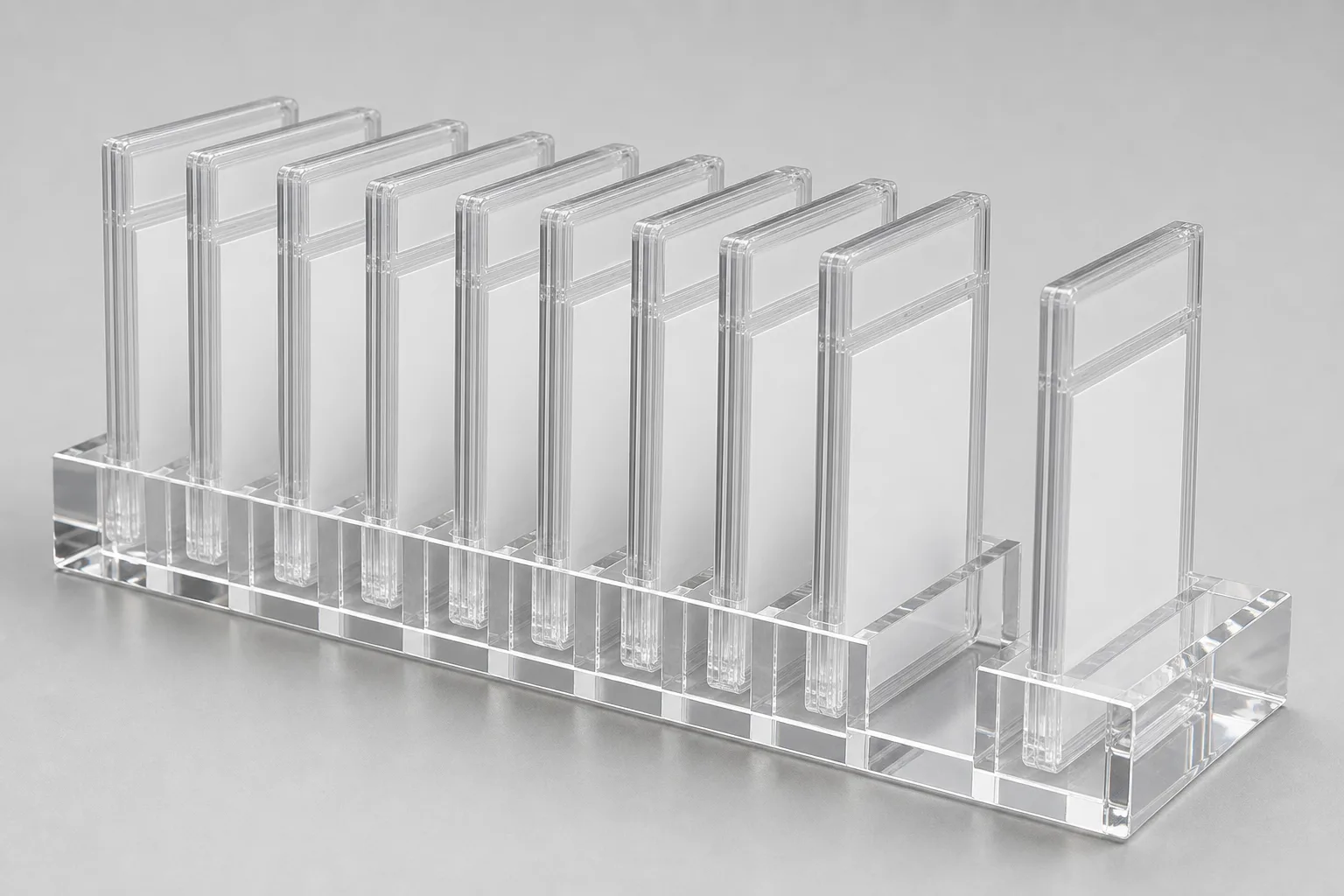
Capacity math is where PSA slab dimensions turn into case dimensions, and it starts from slot pitch, not slab thickness. One PSA slot at about 7mm plus one 5mm acrylic divider gives a 12mm pitch, so a six-slab block needs roughly 77mm of interior run — six slots plus a seventh wall. Stacks are simpler: about 6.5mm per PSA slab plus a seating allowance.
Worked through, the three common formats look like this. A vertical multi-slot block at 12mm pitch puts six PSA slabs in ~77mm and nine in ~113mm of interior width, which is why 6- and 9-slot blocks dominate counter displays — they stay under a forearm's width. A stacking well for raw storage holds ten PSA slabs in about 65mm of slab material; plan ~70mm of well depth to absorb the seating gaps between holders, and verify against a real stack because holders are designed to rest on each other, not to a published stack height. A wall rack rows out on the 136mm slab height: each row wants the slab plus roughly 30mm of visual gap and rail, so a four-row gallery panel lands around 660-680mm tall.
Mixed-profile programs change the pitch per slot, not the method. A block holding four PSA and two BGS slabs runs four slots at ~7mm and two at ~8.5mm, dividers unchanged — the drawing just stops being uniform. The one number I flag on every mixed-profile inspection checklist is which slot is which: a 1.5mm difference between neighboring channels is easy to miss visually and impossible to miss at handover, which is why slot widths are gauged and logged against the drawing before packing, on 100% of pieces, under our ISO 9001 process.
Pitch made visible: each channel is the slab's measured thickness plus ~0.5mm, and the empty slot shows how little clearance a stable fit actually needs.
---
## What this page settles, and what it hands off {#forks}
This page is the dimensional reference: slab envelopes, slot clearance, and capacity math. Choosing a display format and buying cases are different questions with their own pages — and if you're sourcing slab displays commercially, the product page below is where specs turn into a quote.
The division of labor, explicitly. Our [graded card display cases](/products/acrylic-cases/graded-card-display-cases/) product page owns the commercial side — the six case formats, felt and UV options, pricing drivers, and MOQ terms — so once your slab profile is settled, that's where a program gets specified and quoted. Our [trading card display case guide](/guide/trading-card-display-case-guide/) owns the decision layer above it: which display type suits a shop counter versus a collection wall versus sealed product, across PSA, BGS, SGC, and CGC. This page feeds both with the numbers.
For how the dimensions play out in real programs: the [triple PSA slab display case study](/case-studies/triple-psa-slab-display-graded-card-retailer/) documents a three-slot counter block where every slot was cut from the retailer's mailed slab at ~0.5mm clearance, and the [sealed and single-card formats](/products/acrylic-cases/card-display-cases/) sit one page over for programs that mix slabs with booster boxes.
If you're holding a slab and a quantity in mind, the shortest path is physical: [send us the spec](/contact/) — service, format, quantity — and mail one slab. MOQ is 50 pieces per design with zero tooling fees; we measure the holder, cut the sample slot, and the numbers on this page become a fit you can gauge with your own hands.
[^onlygreats]: [Graded card slab sizes for PSA, BGS, SGC, and CGC — Only Greats](https://onlygreats.com/2023/05/03/top-3-graded-card-sleeves-psa-bgs-sgc/) — hobby reference listing measured slab dimensions in inches and millimeters (PSA ~136 x 81 x 6.5mm; BGS ~131 x 84 x 8mm; SGC ~138.5 x 86 x 7.94mm; CGC ~136 x 81 x 7.86mm), the measured-envelope figures behind this guide's comparison table.
[^cgc]: [CGC Cards holder FAQ — what are the dimensions of the CGC Cards holder?](https://www.cgccards.com/about/help-center-faqs/cgc-cards-holder-and-label/general-holder-faqs/) — the grader's own statement that the CGC holder measures approximately 3.15 x 5.30 inches, the one first-party footprint figure among the four major services.