---
title: "Polycarbonate vs Acrylic: Which One Should You Spec?"
description: "Polycarbonate vs acrylic — impact, clarity, UV, cost, and fabrication compared by a factory that runs both. Spec the right plastic before your RFQ goes out."
category: "Comparison"
author: "Dillion Chen"
authorCredential: "Production Manager at Wetop Acrylic — running laser, CNC, polishing, and UV printing lines since 2014, 1,500+ custom projects personally overseen"
datePublished: 2026-04-21
dateModified: 2026-04-21
primaryKeyword: "polycarbonate vs acrylic"
url: https://wetopacrylic.com/guide/polycarbonate-vs-acrylic/
---
## Polycarbonate vs Acrylic: The 30-Second Answer {#short-answer}
The polycarbonate vs acrylic decision comes down to one question: polycarbonate is stronger; acrylic is clearer, cheaper, and easier to fabricate. Pick polycarbonate when something can hit the panel: machine guards, riot shields, security glazing, sports enclosures. Pick acrylic for everything else: displays, cases, signage, retail fixtures, lighting diffusers, and the 90% of custom B2B work where impact is not the driving spec.
In 12+ years running Wetop's production floor, I've had maybe 8 in every 10 "polycarbonate vs acrylic" inquiries end up as acrylic orders once we walked through the buyer's actual application. The reason isn't that polycarbonate is a bad material. It's that most buyers hear "stronger" and stop the analysis there. Polycarbonate's impact advantage is real and sometimes decisive. But optical clarity, UV stability, chemical resistance, edge finish quality, and cost per finished unit all tilt the other way for most display work. This article walks through each of those dimensions the way I walk through them on a buyer qualification call.
---
## How Polycarbonate and Acrylic Compare on 7 Specs {#comparison-table}
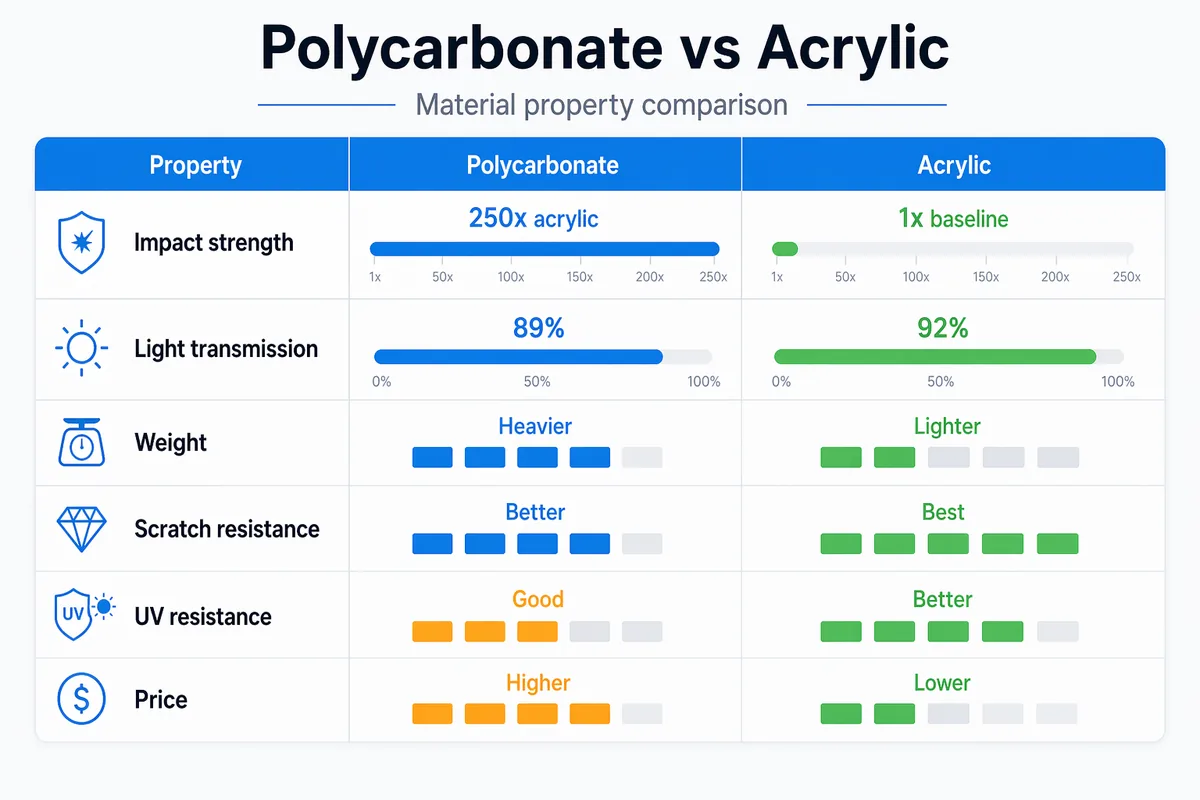
Polycarbonate and acrylic differ across seven properties that actually drive plastic glazing decisions: impact resistance, optical clarity, UV stability, heat resistance, chemical resistance, fabrication flexibility, and cost. The table below uses published technical data from SABIC and Evonik — the two largest global producers of polycarbonate and acrylic sheet respectively.
For display applications, optical clarity and cost drive most decisions, with fabrication flexibility becoming critical as soon as your design includes curves, polished edges, or laser-cut details. For protective glazing, impact and heat resistance flip the priority order entirely.
### Polycarbonate vs acrylic: material property comparison
| Property | Acrylic (Cast PMMA) | Polycarbonate (PC) | Winner |
|---|---|---|---|
| Light transmittance | 90–92% | 86–89% | Acrylic |
| Impact resistance (vs glass) | 10–17× stronger | ~250× stronger | Polycarbonate |
| Scratch hardness (Mohs) | 2–3 | 2–3 (softer than acrylic without coating) | Tie / Acrylic edge |
| UV stability (untreated) | 10+ years clear | Yellows in 2–5 years | Acrylic |
| Max service temperature | 80–95°C | 115–130°C | Polycarbonate |
| Chemical resistance (alcohols, cleaners) | Good | Crazes under alcohols, ammonia | Acrylic |
| Laser-cutting edge quality | Fire-polished off machine | Chars and melts | Acrylic |
| Thermoforming | 160–180°C, clean | 180–200°C, dries out | Acrylic |
| Cost per m² (6mm, US market, indicative) | ~$30–$55 | ~$50–$85 | Acrylic |
The optical transmittance figures for acrylic reference ASTM D1003 test data published by cast acrylic manufacturers such as [Evonik's PLEXIGLAS division](https://www.plexiglas.com/). Polycarbonate transmittance and impact data reference [SABIC's published datasheets for Lexan-brand sheet](https://www.sabic.com/en/products/specialties/lexan-resins-portfolio). Both values are independently verified against ASTM D1003 (transmittance) and [ASTM D256](https://www.astm.org/d0256-10r18.html) (Izod notched impact) standard test methods.
Polycarbonate wins where impact dominates the spec; acrylic wins where clarity, UV stability, and delivered cost matter more.
---
## Where Polycarbonate Is the Right Call {#when-polycarbonate-wins}
Polycarbonate is the correct spec for any application where impact, heat, or security is the primary design constraint. For these use cases I recommend polycarbonate without hesitation, and I'll say so on a quote rather than push an acrylic alternative the application can't support.
The four scenarios where polycarbonate genuinely outperforms acrylic for custom fabrication work: first, **machine guarding and safety enclosures** in manufacturing environments. Polycarbonate absorbs hammer, projectile, and tool impact that would shatter acrylic, and OSHA-compliant machine guards are almost always specified in polycarbonate. Second, **sports and recreational glazing**: hockey rink dasher boards, baseball dugout shields, paintball and airsoft arenas, trampoline park enclosures. The impact loads are severe and repetitive, and polycarbonate is the standard industry spec. Third, **security glazing**: bank teller windows, convenience store partitions, vandal-resistant signage. Polycarbonate is the bulletproof-adjacent material, and multi-layer laminated polycarbonate is UL-rated for ballistic protection. Fourth, **high-heat environments**: lighting fixtures near incandescent or HID lamps, industrial viewing ports, greenhouse roofing exposed to concentrated solar gain. Polycarbonate's 115–130°C service temperature gives a 20–50°C margin over acrylic.
For any of these four categories, sending an acrylic spec is a mistake. I've seen buyers try to save money by switching a machine-guard project from polycarbonate to acrylic. The first projectile impact cracks the acrylic, and the replacement cost plus the safety incident liability erases every dollar saved at the material step.
The real decision tree. If impact, heat, or security drives the spec, polycarbonate wins. For every other custom display and retail application, acrylic is the default.
---
## Why Acrylic Wins on Display Clarity {#clarity-gap}
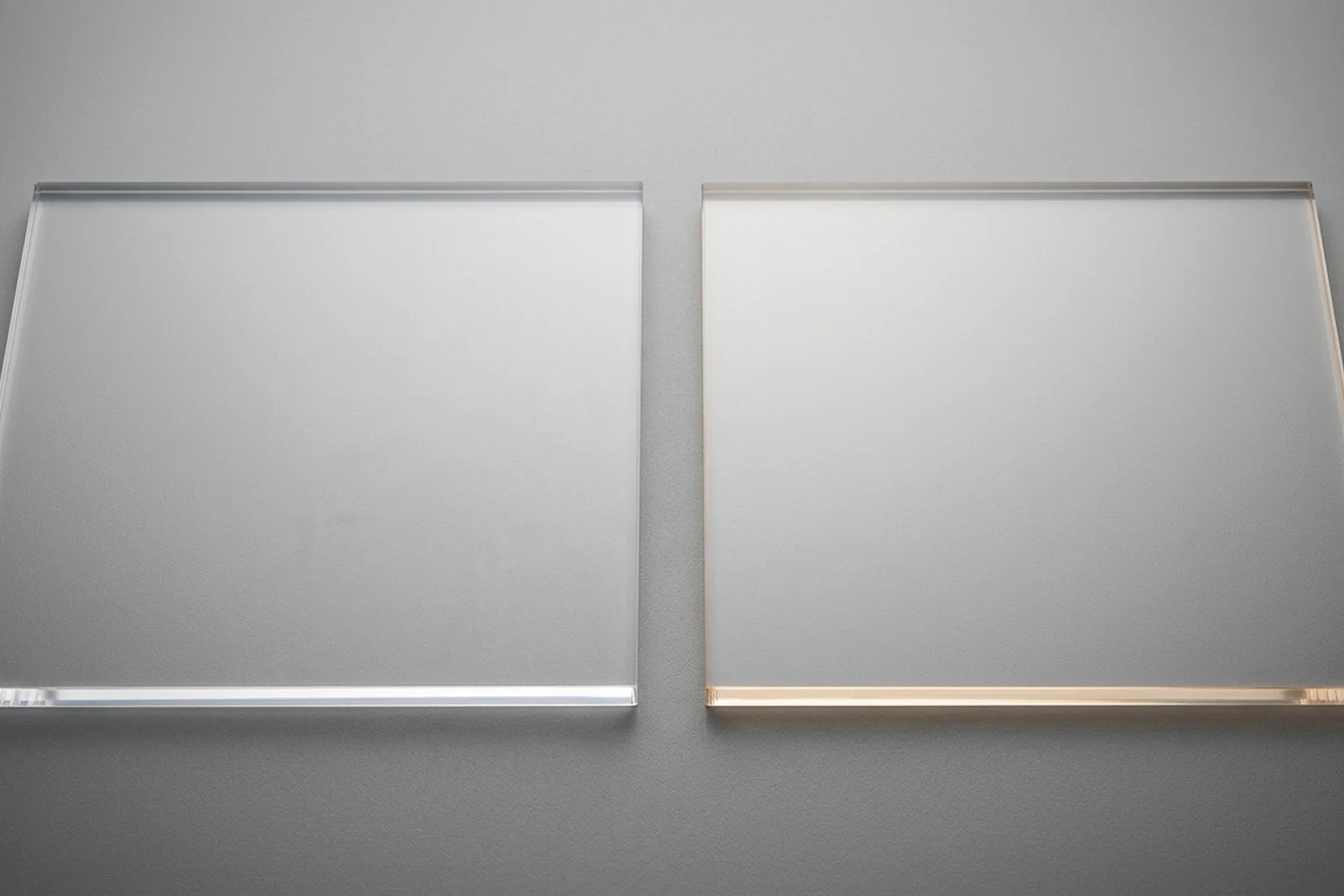
Acrylic's optical clarity is one of the most underweighted advantages in the polycarbonate vs acrylic comparison, and the one that matters most for retail display, signage, and any application where the panel is the product. Cast acrylic transmits 90–92% of visible light; polycarbonate transmits 86–89%. That 3–5 percentage-point gap looks small on paper, but it's visually obvious in side-by-side comparison, especially in thicker panels.
Same 6mm thickness, same lighting. The amber edge tint on polycarbonate (right) becomes obvious in thicker panels and deepens with UV exposure over time.
The deeper clarity problem with polycarbonate is yellowing over time. Untreated polycarbonate yellows under sustained UV exposure — outdoor signage typically shows visible color shift within 2–5 years, and the yellowed surface loses both clarity and impact resistance as the polymer chains degrade at the surface. Untreated acrylic holds color for 10+ years in the same conditions. UV-stabilized grades exist for both materials, but polycarbonate needs the stabilizer to last at all outdoors; acrylic's UV stability is inherent to the polymer. On the factory floor, I spec cast acrylic for every outdoor and window-adjacent display project by default — [3D acrylic letters for storefront signage](/case-studies/3d-acrylic-letters-dimensional-logo-signage/) and illuminated retail fixtures are both applications where polycarbonate would start degrading before the client's brand refresh cycle finishes.
The chemical resistance gap also hits display applications. Polycarbonate crazes (develops stress cracks) under contact with alcohols, ammonia, and many common retail cleaners. Retail staff cleaning a display case with Windex daily are effectively attacking a polycarbonate panel's surface integrity. Acrylic has meaningfully better resistance to these cleaners and holds up for years of routine retail cleaning without crazing.
---
## The Fabrication Gap Most Buyers Underestimate {#fabrication-difference}
The fabrication differences between polycarbonate and acrylic drive cost and lead time more than the raw material price does. When my operators set up a new polycarbonate job on our CNC lines, the schedule buffer I add is almost always bigger than the one I'd add for an acrylic job of the same complexity — and that buffer comes straight out of lead time. On our production floor, acrylic runs through CO2 laser cutters at high speed with a fire-polished edge straight off the machine, no secondary polishing required. Polycarbonate physically cannot be laser-cut cleanly: the material absorbs CO2 wavelengths differently, melting and charring instead of vaporizing, and releases chlorine-containing fumes that damage equipment and fabric.
For polycarbonate shapes, we route on CNC machines with carbide tooling, then mechanically polish each edge — typically sanding through 4–6 grit progressions before final buffing. That's 3–5× the labor time per piece compared to a laser-cut acrylic part of the same complexity, which directly flows into unit cost on any custom shape. For a 500-piece run of panels with rounded corners and cutouts, the labor difference alone can be 30–50% of the total fabrication cost. Buyers who've only worked with flat rectangular panels often don't see this — the gap shows up the moment the design includes anything other than a straight cut.
Thermoforming amplifies the difference. Acrylic thermoforms cleanly at 160–180°C into compound curves, dome shapes, and vacuum-formed enclosures — we make curved display cases, thermoformed standees, and dimensional signage all day. Polycarbonate requires higher forming temperatures (180–200°C) and tends to dry out and warp as moisture escapes during heating — pre-drying is mandatory and process tolerances are tight. For complex 3D shapes, acrylic is both easier to make and more consistent piece-to-piece.
Bonding is the third gap. Acrylic bonds with solvent cement to form optically clear, load-bearing joints — this is how we build [acrylic display cases](/products/acrylic-cases/) with invisible corners. Polycarbonate requires adhesives rather than solvent welding, which leaves visible bond lines and weaker joints. For any display that depends on clean corner joints or invisible bonding, acrylic is the material that delivers the finished aesthetic.
---
## Cost: Raw Material, Fabrication, and Total Delivered {#cost-comparison}
Acrylic is cheaper than polycarbonate at every level of the cost stack: raw material, fabrication labor, and total delivered cost per finished unit. Cast acrylic sheet typically runs roughly 35–50% less per square meter than equivalent-thickness polycarbonate in the US market. Indicative distributor pricing for a 6mm × 1m² sheet is roughly $30–$55 in cast acrylic versus $50–$85 in polycarbonate, varying by brand, grade, and order volume; check current quotes from distributors like ePlastics, Piedmont Plastics, or your regional sheet supplier for today's numbers.
On our floor, I walk buyers through four variables that determine the total cost gap on any specific project. First, the **raw material cost gap** (35–50% against polycarbonate) widens when specifying UV-stabilized polycarbonate, which carries a premium over standard PC. Second, **fabrication speed** — acrylic laser cuts in minutes what polycarbonate takes hours to CNC route and polish. Third, **polishing and finishing labor** — polycarbonate needs mechanical edge finishing after every cut; acrylic's flame or diamond polish is a single finishing pass after laser cutting (see our [diamond vs flame polishing guide](/guide/diamond-vs-flame-polishing-acrylic/) for the edge-finish tradeoffs). Fourth, **scrap rate** — polycarbonate's higher scratch-on-handling risk and moisture sensitivity during thermoforming produce more rejected parts per run, adding indirect cost. In my 12+ years pricing both materials, these factors typically put acrylic at 40–60% lower total delivered cost for equivalent-spec display work.
The exception: when the application genuinely requires polycarbonate's impact resistance or heat tolerance, those costs are the cost of the correct material. I don't quote acrylic for a machine-guard project to save the buyer money — the material won't hold up, and that's a longer-term cost than the material savings.
For an exact cost comparison on your specific project, send specs to inquiry@wetopacrylic.com — we'll quote both materials when your application genuinely calls for comparison, and we'll tell you directly which we recommend. We respond within 24 hours.
---
## "Acrylic vs Plexiglass vs Polycarbonate" — Clearing Up the Terminology {#terminology}
In buyer conversations, brand names and generic terms get used interchangeably. The short decoder: **acrylic = PMMA = plexiglass = perspex = Lucite** (all the same material, different brand or region names; our [acrylic vs glass guide](/guide/acrylic-vs-glass-displays/) covers this terminology in more depth). **Polycarbonate = PC = Lexan (SABIC) = Makrolon (Covestro) = Tuffak (Plaskolite)** — same material, different brands with similar specs.
When an RFQ says "Lexan display case," the buyer means polycarbonate, and I'll clarify on the call whether that's the right material. When an RFQ says "plexiglass case," they mean acrylic, and it almost always is the right material. When an RFQ says "acrylic vs plexiglass vs polycarbonate" as a comparison question, they're really asking "acrylic vs polycarbonate" — plexiglass and acrylic are the same thing.
For a related material comparison on the transparent-glazing side, see our guide on [acrylic vs glass for displays](/guide/acrylic-vs-glass-displays/) — the three-way framing of acrylic, glass, and polycarbonate covers most of the transparent-panel decision space.
---
## Which to Spec for Your Project {#decision}
For the vast majority of custom B2B display, retail, signage, and lighting projects, specify acrylic — specifically cast PMMA at the appropriate thickness and finish for your application. The decision tree below covers the cases where polycarbonate is the correct call instead.
**Spec polycarbonate if:** the application involves expected or possible impact (machine guards, sports glazing, security partitions, vandal-resistant signage), OR the panel sits within 30cm of a heat source above 95°C (HID lighting, industrial viewing ports), OR ballistic/intrusion resistance is required, OR the application is outdoor and mounted where flex under wind load matters more than UV stability (greenhouse glazing, large-span canopies).
**Spec acrylic if:** the panel is a display surface where clarity matters (cases, countertop stands, signage, dimensional letters, POP displays, trade show fixtures), OR the design includes curves, cutouts, or laser-cut details, OR budget matters and both materials meet the functional requirement, OR the application is outdoor signage with no expected impact load, OR the display needs invisible bonded corners (solvent-welded acrylic is optically clearer than adhesive-bonded polycarbonate).
For custom display cases, risers, sign holders, and retail display fixtures, we fabricate in cast acrylic as the default — 3mm to 20mm depending on the application. For specific product categories, see our pages on [acrylic display stands](/products/acrylic-displays/), [acrylic display cases](/products/acrylic-cases/), and [acrylic sign holders](/products/acrylic-displays/acrylic-sign-holders/). If your design brief specifies polycarbonate or Lexan and you want a second opinion on whether acrylic is viable, include that question when you send your RFQ. I review every quote personally and will give you a direct answer — if polycarbonate is genuinely the right material for your application, I'll confirm that and we'll source it; if acrylic will meet the requirement at lower cost, I'll tell you that too.
For thickness selection within acrylic — the common follow-on question after material selection — see our [acrylic thickness guide](/guide/acrylic-thickness-guide/). For the buyer-facing RFQ checklist, our [custom acrylic RFQ guide](/guide/acrylic-rfq-guide/) walks through every spec you should include upfront to get accurate quotes the first time.