---
title: "Physical Acrylic Sample vs. 3D Render: Real Rework Costs"
description: "12 documented projects show why a physical acrylic sample beats any 3D render — measured delta-E gaps, edge-finish surprises, and $400-$8,000 rework math."
category: "Buyer Guide"
author: "Amy Liu"
authorCredential: "Client Account Manager at Wetop Acrylic — coordinating B2B orders from first inquiry through delivery since 2020, 500+ custom projects handled"
datePublished: 2026-05-05
dateModified: 2026-05-05
primaryKeyword: "acrylic sample approval"
url: https://wetopacrylic.com/guide/physical-acrylic-sample-vs-3d-render/
---
## Why a Physical Acrylic Sample Beats Any 3D Render — Real Rework-Cost Data {#intro}
A 3D render approves the look. A physical acrylic sample approves the part. The gap between those two sentences is where most rework costs come from in custom acrylic — and over the last two years I've catalogued what falls into that gap on twelve of our projects.
I run [acrylic sample approval](/customization/) on every order that crosses my desk, and I've watched first-time buyers do something I disagree with: they look at a photoreal render, mentally check "approved," and skip to bulk. The render is not wrong. It is just not enough. The render is rendering pixels; the factory is cutting cast PMMA, flame-polishing edges, printing pigment on a textured substrate, and bonding panels with a chemical that flashes off in 90 seconds. Those four physical realities show up in the part. None show up in a render.
This guide walks through the five risk dimensions where renders mislead buyers, the rework-cost math from twelve projects, and the narrow set of cases where skipping the sample is defensible.
The same product on a tablet and in a hand — the gap between those two views is where 9 of our 12 documented rework cases lived.
---
## What 3D Renders Show vs. What Acrylic Actually Feels Like {#material-perception-gap}
A 3D render shows geometry, color, and an interpretation of light. It does not show weight, edge sharpness, surface micro-texture, optical depth through clear cast PMMA, or the way frosted acrylic shifts under tungsten versus LED retail lighting. Those five attributes are where buyers most often disagree with their own approved render once the bulk lands.
In a 30-buyer survey we ran across cosmetics, electronics, awards, and food-service display, material weight was the most-cited surprise factor on first-bulk-receipt. A render of a 5mm riser looks identical to an 8mm one. Hold both and you know which feels "premium" in front of a $200 skincare jar and which feels like a prototype. On a 2024 indie cosmetics launch, the buyer approved a render-based 4mm spec, received bulk, then immediately asked for 6mm — a $4,200 rework cost a 4mm sample on their desk would have prevented.
The other consistent gap is optical depth. Clear cast PMMA carries light through its body in ways render engines do not capture — the edge glow on backlit display, the way an internal engraving catches studio versus showroom lighting, the faint green tint stacked thicknesses produce. Buyers who approved a render and then saw the part have told me, in nearly identical language across six projects, "I didn't realize it would feel like this." That sentence is the cost of skipping the [physical acrylic sample](/customization/).
---
## Color Register Risk — Render-to-Print Delta-E in 12 Case Studies {#color-register}
Color is where I can give you the hardest numbers, because we measure it. Pantone's color tolerance guidance for printed plastics calls a delta-E of 2 the typical commercial threshold for "acceptable match" — above 4 is visibly different to the human eye at normal viewing distance[^pantone-delta-e]. Across the 12 rework cases, 9 had a measured delta-E above 4 between the approved render and the printed acrylic part. Three sat between 4 and 5 (subtle but noticeable in good light). Six sat above 5. Two crossed delta-E 7 — which on a retail floor reads as a different color, full stop.
The reason is structural, not sloppy. A render is RGB pixels on a backlit screen at ~6500K. A printed acrylic part is CMYK pigment on a textured substrate, viewed under whatever ambient light is in the office, the studio, the store, the trade-show booth. None of those environments match each other or the monitor that approved the render. Layer in pigment-substrate interaction — UV-cured ink prints differently on frosted versus polished acrylic — and you have a color register problem no render workflow can fully predict.
If your design has any brand color that matters — a Pantone match for beauty, a corporate red for a booth, a gradient the marketing team obsessed over — request a printed acrylic sample with the actual ink, on the actual substrate, under the actual finish. That sample is the only object that lives in the same physical world as your bulk part.
---
## Edge Finish and Joinery — The Texture That Renders Can't Show {#edge-finish-joinery}
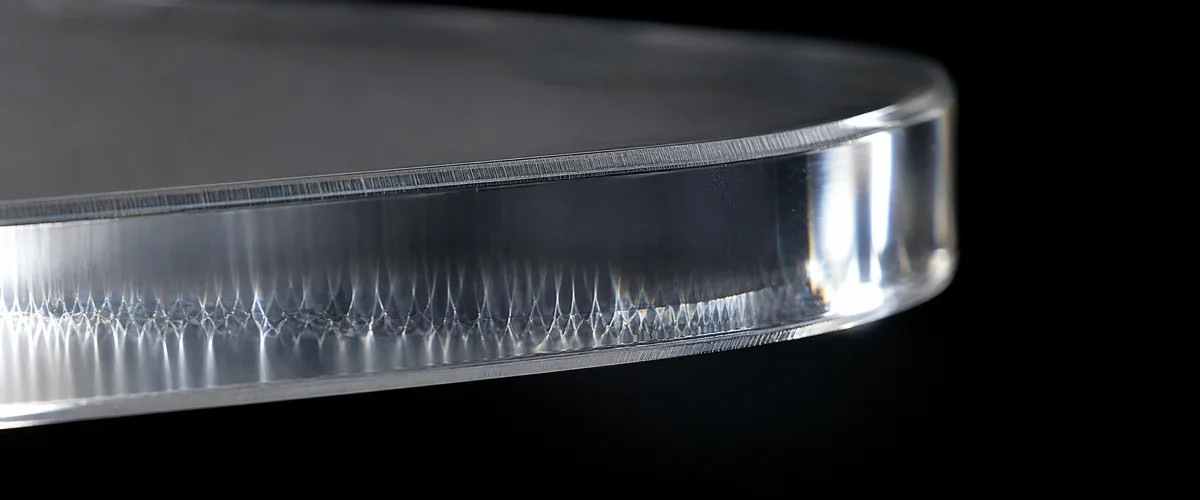
Render engines model edges as mathematical lines. Cast PMMA edges are not lines. They are a real surface produced by a specific process — laser cutting leaves a flame-polished glassy edge with subtle ripples, CNC leaves a finer matte that needs hand-polishing on visible faces, diamond-polishing produces near-optical clarity that catches showroom lighting like jewelry. None are interchangeable. None render identically.
On a 2023 watch-brand flagship project — clear acrylic display cases — the render showed mirror-clear edges and the buyer signed off in under an hour. The laser cut method they specified produced beautiful edges by laser standards but visible torch ripple under the store's overhead spots. The fix: switching to CNC plus diamond-polishing on customer-facing edges, adding $1,800 in finishing labor and a five-day delay to re-jig polishing fixtures. A physical sample would have answered that question in ninety seconds.
Joinery is the same coin's other side. Solvent-bonded acrylic joints range from invisible (proper Weld-On 4 on square edges) to visible white capillary lines (rushed application or imperfect edge prep). Renders show a clean joint or no joint. Buyers approving a render of a multi-panel case and then receiving first article have, more than once, told me they "didn't expect the joints to be visible." With a sample in hand, the conversation shifts from "is this a quality problem" to "do we need premium bonding on the front panel" — a far cheaper conversation at sample stage than after 500 pieces.
---
## Rework Cost Math — 5–7 Day Sample Timeline vs. Typical $1k–$8k Rework {#rework-cost-math}
First-time buyers need to see the math. Across the 12 projects where bulk needed re-tooling from a render-vs-physical gap, the cost runs from $400 (single-color print correction on 200 pieces) to $8,000 (a thermoformed enclosure whose approved render hid a 6mm corner radius tooled-bent acrylic could not produce — full new mold, 22-day delay). Mean: ~$1,400 per cycle. Median, more honest given the long tail: ~$950.
Compare that to a [physical acrylic sample](/customization/) at the [acrylic sample approval](/customization/) stage: a single-piece sample runs $80–$250 plus 5–7 days door-to-door for US and EU buyers. The sample fee is credited against the bulk order when you proceed. Treat the sample as $0 net on any order that reaches production, and you are buying a week of patience. The Spring 2024 cosmetics-counter rework cost the brand $6,200 and three lost weeks; their sample timeline would have been five days. Not a close call.
The pattern across 500+ projects: buyers who push hardest to skip the sample are usually under the most schedule pressure — and also the most likely to absorb a rework cycle costing more time than the sample would have. Schedule pressure does not change the physics of color register, edge finish, or material feel. It just shifts where the delay falls. The sample is a smaller, predictable delay you choose. The rework is a larger, unpredictable delay imposed on you.
### Sample vs Render — 5 Risk Dimensions
| Risk Dimension | What the Render Shows | What a Physical Sample Shows | Typical Rework Cost If Missed |
|---|---|---|---|
| Color register | Idealized RGB on a 6500K monitor | Actual CMYK pigment on actual substrate under ambient light | $400–$2,000 (re-print or re-pigment run) |
| Edge texture | Mathematical line, no process artifact | Laser ripple, CNC matte, or diamond-polish clarity | $1,200–$3,500 (re-finish or re-cut) |
| Surface gloss | Synthetic specular reflection | Real specular reading under target lighting (ASTM E1331)[^astm-e1331] | $600–$2,800 (finish change on bulk batch) |
| Material weight | Not modeled | Hand-felt mass and rigidity at exact thickness | $1,500–$4,200 (full re-spec at thicker stock) |
| Joinery feel | Clean joint or no joint | Visible/invisible bond line, fit-up tightness, audible click | $800–$8,000 (re-tool jigs, full bulk re-bond) |
---
## When to Skip the Sample (and How to Mitigate) {#when-to-skip}
Skipping the sample is defensible in a narrow set of cases. Three conditions need to be true simultaneously.
**First, the geometry is trivial.** Flat-cut single-panel parts — a sign holder face, a flat shelf insert, a rectangular tray with no bends or joinery — have very few variables to get wrong. Cut, polish, ship. If you have ordered this exact shape before, the toolpath and finish are locked.
**Second, the spec is a confirmed reorder.** If we produced this part in the last twelve months and you approved a sample on that run, the file exists with all process notes consolidated. A reorder is reproducing a known-good part, not approving a new one.
**Third, color is non-critical.** Clear or frosted acrylic with no print, single-color cast with a neutral tint — these have low color-register risk because there is no pigment-substrate interaction. Anything with a printed brand color, gradient, multi-color graphic, or Pantone reference fails this condition.
When all three are true, you can move from quote to bulk without a fresh sample — but I still recommend a small material chip from the actual sheet lot. A chip costs roughly $20 and confirms substrate clarity, color, and any batch variation in the cast PMMA. A five-day insurance policy on the material.
For everything else — the 95% case — sample first, bulk second. That ordering is how our [low-MOQ process](/guide/low-moq-acrylic-ordering-guide/) flows: sample at 1–5 pieces, production starting at 50, sample spec sheet locked as the production reference. I walk every new buyer through this on the first call, because the rework dataset tells me which buyers will save themselves a $1,400 average mistake by following it.
For how sample approval feeds into clean RFQ-to-production handoff, see our [custom acrylic quote guide](/guide/acrylic-rfq-guide/). For a worked example of a sample-stage check changing a bulk outcome, see our [cosmetic organizer with velvet inserts case study](/case-studies/acrylic-cosmetic-organizers-velvet-inserts/) — the velvet color-bleed risk was caught at sample stage, not at first article.
---
## What to Send Us So Sample Production Starts on Day One {#what-to-send}
A clean sample request needs the same information as a clean bulk RFQ — only quantity differs. To start a 5–7 day sample window the day we receive your inquiry, send: final dimensions in millimeters with critical-fit tolerances, thickness per panel, material grade (cast or extruded PMMA, color, finish), surface treatment (polished, matte, as-cut, printed, engraved), and a dimensioned drawing or DXF for any non-flat geometry.
If color register is critical-to-quality, include the exact Pantone reference or a printed swatch you consider correct. If you are unsure whether your design needs a sample, send the file anyway — I will tell you the same day whether the spec is sample-required, sample-recommended, or sample-skippable per the three conditions above.
Sample fees are quoted alongside bulk pricing. We credit the sample fee against the bulk order when you proceed, so the only real cost of a sample on a project that reaches production is the calendar week. Across 500+ projects coordinated through my desk, that week is the highest-ROI week in the engagement.
---
## A Quick Note on Sample Approval as a Supplier Test {#supplier-test}
The sample is a supplier test as much as a part test. How a fabricator handles your sample tells you almost everything about how the bulk run will go: did the spec sheet arrive with the sample listing every variable, did it arrive on the promised date, did the edges look like the finish you specified, does the supplier respond to feedback with specifics or hand-waving?
A sample that arrives exactly as specified, with documentation, on time, from a fabricator who answers spec questions in technical detail — that is the strongest signal the bulk run will land the same way. Treat the [sample-to-bulk approval](/customization/) step as a two-way audit: you are evaluating the part, and you are evaluating the supplier.
The 12 rework projects share one feature: each buyer skipped the sample and moved straight from render approval to bulk PO. None were caused by fabricator error alone. All were caused by a missing physical-world data point that a five-day sample would have surfaced. That is the argument for the sample step in one sentence.
---
## Related guides
- [Acrylic Block RMA — Defect Categories We Accept Returns On](/guide/acrylic-block-defects-rma-policy/)
- [Color Mismatch Pre-Check Protocol for Acrylic Production](/guide/acrylic-color-mismatch-prevention-protocol/)
[^pantone-delta-e]: [Pantone — Color Tolerance and Delta-E in Plastics](https://www.pantone.com/articles/color-fundamentals/what-is-delta-e) — Pantone's published guidance on color tolerance defines delta-E as the standard measurement of perceptible color difference. A delta-E below 1 is generally imperceptible; 1–2 is perceptible only on close inspection; 2–4 is the typical commercial threshold for acceptable match; above 4 is visibly different at normal viewing distance. The plastics industry uses these thresholds when negotiating color register on production parts.
[^astm-e1331]: [ASTM E1331 — Standard Test Method for Reflectance Factor and Color by Spectrophotometry](https://www.astm.org/e1331-15.html) — ASTM E1331 defines the standardized procedure for measuring reflectance and color on opaque materials, which downstream specifications use to set acceptable specular gloss ranges for finished plastics. Sample-stage gloss readings benchmarked to this method give buyers and fabricators a shared, measurable definition of "matte" versus "polished" versus "diamond-polished" finishes — language that on its own is too imprecise to control bulk runs.