---
title: "Custom Perfume Tray Programs for Brand Counters"
description: "How fragrance counters and brand agencies spec a custom perfume tray program: bottle envelopes, tester pairing, etch vs silkscreen, reorders, freight, MOQ 100."
category: "Buyer Guide"
author: "Dillion Chen"
authorCredential: "Production Manager at Wetop Acrylic — running laser, CNC, polishing, and UV printing lines since 2014, 1,500+ custom projects personally overseen"
datePublished: 2026-09-21
dateModified: 2026-09-21
primaryKeyword: "custom perfume tray"
url: https://wetopacrylic.com/guide/perfume-tray-programs-fragrance-counters/
---
## The brief says "perfume tray, 12 × 8, mirrored, logo" — production needs the bottle envelope {#bottle-envelope}
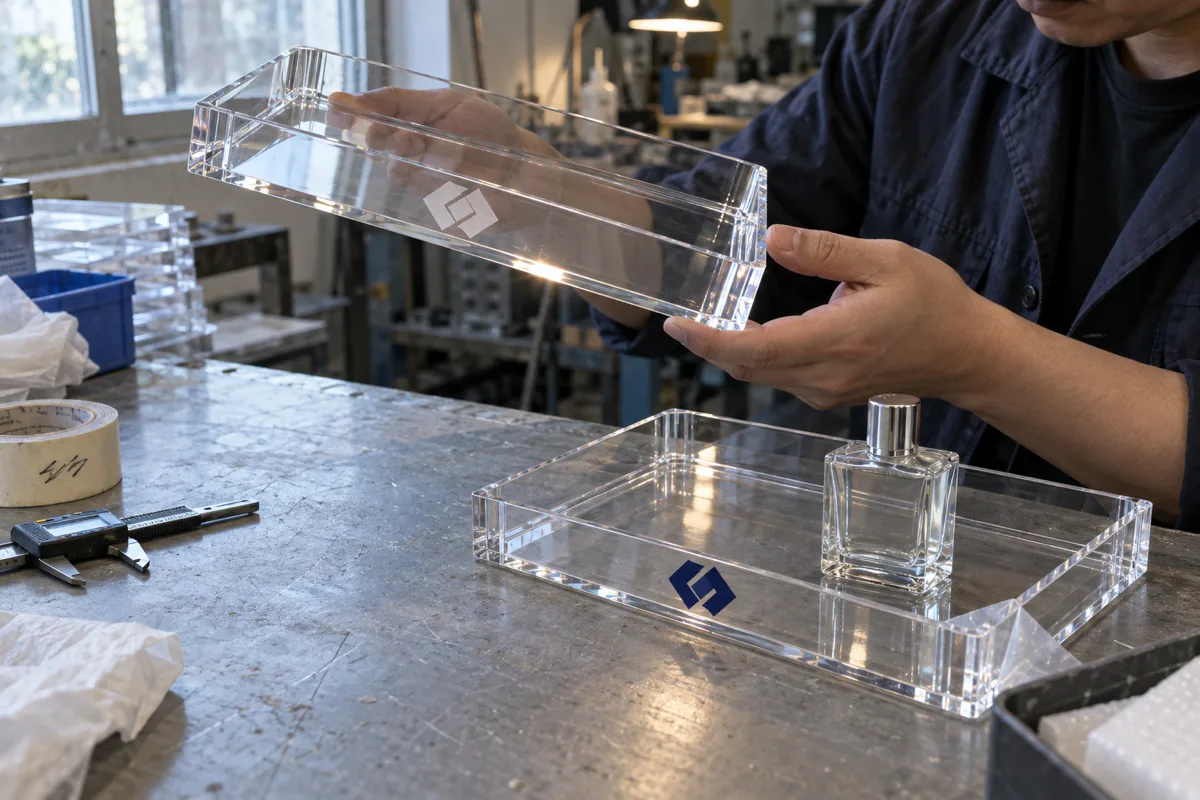
A custom perfume tray is a shallow acrylic tray sized around a specific bottle line for a fragrance counter, a brand agency's counter kit, or a retail gift set. The brief that reaches my bench usually carries a size, a finish, and a logo. What it rarely carries is the bottle envelope: the tallest bottle, the widest base, the cap, and how many bottles share the tray. That envelope decides the internal area, the rim height, and whether the tray needs a locator plate. Without it, our quote is a guess and our sample will be re-cut.
In 12+ years running our production lines I have watched the same 12 × 8 in tray drawn three different ways for three different bottle lines. The external footprint stays; the internal area does not. On a small tray the usable inside is the external size minus twice the wall thickness, so a 3 mm wall takes 6 mm off each internal dimension and a 5 mm wall takes 10 mm. Two bottles that fit on paper can touch on our bench. Send the envelope with the brief and that re-cut never happens.
We size a fragrance tray from the inside out. Start with the widest bottle base and the count per row, add a gap between bottles so a hand can lift one out without knocking the next, then add the wall. The rim follows the bottle: 15–25 mm keeps a tall flacon readable and still stops it sliding when the counter is bumped. Mirrored bottoms are the fragrance default because the reflection doubles the presence of a bottle that is already mostly glass and light.
Side cross-section of a perfume tray with a bonded locator plate. The internal width is the external width minus two walls; the well is the bottle base plus a small clearance per side. Approve the clearance with the real bottle on the sample.
For a tiered acrylic perfume display with cut wells, the same envelope drives the quote. A well is cut to the bottle base plus a small clearance per side so the bottle drops in and stays put. Depth follows the plate: a 5 mm plate locates a bottle, a deeper well needs a thicker or stacked plate. Tier spacing follows the tallest bottle plus the hand that lifts it. Every added well is another cut path and another fit check, so well count and tier count move price more than tray size.
Three layout choices sit under every fragrance tray: a bare shell, bonded dividers, or a removable insert. The [bare tray, bonded divider, and removable insert comparison](/products/acrylic-trays/acrylic-vanity-trays/#perfume-layout-options) on the vanity-tray page covers that decision, including bottle access and cleaning, so ask for shell, divider or insert, and branding as separate quote lines and pick the layout there.
## Tester pairing: the tray and the tester stand share one bottle envelope {#tester-pairing}
A perfume display tray and a tester stand do different jobs on the same counter, and they should be quoted from the same bottle envelope. The tray is the flat surface the retail bottles stand on. The tester stand is the vertical fixture that lifts the open tester to hand height. When the two are drawn separately, the tester bottle is the part that gets missed.
A tester bottle is not always the retail bottle. The cap can be a plain tester cap or no cap, the height can change, and a tester often carries a sprayer that the retail cap hides. The tester bottle is the part I see missed most often. If your program pairs a tray with a tester riser, send both bottles, not one. We draw the tester position from the tester bottle and the tray wells from the retail bottle, and both fit checks happen on the same paid sample.
Matched finish matters more on a fragrance counter than on most retail fixtures, because the bottles are transparent and the acrylic reads through them. A mirrored-bottom tray beside a clear tester riser works; a clear tray beside a frosted riser reads as two vendors. Our [multi-SKU beauty counter display program](/case-studies/beauty-brand-counter-display-program/) shows how one geometry family with replaceable tester inserts holds a counter together across three SKUs, and the [cosmetics and perfume display program](/applications/cosmetics-perfume-displays/) covers the risers, tester stands, and cases that pair with the tray.
You do not need to order tray and stand from the same drawing revision, but you should order them from the same bottle envelope and the same quote. That gives us one sample, one inspection, and one carton plan.
## Laser etch vs silkscreen: same price class, different failure modes on a fragrance counter {#etch-vs-silkscreen}
Laser etching and silkscreen printing land in the same price class on a custom perfume tray. Each adds a modest per-unit step, and neither carries the per-unit cost of full-color UV printing. The choice is not about price. It is about what a fragrance counter does to the mark over months of service.
Fragrance sprays carry their concentrate in alcohol, and in cosmetic labeling the word "alcohol" by itself means ethyl alcohol.[^fda-alcohol] Testers get sprayed above the tray every day. Overspray lands on the rim and on the surface where a logo sits. A silkscreened mark is ink on the top surface, so it sits exactly where the overspray lands and where the cloth wipes. A laser-etched mark is frost cut into the acrylic; there is no ink layer to lift, and wiping cannot remove it.
I run both lines, and I recommend etching for any perfume tray where your logo sits on the rim or the top surface near a tester. Silkscreen still wins when the brand needs a solid color the etch cannot give, when the mark sits on the underside as a second-surface print protected by the acrylic itself, or when a one-color logo runs across a large quantity. On mirrored-bottom trays, a hot-stamped foil mark on the rim is the usual metallic route.
Two identical clear acrylic perfume trays at the finishing bench: an etched mark that reads by frost against gloss, and a silkscreened mark that sits as ink on the surface. Same price class, different service life beside a tester.
| Method on a perfume tray | What it is | Where it holds up | Watch for |
|---|---|---|---|
| Laser etching | Frosted mark cut into the acrylic | Rim, top surface, beside testers, daily wiping | Reads by contrast only; no color |
| Silkscreen | One or two solid ink colors on the surface | Underside second-surface print, large one-color runs | Top-surface ink under overspray and wiping |
| Hot stamping | Gold or silver foil pressed into the surface | Rim of frosted, black, or mirrored-bottom trays | Die cost; foil is a surface layer |
| UV printing | Full-color artwork | Bottom prints, photographic detail | Highest per-unit cost of the four |
Contrast decides legibility more than method does. A white etch disappears on a frosted tray and reads cleanly on clear or black. A dark silkscreen reads on clear and vanishes on black. Send us your vector artwork and we proof placement, size, and contrast on the sample before any logo goes to bulk. The [acrylic tray branding methods comparison](/guide/acrylic-tray-branding-methods-comparison/) routes the full decision by color count, wear, and artwork-change flexibility.
## Converting a wooden perfume display rack to acrylic changes the internal dimensions {#wood-to-acrylic}
A wooden perfume rack converted to acrylic keeps the bottle count and loses most of its wall. Wood racks are built from stock that runs roughly 12–18 mm thick; the acrylic version runs 3–5 mm. Copying the external dimensions gives a wider internal area than the wood had, and copying the internal dimensions gives a smaller external footprint. Decide which one your counter needs before our drawing starts. Every wood rack I have redrawn as acrylic changed its internal area.
The bottle diameter drives everything else. On a wood rack the bottle usually sits in a routed pocket or between rails. On acrylic the same job is done by a cut well in a locator plate, a bonded divider, or a low rim. Send us the bottle base diameter, the number of bottles per tier, the tier count, and the tier spacing your wood rack used. We redraw the rack as bonded acrylic parts and return a drawing with the new internal area, the well diameters, and the external footprint.
Joinery changes with the material. A wood rack is screwed or doweled; an acrylic rack is solvent-bonded, and the joint geometry is different. Long clear spans need a thicker sheet than the wood needed for stiffness, so we state which spans move from 3 mm to 5 mm on our drawing. Finish is also different: a wood rack is stained or painted, while acrylic carries color in the sheet or on the second surface.
The approval gates for a conversion are the drawing, then a paid pre-production sample with the real bottles standing in it. Production follows in 15–20 days after approval, and the MOQ of 100 pieces per design applies to the rack the same way it applies to a tray. A wood-to-acrylic conversion is a normal project for our lines when the brief carries the bottle diameter and the tier spacing.
## Reorders: what stays on file and what gets re-approved {#reorders}
A perfume tray reorder is a repeat of an approved drawing, an approved artwork file, and an approved packout. The cutting program, the etch file, and the proof stay on file. A silkscreen stencil may be re-made for a new run, but it is re-made from the same file, so the mark matches. What a reorder does not carry forward on its own is any change: a new bottle in the line, a smaller logo, a new carton count. When my operators pull a reorder from file, the first question I ask is what changed.
The [documented 1,000-piece engraved tray reorder](/case-studies/artist-tray-brand-repeat-order/) is the pattern to copy. The buyer asked for another 1,000 trays and a smaller engraving. The quote and the proof changed the engraving size and nothing else, and every unchanged field stayed visible so both teams could compare the release against the order record.
We quote a reorder for the real quantity. If your bottle line changed, send the new envelope and we run a new fit check; if the logo changed, we issue a new proof; if the packout changed, we recount cartons. When none of those changed, your order goes to production without a new sample. The [repeat-order change control checklist](/guide/acrylic-repeat-order-change-control-checklist/) lists every field to compare before the PO.
For agencies running the same tray across several brand counters, keep your quantities by design. Three logos at 100 pieces each are three artwork releases, three proofs, and three sets of inspection photos. One logo at 300 pieces is one release. The MOQ of 100 pieces per design holds in both cases; the difference is setup lines on the quote.
## A plain pre-production sample for retail-box prototyping {#plain-sample}
Brand agencies often need the tray before they need the logo. A gift set or a retail box is prototyped around the real tray, and a packaging team cannot cut a box to a rendering. A plain pre-production sample — the exact envelope, the exact rim, the exact finish, no branding — takes 3–5 days and gives that team a real part to build around.
The sample fee is paid separately and is never credited to a production order. It covers material, machine setup, finishing, and inspection for a one-off part, and the price does not change whether the sample carries a logo or not. If you need the branding proofed too, we build a second sample or we photograph the mark on the first production piece for your approval.
Insist that your sample be the correct size. I have seen buyers accept a "close enough" sample to save a few days and then receive a production run that matched the sample instead of the box. The sample is the reference for our 100% inspection, so it must be the part the program wants 300 times over. The [pre-production sample approval checklist](/guide/pre-production-sample-approval-checklist/) lists what to measure and photograph before you sign off.
Sample-first ordering fits the fragrance calendar. A plain sample in week one, a branded proof in week two, and a production release that lands 15–20 days later keeps a counter launch on schedule without paying for a rework. Start a sample through our [customization page](/customization/) if you have the bottle line but not yet the artwork.
## Sea vs air: read freight as a ratio of the FOB line {#sea-vs-air}
Freight on a perfume tray program is easiest to judge as a ratio of the FOB line rather than as a lump sum. Ask us for sea and air on the same packout and compare each mode's share of your tray cost. The ratio tells you whether the counter date is worth paying for, and it stays comparable across quantities.
Air is priced on chargeable weight: the greater of actual weight and volumetric weight, so a light but bulky carton is billed on its volume.[^flexport-chargeable] Shallow acrylic trays stack densely per carton, which keeps both weights low. That is why the sea share of landed cost on a shallow vanity or perfume tray stays small, and why a deep-rimmed tray of the same footprint costs more to move.
A split shipment is the usual answer to a fixed counter date. Air your launch portion, sea the balance. We pack the two portions separately, label them by destination, and quote each mode as its own line so the ratio is visible before you commit. FOB Shenzhen is our standard term; we also quote CIF and DDP when the buyer wants freight and customs rolled into one per-tray figure.
Whatever the mode, keep the trade term on the quote. ICC Incoterms define where delivery happens and where cost and risk transfer between seller and buyer, and two quotes under different terms are not comparable.[^icc-incoterms] With the destination, the quantity, and the date, we return sea and air on the same carton plan.
## What a custom perfume tray costs: the public reference ladder {#price-class}
The public FOB Shenzhen references on our vanity-tray page put a custom perfume tray in the same price class as any shallow vanity tray of the same size, finish, and branding. They are indicative and non-binding; the bottle envelope, the layout, and the branding method move the final number.
| Reference tray | Typical size | Spec | Quantity basis | Indicative FOB range |
|---|---|---|---|---|
| Small clear tray | 10 × 7 in | 3 mm clear, no handles, diamond-polished | 500 pcs | from $3–6 per unit |
| Frosted tray, hot-stamped logo | 12 × 8 in | 3 mm frosted, no handles, gold hot-stamp | 300 pcs | from $4–8 per unit |
| Etched-logo tray | 10 × 7 in | 5 mm clear, beveled edges, laser-etched logo | 300 pcs | from $5–9 per unit |
| Mirrored-bottom tray | 14 × 10 in | 3 mm clear rim, gold-tone mirrored base, hot-stamp | 200 pcs | from $8–14 per unit |
Quantity spreads setup. At 100–250 pieces the cutting setup, edge polishing, and any hot-stamp die spread over few trays, so the per-unit figure is highest. At 500 pieces the setup is amortized across a full run. At 1,000 and above, material, polishing labor, and sheet yield dominate. UV printing adds per-unit cost only and no setup fee; a custom Pantone sheet may require a minimum sheet order.
Read the ladder with your bottle envelope in hand. A locator plate adds a bonded part and a cut path per well. A mirrored bottom adds a second sheet. A 5 mm wall instead of 3 mm adds material and changes the internal area. Send the real spec and we return the tray, branding, sample, packing, and freight as separate lines so you can see which one moved.
## Send the perfume tray RFQ with the bottle envelope attached {#rfq}
The first thing I check on an incoming perfume tray RFQ is the bottle envelope, not the logo. Send us the tallest bottle, the widest base, the cap if it is wider than the base, the number of bottles per tray, and the counter footprint. Add the acrylic color and thickness, the bottom finish, the branding method and vector artwork, the layout choice, the quantity per design, the packing destination, and the trade term. A photo of the bottle line with dimensions marked is enough to open the quote.
Our production MOQ is 100 pieces per design. A paid pre-production sample takes 3–5 days, is paid separately, and is never credited to production. Production takes 15–20 days after drawing, sample, and artwork approval, and every tray is inspected against the approved sample before it ships. We reply to a complete brief within 24 hours.
Use the [perfume tray quote form](/contact/?source=perfume-tray-programs-fragrance-counters) to attach the files. If you are still choosing the surface, our [vanity and perfume tray formats](/products/acrylic-trays/acrylic-vanity-trays/) page carries the current reference sizes, finishes, and the layout comparison; if you are specifying the vertical fixtures, start with our cosmetics and perfume display program instead.
[^fda-alcohol]: [FDA cosmetics labeling claims: "alcohol free"](https://www.fda.gov/cosmetics/cosmetics-labeling-claims/alcohol-free) — FDA states that in cosmetic labeling the term "alcohol" used by itself refers to ethyl alcohol.
[^flexport-chargeable]: [Flexport glossary: chargeable weight](https://www.flexport.com/glossary/chargeable-weight/) — Flexport explains that carriers bill air cargo on the greater of gross weight and volumetric weight.
[^icc-incoterms]: [ICC Incoterms rules](https://iccwbo.org/business-solutions/incoterms-rules/) — ICC defines delivery obligations, cost allocation, and risk transfer for named trade terms such as FOB, CIF, and DDP.