---
title: "Museum Display Cases: Anti-Reflective + UV Spec Guide"
description: "How to specify museum display cases that protect sensitive artifacts — UV transmission thresholds, AR coating, climate seals, and 50-year TCO math from a QC desk."
category: "Buyer Guide"
author: "Deniz Chen"
authorCredential: "QC Manager at Wetop Acrylic — leading 4-stage quality inspection since 2016, 1,000+ custom orders inspected piece-by-piece before ship"
datePublished: 2026-05-05
dateModified: 2026-05-05
primaryKeyword: "museum display cases"
url: https://wetopacrylic.com/guide/museum-grade-acrylic-display-cases-uv-spec/
---
## What "Museum-Grade" Actually Means in Spec Language {#what-museum-grade-means}
"Museum-grade" gets used loosely in catalogs and quote sheets, and that loose usage is the first thing curators need to push back on. In spec language, museum-grade is not a property of the acrylic — it's a stack of four measurable specs applied together: UV transmission below 5% across the 300-400 nm band, anti-reflective coating with specular reflectance below 1%, a sealed base maintaining 45-55% RH with a silica-gel cassette, and a mounting system using polymer rods or magnetic fixings rather than adhesive.
I write that paragraph at the top of every museum project quote we ship, because the first inspection failure I usually catch on a "museum-grade" case sourced elsewhere is that one of those four layers is missing. A case can have brilliant AR coating and still off-gas plasticizer from an adhesive-mounted artifact platform. It can have a beautiful sealed base and still pass enough UV through the front face to shift dye-fugitive textiles in a year. The spec is the stack — pulling any one layer out is what shifts a "museum-grade" case back to a commercial display vitrine.
The other piece of terminology worth fixing early: "museum display cases" describes a function (housing a curated artifact under conservation conditions), not an aesthetic. A clean polished cube with no UV layer and no humidity buffer is not a museum display case, even if it sits in a museum. Across our 3 museum-grade projects in 2024-2025 I've signed off on every case against the four-spec stack above before it leaves the floor — when a buyer says "museum-grade," that stack is what we deliver and what the QC report verifies.
---
## UV Protection — Transmission Thresholds for Sensitive vs Robust Artifacts {#uv-thresholds}
UV protection is the single most consequential spec on a museum display case, because UV damage is cumulative, irreversible, and invisible until it's already done. The threshold depends on what's inside the case. For metal, stone, ceramic, and glass artifacts, museum-grade UV transmission below 5% across 300-400 nm is conservative. For dyed textiles, watercolor on paper, photographs, and historic prints, archival-grade below 2% is the working threshold. For botanical specimens, illuminated manuscripts, and conservation-priority paper, conservation-grade below 1% is what I'd specify and what the Smithsonian's conservation guidance points toward.[^smithsonian]
In our QC chamber I run accelerated UV exposure per ASTM G155 — xenon arc at 340 nm wavelength irradiance, 60-cycle aging — on three acrylic grades alongside a control textile patch and a calibrated colorimeter. Across our 3 museum-grade builds in 2024-2025 I've logged delta-E values below 1.5 over a 12-month equivalent exposure on the museum-grade UV-laminated PMMA, vs delta-E above 4 on standard cast acrylic with no UV layer. Delta-E above 1.0 is the threshold most conservators describe as "noticeable to a trained eye"; delta-E above 3 is the threshold a casual visitor would see. The point of museum-grade UV transmission is to keep the artifact under that 1.0 line for the life of the display.
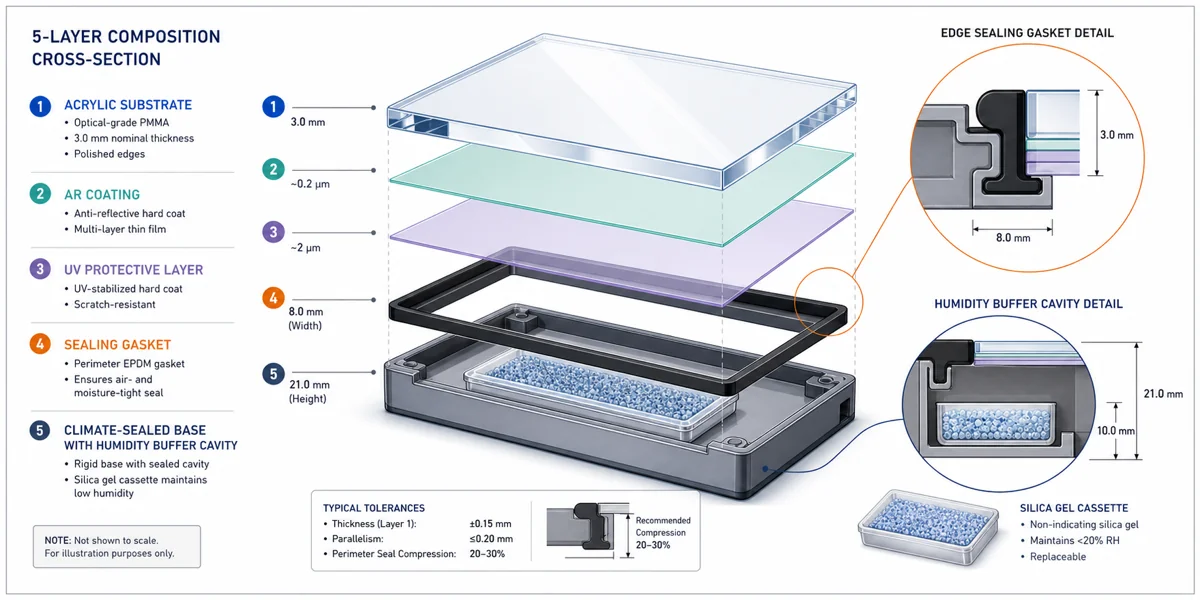
The two added layers (UV-block laminate and AR hard coat on both faces) are what convert ordinary cast PMMA into a museum-grade case — UV out drops below 2%, reflectance drops below 1%.
### Threshold reference by artifact class
| Sensitivity Class | UV Transmission (300-400 nm) | Typical Artifacts | Test Reference |
|-------------------|------------------------------|-------------------|----------------|
| Robust | < 5% | Bronze, stone, ceramic, lithic, glass | Museum-grade UV-laminated PMMA |
| Archival | < 2% | Photographs, dyed textiles, leather, painted wood | Archival-grade PMMA with UV co-extruded layer |
| Conservation | < 1% | Botanical specimens, manuscripts, watercolors, prints | Conservation-grade PMMA, multi-layer UV laminate |
Three things to verify when a supplier quotes a UV transmission number: the wavelength range (300-400 nm is the conservation-relevant band, not just "below 380 nm"), the test method (most reputable suppliers reference ASTM D1003 or equivalent spectrophotometric measurement), and whether the value is for a virgin sample or after the supplier's own accelerated aging. A virgin transmission below 5% that drifts to 12% after 5 years of UV exposure is a museum-grade case that turns into a commercial case in the back half of its design life.
---
## Anti-Reflective Coating — When Coating Beats Untreated Polished Acrylic {#anti-reflective}
Polished cast acrylic on its own is already optically excellent — roughly 92% light transmission with about 8% surface reflection split across the two air-acrylic interfaces. That 8% reflection is the visible glare you fight in any glass-fronted vitrine. Anti-reflective hard coat drops specular reflectance below 1% per ASTM E1331 specular gloss methodology[^astm-e1331], at the cost of roughly 4% absolute light transmission — so AR-coated acrylic typically transmits around 88% versus untreated 92%.
That tradeoff is where curators have to make a deliberate decision. In a low-lux conservation gallery — 50 lux, indirect ambient with a single spot on the artifact — the 8%-to-1% reflection drop is the difference between a visitor seeing the artifact and seeing themselves. The 4% transmission cost is invisible because the eye can't distinguish 88% from 92% at that brightness. AR is the right call. In a brightly lit retail-adjacent display — 500 lux, daylit storefront, vibrant artifact colors — the 8% reflection isn't visually intrusive at high ambient, and the 4% transmission drop noticeably dims a vibrant piece. AR is usually the wrong call.
### How I check AR coating durability before sign-off
Three QC tests I run on every AR sample before it goes into a museum case build:
**Tape peel test.** Apply 3M 600 cellulose tape to the coated surface, press flat, peel at 90°. A museum-grade hard coat shows zero coating transfer onto the tape. A weak AR coating that will lift in cleaning will shed visibly on the first peel.
**Cross-hatch abrasion test.** Score a 1 mm grid through the coating with a calibrated cross-hatch cutter, then run the tape peel over the grid. ASTM D3359 grades adhesion 0B (worst) to 5B (best); museum-grade should test 4B or 5B. I've rejected entire batches at 3B.
**Cleaning chemical exposure.** Apply isopropyl alcohol and a microfiber cloth in 50 wipe-cycles. The coating should show no haze, no streaks, no visible thinning. Curators clean cases regularly; an AR coating that fails at 50 wipes will be visibly degraded inside 12 months of normal exhibition use.
If a supplier quotes AR coating without naming the test references and the durability data, the coating is decoration, not a conservation spec. Ask for the cross-hatch grade and the peel-test result before you accept the quote.
Cross-section of a museum-grade case: AR-coated PMMA front face, UV-blocking laminate, EPDM gasket at the lid joint, and a silica-gel cassette in the sealed base cavity. Each layer carries a measurable spec — pulling any one out drops the case back to commercial-grade.
---
## Climate-Sealed Base — Humidity Buffering for Sensitive Collections {#climate-base}
The base of a museum-grade case is engineering, not just a pedestal. A sealed base built around a silica-gel cassette buffers relative humidity inside the case at 45-55% RH — the conservation-standard band for most organic and mixed-material artifacts — for roughly 8-12 weeks before the cassette needs reconditioning. That hold time depends on three measurable variables: silica-gel mass relative to internal case volume (we typically size at 1 kg per 50 liters of case interior), gasket seal integrity at the lid and any access panels (EPDM or silicone profiles, compressed at design depth), and ambient gallery RH excursions (a gallery cycling between 30% and 70% RH stresses the buffer harder than a stable 50% gallery).
We test sealed-base hold time on every museum project before shipment. The protocol: condition the silica gel to 50% RH equilibrium, install the cassette in the case, close the lid against the gasket, and place a calibrated hygrometer (Vaisala HMP60 or equivalent) inside. Log RH for 90 days at room conditions. A passing case stays inside the 45-55% band for the full 90 days with drift below 5 percentage points. A failing case drifts past 60% in the first 30 days — usually a gasket compression failure, sometimes an undersized cassette.
### What the spec sheet should call out
Three numbers I write into every museum-grade quote so the conservator can verify them at receiving:
- **Cassette capacity in kg of conditioned silica gel** (not "humidity buffered" without quantity).
- **Internal case volume in liters** (so the conservator can calculate buffer ratio independently).
- **Tested hold-time at room ambient** (90 days minimum logging, drift in percentage points).
The reason this matters: a "humidity-controlled" case with a token sachet of silica gel under the artifact platform is not a buffered environment — it's a dehydrated cookie. A real buffer is a sized, conditioned, accessible cassette with a gasket the cassette can actually rely on. Conservators servicing the case need to be able to remove and recondition the cassette without dismantling the artifact mount, so the cassette housing should be a base-access compartment with its own gasket — not an interior tray.
For broader manufacturing process questions on how we build sealed bases, our [ISO 9001 acrylic manufacturer guide](/guide/iso-9001-acrylic-manufacturer/) covers the documented procedures behind each fabrication step.
---
## Mount System — Invisible vs Visible Mounts for Curators {#mount-system}
The artifact mount is where conservation engineering meets exhibition design, and it's the spec layer where curators have the most aesthetic flexibility — provided the underlying material rules hold. Two non-negotiables: no adhesives in contact with the artifact (off-gassing plasticizers can shift pigments and degrade fibers over decades), and no ferrous metal in direct contact with metallic or magnetically sensitive artifacts.
Within those rules, three mount approaches each carry their own visual and conservation tradeoffs.
**Polymer rod mounts (typically PMMA or polycarbonate).** Clear acrylic rods threaded through the artifact's natural openings (textile loops, ceremonial-object handles, mount points designed in by the artist) carry the artifact without adhesive contact. Visually nearly invisible from the gallery viewing angles, archivally inert, fully reversible. The default approach for textiles, ceremonial objects, and garments. Cost: moderate, mostly fabrication labor.
**Magnetic mounts.** Rare-earth magnets recessed into the case base couple to a soft-iron mounting plate hidden under the artifact (or, for ferrous artifacts, directly to the object). Useful for flat artifacts that need to stand vertically — historical documents in folio mounts, photographs, illuminated pages. Conservation-acceptable when the magnetic field strength is below the threshold for the artifact's material sensitivity (negligible for paper, textile, organic materials; verify for any artifact with magnetic media or specific metallic content). Cost: higher than polymer rods because of magnet quality requirements.
**Adhesive-free gravity mounts.** Custom-machined cradles in PMMA or museum board hold the artifact in stable repose under its own weight, with no fixings at all. The right answer for heavy ceremonial bronzes, ceramic vessels, and stone artifacts where a custom cradle distributes weight across multiple contact points padded with conservation-grade fabric. Cost: variable, dominated by cradle machining time.
What I tell curators when a quote comes back with "adhesive-mounted" anywhere in the line items: send it back. Adhesive on or near the artifact is a category mismatch with museum-grade specification, regardless of how clean the rest of the case looks. For colored acrylic mounting frames designed to display fine art without adhesive contact, see our [colored acrylic floating frames case study](/case-studies/colored-acrylic-floating-frames-art-galleries/) for an analogous approach in a gallery context.
---
## Cost vs Longevity Math — 50-Year Design Life Justification {#tco-math}
Museum-grade museum display cases cost more upfront than commercial-grade cases, and the per-unit price is the question that comes up first in every procurement review. The TCO math is what answers it honestly.
Take a representative comparison. A museum-grade custom case with UV-laminated PMMA, AR coating, sealed base with silica-gel cassette, and polymer-rod mount runs roughly $2,400 per unit at our typical 4-6 unit project volumes. A commercial-grade clear acrylic display case with no UV layer, no AR coating, and an open base runs roughly $400 at the same scale. Sticker-shock ratio: 6× the price.
Now apply design life. Museum-grade cases are engineered against a 50-year service life — the UV laminate, the sealed-base gasket profile, and the AR hard coat are spec'd not to degrade meaningfully across that horizon, per the ISO 18934 archival material standard's general framework for permanence assessment.[^iso-18934] Commercial-grade acrylic display cases in active gallery rotation typically need replacement at 7-10 years — not because the acrylic fails, but because UV haze, micro-scratching from cleaning, and edge yellowing accumulate to where the case becomes the visual focal point instead of the artifact.
### TCO math, side by side
| Case Type | Unit Cost | Design Life | Annualized Cost | Replacement Cycles in 50 Years |
|-----------|-----------|-------------|-----------------|--------------------------------|
| Museum-grade custom | $2,400 | 50 years | $48 / yr | 1 |
| Commercial-grade | $400 | 7 years | $57 / yr | 7 |
The annualized cost is the same order of magnitude. Once you add the labor cost of replacing a commercial case 6 additional times (de-mount, transport, install, mount the artifact again — typically $200-$400 per cycle in conservator and installer time), museum-grade becomes the lower-TCO option even before counting any preservation value.
The preservation argument is the real one for curators, and it dominates the math whenever the artifact carries documented value. A delta-E shift above 3 on a dye-fugitive textile is a permanent loss — there is no remediation path, no restoration to original color, no insurance payout that brings the original back. The museum-grade case's job is to keep that shift below the 1.5 line for the design life. The TCO math says you're not paying more; the preservation math says you're paying for an outcome that the commercial case cannot deliver at any price.
For the full hub of custom acrylic vitrine and case configurations we build to museum-grade spec — including LED-integrated and lockable variants — see our [acrylic display cases overview](/products/acrylic-cases/).
---
## Putting the Spec Stack Into Your RFQ {#rfq-language}
When you write the RFQ for museum display cases, the four-spec stack should appear as four explicit line items with measurable thresholds, not as a single "museum-grade" descriptor.
1. **UV transmission target** — name the percentage and the wavelength range (e.g., "UV transmission below 2% across 300-400 nm").
2. **AR coating target** — name the reflectance threshold and the test method (e.g., "specular reflectance below 1% per ASTM E1331").
3. **Humidity buffer target** — name the RH band, hold time, and cassette sizing (e.g., "45-55% RH held for 90 days minimum, 1 kg silica gel per 50 L internal volume").
4. **Mount system constraint** — name what's not allowed (e.g., "no adhesive contact with artifact; polymer rod, magnetic, or gravity-cradle mounts only").
Suppliers who quote against that RFQ language with matching specifications and named test methods are the suppliers who can actually deliver against the four-layer stack. Suppliers who push back on naming the numbers, or who quote "museum-grade" without committing to the thresholds, are quoting marketing language. The RFQ is where the curator decides which is which.
Across the three museum-grade builds I've signed off on in the last two years, every spec sheet attached to the QC report names the four numbers, the test methods, and the verified results before the case ships. That's what makes it a museum-grade case — the spec stack on paper, matched by the measurement record, signed off before the lid closes around the artifact. If you're scoping a project against this stack, [send us your artifact dimensions and sensitivity class](/contact?source=museum-grade-guide) and we'll quote a build with the four numbers committed in writing.
## Related guides
- [Clear Acrylic Box for Display vs Lidded Cases — When Each Wins](/guide/clear-acrylic-box-vs-lidded-display-case/)
- [Acrylic Shelves — A Buyer Guide for Retail Merchandisers in 2026](/guide/acrylic-shelves-buyer-guide-retail/)
[^smithsonian]: [Smithsonian Museum Conservation Institute — Conservation and Care of Collections](https://www.si.edu/mci) — the Smithsonian's conservation institute publishes guidance on light, UV, and humidity thresholds for museum environments; the under-1% UV transmission threshold for conservation-grade displays of light-fugitive materials is consistent with their published recommendations for sensitive collections.
[^astm-e1331]: [ASTM E1331 — Standard Test Method for Reflectance Factor and Color by Spectrophotometry Using Hemispherical Geometry](https://www.astm.org/e1331-15.html) — the ASTM test method we reference for specular reflectance measurement on AR-coated acrylic; required for verifying that AR coating performance is below the 1% reflectance threshold quoted in museum-grade specifications.
[^iso-18934]: [ISO 18934 — Imaging materials — Multiple media archives — Storage environment](https://www.iso.org/standard/77591.html) — the ISO standard governing storage environment requirements for archival materials; the framework supports the 50-year design-life specification for museum-grade display cases housing photographic, paper, and mixed-media artifacts.