---
title: "Mahjong Tile Size Guide — American vs Chinese Dimensions"
description: "American mahjong tiles run near 30 x 22 x 13 mm; Chinese sets start around 32 x 24 x 16 mm. Published sizes, weight math, and how to spec a custom OEM tile."
category: "Buyer Guide"
author: "Deniz Chen"
authorCredential: "QC Manager at Wetop Acrylic — leading 4-stage quality inspection since 2016, 1,000+ custom orders inspected piece-by-piece before ship"
datePublished: 2026-07-05
dateModified: 2026-07-05
primaryKeyword: "mahjong tile size"
url: https://wetopacrylic.com/guide/mahjong-tile-size-guide/
---
## The dimension table — American vs Chinese mahjong tile sizes in mm {#short-answer}
| Tile standard | Height | Width | Depth | Where it appears |
|---|---|---|---|---|
| American standard | 30 mm (1-3/16 in) | 22 mm (7/8 in) | 13 mm (1/2 in) | Most US league and retail sets |
| American enhanced | 32 mm (1-1/4 in) | 22 mm (7/8 in) | 13 mm (1/2 in) | Premium US sets |
| Chinese size 32 | 32 mm (1.26 in) | 24 mm (1 in) | 16 mm (0.63 in) | Standard mainland and pro sets |
That is the practical mahjong tile size landscape in one table: American tiles cluster around 30 x 22 x 13 mm with an enhanced 32 mm-tall premium option,[^gammon-tile-sizes] while Chinese sets start near 32 x 24 x 16 mm and grow from there.[^ymi-size-32] Every downstream decision on a custom set (rack fit, artwork area, set weight, freight) flows from these three numbers.
How to read the table: height is the long face dimension you see standing in a rack, width is the side-by-side dimension that decides how many tiles a rail holds, and depth is the front-to-back thickness that gives a tile its heft. The two traditions diverge most on depth: Chinese tiles run about 3 mm thicker because rack-free mainland play stands tiles on edge, so the tile itself must balance. When we quote an OEM set, the size line is the first thing my team pins down, because it silently sets half the other specs.
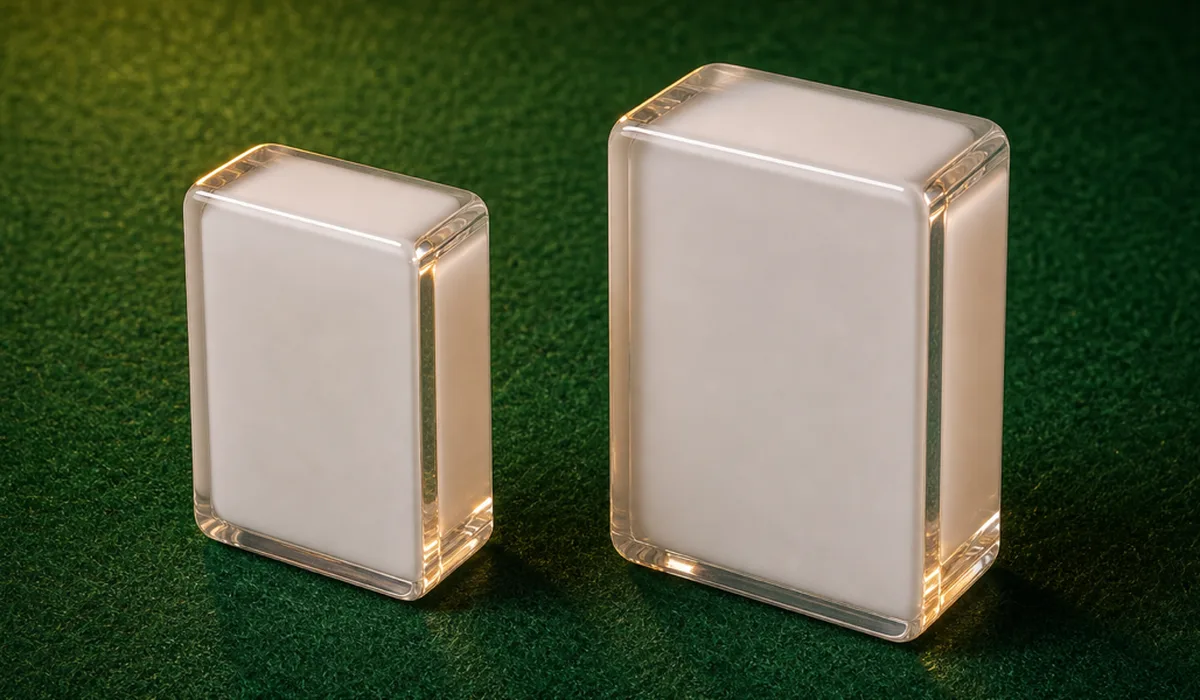
Both tiles drawn at the same 5.5x scale. Height gets the attention, but depth — 13 mm vs 16 mm — is the dimension that changes grip, weight, and rack fit.
A uniformity note from the inspection bench before we go deeper: I judge a custom set less by which size it chose than by how tightly every tile repeats that size. A set that mixes even a fraction of a millimeter of drift across its tiles feels wrong in a way players cannot name but always notice: walls sit unevenly, stacks lean, and the whole product reads cheap. Whatever dimensions you land on in the sections below, the spec conversation with any factory must cover consistency as explicitly as it covers the numbers themselves.
---
## American mahjong tile dimensions — what US set buyers order {#american-dimensions}
The American market has settled hard on the standard size: about 30 mm tall, 22 mm wide, 13 mm deep. Retailers sell it as *the* size precisely because the surrounding ecosystem (racks, pushers, cases, travel bags) is built around it, and a set that deviates strands its owner outside that ecosystem. The published premium option, sometimes labeled "enhanced," raises height to roughly 32 mm while holding width and depth, which adds visible presence and a heavier hand feel without breaking rack fit.[^gammon-tile-sizes]
American play also shapes the tile count and face set: the game runs on an annually changing card of standard hands and uses jokers, which Chinese sets do not carry.[^nmjl-american] A US retail set typically ships 166 tiles with 152 in play. Whether your product should be a 152, 160, or 166 configuration is a separate ordering decision we walk through in our [mahjong set ordering guide](/products/acrylic-mahjong/ordering-guide/). This guide stays on the physical tile; the count question has its own page for a reason.
From the OEM side, one pattern is worth naming. In the American-set inquiries we quoted recently, buyers consistently knew their tile count and artwork direction but asked us for size guidance: the dimension question is the one I found myself answering most, because the market answers it least clearly. The answer we give: unless the brand concept demands otherwise, spec American standard, because compatibility is a feature your customers already paid for in racks and cases they own.
---
## Chinese size conventions — how the numbering maps to millimeters {#chinese-sizes}
Mainland factories label tile sizes with a number, and the number tracks the tile's height in millimeters. The clearest published example: a professional "size 32" set measures 32 mm tall by 24 mm wide by 16 mm deep.[^ymi-size-32] Club and home sets sold in China step up from there, taller and thicker, because bigger tiles are easier to read across a table and stand more stably in rack-free play.
American-standard and Chinese-size tiles side by side. Even a few millimeters of size difference is obvious at a glance — and the depth difference decides how the tile sits in the hand and whether it seats in a rack rail at all.
Depth is the structural difference between the two traditions, not a styling choice. Chinese play builds walls and hands with tiles standing on their own edge, so the tile needs a wide, stable base — hence 16 mm and up. American play seats tiles in a rack rail, so the tile can afford to be 3 mm slimmer and lighter. Copy a Chinese depth onto an American-market set and the tiles will not seat in standard rails; copy an American depth onto a rack-free set and the tiles tip.
On our production side we treat the size number as a starting vocabulary, not a constraint: OEM runs are cut and machined to the client's stated dimensions, and our tooling covers the common American and Chinese size bands. What matters at the factory is that the number on the drawing is explicit: "size 34" means one thing to a Guangdong mold shop and nothing to a US rack manufacturer, so we always convert the label back to three millimeter values before anything gets cut. Full material and construction specs for custom tiles live in our [custom acrylic mahjong tile spec guide](/guide/custom-acrylic-mahjong-tiles-spec-guide/).
---
## Tile weight math — density times volume, per tile and per set {#weight-math}
Cast acrylic (PMMA) has a density of about 1.2 g/cm³,[^makeitfrom-density] which makes tile weight a two-minute calculation instead of a supplier promise. An American-standard blank at 3.0 x 2.2 x 1.3 cm holds 8.6 cm³, or about 10.3 g of solid acrylic; corner radii and edge chamfers trim a few percent, so call it 10 g in hand. A Chinese size-32 blank at 3.2 x 2.4 x 1.6 cm holds 12.3 cm³, about 14.7 g; call it 14–15 g finished.
Scale that up and the numbers turn into freight lines. A complete American tile set lands around 1.6–1.7 kg of tiles alone; a Chinese-style set, with more volume per tile, comes in closer to 2.1 kg. Add racks, pushers, and a case and the shippable American set easily doubles that figure, which is why per-carton weight belongs in your quote request, not in your post-order surprises. We include per-set and per-carton weights in mahjong quotes as standard practice.
The math is also a QC instrument. At first-article inspection I weigh sample tiles against the computed target: a bench scale and thirty seconds catch a wrong-gauge blank or an off-spec material substitution long before a container does. It is the same reason we specify cast acrylic rather than resin for tile work: a buyer can verify cast PMMA's density, hardness, and feel against published figures, while "resin" on a quote sheet can mean nearly anything a supplier wants it to mean.
Weight also carries the premium signal. The buyer instinct that a heavier tile feels better is real, and it is one honest argument for the enhanced height or a thicker custom face. But weight bought through unnecessary volume taxes every shipment of a repeating program, so my advice mirrors what I tell tray buyers: compute the weight first, then decide whether the extra grams are doing work for your brand or just for the freight carrier.
---
## Tile construction — monolithic vs 2, 3, and 4-layer builds {#tile-construction}
Dimensions say how big a tile is; construction says how the body is built, and serious OEM briefs increasingly specify both. A monolithic tile is machined from a single piece of cast acrylic: one material and one color all the way through, the standard build for clear and solid-color sets. Laminated builds bond two, three, or four layers before machining — typically a white or ivory front face that carries the engraving, backed by one or more colored layers that give the tile its back color, and in four-layer collector builds a translucent middle band that reads dimensionally when light passes through the tile.
Why buyers care: a laminated front face puts the engraving into a consistent, high-contrast surface while the back layers carry the brand color, and the layer boundaries show along the tile's edges and chamfers as part of the look. One worry we hear from buyers planning three-layer builds is that the finished tile might feel thin. Layer count and total depth are independent specs — a 13 mm or a 16 mm tile can be one layer or four, and what your hand feels is the depth on the size spec, not the number of laminations. If you are weighing a layered build, tell us the look you want (front-face contrast, back color, translucent band) together with your total depth, and we spec the lamination at the proof stage. Layer recipes are a design conversation, not a fixed menu.
---
## Face area vs artwork legibility — how size caps your design {#artwork-area}
The tile face is your artwork canvas, and it is small: an American-standard face offers 30 x 22 mm (about 6.6 cm²), while a Chinese size-32 face offers 32 x 24 mm, roughly 16% more area. On a custom set with dense artwork (multi-color suit symbols, brand marks, numbering, and letter indices on one face), that 16% is the difference between comfortable spacing and visual crowding.
Two practical consequences follow. First, fine linework that renders beautifully in a vector file can drop below what the face can carry once scaled to 22 mm width. A first-article sample catches this in a way no screen proof can, which is why we sample before every production run. Second, if your design brief demands elaborate faces, the size conversation and the artwork conversation are the same conversation: sometimes the right fix is two millimeters of tile, not a simplified logo. How the artwork actually gets onto the face — laser engraving vs UV print vs CNC — is its own decision with its own trade-offs, covered in our [tile engraving methods guide](/guide/mahjong-tile-engraving-laser-vs-uv-vs-cnc/).
---
## Tile size vs rack and pusher fit — the 18-inch rail math {#rack-fit}
American racks are built to an industry-standard 18-inch (457 mm) rail, and that single number quietly disciplines every tile-size decision for the US market. At the standard 22 mm tile width, a 457 mm rail carries 20 tiles side by side (440 mm) with working clearance. Upsize the tile to 25 mm and the same rail holds 18, and the two-tier wall each player builds in American play starts crowding the rail ends. Depth binds even tighter: rails profiled for a 13 mm American tile will not seat a 16 mm Chinese-depth tile securely, so a "just make it chunkier" request can strand an entire set outside every rack its buyers already own.
This is the fit question we hear as "will your tiles work with my holders?", and it is answerable with a caliper before any tooling decision. I keep a standard rail on the inspection bench for exactly this purpose: when my team gates a custom mahjong order at first-article, rack seating is one of the physical checks, and tiles go into that rail on the flat and on the tilt before the run is released. If your program includes our matching [acrylic racks and pushers](/products/acrylic-mahjong/acrylic-mahjong-rack-and-pusher/), the fit is engineered as one system; if your tiles must fit third-party racks, tell us the rail profile and we check against it at sampling.
---
## Choosing a size for an OEM set — a decision framework {#oem-size-choice}
Buyers rarely need a size invented; they need a default challenged only when the audience demands it. In 10+ years of final inspections I have handled far more fit complaints caused by clever nonstandard sizes than by any standard-size choice, so the framework we walk OEM clients through starts conservative and earns its exceptions:
- **Retail and club sets for the US market: American standard (30 x 22 x 13 mm).** Compatibility with existing racks, cases, and travel bags is a purchased feature — keep it unless the concept requires otherwise.
- **Senior leagues and low-vision players: go taller-faced.** The enhanced 32 mm height, or a Chinese-derived face, buys legibility where it is genuinely valued. Confirm rack depth compatibility before committing.
- **Travel and compact sets: smaller, but sample first.** Shrinking a tile shrinks its artwork and its hand feel together; below the standard band, every millimeter must be justified in hand, not on paper.
- **Heritage or mainland-style sets: size 32 and up, rack-free.** Commit to the thicker depth and design the whole product around edge-standing play.
One of our OEM launches shows the standard-size logic in practice: a game brand building its first custom acrylic set kept American-standard dimensions and spent its differentiation budget on face artwork and color. The full story is in the [mahjong tile set OEM case study](/case-studies/mahjong-tile-set-oem-game-brand-launch/). The size line on that spec was the least glamorous decision and the one that made every accessory decision easy.
---
## The size spec checklist for your RFQ — five numbers {#rfq-checklist}
I read incoming mahjong RFQs from the QC end: every number missing at quote stage is a dispute waiting at inspection stage. Five numbers make a tile size spec complete, and they fit in five lines of an email:
1. **Tile dimensions** — height x width x depth, in millimeters, not a size label alone.
2. **Tolerance** — ask your factory what dimensional tolerance they hold tile-to-tile and confirm it is stated on the quote; uniformity is what your players' hands will judge across a full set.
3. **Corner radius or chamfer** — the edge treatment that decides both hand feel and how tiles slide in a rail.
4. **Engraving or print area** — the artwork zone on the face, so design and size are agreed as one spec.
5. **Target per-tile weight** — computed as tile volume × 1.2 g/cm³ (cast PMMA density), so the sample can be verified against intent, not vibes.
Send those five with your artwork direction and quantity, and a factory can quote precisely and sample fast. Our terms for custom sets: 50-set MOQ, samples in 3–5 days, production in 15–20 days, every set inspected piece by piece before packing. Start with the [custom mahjong tile sets](/products/acrylic-mahjong/acrylic-mahjong-tile-sets/) line from our [acrylic mahjong hub](/products/acrylic-mahjong/), or [send us your size spec](/contact/?source=mahjong-tile-size-guide) — and if the size is still an open question, our [customization process](/customization/) settles it the reliable way: with a sample tile in your hand, measured, racked, and weighed.
[^gammon-tile-sizes]: [What Size Are the Tiles? — GammonVillage Mahjong FAQ](https://www.gammonvillage.com/mah-jong-shop/learn/what-size-are-the-tiles.cfm) — publishes the American standard tile dimensions (1-3/16 in height, 7/8 in width, 1/2 in thickness) and the enhanced 1-1/4 in height option cited in the dimension table.
[^ymi-size-32]: [Chinese Mahjong Set of 146 Standard Size 32 Tiles — Yellow Mountain Imports](https://www.ymimports.com/products/us-ct011-a) — a published Chinese professional set spec: size 32 tiles measuring 1.26 x 1 x 0.63 inches (32 x 24 x 16 mm), the documented example behind the size-number-to-millimeter mapping.
[^nmjl-american]: [The Game — National Mah Jongg League](https://www.nationalmahjonggleague.org/game.aspx) — the League's own description of how American mahjong differs: the annually changing card of standard hands and the use of jokers and additional tiles.
[^makeitfrom-density]: [PMMA (Acrylic) material properties — MakeItFrom](https://www.makeitfrom.com/material-properties/Polymethylmethacrylate-PMMA-Acrylic) — displays the 1.2 g/cm³ density used in the per-tile and per-set weight calculations.