---
title: "Large Lucite Boxes — When 'Lucite' Branding Matters and When It Doesn't"
description: "Lucite vs generic cast acrylic compared on specs, cost, and buyer perception. When the Lucite brand premium is worth paying — and when it isn't."
category: "Comparison"
author: "William Cho"
authorCredential: "Founder of Wetop Acrylic — building custom acrylic in Shenzhen since 2008, 2,000+ B2B projects shipped across 25+ countries"
datePublished: 2026-05-05
dateModified: 2026-05-05
primaryKeyword: "large lucite box"
url: https://wetopacrylic.com/guide/large-lucite-boxes-vs-generic-cast-acrylic/
---
## Large Lucite Boxes vs Generic Cast Acrylic: The 30-Second Answer {#short-answer}
A "large lucite box" is a large cast PMMA box made from sheet stock branded **Lucite** by Lucite International, a Mitsubishi Chemical company. Chemically and structurally, it is the same cast acrylic family as generic cast PMMA from Plaskolite, Evonik, or any reputable Asian cast mill. The brand premium runs 40–60% on the raw sheet and 60–80% on the finished box at typical B2B order volumes.
Buyers walk into our quote calls speccing "Lucite" as if it's a chemistry, not a brand. We don't push back — we explain. In 18+ years building this business I've watched the same conversation repeat: a buyer asks for a large lucite box, we send a generic cast PMMA quote and a Lucite-branded quote side by side, and the buyer almost always picks the generic — once they see that the spec sheet, the optical clarity, and the laser-cut edge finish are within a margin no end-customer will ever see. The exception is when the brand itself is the point, which is a real but narrower set of cases than most buyers initially think.
This guide walks through the trademark history, the head-to-head spec gap, the buyer-perception math, and the RFQ language that gets you Lucite-grade performance at generic cast pricing.
_A large lucite box in a luxury boutique. The box is cast PMMA. The brand on the spec sheet is the only thing the customer can't see._
---
## Lucite Trademark History — What the Brand Actually Guarantees {#trademark-history}
Lucite is a brand name, not a polymer. The trademark was first registered by DuPont in 1937 as the marketing name for its cast PMMA sheet, which DuPont developed in parallel with German Röhm & Haas's Plexiglas. After several decades and corporate transitions — DuPont divested its acrylic business to ICI Acrylics in 1993, ICI's acrylics arm spun off as Lucite International in 1999, and Mitsubishi Rayon (now Mitsubishi Chemical Group) acquired Lucite International in 2009[^lucite-history] — the Lucite trademark today sits inside the Mitsubishi Chemical family alongside Mitsubishi's Acrylite and Shinkolite brands.
What the Lucite brand actually guarantees on a 2026 purchase order is three things, and only three things. **One**: the resin and the cast sheet were produced under Lucite International's quality management system, which is tighter on batch-to-batch optical haze and yellowness index variance than most mid-tier generic cast mills. **Two**: the documentation pack — mill test report, grade designation, batch traceability — uses the Lucite brand name and Lucite spec codes, which is what a procurement document or a luxury brand spec sheet expects to see. **Three**: brand provenance for downstream marketing, which is why luxury retail and creative-director projects pay the premium. None of those three is a polymer-chemistry claim. A reputable generic cast PMMA from Plaskolite, Evonik, or a Tier-1 Asian mill delivers the same chemistry at the same ASTM D788 grade. For a deeper read on cast vs extruded as a process distinction — which is the chemistry decision buyers actually need to make first — see our [cast vs extruded acrylic guide](/guide/cast-vs-extruded-acrylic/).
The naming clarity matters because the wrong question costs money. "Should I order Lucite or acrylic?" is a brand-vs-generic question. "Should I order cast or extruded?" is a chemistry question. The chemistry question changes what you get; the brand question changes what you pay.
---
## Lucite vs Generic Cast PMMA — Head-to-Head Specs {#spec-comparison}
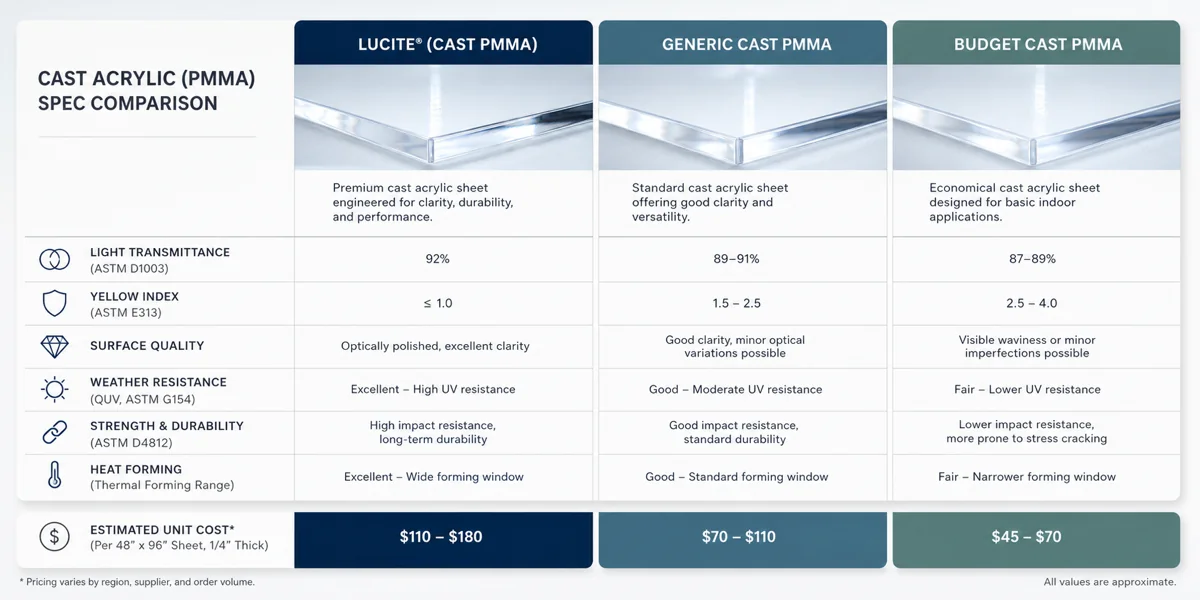
When we run a Lucite-branded sheet and a reputable generic cast PMMA sheet side by side on our QC bench at 6mm thickness — same nominal grade, same fabrication batch — the spec gap is small enough that most buyers can't pick the winner blind. The table below pulls published technical data from the Lucite International product datasheet[^lucite-spec], the ASTM D788 cast PMMA standard[^astm-d788], and our own incoming-batch QC log on generic cast PMMA from Tier-1 Asian mills.
Same corner joint, same 6 mm cast PMMA. Lucite vs reputable generic differ by less than 1 percentage point on haze; budget cast shows visible scatter under directional light.
### Lucite vs Generic Cast PMMA: Spec and Cost Comparison
| Property | Lucite-branded cast | Reputable generic cast PMMA | Budget cast |
|---|---|---|---|
| Light transmittance (ASTM D1003) | 92% | 91–92% | 88–90% |
| Optical haze | <1% | <1.5% | 2–3% |
| Heat deflection temp (HDT, 1.82 MPa) | 95–100°C | 90–95°C | 80–88°C |
| Surface hardness (Rockwell M) | M93–M95 | M90–M93 | M85–M90 |
| Batch optical variance | Tightly controlled, branded MTR | Batch-controlled, generic MTR | Loose, mill-cert only |
| Unit cost per finished box (50 pcs, 300×300×300mm, 6mm wall) | $90–$140 | $55–$85 | $35–$55 |
Read the table this way. **Optical**: Lucite and reputable generic cast both clear the 91% transmittance and sub-1.5% haze threshold that the human eye cannot reliably distinguish in a finished display box. Budget cast drops to a level where you can see the haze in a thick wall under directional light. **Mechanical**: Lucite holds 5–10°C higher HDT and a couple of Rockwell points in surface hardness. Real-world impact on a display box at room temperature: zero. **Cost**: the spread is 60–80% from generic to Lucite at this volume, and another 40–55% from budget to generic. The chemistry tightens fast as you climb; the price tightens slowly. For a broader material decision — cast acrylic vs polycarbonate vs PETG, when those alternatives are even on the table — our [acrylic plastic box vs polycarbonate vs PETG guide](/guide/acrylic-plastic-box-vs-polycarbonate-vs-petg/) covers the family-level tradeoff.
The single number a buyer should anchor on: the Lucite premium on a finished large lucite box is 60–80% over reputable generic cast at 50-piece order quantity. Not 5%. Not 200%. Sixty to eighty percent.
Lucite vs reputable generic cast vs budget cast at 6mm thickness, 50-piece order. The mechanical and optical gaps are real but small; the cost gap is real and large.
---
## When 'Lucite' Branding Is a Buyer-Confidence Signal {#brand-as-signal}
Across 30+ buyer conversations on lucite branding over the last three years, a clear pattern shows up: the brand premium translates to real downstream value in three specific scenarios, and is dead weight everywhere else. If your project sits inside one of these three, paying the premium is a defensible call.
**Luxury retail display where the brand brief names Lucite.** Heritage luxury houses — handbags, watches, fragrance, fine jewelry — write material specs that reach back to the 1940s and 50s, when Lucite-branded cast acrylic was a status material on its own. Creative directors who grew up inside that vocabulary use "Lucite" the way they use "Italian leather" or "Murano glass" — as part of the brand story, not as a polymer choice. When the visual merchandising team writes "large lucite box" on the brief, the brand is the spec. Substituting generic cast PMMA breaks the brief, even if the finished box is optically identical. We've shipped this kind of work to luxury retail in Paris and Milan, and the brand-on-the-MTR is what makes the program approvable. For a related case showing how high-perception retail display is built and shipped, see our [acrylic phone display stands case study](/case-studies/acrylic-phone-display-stands-carrier-retail/).
**Museum and archival casework.** Conservators and museum-grade case fabricators specify single brand-tier cast PMMA for long-program installations because brand-controlled batch consistency reduces optical drift over a 10–20 year service life. A reputable generic cast PMMA performs identically at year one; the data thins out at year fifteen. Where the project is long-life and the cost of recase is high, paying the brand premium is essentially insurance.
**Contract work where procurement names Lucite.** Government, defense, and enterprise procurement documents sometimes literally name Lucite (or Plexiglas, or Acrylite) as an approved material. In that case the spec is a compliance gate, not a quality argument. Substituting generic cast PMMA, even if technically equivalent, makes the supplier non-compliant. Source Lucite, document it, ship it.
Outside those three, the brand is buying you a sticker. Trade-show booths, corporate gifting, awards programs, retail POP, e-commerce product photography, signage — none of these audiences read the MTR, none of them ever see "Lucite" on the box, and none of them pay more for the brand provenance. That's the territory where generic cast PMMA wins on every dimension that matters to the buyer.
---
## When Generic Cast Acrylic Delivers Identical Performance at Half the Price {#generic-wins}
The value math on a custom lucite box gets clear once you separate the audience question from the chemistry question. On the chemistry side, a reputable generic cast PMMA — Plaskolite Optix, Evonik PLEXIGLAS GS, Mitsubishi Acrylite GP, or a Tier-1 Asian cast mill we've qualified through 50+ batches — sits inside the same ASTM D788 grade band as Lucite. On the audience side, the buyer base that pays for the Lucite brand is narrower than the buyer base that pays for cast acrylic generally. Five scenarios where generic cast is the right call.
**B2B trade-show booths and product reveals.** Booth visitors look at the product inside the box, not the spec sheet on the back. Generic cast PMMA at 6–10mm wall thickness gives you the same flame-polished laser-cut edge, the same optical clarity, the same 92% light transmittance Lucite advertises. The 60–80% premium delivers zero visible value on the booth floor. **Corporate gifting and awards programs.** Recipient sees a polished acrylic award; recipient does not see the resin grade. We've shipped six-figure annual award programs in generic cast PMMA where the gift weighed and felt identical to a Lucite-branded equivalent the client priced before coming to us. **Retail POP and shelf-edge display.** The end-customer is a shopper, not a procurement officer. A polished generic cast box with crisp UV-printed branding and a visible-edge laser cut reads as premium without the brand-tier sheet cost. For more on cost engineering across volume tiers, see our [custom POP displays design and cost guide](/guide/custom-pop-displays-design-cost/).
**E-commerce product photography props.** Photographers buy clear cast boxes for tabletop product shoots; the box never appears in the frame at full clarity, and any haze under 2% is invisible at typical lighting setups. Generic cast wins on cost without compromising the shot. **Internal corporate display — boardroom, lobby, archive.** When the audience is your own staff and visiting clients, the brand name on the resin doesn't pull conversion weight. Generic cast PMMA at proper thickness with brand-correct fabrication — sharp corners, flame-polished edges, invisible solvent joints — reads as premium because the fabrication is premium, not because the sheet is Lucite-branded.
The pattern across all five: when the buyer paying the premium is a procurement manager rather than a creative director, and the end-customer audience reads finish quality rather than spec sheets, generic cast is the correct spec. The other large category we get this question for is acrylic display cases generally — see our [acrylic cases hub](/products/acrylic-cases/) for the full product family Wetop fabricates in cast PMMA.
---
## How to Spec a 'Lucite-Grade' Acrylic Without Paying the Brand Premium {#spec-language}
The RFQ language that gets you Lucite-grade performance at generic cast pricing is short, specific, and brand-agnostic. Five rules that work in 90% of B2B sourcing situations.
**Rule 1: Specify the spec, not the brand.** Write "cast acrylic (cast PMMA) to ASTM D788, light transmittance ≥92%, optical haze <1%, surface hardness Rockwell M90+, with mill test report on each batch." That language is tight enough to exclude budget cast and extruded acrylic, and broad enough to let the supplier source from the most cost-effective brand-tier mill that clears the bar. **Rule 2: Name acceptable equivalents.** Write "Plaskolite Optix, Evonik PLEXIGLAS GS, Mitsubishi Acrylite GP, Mitsubishi Lucite, or equivalent Tier-1 cast PMMA." Procurement-speak for "any of these brands works, and equivalent generic cast PMMA also works if it meets the spec above." **Rule 3: Require the MTR with every shipment.** Mill test report on each batch documents the actual sheet brand, grade, optical haze test, and yellowness index. That's your audit defense if anyone later asks whether you sourced "real" Lucite-grade material.
**Rule 4: Ask for a side-by-side sample at the start.** Any reputable cast acrylic fabricator should be willing to ship a Lucite-branded coupon and a generic cast PMMA coupon at the same thickness and finish, in the same package. Hold them under the same lighting. If your eye can't tell, your buyer's eye can't tell either. We do this on every quote where the buyer has flagged "Lucite" — it shortens the brand-vs-generic conversation from three weeks to one meeting. **Rule 5: Default to generic; upgrade to branded only when the audience demands it.** The right starting position on any custom lucite box program is generic cast PMMA at the proper grade. Move to Lucite-branded only when one of the three scenarios in the brand-as-signal section above is in play. That decision sequence saves you 40–60% on every project where the brand is not the point.
For new buyers running their first cast acrylic program, we recommend pairing the RFQ above with a [supplier audit checklist](/guide/supplier-audit-checklist-acrylic/) — sheet sourcing transparency is one of the fastest ways to separate a real cast acrylic fabricator from a budget reseller who'll quietly substitute extruded.
---
## Spec the Material to the Audience, Not to the Brief {#close}
In 18+ years quoting custom acrylic for B2B buyers across 25+ countries, the lucite-vs-acrylic conversation comes up often enough that we've stopped being surprised by it. The trademark history is real. The spec gap between Lucite-branded cast PMMA and a reputable generic cast PMMA is real but small. The cost gap is real and large. The buyer-confidence value of the Lucite brand is real but narrow — luxury retail, museum-grade, or compliance-driven contracts.
For everyone outside those three audiences — trade-show, gifting, awards, POP, e-commerce, internal display, B2B comparison procurement — generic cast acrylic at the right grade and the right fabrication delivers the same finished result at 40–60% lower landed cost, and your buyer cannot tell the difference once the box is on the shelf.
If you're sourcing a large lucite box right now and you're not sure which side of that line your project sits on, send us the brief. I review every cast PMMA quote personally and will tell you directly: brand-tier Lucite, brand-tier alternative (Plaskolite, Evonik, Acrylite), or reputable generic cast — with the spec sheet and the unit-cost spread on each, so you pay for the brand only when the brand is the point. [Send your project brief](/contact?source=lucite-vs-acrylic) with dimensions, finish, and quantity, and we'll come back inside one business day.
## Related guides
- [Acrylic Pedestals — 200lb Load Engineering for Retail & Museum Display](/guide/acrylic-pedestals-200lb-load-engineering/)
- [Museum Display Cases: Anti-Reflective + UV Spec Guide](/guide/museum-grade-acrylic-display-cases-uv-spec/)
[^lucite-history]: [Lucite International — Mitsubishi Chemical Group](https://www.mcgc.com/english/group_companies/group_companies_global/group_company_06.html) — corporate history of the Lucite trademark, from DuPont 1937 origin through ICI Acrylics, Lucite International, and acquisition by Mitsubishi Rayon (now Mitsubishi Chemical Group) in 2009.
[^lucite-spec]: [Lucite International cast acrylic product datasheets](https://www.luciteinternational.com/) — manufacturer-published technical specifications for cast PMMA grades sold under the Lucite trademark, used here for the optical, HDT, and surface-hardness comparison values.
[^astm-d788]: [ASTM D788 — Standard Classification System for Poly(Methyl Methacrylate) (PMMA) Molding and Extrusion Compounds](https://www.astm.org/d0788-22.html) — industry-standard classification for cast PMMA grades, the spec language Wetop recommends in RFQs to get Lucite-grade performance from any qualified cast PMMA supplier.