---
title: "How to Choose an Acrylic Supplier: A Factory Guide"
description: "Avoid costly supplier mistakes. This factory-floor guide covers quotes, audits, ISO 9001 validation, and red flags that reveal a serious acrylic supplier."
category: "Buyer Guide"
author: "William Cho"
authorCredential: "Founder of Wetop Acrylic — building custom acrylic in Shenzhen since 2008, 2,000+ B2B projects shipped across 25+ countries"
datePublished: 2026-03-13
dateModified: 2026-03-13
primaryKeyword: "acrylic supplier"
url: https://wetopacrylic.com/guide/how-to-choose-acrylic-manufacturer/
---
## What Your Quote Reveals Before You See a Sample {#quote-signals}
A complete quote from a serious acrylic supplier specifies material grade, thickness and tolerance, surface finish, unit price, setup or tooling fees, sample lead time, production lead time, and shipping terms — all in writing, without you having to ask. If a quote arrives missing three of those nine items, that's not a quote. It's a placeholder, and it tells you something important about how this supplier operates.
I've seen this on three out of every five new inquiries we receive: buyers who've already spent two weeks with a supplier they're now abandoning, because the quote looked fine until the sample arrived and nothing matched. The quote had a price and a lead time. That's it. No material grade, no finish spec, no tolerance callout. I understand why buyers don't always know to ask for these items — sourcing acrylic isn't their full-time job. But a supplier who doesn't include them isn't protecting you. They're leaving themselves flexibility to substitute materials, cut finish steps, or renegotiate price once you're committed. The nine-item checklist below is what a complete first-round quote should contain:
### The nine-item quote checklist
| Item | Why It Matters | Red Flag If Missing |
|------|---------------|---------------------|
| Material type | Cast vs extruded PMMA affects optical quality and edge polishing | Supplier can substitute without you knowing |
| Thickness + tolerance | Structural and aesthetic baseline | Parts may not fit or look as intended |
| Surface finish | Polished, matte, frosted — different cost and appearance | You get whatever's cheapest that day |
| Printing method | UV, silk-screen, hot stamping — each has different minimum runs | Color and durability can vary wildly |
| Unit price | Per-piece cost at your order quantity | Obvious — but verify it covers the finish spec above |
| Setup / tooling fees | One-time mold or jig fees for custom shapes | Hidden costs appear on invoice |
| Sample lead time | Days from payment to sample dispatch | Reveals fabrication capacity |
| Production lead time | Days from approved sample to shipment | Reveals real capacity, not sales optimism |
| Shipping terms | FOB, EXW, CIF, DDP — determines who carries risk in transit | Unclear terms = disputed liability on damaged shipments |
Ask for all nine in your RFQ. If you're not sure how to structure the request, our [acrylic RFQ guide](/guide/acrylic-rfq-guide/) walks through exactly what to include and how to phrase it.
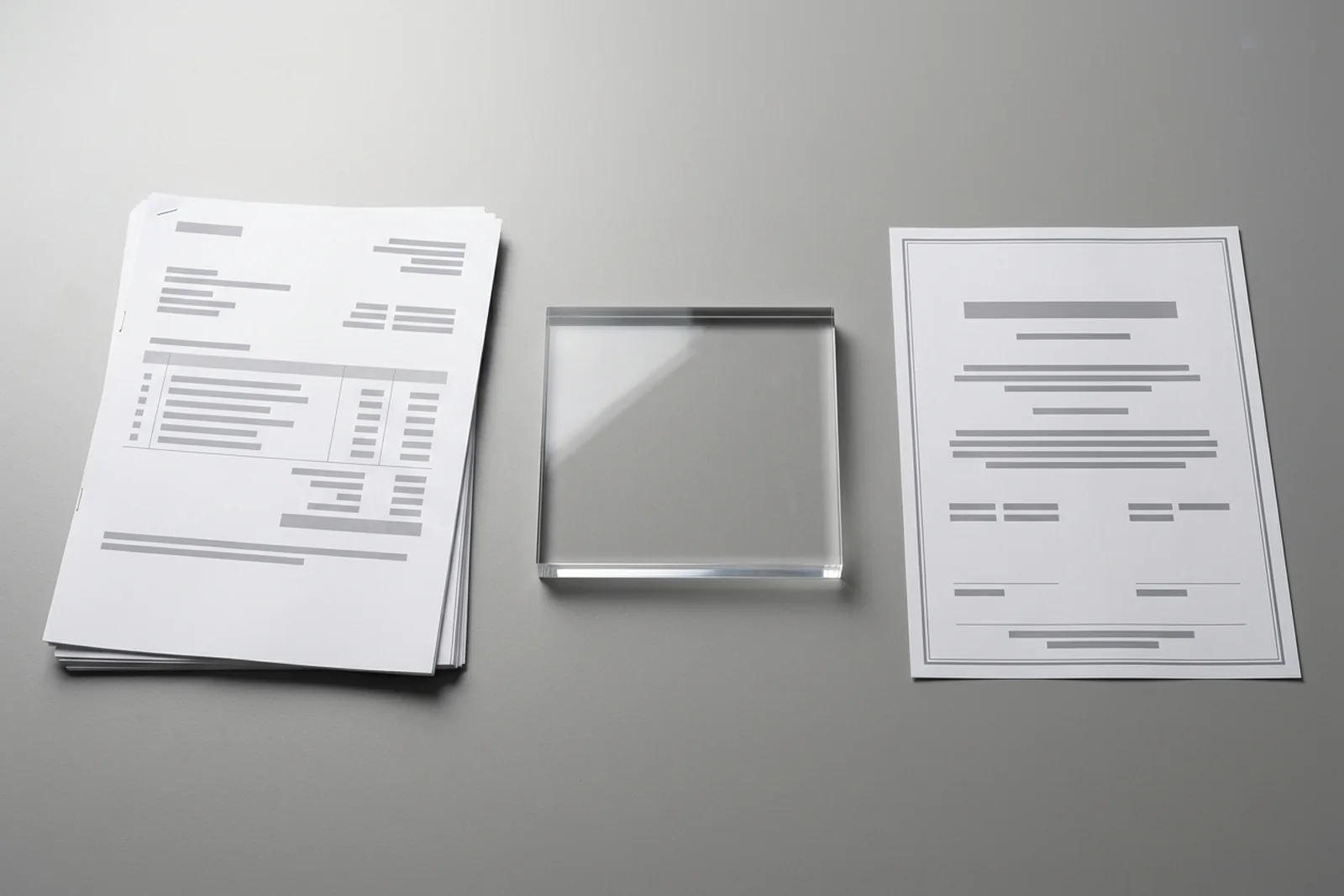
The three artifacts every buyer should have on the desk before committing: a spec-complete quote, a physical PMMA sample, and a verifiable ISO 9001 certificate.
---
## How to Read a Factory Site Visit (or Video Audit) {#site-visit}
A 30-minute factory walkthrough reveals more than three months of email exchange. Buyers who skip this step — or accept a curated photo deck as a substitute — have no reliable way to distinguish a real manufacturer from a trading company placing orders at a third-party factory. The difference matters when quality problems emerge mid-production and no one can explain where they happened.
When I host a buyer visit, I want them to ask hard questions — and I'll tell them exactly which questions I wish more buyers would raise. Walk the production floor, not just the showroom. Ask to see the machine list: a real acrylic fabrication facility runs laser cutters, CNC machines, bending equipment, and polishing lines under one roof. At Wetop, that's 8 laser cutters, 4 CNC machines, and a dedicated diamond polishing line — all in our 5,000 m² Shenzhen facility. If the "factory" you're visiting has two machines and a storage room full of other suppliers' boxes, you're at a warehouse, not a manufacturer. Ask where the polishing and printing happen. If the answer involves "our partner factory nearby," that's an outsourcing chain — and every handoff in that chain adds time, cost, and a potential quality break point.
For a video audit when an in-person visit isn't feasible, request a live walkthrough via video call — not a pre-recorded video. Ask the contact to pan the camera to the production floor mid-shift, show you a piece in-process, and introduce you to the QC station. A supplier with nothing to hide will show you everything. A supplier who "doesn't have that area available right now" is scripting the tour.
### What to confirm on the visit or video call
- Machine list: does it match the capabilities on their website?
- Material storage: is raw acrylic sheet stored flat, labeled by grade and thickness?
- QC station: is there a dedicated inspection area with measurement tools?
- Work-in-progress: can they show you an order at a production stage similar to yours?
- Staff: are workers clearly assigned to specific processes, or does it look chaotic?
---
## How to Validate ISO 9001 and QC Documentation {#iso-validation}
ISO 9001 certification is verifiable in minutes — there is no reason to take a supplier's word for it. The certification covers quality management systems: whether the factory has documented processes for production planning, inspection, nonconformance handling, and corrective actions. It does not guarantee your specific part will be perfect, but it guarantees the factory has a system for catching and fixing problems — which is exactly what you want when production runs 15–20 days and you're 8,000 miles away.
To verify: ask for the ISO 9001 certificate number and the name of the certifying body (SGS, Bureau Veritas, TÜV Rheinland, and similar accredited registrars are standard for China-based manufacturers). Then look up that certificate in the registrar's online database. SGS, for example, publishes a searchable certificate registry at sgs.com. The certificate entry will show the company name, manufacturing scope, issue date, and expiry date. If the certificate is expired or the scope doesn't include acrylic fabrication, the certification is either lapsed or misapplied. Wetop has held ISO 9001 certification since 2018, certified by SGS — certificate details are available on request.
Beyond ISO 9001, ask for two additional documents. First, a material test report: your supplier should be able to provide an SGS or ROHS test report for the acrylic sheet they use, confirming material compliance for your target market. Second, a QC protocol document: what does 100% inspection actually mean at this factory? At Wetop, every piece is checked against the approved sample before packing — dimensions, surface finish, print registration, and joint clarity — documented per order. That's not a claim; it's a written process I can show you on request.
The ISO 9001 quality management standard[^iso-9001] provides the framework; what matters is whether your specific supplier has built actual documented procedures around it — not just obtained the certificate.
---
## Red Flags That Predict Supplier Ghosting {#red-flags}
Some suppliers are good at samples and disappear into production. The signals are almost always visible before you sign anything — but buyers don't know what to look for because the sample looked great. I've seen this pattern from the factory side: a supplier who shines at samples has usually built their business around winning new customers, not serving repeat ones. Their incentive structure rewards speed-to-sample, not consistency-at-scale.
Watch for these seven signals in the evaluation phase:
1. **Response time degrades after the sample ships.** Before the sample, replies came in hours. After you approved it, replies take days. This is the most reliable early indicator. A supplier's communication behavior toward a paying customer is a preview of their behavior toward a repeat customer.
2. **No documented QC process, just assurances.** "We check everything" is not a QC process. Ask what gets checked, who checks it, and what happens when a defect is found. If the answer is vague, the process doesn't exist.
3. **Prices drop unexpectedly on the second quote.** A 20% price drop between the sample quote and the production quote usually means material substitution is planned. Ask specifically: same material grade? Same thickness? Same surface finish process?
4. **They can't name the acrylic sheet supplier.** A manufacturer with a real supply chain knows where their material comes from. If they can't name the sheet supplier — or give vague answers like "we source locally" — material traceability doesn't exist.
5. **The sample took twice the quoted lead time with no proactive update.** If a supplier misses a sample deadline without telling you until you follow up, that's how they'll handle production delays too.
6. **No fixed factory address or registration.** Look up the company on a Chinese business registry or ask for their business license (营业执照). Legitimate manufacturers have a fixed address and a verifiable registration. Trading companies sometimes operate without one.
7. **Reluctance to do a video audit.** As covered above — if a factory won't show you the floor live, ask why.
The Institute for Supply Management[^ism] notes that supplier reliability is best predicted by a combination of documented processes and demonstrated follow-through on small commitments — exactly the early signals above. Don't wait for a large production run to discover a supplier's reliability floor.
---
## How to Match the Acrylic Supplier to Your Product Type {#product-fit}
Not every acrylic supplier is set up for every product type. A manufacturer optimized for high-volume retail signage is not the same as one that excels at display cases with polished mitered joints and UV-printed logos. Choosing based on price or certification alone, without checking product-type fit, is one of the most common sourcing mistakes I see from first-time buyers.
The Plastics Industry Association[^plastics-industry] classifies acrylic fabricators broadly, but within that category, capability ranges from basic laser-cut flat parts to complex multi-piece assemblies with print and structural components. Before requesting a quote, confirm three things: First, has this supplier made a product in your category before? Ask for photos or references — not a generic portfolio, but projects similar to yours in material, finish, and complexity. Second, do they have the specific fabrication processes your product requires? A cosmetics display with UV-printed logos and a mitered case body needs UV printing capability, CNC cutting for precise angles, solvent bonding skills, and in-house [diamond vs flame polishing capability](/guide/diamond-vs-flame-polishing-acrylic/) — not just a laser cutter. Third, what does their typical order size look like? A factory accustomed to 10,000-piece orders may not apply the same care to a 200-piece custom run.
For cosmetics and beauty brands, the [cosmetics and perfume display application page](/applications/cosmetics-perfume-displays/) details what fabrication capabilities actually matter for that product category — including surface finishes, printing options, and MOQ considerations for retail launches. For buyers sourcing retail display stands or POS fixtures, the [acrylic displays hub](/products/acrylic-displays/) shows the range of configurations and materials we fabricate most often, with specs by product type. Buyers evaluating suppliers for case and display-box work should cross-check the [acrylic display cases hub](/products/acrylic-cases/) — a category where fabrication quality differences (edge polishing, corner joints, UV resistance) are directly visible to the end customer and reveal supplier skill gaps quickly.
---
## The Three Questions I Wish Every Buyer Would Ask {#buyer-questions}
After 18+ years of hosting site visits, answering RFQs, and working through production problems with buyers, I've noticed the buyers who have the smoothest projects almost always ask the same three questions. They're not complicated. They're not technical. They just require a supplier who's thought through their own process.
**Question 1: "What happens when the production run has defects?"**
This question tells you whether the supplier has a corrective action process or is going to stall and hope you don't notice. A good answer includes: how defects are caught (100% inspection vs spot check), what the threshold is for raising a concern with the buyer, and what the resolution path looks like (replacement, rework, or credit). A bad answer is any version of "our quality is very high so this doesn't happen."
**Question 2: "Can I see a piece from a current production order for a different customer?"**
This removes the curated sample from the equation. You're asking to see real production output, not a showpiece. A confident manufacturer will show you. The piece doesn't need to be in your product category — you're evaluating surface finish quality, joint clarity, and print registration on something that came off the same line your order will use.
**Question 3: "What is your material traceability process?"**
If something goes wrong with the material — yellowing, cracking, off-color — can the supplier trace which batch of acrylic sheet went into your order? A real manufacturing operation keeps material batch records. At Wetop, every production order references the sheet supplier, batch number, and material spec — so if a defect emerges, we can identify whether it's a material issue or a fabrication issue within hours, not weeks of back-and-forth.
These three questions reveal more about a supplier's actual operating standards than any certification document. Use them on your first inquiry call — the answers will save you from the wrong partnership before you've committed a dollar to production. For a deeper look at how we run our own production and QC, the [process overview](/about/process/) and [quality control page](/about/quality/) both document the specifics you'd want to verify with any supplier.
---
## Putting It Together: A Supplier Evaluation Checklist {#checklist}
Use this checklist on every new acrylic supplier before committing to production. It distills everything in this guide into a single pass-fail reference — if a supplier clears all six categories, you're working with a real manufacturer. If they fail two or more, keep looking.
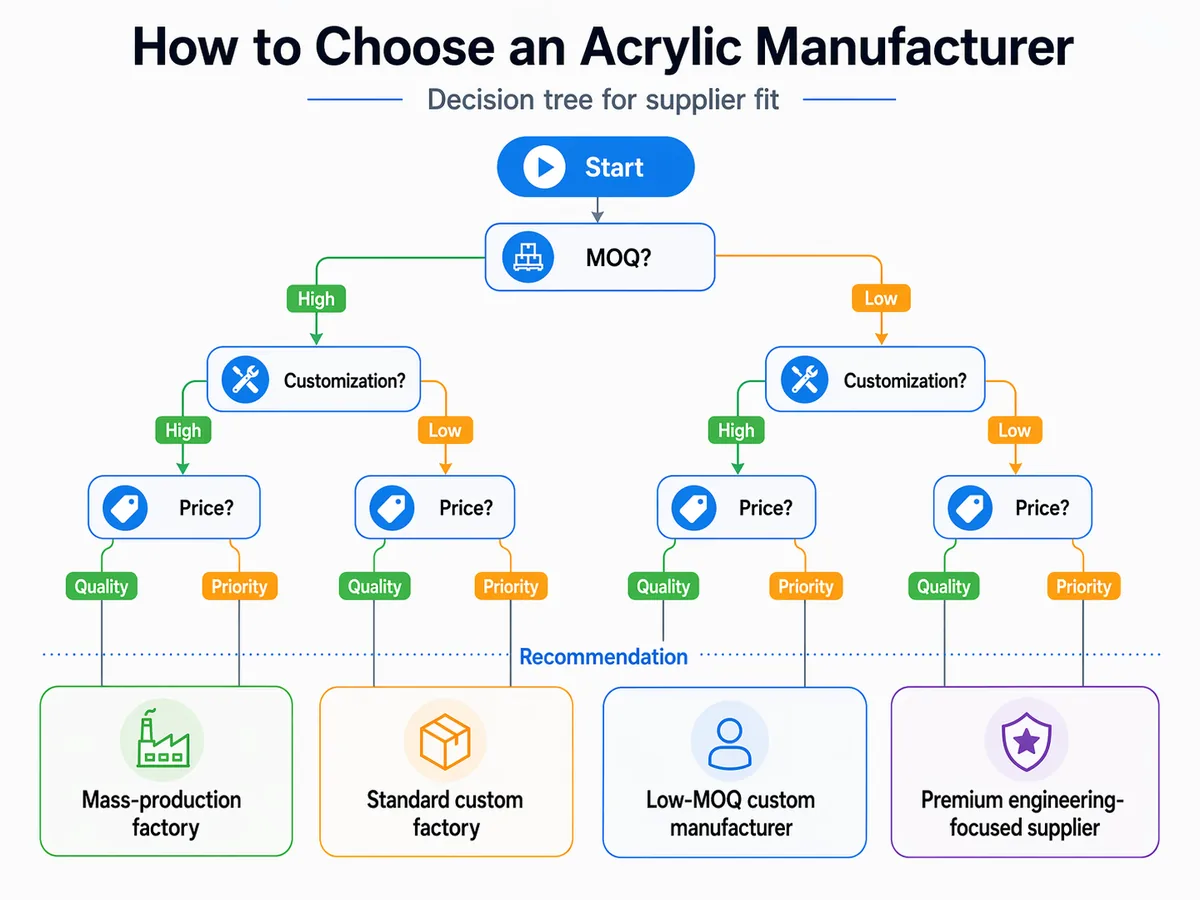
MOQ, customization complexity, and whether price or quality leads the brief will usually tell you what supplier type fits the project.
| Category | Pass | Fail |
|----------|------|------|
| **Quote completeness** | All 9 items present in writing | Missing material grade, tolerance, or lead time |
| **Factory verification** | Video audit or in-person visit completed | Photo deck only, video audit declined |
| **ISO 9001 status** | Certificate verified against registrar's registry | Certificate number unavailable or expired |
| **QC documentation** | Written inspection process with specific checkpoints | Verbal assurances only |
| **Communication pattern** | Consistent response within 24 hours throughout evaluation | Response time degraded after sample was sent |
| **Product-type fit** | Portfolio includes similar product category and complexity | Generic portfolio only, no comparable projects |
The customization capability page at [/customization/](/customization/) lists everything Wetop can fabricate in-house — processes, materials, and finishing options — which is the kind of specificity this checklist asks you to demand from any supplier you evaluate.
[^iso-9001]: [ISO 9001 — Quality management systems](https://www.iso.org/iso-9001-quality-management.html) — ISO's overview of the ISO 9001 quality management standard, including what the certification covers and how it is issued and maintained by accredited certification bodies.
[^ism]: [Institute for Supply Management](https://www.ismworld.org/) — Professional association for supply chain and procurement managers; publishes research and standards on supplier evaluation, qualification, and risk management used by procurement teams across manufacturing industries.
[^plastics-industry]: [Plastics Industry Association](https://www.plasticsindustry.org/) — US trade association for the plastics industry, representing manufacturers, material suppliers, and fabricators; publishes industry data and capability classifications for plastics processing operations.