---
title: "Food Safe Acrylic Boxes for Dessert Display"
description: "A food safe acrylic box is a compliance chain, not a label — direct contact vs display cover under FDA 21 CFR 177.1010, plus care and chilled lid-fit specs."
category: "Industry"
author: "Deniz Chen"
authorCredential: "QC Manager at Wetop Acrylic — leading 4-stage quality inspection since 2016, 1,000+ custom orders inspected piece-by-piece before ship"
datePublished: 2026-07-19
dateModified: 2026-07-19
primaryKeyword: "food safe acrylic box"
url: https://wetopacrylic.com/guide/food-grade-acrylic-boxes-dessert-display/
---
## "Food safe" means two different boxes — decide which one you're buying {#two-questions}
Buyers asking for a food safe acrylic box are really asking one of two questions, and they carry different specs and different paperwork. If food sits directly on the acrylic — a tiramisu on the box floor, candy in a dispenser bin — you need food-grade material with documentation. If the box only covers plated or wrapped food, you don't.
That distinction is the single most useful thing to settle before an RFQ goes out, because it decides cost, material sourcing, and what your supplier owes you in writing. Ten years of qualifying orders for final inspection have put the same two food-safety failures in front of me: the phrase "food safe box" applied to a display cover that never touches food, and — worse — a direct-contact dessert box specced with no compliance question asked at all. Single-serve tiramisu and dessert boxes are among the most frequent box inquiries we see from cafes and dessert brands, and most of those briefs arrive without the contact question answered. This guide draws the boundary, walks the regulations that sit on the direct-contact side of it, and covers the two specs that trip up food-service boxes in practice: washing and chilled lid fit.
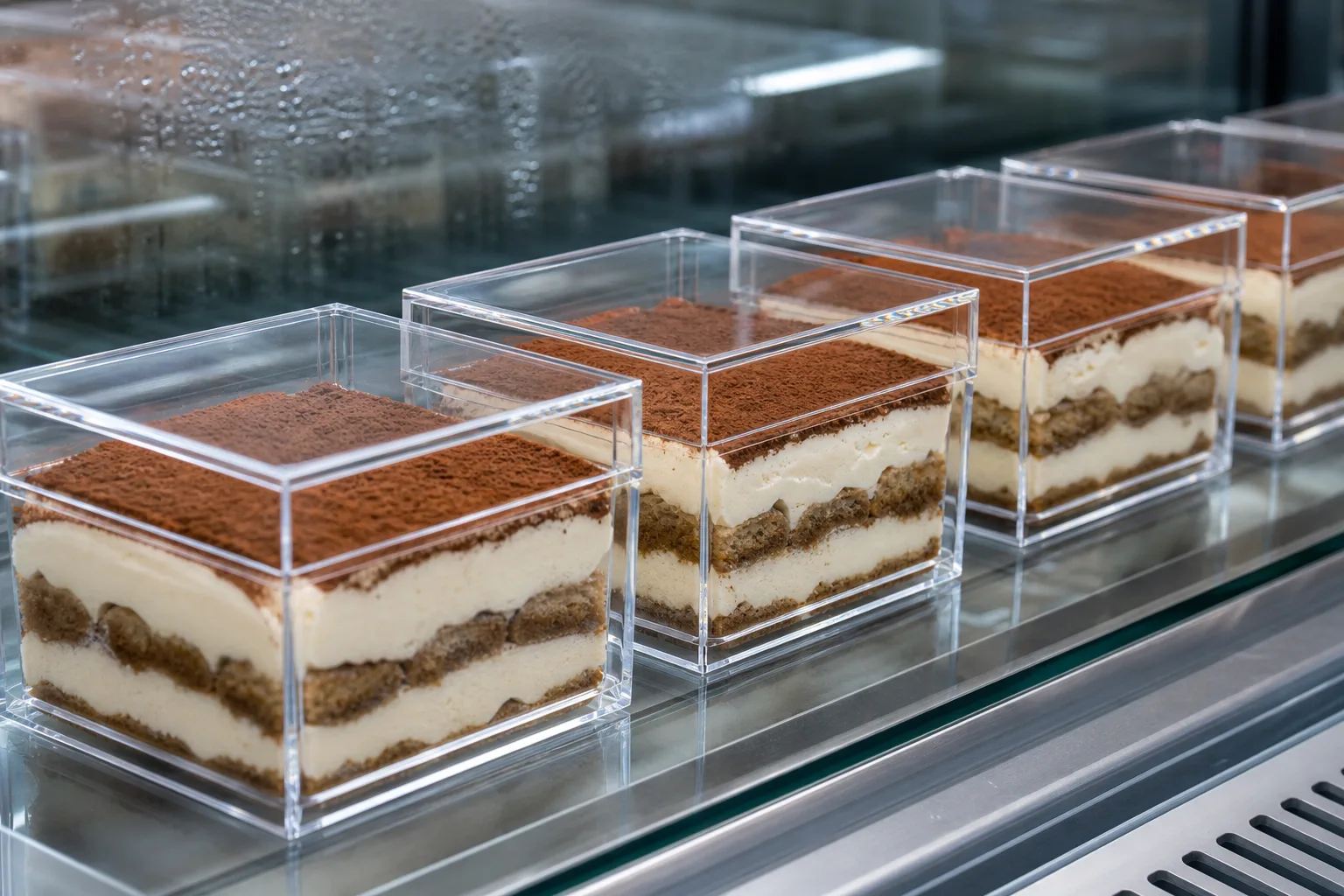
The food-grade boundary in one picture: a dessert box whose floor carries the food is a food-contact article; a dome over a plated dessert is not. Speccing food-grade for a cover wastes money; skipping it on a contact box skips the compliance your buyer's health inspector may ask for.
---
## What the food-contact paperwork actually says {#compliance-docs}
Acrylic is permitted for direct food contact when it is made to a food-grade formulation. In the US, FDA regulates it under 21 CFR 177.1010 — "Acrylic and modified acrylic plastics, semirigid and rigid" — which sets composition and extraction limits.[^cfr] In the EU, Regulation (EU) 10/2011 allows only positive-listed substances and sets migration limits.[^eu10]
The load-bearing phrase is *food-grade*. Acrylic sheet comes in optical, signage, display, and food-contact formulations, and nothing about clarity or thickness tells you which one you're holding — compliance is a chemistry question about what migrates out of the plastic into food, tested against water, acid, ethanol, and fatty simulants. A box cut from a generic display sheet isn't dangerous by default; it's *unverified*, which for a commercial food program amounts to the same problem. So the buyer question that actually protects you is never "is acrylic food safe?" — it is "is *this* box fabricated from a documented food-grade acrylic, and can you produce the declaration?"
The BPA question comes up on nearly every candy-box inquiry, and the answer is clean: acrylic is BPA-free by chemistry. PMMA is polymerized from methyl methacrylate, not from bisphenol A — BPA belongs to polycarbonate's base chemistry, a different plastic. So a food safe acrylic box carries a genuine, verifiable BPA-free claim without any special grade or additive, which matters for candy retail where parents read labels. It is one of the few marketing claims on a food-service acrylic product that needs no asterisk.
What the documentation looks like in practice: a food-contact declaration or technical data sheet for the specific sheet grade used, referencing 21 CFR 177.1010 and — for EU-bound goods — Regulation (EU) 10/2011. The fabricator's role in this chain is honest but limited: the food-contact status is established by the material maker and the regulation, and a good factory specifies a compliant grade, fabricates it cleanly, and passes the paperwork through. We supply the declaration and TDS with a food-service quote on request; what no fabricator can honestly supply is an in-house migration test, because that is a material-lab discipline, not a fabrication one. The same compliance chain applies to trays — our [food-safe acrylic tray guide](/guide/food-safe-dishwasher-safe-acrylic-trays/) covers the tray-scoped version of this question, including the BPA chemistry; this page covers boxes, where the lid, the closure, and chilled service change the spec.
---
## Three food-service box formats, three spec profiles {#three-formats}
Dessert boxes, candy dispensing boxes, and bread or pastry covers account for most food safe acrylic box inquiries, and each sits differently against the contact boundary. A dessert box is almost always direct contact; a candy dispenser is contact at the bin and chute; a bread cover is usually contact-free until the loaf sits unwrapped on an acrylic base.
The table below is the routing we walk food-service buyers through at quote stage. The point isn't that one format is stricter than another — it's that the food-grade requirement attaches to specific parts, and a mixed build can split the spec: food-grade for the floor the dessert touches, standard cast acrylic for the cover nobody's croissant will ever meet.
| Format | Typical use | Contact status | Food-grade needed? | Closure that suits it |
|---|---|---|---|---|
| Single-serve dessert box | Tiramisu, mousse cups, gift desserts | Food on the box floor and walls | Yes — interior parts | Lift-off or telescoping lid |
| Dessert display box (multi-piece) | Counter display of unwrapped pastries | Food on floor or internal tray | Yes — contact parts | Hinged or lift-off front |
| Candy dispensing box / gravity bin | Bulk candy, pick-and-mix retail | Candy against bin walls and chute | Yes — bin and chute | Hinged fill lid, dispensing flap |
| Bread / pastry cover or dome | Bakery counter, buffet service | Cover only — food on a plate or board | No — unless the base is acrylic | Lift-off dome, flip lid |
| Packaged-goods display box | Wrapped chocolates, boxed sweets | Wrapper touches acrylic, food never does | No | Any |
Two practical notes from the inspection side. First, candy dispensers earn their compliance scrutiny: candy sits against the acrylic for days or weeks, far longer than a plated dessert, so the bin material declaration matters more, not less, than on a dessert box. Second, for boxes where food does touch the interior, cast acrylic is the grade to request over extruded — the same reasoning as trays: cleaner polished edges, better solvent-bond behavior at the corners, and more consistent resistance to the stress that crazing exploits. Format and size options for the non-food-specific side of these builds are on our [custom acrylic boxes](/products/acrylic-boxes/) hub, and the counter-display context — where these boxes usually end up standing — is covered on our [food and bakery displays](/applications/food-bakery-displays/) page.
---
## Washing: the care spec that decides how long the box stays clear {#cleanability}
No acrylic box is dishwasher-safe, food-grade or not. PMMA's heat-deflection temperature is roughly 96 °C with a glass transition near 110 °C,[^makeitfrom] and a hot wash-dry cycle pairs that heat with aggressive detergents — the combination that crazes acrylic into permanent hairline cracks. Hand-wash in warm water with mild dish soap and a soft cloth.
This is the same care spec as acrylic serving trays, and it matters more on boxes than buyers expect, because boxes have interior corners. Crazing loves stress, and the solvent-bonded corner of a box carries more residual stress than the open floor of a tray. When a cloudy box comes back to my inspection table, the first place I look is along the bond lines — that is where a hot detergent cycle shows its first hairline cracks, exactly where cleaning brushes also scrub hardest. The don'ts carry over unchanged: no alcohol wipes, no ammonia-based glass cleaners, no acetone or solvent products, no abrasive pads, no paper towels. For dried-on cream or chocolate, soak first and wipe rather than scrub. A dessert box in daily cafe service, hand-washed to this spec, stays presentably clear for years; the boxes I have seen come back cloudy had nearly always met a dishwasher, a solvent spray, or a scouring pad.
One scope line, so the material is specced honestly: acrylic dessert and candy boxes are cold-and-ambient service items. They are not for hot food, microwaving, or oven-adjacent placement — PMMA softening near 96 °C rules those out — and a bakery moving boxes near proofing ovens should flag the placement at the briefing stage so the layout keeps them clear of sustained heat.
### The care card worth shipping with a food-service box order
The simplest, highest-leverage quality measure on a food-service box program is a printed care card in the carton, because the failure modes are behavioral, not material. I recommend one on every direct-contact program we quote, and the content fits in six lines:
| Do | Don't |
|---|---|
| Hand-wash in warm water with mild dish soap | Run boxes through a dishwasher — heat plus detergent crazes PMMA |
| Wipe with a soft cloth, sponge, or microfiber | Use abrasive pads, scouring powder, or paper towels |
| Soak dried cream or sugar loose, then wipe | Scrub hard at bond lines and corners |
| Dry condensation with a dry soft cloth | Spray alcohol, ammonia glass cleaner, or sanitizer solvents on the acrylic |
| Serve cold and room-temperature food | Place near ovens, warming lamps, or heat vents |
| Air-dry away from heat and direct sun | Stack boxes wet — trapped moisture marks the gloss |
None of this is exotic — it is the standard acrylic care discipline — but on boxes the corners concentrate the consequences. A cafe that laminates this card next to the wash sink gets years out of a box program; one that leaves care to habit replaces boxes by the season.
---
## Chilled service: lid fit, contraction, and condensation {#cold-case-fit}
Dessert boxes live in refrigeration — that's the point of tiramisu — and cold changes the lid-fit math. Acrylic contracts about 76 µm per meter for every degree Celsius it cools,[^makeitfrom] so a 300 mm lid moving from a 24 °C kitchen into a 4 °C chiller loses roughly 0.46 mm of length. Spec the clearance for it.
The failure mode isn't the steady state — a box and lid chilled together shrink together, and the fit tracks. The trap is the transient: a room-temperature lid pressed onto a box that has been sitting chilled, or a friction-fit lid cut to a snug zero-clearance fit at workshop temperature that binds when the assembly cools and the tolerances stack the wrong way. On any friction-fit or telescoping box destined for chilled service, we spec at least 0.5 mm of clearance on the fit — enough to absorb the thermal swing, still snug enough to seat cleanly — and we confirm it on a physical sample that has actually been through a fridge, not just measured on the bench. The simpler route, and the one most dessert programs land on, is a plain lift-off lid, which has no interference fit to bind in the first place. The full closure menu — lift-off, telescoping, friction-fit, hinged, magnetic — and what each adds in tolerance and hardware is in our [acrylic box lid and closure guide](/guide/acrylic-box-lid-closure-types-guide/); for chilled service, read that menu with the contraction number in hand.
Condensation is the other cold-service reality. A chilled box carried into warm room air fogs, on the outside, within seconds — that's physics, not a defect — and the fog wipes off with a dry microfiber cloth. What matters at the spec stage is drainage of the habit: staff who wipe chilled acrylic with whatever sanitizer is at hand will craze it, so the care card that ships with a chilled-service order should say *dry soft cloth for condensation, mild soap wash at close* explicitly. And to keep categories straight: these are boxes that ride *inside* refrigeration. A refrigerated display cabinet itself — compressor, gaskets, condensate management — is a different industry, as our [pastry display case guide](/guide/pastry-display-case-buyer-guide/) spells out; acrylic boxes go in it, they don't replace it.
Single-serve dessert boxes in chilled service — the format behind many of the food-grade box inquiries we see. The floor the tiramisu sits on is the food-contact part; the lift-off lid avoids the friction-fit binding that cold service can cause.
---
## Speccing a food safe acrylic box order {#ordering}
A complete food safe acrylic box brief answers five things: what the food is and whether it touches the acrylic, the box dimensions and wall thickness, the closure type, whether service is ambient or chilled, and the quantity. With those five, a supplier can quote the right material grade, the right lid clearance, and the right paperwork in one pass.
From our side, the standard terms: MOQ is 50 pieces per design, samples ship in 3–5 days, production runs 15–20 days, and payment is a 30% deposit with the balance before shipment. Every box passes 100% inspection in our ISO 9001-certified factory — for food-service builds that inspection includes the bond lines and lid fit, because those are where washing and chilling stress the box later. The food-grade material declaration and TDS come with the quote on request; if a supplier quoting your dessert box program cannot produce that paperwork for a direct-contact build, treat it as the red flag it is, regardless of how clear the sample looks.
Branding rides along in the same run — laser-etched or UV-printed logos on lids and fronts — and for gift-oriented dessert formats, the [acrylic gift boxes](/products/acrylic-boxes/acrylic-gift-boxes/) page covers the presentation-side options. For a worked example of how a multi-store box program moves from sample approval to rollout — the same sample-gate-then-production path a food-service box order follows — see our [acrylic gift box boutique rollout case study](/case-studies/acrylic-gift-box-boutique-rollout/). When you're ready to spec a run, [send us the five brief points above](/contact/?source=food-grade-acrylic-boxes-dessert-display) and note "direct food contact" wherever it applies; we respond within 24 hours, and the compliance question gets answered before the deposit, not after.
[^cfr]: [FDA 21 CFR 177.1010 — Acrylic and modified acrylic plastics, semirigid and rigid (eCFR)](https://www.ecfr.gov/current/title-21/chapter-I/subchapter-B/part-177/subpart-B/section-177.1010) — the US regulation permitting acrylic plastics for direct food contact under defined composition and extraction limits, the compliance basis for direct-contact dessert and candy boxes.
[^eu10]: [Regulation (EU) No 10/2011 on plastic materials and articles in contact with food](https://eur-lex.europa.eu/eli/reg/2011/10/oj/eng) — the EU framework that allows only Annex-I-listed substances and sets migration limits for plastic foodware, the second regulation a food-contact acrylic declaration should reference for EU-bound goods.
[^makeitfrom]: [PMMA (Acrylic) material properties — MakeItFrom](https://www.makeitfrom.com/material-properties/Polymethylmethacrylate-PMMA-Acrylic) — displays cast PMMA's heat-deflection temperature (~96 °C), glass transition (~110 °C), and thermal expansion (~76 µm/m·°C), the numbers behind the no-dishwasher rule and the chilled lid-clearance spec.