---
title: "FOB vs DDP: Which Term Fits Your Acrylic Order?"
description: "FOB vs DDP for custom acrylic orders from China — who pays and owns what at each shipping leg, landed-cost math with typical ranges, and when each term wins."
category: "Buyer Guide"
author: "William Cho"
authorCredential: "Founder of Wetop Acrylic — building custom acrylic in Shenzhen since 2008, 2,000+ B2B projects shipped across 25+ countries"
datePublished: 2026-07-27
dateModified: 2026-07-27
primaryKeyword: "fob vs ddp"
url: https://wetopacrylic.com/guide/fob-vs-ddp-acrylic-orders/
---
## What the FOB vs DDP choice actually splits {#what-it-splits}
FOB and DDP are Incoterms — standardized trade rules published by the International Chamber of Commerce that define, for eleven named terms, exactly where cost and risk pass from seller to buyer.[^icc] FOB hands both to the buyer when goods are loaded on the vessel at the origin port. DDP keeps both with the seller all the way to the buyer's door, import duty included.
The gap between those handoff points is the entire conversation. In my 18+ years shipping custom acrylic to buyers in 25+ countries, the FOB vs DDP question has produced more first-order confusion than any spec, material, or payment topic — usually because a buyer compares an FOB number against a DDP number as if they priced the same thing. They don't. The FOB price buys you goods on a ship; the DDP price buys you goods in your warehouse. Between the two sit freight, insurance, destination handling, customs clearance, duty, and a truck — real costs someone must pay under either term. The only question is who arranges them, who carries the risk while they happen, and whose markup rides on top.
One scope note: this guide covers the responsibility split. The separate question of ocean versus air — and the split-shipment play that sends a launch quantity by air while the bulk sails — has its own math, and our [air freight vs ocean freight guide](/guide/air-first-split-shipment-acrylic/) owns that decision.
---
## Who pays what, leg by leg {#leg-by-leg}
Read any FOB vs DDP comparison as a table of legs, because that's what the terms are: an agreement about which column each leg's cost and risk lands in. The US International Trade Administration's Incoterms overview breaks the obligations out the same way.[^ita]
| Leg | FOB Shenzhen | DDP (your door) |
|---|---|---|
| Production + export packaging | Seller | Seller |
| Inland transport to origin port | Seller | Seller |
| Export customs clearance | Seller | Seller |
| Loading on vessel | Seller | Seller |
| Ocean / air freight | **Buyer** | Seller |
| Cargo insurance | **Buyer** (recommended) | Seller |
| Destination port / terminal charges | **Buyer** | Seller |
| Import clearance + brokerage | **Buyer** | Seller |
| Import duty and taxes | **Buyer** | Seller |
| Last-mile delivery | **Buyer** | Seller |
| Risk during main transit | Buyer | Seller |
The same six legs exist under both terms — FOB vs DDP only decides whose column each leg lands in, and where risk transfers.
The risk row deserves a sentence, because buyers fixate on cost and forget it. Under FOB, if a container goes overboard mid-Pacific, that's the buyer's loss — which is why marine cargo insurance, typically a fraction of a percent of cargo value, belongs in every FOB budget. Under DDP the seller carries that exposure, and an honest DDP price includes it.
---
## Landed-cost math: one order, both ways {#landed-cost}
Never compare an FOB quote to a DDP quote directly — extend both to landed cost. Here's a worked example for a mid-size order: 200 custom serving trays, 20 cartons, about 280 kg and 1.5 cbm, China to the US. The freight figures are typical ranges as of mid-2026; treat them as illustration and get live quotes.
| Cost line | FOB route (typical range) | DDP route |
|---|---|---|
| Goods (200 trays) | $1,800 (FOB Shenzhen) | included |
| Ocean LCL freight | $150-400 | included |
| Origin + destination handling | $300-500 | included |
| Cargo insurance | $20-40 | included |
| Customs brokerage | $125-250 | included |
| Import duty | per current rate — ask your broker | included |
| Last-mile delivery | $150-350 | included |
| **Landed total** | **$2,545-3,340 + duty** | **one all-in figure, e.g. ~$3,100-3,500** |
Two honest observations about that table. First, LCL (less-than-container-load) ocean shipping carries heavy fixed handling charges relative to freight itself — at 1.5 cbm, the paperwork and terminal fees can cost more than the ocean leg. This is why small ocean shipments often price worse than buyers expect, and why courier DDP competes so well below roughly half a pallet. Second, the duty cell is deliberately blank of numbers: rates vary by product classification and origin, and they change — sometimes mid-order. I've watched buyers budget from a tariff percentage in a year-old blog post and miss by thousands. Get the current rate from your customs broker at quote time, in writing, and re-check it before the balance payment.
Deposit timing rounds out the cash picture: our orders run 30% deposit with the balance before shipment, samples in 3-5 days, production in 15-20 days — the payment mechanics and their reasoning live in our [deposit vs full payment guide](/guide/deposit-vs-full-payment-custom-acrylic/).
---
## Three misreadings that cost buyers real money {#misreadings}
The FOB vs DDP mistakes I see repeat themselves, so here are the three we spend the most time untangling on quote calls: comparing the two prices head-to-head, confusing FOB with EXW, and treating a duty estimate as a duty rate.
The head-to-head comparison is the classic. A buyer collects an FOB quote from us and a DDP quote from another factory, sees a 40% gap, and concludes someone is overcharging. Extend both to landed cost and the gap usually shrinks to single digits — the DDP number simply already contains the four legs the FOB buyer hasn't priced yet. When we quote FOB Shenzhen, we attach carton count, gross weight, and volume for exactly this reason: those three numbers are what a forwarder needs to complete your side of the comparison in an afternoon.
The EXW confusion runs the other way. Ex Works means the goods are yours at the factory gate — you arrange export clearance in China, which is genuinely painful for a foreign buyer. FOB is friendlier than its reputation: the seller handles everything in-country, including export customs, and hands off only when the cargo is on the vessel. I've had buyers avoid FOB for years believing it meant "figure out China logistics yourself." It doesn't.
The duty misreading is the expensive one, covered above but worth repeating as a rule: a duty percentage is a snapshot, not a constant. Classification, origin rules, and trade policy all move. Your broker's current written answer is the only number that belongs in a landed-cost model.
---
## When DDP wins {#when-ddp}
DDP earns its markup on small, parcel-able orders and first imports. If your 50-200 pieces pack into a few cartons, a courier-based DDP shipment gives you one all-in price, door delivery in roughly 5-10 days, no broker to hire, no importer-of-record learning curve — and at that size, often a lower total than FOB-plus-LCL's fixed fees.
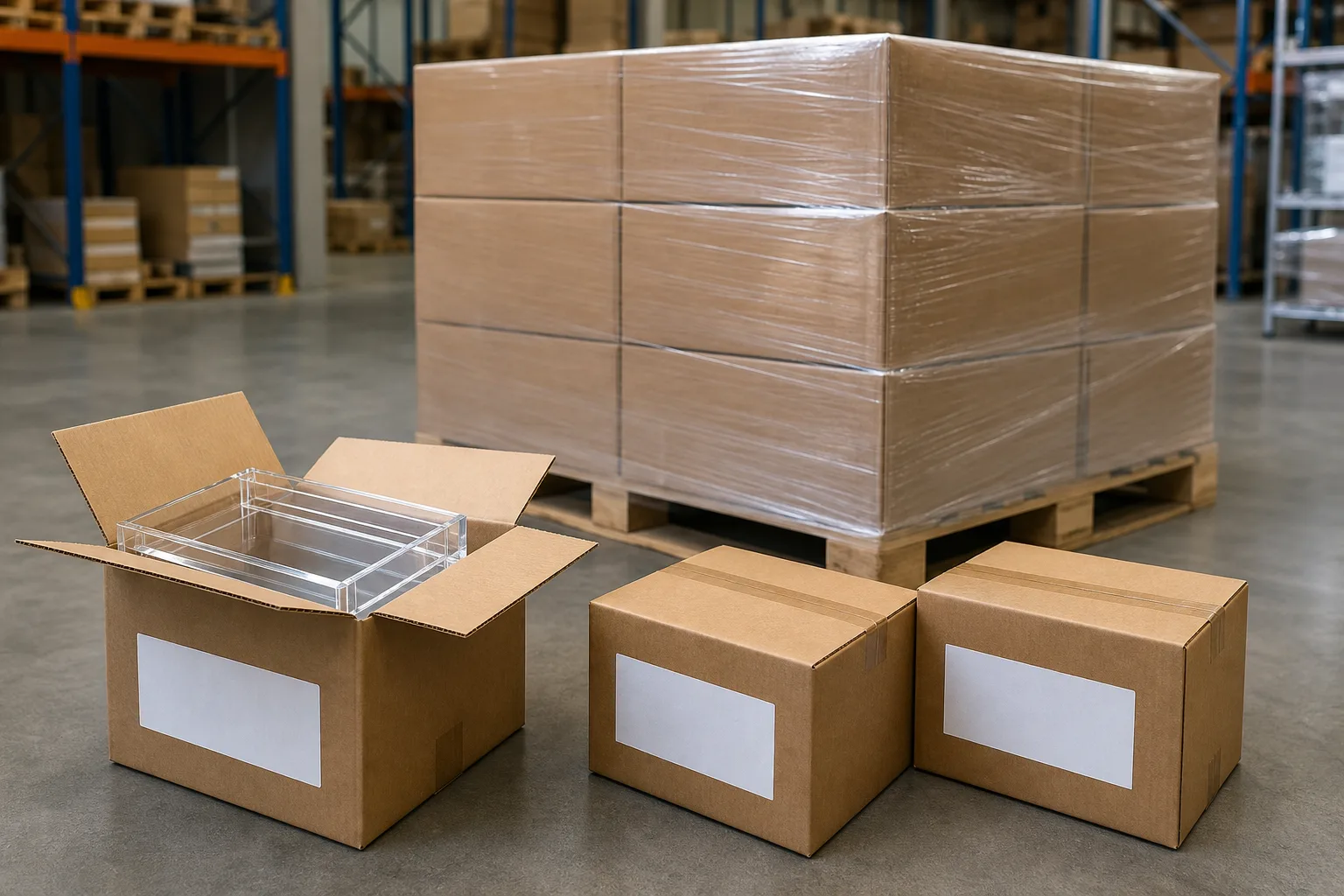
Same factory, two routes: a few courier cartons ride DDP to the buyer's door, while pallet-scale orders hand off FOB at the Shenzhen port.
The structural reason is that couriers cleared the customs problem at scale: express carriers run their own brokerage and clearance pipelines, so a 60 kg shipment rides infrastructure a one-time importer could never assemble at that price. That's why e-commerce sellers restocking compact goods — like the sign-holder seller programs in our [e-commerce sign holders case study](/case-studies/acrylic-sign-holders-ecommerce-sellers/) — default to DDP courier terms: predictable per-order landed cost, no surprises at delivery, restocks that arrive while a sea shipment would still be at the origin port.
DDP is also the right training-wheels term for a pilot. A first 50-piece order — the MOQ across our [custom acrylic tray](/products/acrylic-trays/) range and everything else we build — is usually about validating product and demand, not about optimizing freight. Pay the all-in price, get the goods, learn the demand curve; optimize the term when the volume justifies it.
Two cautions. Insist on the word DDP on the quote — DAP (Delivered At Place) looks similar but leaves duty with you, and the difference surfaces as a surprise invoice at delivery. And confirm who acts as importer of record; a DDP seller or their agent should be handling entry, not quietly filing it in your name.
---
## When FOB wins {#when-fob}
FOB wins from pallet volume upward, and the advantage compounds with every reorder. At half a pallet and beyond, a buyer's own freight forwarder — with negotiated lane rates and consolidated bookings — beats any seller-arranged, markup-carrying freight almost every time. You also gain control: carrier choice, transit speed, insurance level, and clearance handled by a broker who answers to you.
There's a transparency argument too, and it's the reason FOB Shenzhen is our default quoting term. An FOB price is clean: it contains the product, export packaging, inland haulage, and export clearance — things the factory actually controls — and nothing else. A DDP price from a factory necessarily bundles someone else's freight and someone else's duty estimate, padded enough to protect the seller if rates move. At 50 pieces that padding is a convenience fee worth paying. At 2,000 pieces it's real money, and a buyer with a forwarder captures it back. Most of our long-run buyers made exactly this migration: DDP courier for the pilot, FOB with their own forwarder from the first full rollout onward.
Under FOB you become the importer of record, which means entry filing, product classification, and duty payment in your country sit with you — in practice, with the licensed customs broker you or your forwarder appoint. US Customs and Border Protection licenses brokers precisely to conduct that business on importers' behalf,[^cbp] and most forwarders bundle brokerage into their door quote, so "hire a broker" usually means one extra line on an invoice, not a hiring process.
Documentation is the part of FOB we can make painless from our side, so we do. Every FOB shipment leaves our factory with the paper set a broker needs to file entry cleanly: commercial invoice, packing list with per-carton weights and dimensions, and the material declarations customs occasionally asks for on plastic goods. When we book the handoff with your forwarder's Shenzhen agent, we send the same set ahead of the cargo — clearance delays are almost always document delays, and a complete file the day the vessel sails is the lowest-cost insurance in this business.
The FOB vs DDP rule I give buyers after 2,000+ shipped projects is short: parcel-size order or first import — take DDP and buy simplicity; pallet or better, or any repeat program — take FOB, appoint a forwarder, and keep the margin. When you're ready to run your own numbers, send your quantity and destination through our [customization page](/customization/) and we'll quote FOB Shenzhen with carton counts, weights, and volume — everything your forwarder needs for a live freight comparison.
[^icc]: [Incoterms 2020 — International Chamber of Commerce](https://iccwbo.org/business-solutions/incoterms-rules/incoterms-2020/) — the ICC's official rules defining the eleven trade terms, including the seller/buyer cost and risk split under FOB and DDP cited throughout this guide.
[^ita]: [Know Your Incoterms — US International Trade Administration](https://www.trade.gov/know-your-incoterms) — US government explainer of buyer and seller obligations under each Incoterm, source for the leg-by-leg responsibility breakdown.
[^cbp]: [Customs Brokers — US Customs and Border Protection](https://www.cbp.gov/trade/programs-administration/customs-brokers) — CBP's description of licensed customs brokers, who conduct entry filing and duty payment on behalf of importers of record, cited for the FOB buyer's clearance obligations.