---
title: "Custom POP Displays: A Design & Cost Guide for CPG Brands"
description: "Custom POP displays — formats, materials, cost drivers, and MOQ realities from a factory that ships 2,000+ B2B display projects. Spec right before RFQ."
category: "Industry"
author: "William Cho"
authorCredential: "Founder of Wetop Acrylic — building custom acrylic in Shenzhen since 2008, 2,000+ B2B projects shipped across 25+ countries"
datePublished: 2026-04-21
dateModified: 2026-04-21
primaryKeyword: "custom pop displays"
url: https://wetopacrylic.com/guide/custom-pop-displays-design-cost/
---
## What Drives Custom POP Display Cost and Success {#what-drives-cost}
Custom POP displays succeed or fail on five variables: format fit to shopper behavior, material match to campaign duration, graphics that communicate in 3 seconds, MOQ economics that match your launch size, and lead time aligned to your retail reset date. Unit cost spans $15 to $120+ depending on how those five variables resolve for your specific campaign. The biggest mistake I see CPG brand teams make isn't overspending — it's specifying the wrong material for the campaign duration, so the display either looks tired before the promotion ends or carries permanent-fixture cost for a 6-week promo.
Since founding Wetop in 2008 I've watched thousands of POP display projects move from brand brief to retail floor, and the pattern is consistent: brands that get the material-to-duration match right spend less over the campaign lifecycle than brands that repeat the "cheap corrugated that falls apart" or "premium acrylic for a 4-week promo" mistake. This guide walks through the decisions I walk every new CPG buyer through on the first call (format, material, graphics, MOQ, and lead time) with real cost ranges so you can benchmark quotes before you receive them.
---
## The 5 POP Display Formats CPG Brands Actually Use {#five-formats}
Five POP display formats cover roughly 90% of the custom retail POP work we fabricate: freestanding floor displays, endcap displays, counter / PDQ displays, pallet displays, and clip-strip displays. Each serves a distinct shopper-intercept moment in the retail journey and has a different cost and MOQ profile. These format definitions align with the global POP display industry standards published by the [Shop! Association](https://shopassociation.org/), the international trade body for retail marketing and shopper marketing. Picking the wrong format for the intercept moment is the single most common design mistake in POP retail.
**Freestanding floor displays** sit in aisle endcaps, entry zones, or free-standing islands: 3 to 6 feet tall, product-loaded, visible from 20+ feet. These work for impulse categories (beverages, snacks, seasonal items) and new product launches where awareness matters more than considered purchase. Cost range: $40–$120 per unit in custom acrylic with full-color graphics, MOQ from 50. **Endcap displays** mount at the end of a shelf run, typically 3–4 feet wide with 3–5 tiers of product — the highest-value POP position in most grocery and mass retailers. These are often semi-permanent fixtures that rotate through product seasonally. Cost range: $60–$150 per unit in acrylic, MOQ from 50. **Counter / PDQ displays** (Product Display Quick) sit on checkout counters, pharmacy counters, or service desks: 12–18 inches tall, optimized for single-product hero display at the moment of payment. These drive impulse conversion on small-basket items. Cost range: $15–$45 per unit in acrylic, MOQ from 100.
**Pallet displays** are full pallets of product with a branded surround — used in Costco, Sam's Club, and BJ's warehouse clubs where shoppers expect bulk stacks. The surround is usually corrugated for cost reasons (it ships with the product and doesn't need to last beyond the promo). Cost range: $8–$30 per surround, MOQ 500+. **Clip-strip displays** are narrow vertical strips that clip onto shelf edges, holding 6–12 packaged items as impulse add-ons near related categories (example: lip balm near checkout, batteries near flashlights). Cost range: $3–$12 per clip strip, MOQ 500+.
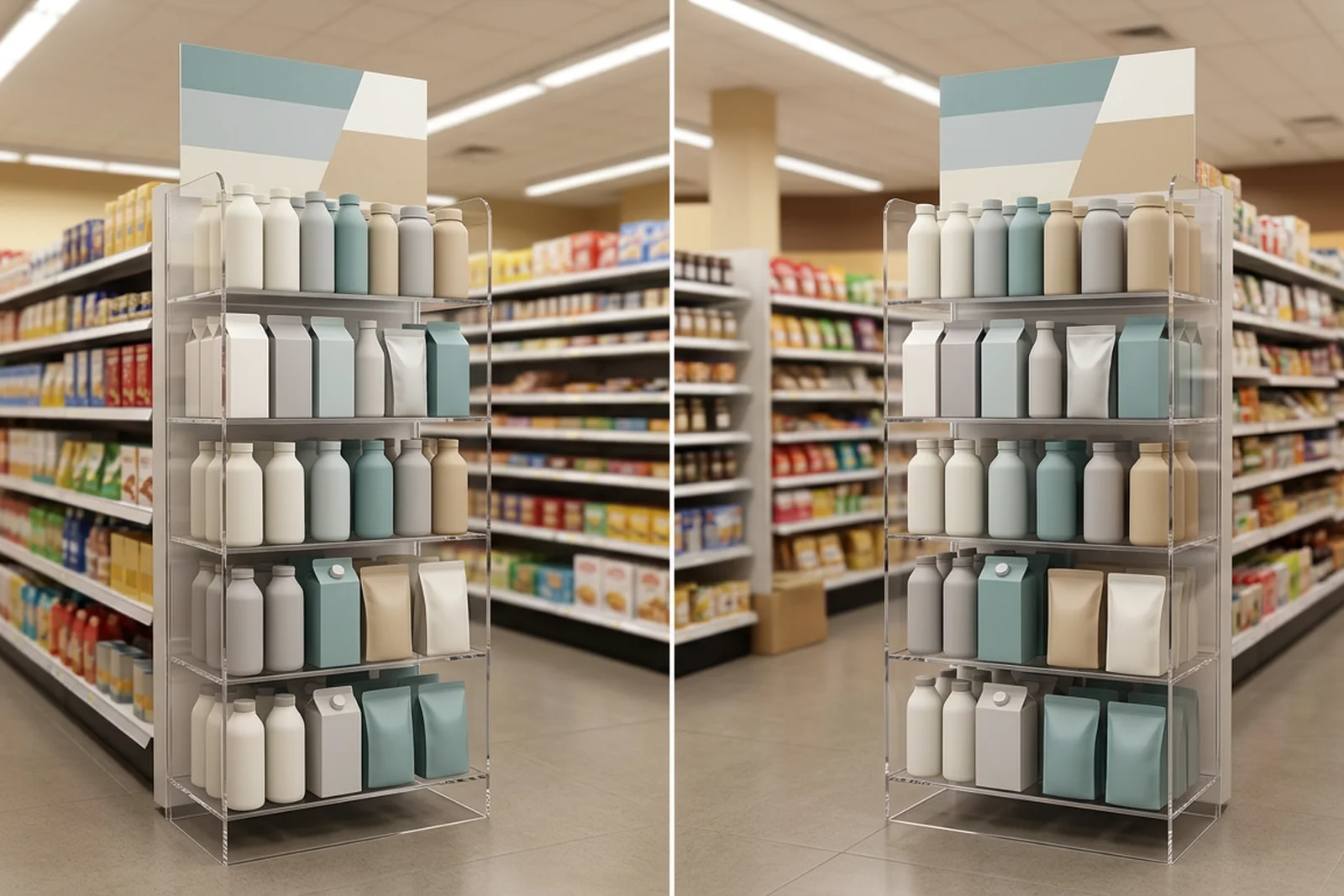
Five POP display formats at approximate relative scale, with placement context and typical custom-fabrication cost ranges (custom acrylic or corrugated depending on format — see material matrix below).A freestanding floor POP display on an aisle endcap — the highest-visibility POP position in most grocery and mass retailers. Acrylic body with UV-printed graphics, 5-tier product loading.
---
## Design Priorities That Drive ROI {#design-priorities}
The three design priorities that determine whether a POP display drives incremental sales or sits on the retail floor unused: shopper-intercept clarity at 10 feet, brand system continuity with packaging, and product-to-graphic visual hierarchy. A POP display that fails any one of these three tests underperforms regardless of material quality or fabrication precision.
**Shopper-intercept clarity at 10 feet** means the display communicates its core message (product category, brand, key benefit, or promotion) before the shopper is close enough to read body copy. Shopper-marketing research bodies like the [Path to Purchase Institute](https://www.pathtopurchaseiq.com/) publish ongoing data on shopper-intercept behavior and in-store POP effectiveness. In 18+ years shipping retail POP, I've watched brand teams over-design headline type and under-invest in silhouette and color block contrast. The display that wins doesn't have the most information; it has the clearest information pyramid. Brand mark (2-foot read distance) → category identifier (6-foot read) → product hero image (10-foot read) → promotional message (stopping distance). **Brand system continuity** means the POP display carries the same color system, typography, and visual voice as the product packaging, digital marketing, and out-of-home advertising for the same launch. Fragmented brand systems on POP (where the display looks like it came from a different agency than the packaging) cut conversion rates measurably, because shoppers don't recognize the display as part of the brand experience they've seen elsewhere. **Visual hierarchy** means the product itself is the hero, not the display. Over-designed POP that competes with product packaging for visual attention reduces conversion; quality POP frames and elevates the product without fighting it.
For beauty, cosmetics, and prestige CPG categories where merchandising aesthetics directly reinforce brand premium positioning, see our deeper treatment in the [cosmetics acrylic display benefits guide](/guide/cosmetics-acrylic-display-benefits/) — the merchandising principles overlap heavily with premium POP design.
---
## The 6 Cost Drivers Behind Every POP Display Quote {#cost-drivers}
Six variables drive 90% of unit cost variance on custom POP display quotes: material, size, graphics method, assembly complexity, order quantity (MOQ tier), and shipping origin. In my 18+ years pricing POP programs across 25+ countries, I've watched buyers save 20–40% on the same quote just by understanding which of these six levers to negotiate on — usually MOQ tier or graphics complexity, rarely material once the durability requirement is set.
**Material** is the largest single driver. Corrugated cardboard is the cheapest ($3–$15 per unit delivered for counter displays), acrylic is mid-range ($15–$120 depending on format and size), and metal + wood are the most expensive ($80–$300+ per unit). Material also drives campaign duration fit — see next section. **Size** drives material cost linearly but fabrication cost non-linearly: a 6-foot floor display isn't 2x the cost of a 3-foot floor display; it's often 3–4x due to heavier base requirements, more complex assembly, and higher shipping dimensional weight. **Graphics method** spans single-color silkscreen (cheapest, $0.50–$2 per unit), full-color UV print direct to acrylic (mid, $3–$12 per unit — see our [UV printing on acrylic guide](/guide/uv-printing-on-acrylic/) for the technology), backlit / edge-lit illuminated panels (premium, $15–$60 per unit), and digital LCD integration (highest, $80–$400+ per unit).
**Assembly complexity** (how many SKUs, tiers, moving parts, and finish operations the display requires) hits unit cost through labor hours. A simple 3-tier acrylic counter display might take 12 minutes of assembly labor; a 5-tier endcap with branded headers, illuminated base, and anti-theft locks might take 90 minutes. **MOQ tier** drops unit cost meaningfully at each threshold: 50 units (premium/test), 500 units (launch), 5,000 units (national rollout), 25,000+ units (category leader rollout). The per-unit savings between 50 and 500 units is typically 20–35%; between 500 and 5,000 is typically 15–25%. **Shipping origin** matters because freight from China to US ports runs $1–$4 per unit depending on display volume and container fill efficiency — for small lightweight counter displays, this is 5–15% of unit cost; for large floor displays, it can be 20%+.
For a structured RFQ that gets accurate quotes on the first pass, see our [custom acrylic RFQ guide](/guide/acrylic-rfq-guide/) — the same spec discipline applies to POP display quotes.
---
## Material Matrix: Acrylic vs Corrugated vs Metal vs Wood {#material-matrix}
Four materials dominate custom POP display fabrication, and each has a distinct fit profile based on campaign duration, brand positioning, and unit economics. The [Retail Industry Leaders Association (RILA)](https://www.rila.org/) publishes supplier-retailer collaboration frameworks that many of these material decisions ultimately flow through when POP programs reach major US retailers. The decision matrix below is the one I walk every new CPG buyer through on their first qualification call.
**Corrugated cardboard** is the correct material for short-duration promotions (4–12 weeks), new product launches being tested in limited markets, and pallet surrounds in warehouse clubs. It ships flat, assembles in under 2 minutes, and is designed to be recycled at end of campaign. Cost is the lowest of any POP material. Tradeoffs: lifespan under 12 weeks, visible degradation under moisture or rough handling, limited finish quality. MOQ typically 500–1,000+ due to printing and die-cutting setup costs. **Custom acrylic** is the correct material for 3-month to 5-year campaigns, premium product categories where aesthetics reinforce brand positioning (cosmetics, premium beverage, electronics, luxury CPG), and semi-permanent endcap fixtures that rotate products seasonally. Tradeoffs: heavier than corrugated (higher freight), longer lead time, higher unit cost. MOQ starts at 50 at Wetop, which makes it viable for boutique and regional test launches that corrugated MOQs exclude.
**Metal** (typically powder-coated steel or aluminum) is the correct material for permanent in-store fixtures (5–10+ year service), heavy-loaded product categories (hardware, automotive, bulk grocery), and high-theft environments where metal construction deters theft. Tradeoffs: heaviest freight cost, longest lead time (custom tooling adds 10–15 days), highest unit cost. MOQ 100–500 depending on complexity. **Wood** (often MDF or plywood with veneer or paint finish) is the correct material for premium boutique environments (luxury beauty, craft spirits, artisan food brands) where warmth and tactile quality reinforce brand positioning. Tradeoffs: higher moisture sensitivity than metal or acrylic, variable wood-grain consistency across units, longest fabrication lead time. MOQ 100–500.
For acrylic-specific design choices on finish (clear, frosted, or colored), see our guide on [clear vs frosted vs colored acrylic](/guide/clear-vs-frosted-vs-colored-acrylic/) — these finish decisions drive significant aesthetic differences in POP displays at similar cost.
Pick the quadrant that matches your campaign duration first, then optimize within that material. Picking corrugated for a 2-year endcap program — or acrylic for a 6-week promo — is the most common material-fit mistake.
---
## MOQ and Lead Time Realities {#moq-lead-time}
Custom POP display MOQ starts at 50 units for acrylic at Wetop, runs 100–500 for metal and wood, and 500–1,000+ for corrugated — this single variable often decides the material. When I walk a new CPG buyer through their first POP program, MOQ is almost always the first question they ask and the first one that reshapes their material choice once I share real numbers. Brand teams launching a new SKU in 10–50 door test markets are regularly locked out of corrugated MOQ economics, which pushes the decision toward acrylic even for short-duration campaigns. That's not a bad outcome: a 50-unit acrylic counter display order costs less per unit than a 1,000-unit corrugated order that includes 950 units you don't need.
Lead time from approved design to US delivery is 30–45 days for custom acrylic POP — 15–20 working days fabrication at our Shenzhen facility, plus 10–18 days ocean freight to US West or East Coast ports, plus buffer for customs clearance and inland transit. Air freight compresses ocean transit to 5–7 days but costs 3–4x more per unit, so we recommend air only for time-critical launches where the retail reset date is fixed and the brand can't slip. Metal POP adds 10–15 days for custom tooling; wood POP adds 5–10 days for milling and finishing. Corrugated is the fastest at 10–15 days total fabrication if designs are approved on the first pass.
Plan retail launches backward from the on-shelf date. For an acrylic POP program shipping to US retail on June 1, the schedule looks like: May 15 warehouse arrival for distribution (14 days buffer), April 10 production start (35 days including sea freight), April 3 final design approval (7 days for sampling photo approval), March 20 initial RFQ submission (14 days for design refinement and quoting). That's roughly 10–11 weeks from first RFQ to on-shelf. Compressing this timeline is possible with air freight and expedited approval rounds, but every compressed step carries cost.
---
## Which to Spec for Your Launch {#which-to-spec}
For the vast majority of CPG POP display programs (product launches, seasonal promotions, endcap campaigns, and premium merchandising fixtures), custom acrylic is the correct spec. The decision tree below covers the exceptions.
**Spec corrugated if:** the campaign is under 12 weeks AND order quantity exceeds 500 units AND the retail environment is dry (no produce, no cold-case, no humid stockrooms) AND the display is a pallet surround or simple counter unit with minimal structural load. **Spec custom acrylic if:** the campaign is 3 months or longer, OR order quantity is 50–500 units, OR the brand positioning is premium and merchandising aesthetics matter, OR the display is an endcap fixture that will rotate products seasonally, OR illumination is part of the design. **Spec metal if:** the display will be permanently installed for 5+ years in high-traffic retail, OR anti-theft construction is required, OR the product category is heavy (hardware, automotive, bulk grocery). **Spec wood if:** the brand positioning is premium boutique where warmth and tactile quality reinforce the brand (luxury beauty, craft spirits, artisan food) AND budget supports the premium material cost.
For custom acrylic POP display programs, we fabricate at Wetop from 50-unit MOQ, with standard options including clear or colored acrylic body, UV-printed full-color graphics, optional LED edge lighting or base illumination, multi-tier shelf configurations, anti-theft locks for high-value products, and flat-packed shipping for low freight cost. For product-page context on the acrylic POP category, see our [point-of-purchase / POS displays application page](/applications/pop-pos-displays/). If your brief isn't finalized and you want a second opinion on material, format, or graphics approach before you issue RFQs, include that when you email us — I personally review every new CPG inquiry and will give you direct recommendations on what to spec.
For deeper material-finish decisions within acrylic, see our guides on [clear vs frosted vs colored acrylic](/guide/clear-vs-frosted-vs-colored-acrylic/) and [UV printing on acrylic](/guide/uv-printing-on-acrylic/). For industry context on the POP + POS application space, see our case studies on [acrylic menu holders for restaurant chains](/case-studies/acrylic-menu-holders-restaurant-chain/) and [acrylic sign holders for ecommerce sellers](/case-studies/acrylic-sign-holders-ecommerce-sellers/) — the same custom-fabrication discipline applies across POP and retail signage.