---
title: "Custom Mahjong Tile Manufacturer: FOB Cost Math"
description: "Why a custom mahjong tile manufacturer quotes $40-60 per set when Alibaba shows $7 — the FOB cost stack, cast vs extruded, engraving, and MOQ tiers."
category: "Manufacturing"
author: "Dillion Chen"
authorCredential: "Production Manager at Wetop Acrylic — running laser, CNC, polishing, and UV printing lines since 2014, 1,500+ custom projects personally overseen"
datePublished: 2026-07-20
dateModified: 2026-07-20
primaryKeyword: "custom mahjong tile manufacturer"
url: https://wetopacrylic.com/guide/custom-mahjong-set-manufacturing-cost-fob/
---
## The $7 mahjong set is a different product {#seven-dollar-anchor}
A $7-per-set mahjong listing and a $40-60 quote from a custom mahjong tile manufacturer describe two different products, not two margins on one product. The $7 set is stock: molded tiles, shared artwork, giant amortized runs. A custom set is CNC-cut cast acrylic carrying one brand's engraved artwork — and its cost stack starts from zero on every design.
An incoming mahjong RFQ goes nowhere until one anchor is named: whether the buyer has priced against a stock listing. Marketplace stock sets are real products with a real place in the market — if a buyer needs generic inventory to resell, a stock set is the correct purchase and no custom factory can touch its price. The enormous molded runs behind it spread mold cost, artwork, and setup across so many units that the per-set share rounds toward zero.
A brand launching its own set is buying something else entirely: a design it owns, a tile spec it chose, a color standard its customers will photograph. American mahjong itself is standardized — 152 tiles under the National Mah Jongg League composition, played with racks[^wiki-amj] — so what a brand actually sells is execution: material, engraving, color, feel. This guide walks the FOB cost stack line by line so you can see where the money goes and which decisions move it. For the process side — the 9-point quote checklist, sample stages, timelines — see our [mahjong ordering guide](/products/acrylic-mahjong/ordering-guide/); this article stays on the cost math.
---
## The real FOB cost stack {#fob-cost-stack}
An FOB Shenzhen quote for a custom mahjong set stacks five blocks: material, machining and engraving, color and finishing, assembly and QC, and packaging — plus setup labor amortized across the run. FOB means the price covers everything through China export clearance; ocean freight, duty, and destination costs sit on the buyer's side.
| Cost block | What it covers | What moves it |
|------------|----------------|---------------|
| Material | Cast PMMA sheet, per-tile blank volume | Tile size, count (152/160/166), specialty backs |
| Machining + engraving | CNC cutting, edge finishing, artwork engraving | Engraving coverage, artwork complexity |
| Color + finishing | UV fill into recess, layer colors, polish | Colorway count, custom Pantone ($200-300 one-time each) |
| Assembly + QC | Set assembly, piece-by-piece inspection | Tile count, accessory lines |
| Packaging | Standard protective packing included | Printed rigid box from ~500 sets; gift formats per spec |
| Setup (amortized) | CAM programming, engraving calibration, color batching | Order quantity — the whole MOQ ladder |
Reading the table top to bottom is also reading a production schedule. Material commits first — we cut blanks for the whole run in one sheet batch so every tile in a colorway shares one melt lot and one color standard. Machining and engraving hold the middle of the calendar and most of the machine-hours; color, cure, and assembly close it out; and QC runs piece-by-piece before packing, the same 100% inspection we run on every order that leaves the factory. I walk buyers through the stack in this order because it answers the question behind the question: a quote is not a markup on a mystery — it is these six lines, and every spec decision you make lands visibly in one of them.
Two structural facts frame the stack. First, there are zero tooling fees: tiles are cut and engraved, not molded, so no line item exists for steel — the subject of our [zero tooling fees guide](/guide/zero-tooling-fees-cnc-acrylic-vs-molded/). Second, FOB Shenzhen has a precise boundary: manufacturing, QC, standard packaging, inland haulage to Yantian or Shekou, and export clearance are inside it; ocean freight, insurance, destination duty, brokerage, and last-mile delivery are outside. Buyers comparing our FOB number against a competitor's EXW number — or against a marketplace price that excludes everything — are comparing different boundaries, not different factories. When a buyer wants one landed number instead, we quote DDP to the door against a ZIP code.
---
## Cast vs extruded acrylic: what the substrate does to cost {#cast-vs-extruded}
Custom mahjong tiles run on cast acrylic, and the substrate choice is a cost line, not a footnote. Cast PMMA is batch-produced sheet — poured and cured rather than continuously extruded — which costs more per kilogram but machines and engraves cleanly at tile scale. Extruded sheet saves money on paper and pays it back in scrap.
The difference is molecular, and on my lines it is visible the moment a cutting tool touches the sheet. Cast acrylic carries higher molecular weight and better thermal stability, which is why it is the standard grade for machined and engraved work[^azom-cast]; its mechanical profile — elastic modulus around 3 GPa, dense and rigid[^makeitfrom] — holds a crisp engraved edge at the 0.5-1mm depths tile artwork needs. Extruded sheet, made for flat glazing and vacuum forming, runs softer and melts at lower temperature: under an engraving spindle it smears, gums the tool, and throws edge burrs that finishing labor then has to chase. Since 2014 I have costed this trade both ways on our CNC and engraving lines, and at mahjong-tile scale the arithmetic is one-directional — the sheet saving is single-digit percent of the material block, while the scrap and rework it introduces attack the much larger machining block.
So when you compare a custom mahjong tile manufacturer against a lower quote, ask which substrate is being quoted before comparing numbers. A quote built on extruded sheet is not the same product, and the difference surfaces after 50 sets are already on the water — in soft edges, hazy engraving floors, and tiles that feel lighter than the sample the buyer approved.
---
## Engraving plus UV fill vs surface printing {#engraving-vs-print}
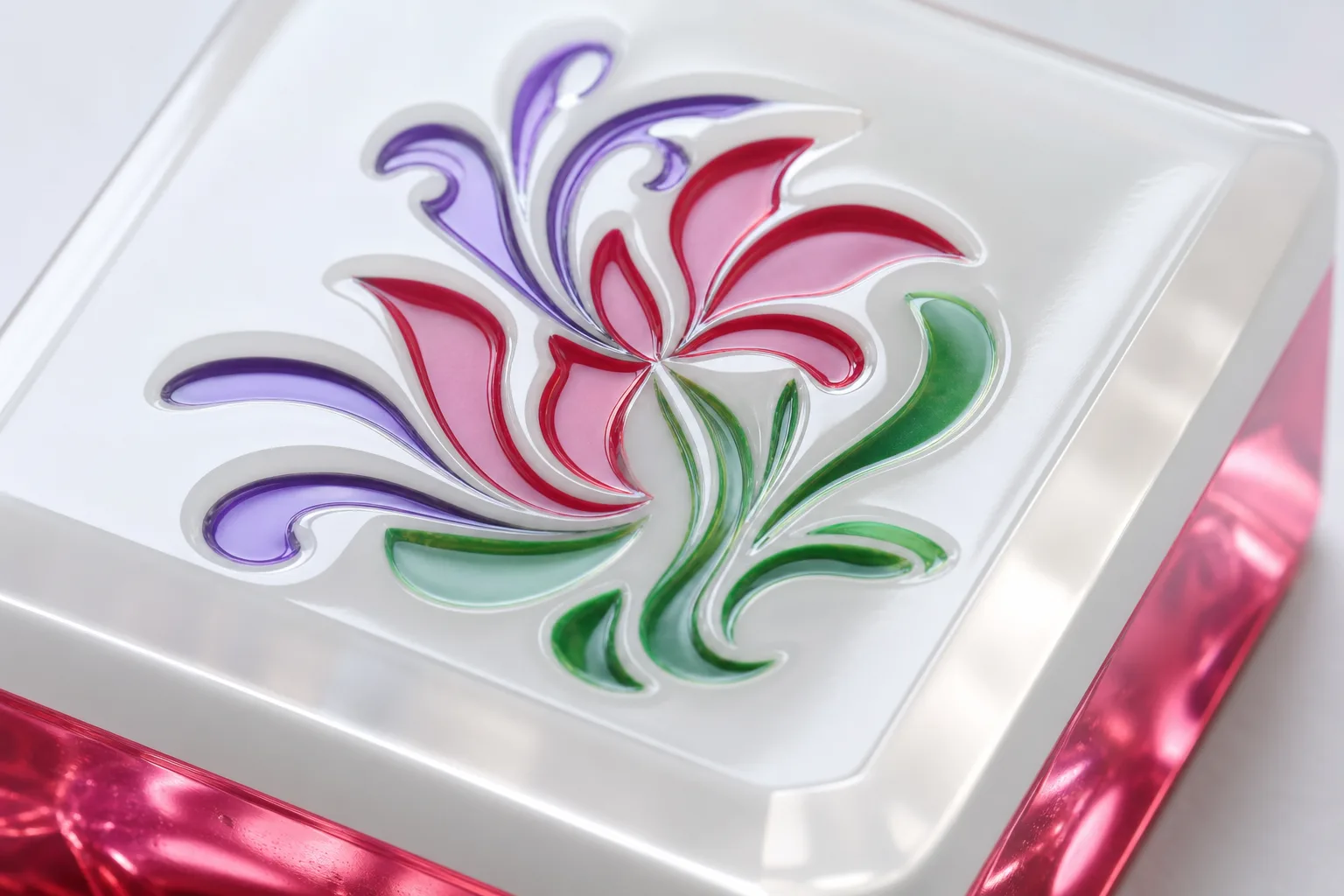
Engrave-then-fill costs more than surface printing because it is two registered operations per tile face: the artwork is engraved into the acrylic, then UV ink is printed into the recess. The payoff is placement — color sitting below the wear surface, where thousands of shuffles cannot reach it.
A surface-printed tile is one pass under a UV printer: fast, accurate, and the right economics for graphics that live under acrylic or away from friction. Mahjong is the hostile case — tiles are washed face-down against each other every single hand, which is abrasion engineered directly onto the artwork. Surface ink on a shuffled tile face is a countdown. The engrave-and-fill sequence we run instead puts machine time into every face: engraving spindle passes per tile, then UV registration into the recess, then cure and inspection. Multiply across 152-166 tiles per set and 50-250 sets per run and you can see exactly where this cost block earns its share of the $40-60 band. Our [engraving method comparison](/guide/mahjong-tile-engraving-laser-vs-uv-vs-cnc/) covers the laser, CNC, and UV trade-offs in production detail.
The cost conversation around decoration has a second axis: coverage. A monogram on the joker and a custom back color is a light engraving program; full-face illustrated artwork across all suits is a heavy one, with proportionally more spindle time and more UV registration checks per set. When I estimate the machining block on an RFQ, artwork coverage is the number I look for before anything else — two briefs with identical tile counts can sit a meaningful distance apart on this line alone. It is also the block where good artwork preparation pays cash: clean vector files with outlined fonts engrave exactly as drawn, while artwork we have to redraw adds pre-production hours before a spindle ever spins.
One method we do not sell: hand paint-fill. Brush-filled engraving is a genuine craft on one-off heirloom sets, but it cannot hold color consistency across an OEM run, and consistency is the entire promise a brand makes shelf to shelf. The engrave-plus-UV-fill result reads very close to hand fill — at machine repeatability.
Where the machining budget goes: artwork engraved below the tile face, UV color filled into the recess. Shuffling wears the surface — the ink is not on the surface.
---
## Tile count: what 152 vs 160 vs 166 does to the number {#tile-count-cost}
Tile count moves cost almost linearly. Every added tile is more sheet, more engraving spindle time, more UV registration, and more inspection — so a 160-tile set runs about 5% above a 152, and a 166-tile Amazon-standard set about 9% above, before the knock-on effect of a larger case and insert.
The three counts serve three buyers. The 152 configuration is the NMJL-exact composition[^wiki-amj] — tournament-legal under the league's annual card,[^nmjl] the pick for clubs and competitive programs. The 160 adds two spare jokers and six blanks; it is what we recommend to retail brands, because the roughly 5% cost delta costs less than the returns it prevents — a customer who loses one tile returns a whole set. The 166 matches the prevailing Amazon retail standard, and brands selling into that channel usually match it so their listing compares cleanly.
The second-order cost is dimensional. Eight or fourteen extra tiles enlarge the case footprint, the cradle insert, and the shipped weight per set — small per unit, real across 250 sets of sea freight. This is also where tile size multiplies against count: moving from a 30x23x13mm compact tile to a 36x25x15mm full-size tile raises per-tile material volume by about half, which lands harder on a 166-count set than a 152. Count and size decisions belong on the table at the same time, and the ordering guide's spec worksheet forces exactly that conversation.
---
## The MOQ ladder: 50, 200, 500 {#moq-ladder}
The quantity ladder exists because setup is labor, not tooling. CAM programming, engraving calibration, and color batching cost the same whether they feed 50 sets or 500 — so their per-set share falls as quantity climbs. On current quotes, a fully custom set typically runs $58 per set at 50 sets, $56 at 100, $50 at 200, $49 at 250, and $47 at 500 — FOB Shenzhen, exact number set by spec. Tiles are fully custom at every rung — your artwork, engraving, and colorways from 50 sets; the ladder gates only custom packaging and accessory customization, which start at 250 sets.
The three tiers of the custom mahjong MOQ ladder. Nothing in the ladder is a mold amortizing — it is setup labor thinning out across more sets, with the printed-packaging tier arriving around 500 sets.
The ladder also changes what is practical, not just what is chargeable. At 50 sets, one colorway keeps the color batch clean and the calendar short — this is the launch-and-learn tier, and the [game brand launch case study](/case-studies/mahjong-tile-set-oem-game-brand-launch/) shows what a first run at this tier looks like end to end. At 200 sets, a second colorway stops being a setup-heavy luxury: the engraving programs are shared across colorways, so only the color batching multiplies. At 250 sets, custom packaging and full-kit accessory customization open. At 500 sets, packaging changes class — printed rigid boxes come into range — and the product starts competing on shelf presentation, not just tile quality. Note what never appears on any tier: a tooling line. When my operators set up a mahjong run, they load programs and calibrate spindles; nobody bolts a mold into a press.
---
## Packaging tiers and the costs quotes hide {#hidden-costs}
The honest total for a custom mahjong program is the per-set band plus three smaller lines buyers discover late: custom color setup at $200-300 per Pantone, samples at $40-500 that do not credit back, and the freight-and-duty stack beyond FOB. None are large; all are real, and all belong in a launch budget.
Custom color is the most common surprise. Stock palette colors cost nothing extra; a custom-matched Pantone carries a $200-300 one-time setup per color, available from the 50-set floor — so a brand speccing three bespoke colors has added $600-900 before the first tile cuts. Samples run three stages ($40-80 single tile, $180-320 twelve-tile color check, $300-500 full set with air freight) and are not credited to production, because one-off engraving and calibration labor far exceeds the fee. Packaging is included at the standard protective tier; printed rigid boxes start around 500 sets, and gift formats quote per spec. Payment on mahjong programs is a 40% deposit with the balance before shipment — the cluster exception to our site-wide 30% standard, carrying the heavier custom-labor share of these runs.
The last hidden line is not a fee but a comparison error we correct weekly: quoting apples against oranges on payment and freight terms. A competitor's number that looks lower may be EXW (add inland haulage and export clearance), exclude the color setup, or assume surface printing where our number assumes engrave-and-fill. Before comparing two quotes, force them onto the same boundary — same incoterm, same tile count, same decoration method, same packaging tier — and ask each factory to itemize. A custom mahjong tile manufacturer confident in its cost stack will show the lines; a quote that arrives as one opaque number is telling you where the flexibility will come from later.
Price the whole stack against your retail plan and the math usually closes comfortably — a $40-60 FOB set supports the pricing tier US mahjong brands actually sell at, which is why this category keeps growing. If you want the number for your specific spec, [send us your tile count, size, colorways, and quantity](/contact/) — or a photo of the set you are competing with — and we return an itemized FOB and DDP quote within 24 hours, with every line in this article visible on it.
[^wiki-amj]: [American mahjong](https://en.wikipedia.org/wiki/American_mahjong) — documents the 152-tile American composition and rack-based play, the standardized game structure that custom brands differentiate on execution rather than rules.
[^azom-cast]: [Polymethylmethacrylate — PMMA Cast Sheet, AZoM](https://www.azom.com/article.aspx?ArticleID=786) — materials database entry for cast acrylic sheet, the batch-produced substrate grade referenced for machined and engraved work.
[^makeitfrom]: [PMMA (Acrylic) material properties, MakeItFrom](https://www.makeitfrom.com/material-properties/Polymethylmethacrylate-PMMA-Acrylic) — property data for PMMA including elastic modulus around 3 GPa, supporting the rigidity claim behind crisp engraved edges.
[^nmjl]: [National Mah Jongg League — The Game](https://www.nationalmahjonggleague.org/game.aspx) — the league whose annual card defines American mahjong play.