---
title: "Custom Acrylic Coasters: Bulk-Order Spec Guide"
description: "Spec custom acrylic coasters by thickness, print method, edge finish, non-slip backing, sample approval, and MOQ economics for 100-1,000-piece orders."
category: "Buyer Guide"
author: "Amy Liu"
authorCredential: "Client Account Manager at Wetop Acrylic — coordinating B2B orders from first inquiry through delivery since 2020, 500+ custom projects handled"
datePublished: 2026-08-27
dateModified: 2026-08-24
primaryKeyword: "custom acrylic coasters"
url: https://wetopacrylic.com/guide/custom-acrylic-coasters-spec-guide/
---
## Three coasters on the desk: pick thickness by feel {#thickness-pick}
Custom acrylic coasters run 3 to 5 mm thick as standard: 3 mm suits giveaway budgets, 4 mm is the hospitality default, and 5 mm reads premium in the hand. We cut all three from cast PMMA at a 100-piece-per-design MOQ, with samples in 3-5 days and production in 15-20 days.
The quickest thickness decision I see buyers make involves no data sheet at all. When I mail a thickness set — one 3 mm, one 4 mm, and one 5 mm blank, same 100 x 100 mm footprint — the buyer picks one up, weighs it in one hand, taps it on the desk, and the choice is made in under a minute. Thickness in a coaster is not a strength spec the way it is in a shelf or a display case. Nothing structural happens under a drink. Thickness is feel: how the piece sits when a guest sets it down, whether it reads as a giveaway or as part of the room.
The numbers behind that feel are simple. Cast acrylic has a density of 1.18 g/cm³, per the published PMMA data[^azom-pmma], so a 100 x 100 mm square weighs about 35 g at 3 mm, 47 g at 4 mm, and 59 g at 5 mm. That 24-gram spread between the ends of the range is the entire difference between "conference swag" and "part of the bar."
| Thickness | Weight (100 x 100 mm) | In the hand | Program fit |
|---|---|---|---|
| 3 mm | ~35 g | Light, flexes slightly at the corners | One-event promo giveaways, mailer inserts |
| 4 mm | ~47 g | Firm, sits flat, no flex | Hospitality and bar programs, daily use |
| 5 mm | ~59 g | Noticeable heft, plank-solid | Premium boxed sets, retail resale |
Above this band sits the block tier — 10-12 mm slabs that behave less like a coaster and more like a small pedestal. They exist, we cut them, and they belong to a different sheet spec and price class; more on them in the reference-sample section, because that is usually where they enter the conversation.
The three spec layers of a custom coaster in one cross-section: thickness sets the feel and weight, the edge profile sets the tier, and the backing build decides how it behaves on a polished bar top.
## Print method follows the artwork, not the price list {#print-method}
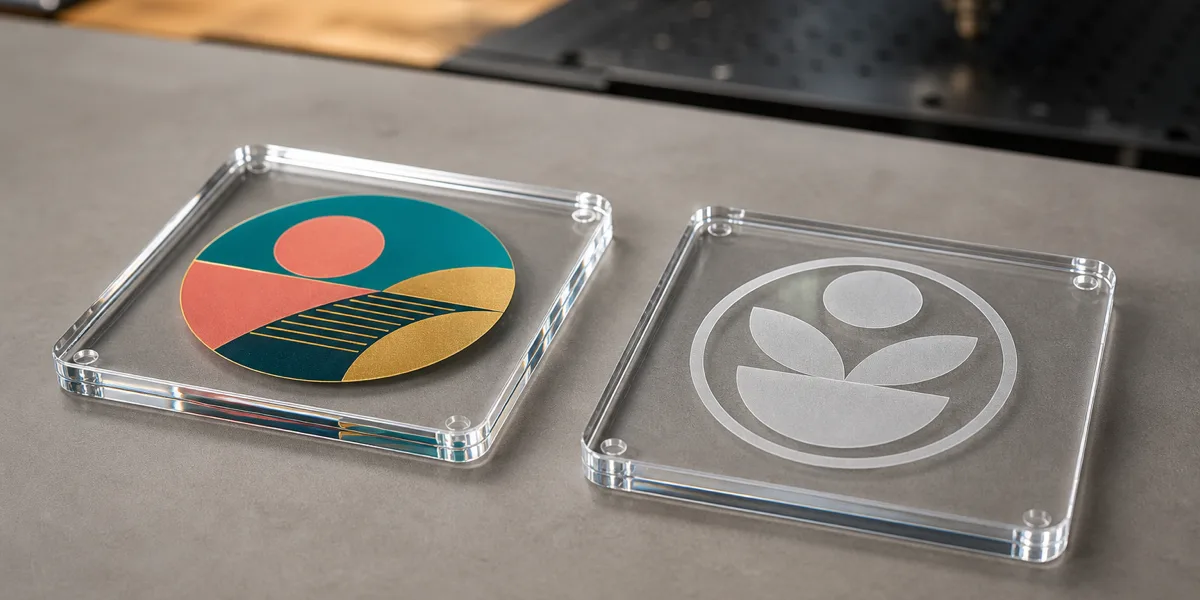
Match the decoration to the artwork type: UV printing for photographic or multi-color designs, screen printing for one- or two-color logos at volume, and laser etching for a permanent frosted mark with no color. All three run in-house here, so the artwork decides the method — not what a supplier happens to own.
The same square blank, two different answers: full-color UV print for photographic artwork, laser-etched frost for a permanent single-tone mark.
UV printing lays cured ink directly on the acrylic and handles gradients, photographs, and unlimited colors in one pass with no setup per color. That last part matters more for coasters than almost any other product we make, because coaster programs love design variety — a bar wants four cocktail illustrations, not four hundred of one. How the process itself works, ink adhesion and all, is covered in our [UV printing on acrylic guide](/guide/uv-printing-on-acrylic/), so I will not re-teach it here.
One decision inside UV is worth naming: surface. Printing the underside of a clear coaster — so the artwork reads through the acrylic and the top face stays glossy and wipeable — is the same second-surface logic we use on artwork trays, and the quality traps that come with it (adhesion, opacity backing, edge sealing) are walked through in our [bottom-printed tray print-quality guide](/guide/bottom-printed-acrylic-trays-print-quality/). For coasters that meet wet glassware every night, second-surface print is usually the durable answer.
Screen printing pushes ink through a stencil mesh, one screen per color. Each screen is a setup cost, which is why it only wins on a specific shape of order: one or two spot colors, one design, high quantity. A 1,000-piece single-logo corporate run quotes well on screen; a 400-piece four-design cocktail set does not.
Laser etching removes material instead of adding ink — a frosted, permanent mark that cannot chip or wash off, in one tone, no color. It reads quietly premium, which suits hotel monograms and distillery logos, and it pairs naturally with the beveled edge tier below.
| Artwork | Method | Why |
|---|---|---|
| Photograph, gradient, multi-color | UV print | No per-color setup; second-surface option protects the art |
| 1-2 color logo, one design, 500+ pcs | Screen print | Per-screen setup amortizes at volume |
| Single-tone monogram, permanence | Laser etch | Frosted mark in the material itself, cannot wear off |
| Two-color layered look | Two-tone build | Bonded color layers, no ink at all — see below |
## Matching a competitor's reference sample {#reference-sample}
A reference sample is the fastest spec document a buyer can send. Mail us the coaster you want to match — or photos with a ruler in frame plus a thickness measurement — and we measure it, match it to a standard sheet spec, and quote both the match and any alternative that reaches the same feel for less.
This request comes up constantly in giftware sourcing, and I understand why: the buyer has already seen the product they want at a trade show or in a competitor's line, and re-describing it in words loses information. Calipers do not. Thickness, footprint, corner radius, edge treatment, print surface — a physical reference answers all five in one measurement session, and the sample we send back becomes the proof that we read it correctly.
One honest flag from these conversations: reference coasters benchmarked at half an inch tall are not in the 3-5 mm family at all. Half an inch is 12.7 mm — the block tier — cut from thick sheet with polished faces, at a different material cost per piece. We quote it happily, but I always show it next to a 5 mm option, because some buyers want the block look and others only wanted "substantial" and can get there for meaningfully less. The same measure-then-decide path applies: match first, then compare.
## Why color approval needs a physical sample {#color-sample}
Approve layout on a photo proof; approve color on a physical sample. The same artwork file renders differently on your monitor, in cured UV ink on acrylic, and under your venue's lighting — three shifts a screen cannot show you. A printed sample ships in 3-5 days, and your written approval of it locks the spec for bulk.
The failure this prevents is expensive precisely because it is invisible until delivery. Brand reds drift toward orange or wine depending on ink build and the white backing layer behind it; a clear coaster's print also reads differently against dark wood than against a white tablecloth, because with transparent products the background participates in the color. None of that is a defect — it is physics — but it means the only trustworthy approval is the one made holding the object in the light it will live in.
So the gate we run is deliberately unskippable, and it is the same one we apply on premium tray work where the finish expectations are highest: physical sample, your approval in writing, then production against that approved sample with 100% piece-by-piece inspection before packing under our ISO 9001 system. When a buyer is matching a competitor reference, the sample stage does double duty — it confirms our color AND confirms the match against the object you sent. If a deadline is tight, sample photos under daylight and warm light can bridge the decision, but I tell every program buyer the same thing: for a 1,000-piece run with your logo on it, wait the extra days and hold the sample.
## Edge finishes: where the premium tier lives {#edge-finishes}
Coaster edges come in three working tiers: flame-polished square edges as the glassy standard, diamond-polished edges where dead-flat gloss matters, and a 45-degree beveled top edge as the premium tier — a light-catching facet that photographs like cut glass and separates a boxed retail set from a bar giveaway.
Flame polishing runs a torch along the cut edge until it flows glossy; it is fast, consistent on straight profiles, and what most coaster programs ship with. Diamond polishing mills the edge with a diamond cutter head for the flattest, most optical face — the pick when the coaster sits in acrylic gift packaging where edges face the customer at eye level. The bevel is a machining pass on top of either: a 45-degree facet around the top perimeter that catches light the way a chamfered glass edge does. It costs machine time, so it lives in the premium tier, and it is the single cheapest way to make a 5 mm coaster read like a considered object rather than a cut square.
Two premium builds extend the edge conversation. For boxed sets, a matching caddy or holder with mitered 45-degree corner joints turns four coasters into a gift product — the corner joinery is where high-end buyers look first, and it gets the same seam standards as our premium tray work. And for a two-color look with no printing at all, a layered two-tone build — two bonded color layers exposed at the edge — carries the design in the material itself; the construction logic is the same one covered in our [two-tone acrylic fabrication guide](/guide/two-tone-acrylic-tray-fabrication/).
## Non-slip backing options {#non-slip-backing}
The underside gets one of three treatments: clear silicone bumper dots at the corners, a full EVA foam pad, or a cork sheet. Bumpers preserve the through-view of clear acrylic and vent condensation; EVA gives full-face grip on polished counters; cork adds a warmer, furniture-friendly underside for premium sets.
Backing earns more attention than it gets, because the coaster's whole job is the underside: a coaster exists to protect the table from cold-drink condensation and hot-drink heat[^wiki-coaster], and a polished acrylic square on a polished bar top will hydroplane on its own condensation ring without something gripping. The acrylic itself is unbothered — PMMA absorbs about 0.3% water[^azom-pmma], which is why the top surface shrugs off a night of wet glassware — but the interface with the table needs engineering.
The choice maps to the program. Bar and restaurant rollouts default to silicone bumpers: about 8 mm diameter, 2 mm standoff, nearly invisible under a clear coaster, and the gap lets air dry the underside between drinks. Corporate desk sets lean EVA pad — full-face grip, no rock on uneven desks. Premium boxed sets often go cork for the material story. All three are applied at our assembly bench during packing, so the spec is one line in your quote request, and switching options between the sample and bulk is a zero-cost change.
## MOQ economics from 100 to 1,000 pieces {#moq-economics}
Coaster pricing is driven by four levers: thickness (material volume), print method (setup vs per-piece cost), edge tier (machine time), and quantity. MOQ is 100 pieces per design with zero tooling fees — coasters are laser- and CNC-cut, not molded — so scaling from 100 to 1,000 pieces moves cost through amortization, not tooling.
The design-count math is where promo buyers save or spend the most. At 100 pieces per design, a 400-piece order can be one design or four; UV printing treats those identically because there is no setup per artwork, while screen printing needs a screen per design per color and quotes accordingly. This is why I steer multi-design cocktail sets to UV even when each design is only one color — four screens against 100 pieces each rarely beats setup-free digital.
Freight stays gentle because coasters pack dense and flat. Using the weights from the thickness section, a 500-piece run at 4 mm is roughly 24 kg of product; call it 30 kg cartoned. That keeps express air freight a live option for deadline-driven promo programs — trade-show merchandise on a fixed date — while sea freight takes over on 1,000-piece-plus hospitality rollouts where the calendar has slack. We shipped exactly that shape of program in our [branded giveaway trade-show rollout](/case-studies/branded-acrylic-giveaway-trade-show-rollout/), where the freight mode was chosen backward from the show date.
Commercial terms are the same as every Wetop order: 30% deposit before production, 70% balance before shipment, FOB Shenzhen as the default term with express, air, and sea quoted per destination. Samples in 3-5 days, production in 15-20 days after sample approval.
## What to send for a coaster quote {#ordering}
Six fields quote a coaster program completely: quantity and design count, size and shape, thickness (or "send me the thickness set"), artwork files with the print method left to us to recommend, edge tier, and backing choice. With those, we return a quote within 24 hours; with a reference sample in the mail, we return a match spec too.
You do not need finished artwork to start — a logo file and a description of the look is enough for us to recommend the method and build a sample plan, the same way we run coaster-and-tray programs for hotels alongside our [custom acrylic trays](/products/acrylic-trays/). Hospitality buyers bundling coasters with amenity trays can use the [hotel amenity-tray manufacturing plan](/case-studies/hotel-amenity-tray-rollout/) to define shared color references, approval records, and packing inputs without assuming a combined production batch or freight booking.
Six fields, one message: [send your coaster brief](/contact/?source=custom-acrylic-coasters-spec-guide) and a quote plus a sample plan come back to you in one reply. Still deciding how premium your program should feel? That question settles faster in your hand than on a spec sheet — ask for the thickness set and both edge tiers in the same sample, and let the coasters tell you.
[^azom-pmma]: [Polymethyl Methacrylate (PMMA, Acrylic) — AZoM material properties](https://www.azom.com/article.aspx?ArticleID=788) — displays PMMA density of 1.18 g/cm3 and water absorption of 0.3%, the figures behind the per-thickness weight math and the wet-surface behavior notes.
[^wiki-coaster]: [Drink coaster — Wikipedia](https://en.wikipedia.org/wiki/Drink_coaster) — documents the coaster's function of protecting surfaces from cold-drink condensation and hot drinks, and the long tradition of branded coasters as advertising media, context for the backing and promo-program sections.