---
title: "Custom Acrylic Box Cost at 100, 500, and 1,000"
description: "See how custom acrylic box cost moves from 100 to 500 to 1,000 pieces as wall thickness, lid type, and print add-ons change, using published FOB Shenzhen bands."
category: "Buyer Guide"
author: "Amy Liu"
authorCredential: "Client Account Manager at Wetop Acrylic — coordinating B2B orders from first inquiry through delivery since 2020, 500+ custom projects handled"
datePublished: 2026-09-12
dateModified: 2026-09-12
primaryKeyword: "custom acrylic box cost"
url: https://wetopacrylic.com/guide/custom-acrylic-box-cost-100-500-1000/
---
## Start from a published box, not a blank estimate {#reference-bands}
Most requests I receive for a box price name a quantity and nothing else. "Price per box at 500" leaves out the three inputs that move the number most: wall thickness, lid type, and print. Custom acrylic box cost only becomes comparable once those three are fixed, so when I walk a first-time buyer through a box quote I start from one of the two reference boxes we publish and price it at three quantities.
The first reference is a 100 × 100 × 100 mm clear box in 3 mm acrylic with a magnetic lid: $6–12 each at 100 pieces, $3–6 at 500, and $2–4 at 5,000, FOB Shenzhen. The second is a 200 × 150 × 100 mm frosted box with a magnetic lid, velvet insert, and UV-printed branding: $16–30 at 100, $10–20 at 500, and $7–14 at 5,000. We quote both as indicative bands for that named specification, not as a catalog.
We do not publish a separate 1,000-piece figure. Read it as a point between the 500 and 5,000 bands, closer to the 500 side, because the setup share keeps shrinking while material and labor per box stay flat. Ask for the 1,000 line on your own drawing rather than interpolating it for a budget approval.
The same box at three quantities. The 100-to-500 step roughly halves the band; the 500-to-5,000 step trims it further. A 1,000-piece line lands between the two right-hand bars of each group.
Our [acrylic boxes hub](/products/acrylic-boxes/) carries both ladders plus single-quantity rows for a medium storage box, a drop-front shoe box, and a large shadow box. Keep that table open while you write the brief so every difference from our reference has a line beside it.
## Setup spreads across units; material does not {#setup-amortisation}
Every new box design starts with work we do once: drawing review, a cutting layout for each panel size, a screen per print color or a foil die, an artwork proof, first-off inspection, and carton development. At 100 pieces each box carries one hundredth of that work. At 500 it carries one five-hundredth, which is why the published bands roughly halve between those two quantities.
The per-unit work never leaves. Each box still consumes sheet, laser or CNC time, edge polishing, solvent bonding, lid hardware, print time, protective film, 100% inspection, and packing. Those inputs scale with the order, so the 500-to-5,000 step trims the band instead of halving it again.
We keep quantities by design. Two artworks at 500 each are two proof paths and two print setups, not one 1,000-piece run. Two sizes at 250 each are two cutting layouts and two first-off checks. Ask us to show which setup lines are shared and which repeat.
## Wall thickness sets the material line {#wall-thickness}
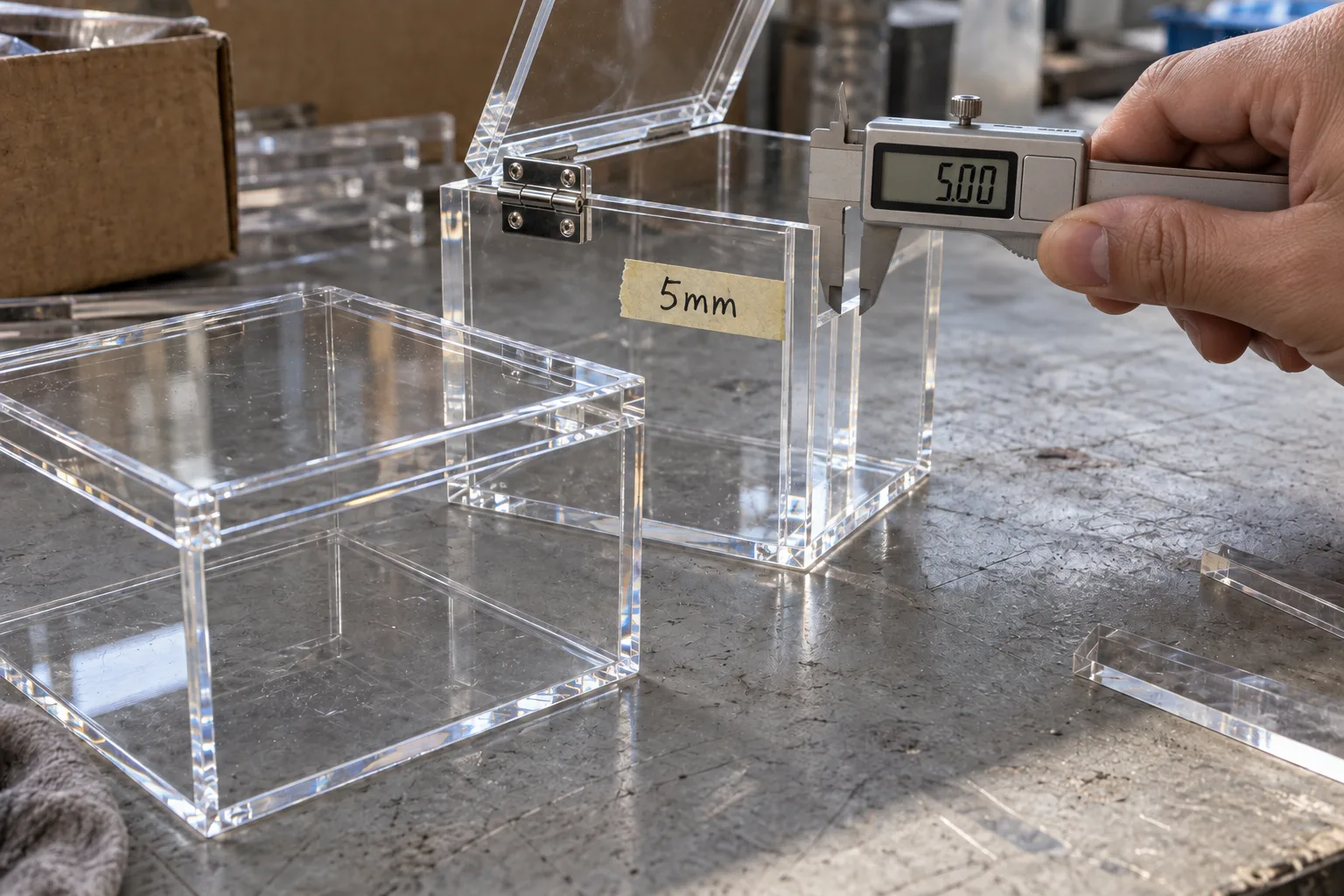
Wall thickness is the first spec I confirm, because sheet is the largest per-unit input and it does not amortise. A 5 mm box uses about 1.7 times the sheet volume of a 3 mm box with the same outside dimensions, and thicker sheet also takes longer to polish and bond.
The published rows show how thickness and size compound. I have watched a 4 mm brief become 5 mm once the buyer weighed the contents, so settle the gauge before you compare quotes. The 100 mm cube runs on 3 mm. We quote the 250 × 150 × 100 mm storage box with a six-compartment divider at $8–15 each for 200 pieces on 4 mm, and the 350 × 250 × 200 mm drop-front shoe box at $12–22 for 200 pieces on 5 mm. The 500 × 400 × 80 mm shadow box with wall-mount hardware is $18–35 at 100 pieces on 5 mm. Each step up in outside size pulls the wall gauge up with it, so the material line grows faster than the footprint.
Select the gauge from panel span, contents weight, and how the box is handled, not from a premium feeling. Our [acrylic box wall thickness guide](/guide/acrylic-box-wall-thickness-guide/) covers the span-to-gauge decision; the quote only needs your outside dimensions and the gauge you chose.
Two of the three inputs that move a box quote: wall gauge and lid hardware. The caliper reading is the fastest place to settle a thickness debate before anything is cut.
## Lid type adds hardware and assembly {#lid-type}
A lift-off lid is the lowest-cost closure because it is a second cut panel with no attachment work. Sliding and telescoping lids add only a tighter tolerance on the fit. Magnetic lids add inset neodymium magnets and the bonding time to seat them. Hinged lids add a bonded metal or plastic hinge plus alignment. Lockable lids add a lock or hasp and a cut-out for it.
So the answer to the question I hear most, whether a hinged box costs more than one with a separate top, is yes. The hinge is purchased hardware plus an assembly step that a loose lid never needs. If the budget is tight and the lid does not have to stay attached, a lift-off or telescoping lid usually holds the same look at a lower line.
Both published references use a magnetic lid, so their bands already include magnets and bonding. Swapping to a lift-off lid moves the quote down; adding a lock moves it up. Our [acrylic box lid types guide](/guide/acrylic-box-lid-closure-types-guide/) compares all seven closures; put the chosen one on your drawing before you ask three factories to quote.
## Print add-ons and artwork versions {#print-add-ons}
Each branding method changes a different line. UV printing needs no screen, so it adds a per-unit print cost and suits full-color or variable artwork. Silk-screen printing adds one screen per color as setup, then a low per-unit cost on longer runs. Foil stamping adds a die. Laser engraving adds machine time and gives a frosted mark with no color, which is why we recommend it for collectible boxes that carry a brand mark on clear walls.
Metallic gold is the request that most often surprises a buyer. A true reflective gold comes from silk-screen with metallic ink or from foil, each with its own setup. A UV-printed gold tone reads well at arm's length and costs less. Decide which effect the front of your box needs before the artwork is final, and we can carry both routes on your quote as alternates.
Artwork versions multiply the setup, not just the quantity. Ten collectible box designs at 100 pieces each are ten proofs, ten print files or screens, and ten first-off checks, even when the box drawing is identical. The [printed acrylic box guide](/guide/acrylic-box-printing-methods-guide/) routes the artwork to a method; the [metallic gold acrylic box manufacturing case](/case-studies/metallic-gold-printed-acrylic-box-multi-sku/) shows how we separate the physical box drawing from the artwork matrix so each SKU is quoted at its own quantity.
We can issue a quote before your artwork is final. I ask for the print area, color count, and whether metallic is required, and we price the method with placeholder artwork. The production-ready file only has to reach us before the proof.
## Inserts, lining, and the outer carton are separate lines {#inserts-packaging}
Our published premium band already includes a velvet insert and UV branding, which is why its 100-piece floor is $16 rather than $6. Priced separately, velvet or suede lining adds about $1–3 per unit and a custom die-cut foam insert about $2–5, depending on the cavity count and material.
We quote a printed outer carton or rigid gift box on top of the acrylic box. It has its own artwork, its own supplier, and its own quantity, so it belongs on a separate row rather than inside the unit price. When you ask for a unit price without freight, ask for the box, the insert, and the outer packaging as three lines you can add or remove.
Send us what goes inside the box: product dimensions, weight, and how the buyer removes it. We size the cavity from that and confirm the fit on the paid sample. We include insert design in the sample process; the insert material is a per-unit line. Our [branded acrylic box page](/products/acrylic-boxes/custom-acrylic-boxes/) lists the print and finishing routes that pair with each packaging level.
## A dimension change is a new cutting layout {#dimension-change}
Buyers often ask whether reducing a box from 50 mm deep to 25 mm cuts the price in proportion. It reduces the four wall panels, so the material line falls, but the base and lid panels stay the same size and the lid hardware, bonding, print, and inspection are unchanged. The unit price moves less than the depth did.
A dimension change also changes the sheet layout. A 5% change in one panel can cross a sheet boundary and improve or hurt yield, so the quote does not move as a smooth percentage. Ask us for the revised depth as a separate option with its own price and its own sample, because the approved sample for the original depth no longer proves the new fit.
I quote the two depths side by side whenever a buyer is deciding between them. It costs nothing to price both, and it stops a "small" change from arriving after sample approval as a surprise.
## Sample fee, MOQ per design, and the 1,000-piece decision {#sample-moq}
Our paid samples take 3–5 days and are paid separately. The sample fee is never credited to or deducted from the production order; it covers the one-off sheet, cutting setup, print or engraving setup, finishing, and inspection we need to build one approved box. Budget the sample and its courier as their own line before the 100-piece run.
Our production MOQ is 100 pieces per design and per size. Two sizes at 50 each remain two designs at half the minimum, because each size needs its own cutting layout and print file. Pick your strongest size for the first run and validate the second on a paid sample.
If the first quote lands above your target, ask us for a value-engineered alternate on the same drawing: a lift-off lid instead of magnets, 3 mm instead of 4 mm where the span allows, UV instead of foil, a simpler divider instead of foam. Most redesigns land 15–30% below the original quote without changing the box your buyer sees.
Then read the three tiers as inventory decisions for your program. The 100-piece tier buys production evidence with the least cash exposure. The 500-piece tier suits a stable drawing with a deployment plan and captures most of the setup saving. The 1,000-piece tier trims the band further only when the artwork, size, and forecast are all stable; ten SKUs at 100 each stay at the 100-piece economics. I ask for the decision date on each release so the tier table turns into a deployment plan rather than a discount exercise. Our [custom acrylic gift box manufacturing case](/case-studies/acrylic-gift-box-boutique-rollout/) walks through the closure, print, insert, and packing controls we use to keep a repeat program on the same price basis.
## Freight, duties, and the landed total {#landed-cost}
Our default term is FOB Shenzhen, which keeps main freight, insurance, destination charges, duties, and final delivery outside the unit price. A clear box is light for its volume, and carriers can bill on dimensional weight when carton volume outweighs actual weight,[^fedex] so ask for carton dimensions, units per carton, and gross weight with every tier before you compare landed totals.
Duties and taxes are the importer's line. The applicable rate depends on the HS classification at the destination, and published tariff rates exclude VAT and other fees, so the landed total is the purchase price plus freight, insurance, duty, and those fees.[^trade-gov] I put the HS code we use on the commercial invoice; your broker confirms the rate at your port.
Air against sea is a deadline trade, not a unit-price trade. Sea suits a 500 or 1,000-piece release with a planned launch date; air suits a first 100-piece run against a fixed event. Work backward from your date: 3–5 days for our sample plus courier, your approval, 15–20 days of production after the deposit, then transit. If the arithmetic does not close, we can split a first air shipment from a sea balance, which costs less than air-freighting the whole order.
| What to send | Why it changes the quote |
|---|---|
| Outside dimensions and wall gauge | Sheet volume, cutting layout, and polishing time |
| Lid type | Hardware plus assembly, or tolerance only |
| Print method, color count, metallic yes or no | Screen or die setup versus per-unit UV cost |
| Number of artwork versions and quantity per version | Each version is its own 100-piece design with its own proof |
| Insert material and what goes inside | Cavity design, per-unit insert line, and sample fit check |
| Outer carton or gift box | Separate artwork, supplier, and quantity row |
| Destination and required date | Carton volume, mode, duty basis, and whether air is needed |
## Send a three-tier box RFQ {#rfq}
Send us one drawing with outside dimensions, wall gauge, lid type, print method, artwork count, insert, outer packaging, quantity per design, destination, and required date. Ask for 100, 500, and 1,000-piece lines on that same specification, with setup, sample, packing, and freight shown as their own rows.
We reply to a complete brief within 24 hours with those lines and the assumptions behind them. Our production runs 15–20 days after the sample, artwork, and deposit are approved, and we inspect every box against your approved sample before it ships.
Use our [box quote form](/contact/?source=custom-acrylic-box-cost-100-500-1000) to upload the drawing and artwork. Start from our [acrylic boxes hub](/products/acrylic-boxes/) for the published bands and our [branded acrylic box page](/products/acrylic-boxes/custom-acrylic-boxes/) for the print and finishing routes, so the price you compare has a physical box behind it.
[^fedex]: [FedEx dimensional weight guidance](https://www.fedex.com/en-us/shipping/packaging/what-is-dimensional-weight.html) — FedEx explains how package dimensions can set billable shipping weight when volume outweighs actual weight.
[^trade-gov]: [International Trade Administration — Import Tariffs and Fees Overview](https://www.trade.gov/import-tariffs-fees-overview) — ITA notes that duty lookup needs the HS code and that tariff rates exclude VAT and other fees that make up the landed cost of a shipment.