---
title: "Bakelite Mahjong Tiles vs Bone vs Acrylic — What Changed"
description: "Bakelite mahjong tiles defined the 1930s American game. We compare bakelite, bone-and-bamboo, and cast acrylic on feel, durability, care, and OEM sourcing."
category: "Comparison"
author: "William Cho"
authorCredential: "Founder of Wetop Acrylic — building custom acrylic in Shenzhen since 2008, 2,000+ B2B projects shipped across 25+ countries"
datePublished: 2026-07-09
dateModified: 2026-07-09
primaryKeyword: "bakelite mahjong tiles"
url: https://wetopacrylic.com/guide/bakelite-vs-bone-vs-acrylic-mahjong-tiles/
---
## Three materials, one game — the comparison table {#short-answer}
Mahjong reached America in 1920, and every era of the game since has had a defining tile material: bone dovetailed to bamboo in the early export sets, bakelite mahjong tiles through the 1930s boom, and cast acrylic in the OEM sets brands commission today. Three materials, one game, and the reasons each material won its era still decide how a new set should be specced.
| Property | Bone and bamboo | Bakelite | Cast acrylic |
|---|---|---|---|
| **Era** | 1800s–1920s | 1930s–1950s | 1960s–today |
| **Construction** | Two pieces — carved bone face dovetailed to a bamboo back | Machined from solid cast phenolic stock | CNC-cut, engraved, and polished from cast PMMA |
| **Consistency** | Varies tile to tile — every face hand-carved | Good within a batch; color drifts between batches | Uniform across a production run |
| **Aging** | Joint loosens, cracks, yellows unevenly | Darkens to a butterscotch patina | Colorfast — no patina, no drift |
| **Care** | Humidity-sensitive, careful storage | Gentle cleaning only; the patina carries the value | Mild soap and water |
| **Availability** | Vintage only | Vintage only | In production — standard and custom colors |
Read the table by column, not by row. Collectors read down the bakelite column: what to hunt, what the patina means, how to keep it. Brands, designer labels, and clubs commissioning product read the acrylic column (that is the production reality we work in every day), while the first two columns explain the look customers keep asking new sets to echo.
## The bakelite era — how the first plastic took over the American game {#bakelite-era}
Bakelite mahjong tiles date from roughly the 1930s through the 1950s, when the first fully synthetic plastic met the first great American mahjong boom. The material was hard, dense, machinable, and could be colored through the body: everything the game asked of a tile, at a price bone carvers could never match.
Bakelite bridged the gap between hand-carved bone-and-bamboo tiles and today's cast acrylic production sets — its 1930s–1950s boom defined what an American mahjong tile looks and feels like.
The material came first. Leo Baekeland discovered Bakelite, a phenol-formaldehyde polymer and the first fully synthetic plastic, in 1907[^baekeland]. Through the following decades it went into telephones, radios, jewelry, and billiard balls; hard goods that needed to be machined, polished, and colored. Mahjong tiles fit that profile exactly.
The game came next. Mahjong was introduced to the United States in 1920 and became a full craze; by 1937 the confusion of competing house rules had grown bad enough that a group of enthusiasts met in New York City to standardize the American game, founding the National Mah Jongg League[^nmjl]. The League's annual card and joker-heavy hands gave American mahjong its own identity, and its own demand for tiles. Bakelite was the material that met it: tiles machined from solid phenolic stock, dense enough to feel substantial, hard enough to survive decades of shuffling, and available in the ambers, greens, and creams that collectors now recognize on sight.
Those sets never really left. Bakelite pieces darken over decades toward the butterscotch tone the material is famous for, and vintage Bakelite goods are actively prized by antique dealers and collectors: complete mahjong sets trade well above what a comparable new set costs. When a designer sends us a reference photo for a heritage-styled program, nine times out of ten the photo is a bakelite set.
I did not come to this history through collecting — I came to it through inquiries. In 18+ years of quoting custom acrylic, I have watched mahjong briefs change from "clear tiles, engraved faces" to mood boards full of amber sets photographed on family card tables. The buyers writing those briefs are not asking us for bakelite; they are asking for what bakelite meant — warmth, weight, permanence — in a material we can actually run at production scale.
## Bone and bamboo — the two-piece tiles that came before plastics {#bone-and-bamboo}
Before plastics, a mahjong tile was two materials joined by hand: a carved bone face dovetailed to a bamboo back. The construction is beautiful and instantly recognizable, and it is also the tile's built-in failure point, which is why so few century-old sets survive in playable condition.
Every face was hand-carved and hand-inked, so no two tiles in a set are truly identical: character depth, stroke weight, and ink coverage vary tile to tile. That variance is charming in a display cabinet and a real problem at a game table, where players can learn to recognize individual tiles from their backs and edges. The bigger problem is age. Bone and bamboo are organic materials that respond to humidity in different directions: the bone face and the bamboo back expand and shrink at different rates, so the dovetail joint loosens, hairline cracks open along the bone, and the two halves yellow at different speeds. A bone-and-bamboo set that has lived through eighty summers without climate control usually shows all three.
None of this is a reason to dismiss the material. If you have inherited one of these sets, you are holding the version of the game that predates every plastic — treat it as the antique it is. The dovetail work on a good set is genuinely fine craft; I have kept photos buyers sent of tiles their great-grandparents played, and the carving puts plenty of modern tooling to shame. But it explains why, the moment a machinable plastic existed, tile makers switched and never looked back.
## Why modern American sets spec cast acrylic {#why-cast-acrylic}
Cast acrylic is the direct heir to bakelite mahjong tiles: a hard, dense, machinable plastic that takes color through the body and polishes to a clean face — minus the batch-to-batch color drift and the darkening patina. It is the default material for every OEM mahjong set we build, and there are three production reasons why.
First, uniformity. A modern set is cut from cast PMMA sheet on CNC and laser lines, so tile 1 and tile 144 come off the run with the same dimensions, the same color, and the same face. That consistency is precisely what bone could never offer and what bakelite only offered within a single batch. Second, engraving fidelity. Cast acrylic takes laser etching, UV print, and CNC engraving cleanly, which is what makes crisp character faces and custom artwork possible at production scale. We compare the three methods in our [tile engraving guide](/guide/mahjong-tile-engraving-laser-vs-uv-vs-cnc/), and the full material spec lives in our [custom acrylic mahjong tile spec guide](/guide/custom-acrylic-mahjong-tiles-spec-guide/). Third, colorfastness. The color in a cast acrylic tile is the color it keeps: the shade your customers unbox in year three is the shade approved at swatch stage, with no oxidation clock running the way there is on phenolic plastic.
That material call is also where our production floor shows. We run 8 laser cutters and 4 CNC machines with a dedicated diamond polishing line, and we have printed UV graphics directly on acrylic since 2020. The same lines that cut our display and case work cut tile sets, so the finish standards transfer. Every set we ship goes through 100% piece-by-piece inspection before it leaves the factory, because a mahjong set has a failure mode most products do not: one bad tile out of 144 spoils the entire product.
One clarification we make on almost every OEM inquiry: when buyers ask whether we pour tiles from resin, the answer is that we fabricate from cast acrylic sheet, not casting resin. Cast PMMA is the material that holds tolerance and finish at production scale. American-style sets also carry their own configuration demands — jokers, racks, pushers — and the sets we have shipped for [a game brand's launch line](/case-studies/mahjong-tile-set-oem-game-brand-launch/) were specced around exactly that. Everything in the [acrylic mahjong range](/products/acrylic-mahjong/) starts from the same material call.
## Feel, weight, and the clack — the three materials in hand {#feel-weight-clack}
The feel difference between the three materials is mostly a density-and-surface question. Cast acrylic runs about 1.2 g/cm³[^pmma-density]; bakelite is noticeably denser piece for piece, so a vintage tile carries a little more heft at the same size; bone-and-bamboo tiles are the lightest and warmest of the three, with a softer, quieter table sound.
The sound matters more than buyers expect. The sharp clack of tiles hitting the table and the wall being shuffled is part of the game's sensory identity, and hard plastics — bakelite then, acrylic now — are what produce it. Bone gives a duller knock. Between bakelite and acrylic the difference in hand is real but subtle: similar surface hardness, similar snap on the felt, a slight weight advantage to bakelite. If your project has a target weight, tile size is the lever that moves it; the per-tile and per-set math lives in our [mahjong tile size guide](/guide/mahjong-tile-size-guide/).
Here is where I land after 18+ years of fielding "will it feel right?" questions: no paragraph I write settles feel, and I no longer try. A physical sample does what I cannot. Buyers planning a set around a specific hand-feel — a designer matching a grandmother's set, a club replacing worn tiles — should hold the actual tile before approving production. We ship samples in 3–5 days; [request one against your reference set](/contact/?source=bakelite-vs-bone-vs-acrylic-mahjong-tiles) and judge the weight, the surface, and the clack with your own hands.
## Caring for each — vintage preservation vs zero-fuss acrylic {#care}
Care requirements split cleanly along material lines: vintage bakelite and bone reward gentle, minimal handling, while cast acrylic asks for almost nothing: mild soap, water, a soft cloth, and no ammonia- or alcohol-based cleaners, which can stress-craze the surface over time.
For bakelite, the patina is the value. The butterscotch darkening that collectors pay for is surface oxidation accumulated over decades, so aggressive polishing that strips it back to the original color can strip value with it. Clean your vintage tiles with a barely damp cloth, keep them out of direct sun, and leave restoration decisions to someone who knows the collector market. For bone and bamboo, humidity is the enemy: stable indoor conditions and a lined case slow the joint movement and cracking that age inflicts on the two-piece construction.
And here is the honest part: if you own a playable vintage set, you often should not replace it. A bakelite set in good condition is worth more as itself than any reproduction, and a family bone-and-bamboo set carries history no production run can. I tell buyers this even when it costs us an order. I would rather lose a quote than see a family heirloom retired for a reproduction it did not need. Where we come in is the other cases: the vintage set that is too fragile or incomplete to play, the brand that wants the era's look without the era's fragility, the club that needs twelve matching sets. That is a production problem, and it is the one we solve.
## Reproducing the vintage look in modern cast acrylic — for brands {#vintage-look-oem}
Butterscotch ambers, deep jade greens, warm two-tones — the color language of the bakelite era is reproducible in modern cast acrylic as solid and two-tone color programs, and heritage-styled programs have become one of the more distinctive OEM mahjong requests we build. The look is vintage; the material behaves like a current production part. One capability line we draw before any quote: true marble-pattern acrylic sheet is not available, so we do not promise a swirl we cannot cast. Where your reference set shows marbling, we match its dominant tone as a solid butterscotch or amber, or split the palette into a two-tone program, and the physical swatch you approve confirms which reads truer to the set you are echoing.
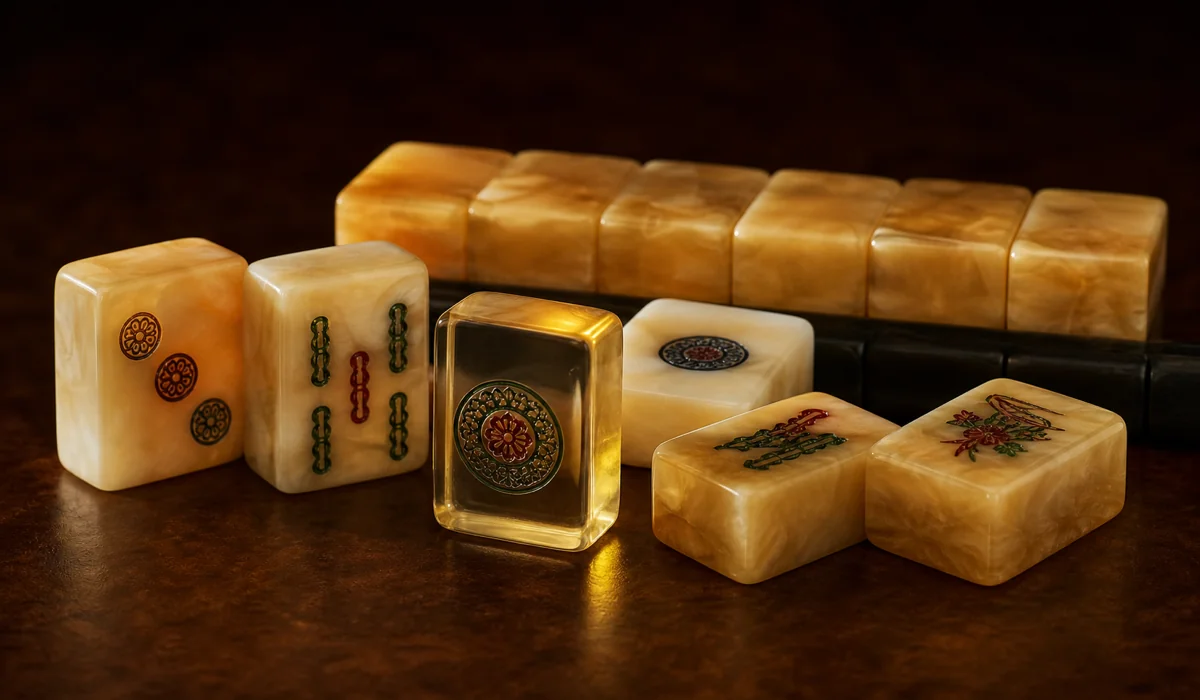
A heritage-styled production set: butterscotch and warm amber cast acrylic that echoes the bakelite era, cut and engraved on modern lines so all 144+ tiles match.
The workflow runs on physical color approval, because heritage tones live or die on the exact shade. You send the reference — usually photos of a vintage set, sometimes the set itself — and we develop color options against it. Before any production cutting starts, you approve physical swatches, not screen renders; on a recent two-collection designer run, swatch matching was the gate the entire 300-set program waited on, and it is the step that keeps "butterscotch" from arriving as "mustard."
Color development is the part of these programs I stay closest to personally. Heritage tones are unforgiving: the same amber formula reads darker as the part gets thicker, and a tone that looks right on a small chip can read differently across a full tile face. So we develop swatch options against the reference photos, send the physical chips for approval, and lock the color before our production run starts. From approved swatch to shipped goods, the numbers are our standard ones: MOQ 50 sets per design, samples in 3–5 days, production in 15–20 days, 100% inspection before anything leaves the factory.
If you are earlier in the process — artwork not final, tile size not chosen — start with the [artwork-to-production guide](/guide/custom-mahjong-tiles-artwork-to-production/) for the file-and-proof workflow, and see how a [designer label took a heritage-flavored set from concept to launch](/case-studies/designer-mahjong-set-oem-promotional-brand/). When you are ready to spec, the [custom tile-set page](/products/acrylic-mahjong/acrylic-mahjong-tile-sets/) covers configurations, and our [customization process](/customization/) walks through how we take a reference photo to a quoted program. Send us the vintage set you are echoing, tell us where you want the new set to land on weight and color, and we respond within 24 hours with color options and a quote.
[^baekeland]: [Science History Institute — Leo Hendrik Baekeland](https://www.sciencehistory.org/education/scientific-biographies/leo-hendrik-baekeland/) — biography confirming Baekeland discovered Bakelite, the first fully synthetic plastic, in 1907, and that vintage Bakelite goods are prized by antique dealers and collectors today.
[^nmjl]: [National Mah Jongg League — league history](https://www.nationalmahjonggleague.org/league.aspx) — confirms mahjong's 1920 introduction to the USA and the League's 1937 founding in New York City to standardize the American game.
[^pmma-density]: [MakeItFrom — PMMA (acrylic) material properties](https://www.makeitfrom.com/material-properties/Polymethylmethacrylate-PMMA-Acrylic) — displays the 1.2 g/cm³ density value for PMMA used in the feel-and-weight comparison.