---
title: "Air-First Split Shipment for Custom Acrylic — Cost vs Speed Math"
description: "Cut $1k-$5k from a $20k acrylic shipment by splitting freight: air for samples and critical batches, ocean for the rest. Real lane comparisons inside."
category: "Buyer Guide"
author: "Amy Liu"
authorCredential: "Client Account Manager at Wetop Acrylic — coordinating B2B orders from first inquiry through delivery since 2020, 500+ custom projects handled"
datePublished: 2026-05-05
dateModified: 2026-05-05
primaryKeyword: "air freight acrylic"
url: https://wetopacrylic.com/guide/air-first-split-shipment-acrylic/
---
## When All-Air Freight Makes Sense (and When It's Wasteful) {#when-all-air}
All-air freight is the right call in exactly two situations: your total volume is under roughly 1 cubic meter (about 200-400 lbs of finished acrylic), or your launch date is closer than 18 days from the day production wraps. Outside of that window, sending the whole order by air burns money you don't need to spend. On a typical $20k custom acrylic order, all-air freight from a China gateway to a US destination port runs $4,500 to $6,500 — call it 22-32% of the merchandise value. Ocean LCL covers the same load for $700-$1,400. That's where the split-shipment math lives.
I get this question on a third of my inquiries: "What's the fastest way to ship?" The honest answer is rarely "all of it by air." Across the 6 split-shipment orders I coordinated in 2025, the average savings was $2,840 vs all-air, and zero of them missed the buyer's launch window. The trick is figuring out which units actually need to fly and which can wait three weeks on a slow boat — and most B2B buyers haven't been walked through that math because their forwarder makes the same margin either way.
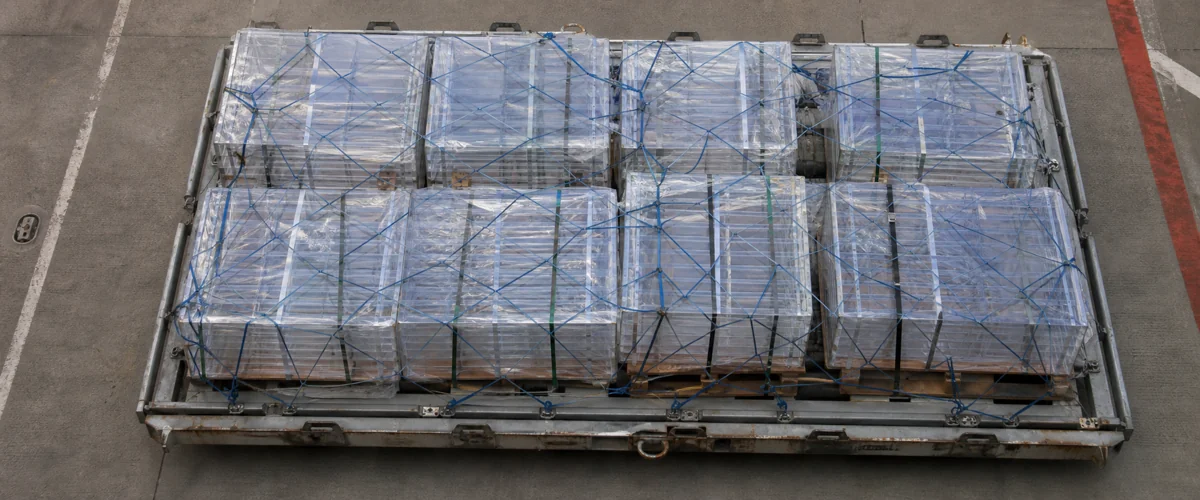
Air-first split shipment in practice: a small pallet flies ahead for the launch, the bulk container ships ocean behind it. Same purchase order, two consignments, one delivery window.
The decision tree is genuinely simple once you know the inputs. Below is the framework I run before quoting any client a freight number.
| Order Size | Deadline From Production-Finish | Recommended Mode | Why |
|---|---|---|---|
| Under 1 CBM (small launch run) | Any | All-air | Ocean entry/brokerage flat fees ($250-$450) eat the savings |
| 1-5 CBM | Under 18 days | All-air | Ocean transit alone is 18-30 days — won't make it |
| 1-5 CBM | 25-45 days | Air-first split (10-15% air, balance LCL) | Air the hero pieces, ocean the rest |
| 5-15 CBM | 30-50 days | Air-first split (10% air, balance LCL) | LCL still wins per CBM; air covers launch risk |
| 15+ CBM | 35+ days | All-ocean LCL or 20-ft FCL | FCL break-even kicks in; split shipping no longer pencils |
| Any size | Under 10 days | Air the priority half, accept overage | Even air struggles — book air the hero SKUs first |
## Air-First Split — Sending Samples + Critical Batches First {#air-first-split}
The air-first split is the most common pattern I run, and it works because most B2B launches don't actually need 100% of the order on day one. They need 10-15% on day one — the photographer's hero shots, the flagship store's opening floor set, the trade show booth, the buyer-meeting samples — and they need the other 85-90% within four weeks of that. Two shipping modes, two timelines, one delivery commitment.
The cleanest version of this looks like a $20k order shipping as: 8 cartons by air freight acrylic on day 0 (production finish + 2 days for QC and air booking), arriving destination on day 4-7; 32 cartons by ocean LCL departing day 5-7, arriving destination on day 28-35. The buyer hits their launch with the air leg, restocks with the ocean leg, and the freight bill comes in around $1,800-$2,400 instead of the $5,500 all-air number. That's a $3,000+ delta on a single order, and it's not theoretical — that's the average from my 2025 split-shipment book.
What I tell clients during the air-first conversation: pick which units fly by event, not by guess. The hero piece for the showroom photoshoot. The 50 sample units for the regional buyer meeting. The first store's full set if the chain is launching in waves. Anything that has a hard date attached to it goes air. Everything that's "we'd like it on the shelf by Q3" goes ocean. The sorting question isn't "is this important?" — everything's important. The question is "does this unit have a date?"
For one automotive showroom client, we ran exactly this pattern: 12 countertop display units flew on day 1 to make the model launch event, the remaining 60 units shipped ocean LCL behind them. The full case write-up of that program is on our [automotive showroom countertop displays case study](/case-studies/automotive-showroom-countertop-displays/) — it's a useful read on how the freight strategy plugged into a tightly choreographed retail launch.
The companion piece to this guide — the production-side counterpart — is our [sample-to-bulk trade show deadline guide](/guide/sample-to-bulk-trade-show-deadline/), which covers how to sequence sample approval and bulk production so the air leg has something to put on the plane.
## Ocean LCL vs FCL Break-Even — Typical Cubic Feet Thresholds {#lcl-vs-fcl}
LCL stands for Less than Container Load — your cargo shares a 20-foot or 40-foot container with other shippers, and you pay per cubic meter (CBM) of space used. FCL is Full Container Load — you pay for the whole box regardless of how full it is. The break-even point between them is the single most-asked question I get from procurement teams, and the honest answer is: on the lanes I run most often, LCL stays competitive up to about 12-15 CBM, after which FCL starts winning even on partial fills.
Here's why that threshold matters for acrylic specifically. Custom acrylic is volumetric, not dense. A 50-piece run of countertop display cases at 400mm × 300mm × 250mm with foam-lined cartons takes roughly 3-4 CBM. A 500-piece run of the same SKU is 30-40 CBM — well past LCL territory. So the LCL/FCL choice maps almost cleanly to order quantity for any single SKU. If you're ordering one product type at 50-300 units, you're in LCL. At 500-2,000 units, you're at the break point. Above 2,000 units of bulky display product, FCL is almost always the call.
The numbers I work with on the China-to-US-West-Coast lane in early 2026 (subject to weekly index movement[^drewry]):
| Volume | Mode | Approx Per-CBM Rate (FOB origin to US gateway port) | Typical Total |
|---|---|---|---|
| 1-3 CBM | LCL | $130-$180/CBM | $130-$540 |
| 3-10 CBM | LCL | $110-$150/CBM | $330-$1,500 |
| 10-15 CBM | LCL (break point approaching) | $100-$140/CBM | $1,000-$2,100 |
| 15-25 CBM | LCL or 20-ft FCL | LCL $90-$130/CBM vs FCL ~$1,800-$2,400 flat | Roughly even |
| 25-33 CBM | 20-ft FCL | ~$55-$75/effective CBM | $1,800-$2,400 flat |
| 33-67 CBM | 40-ft FCL | ~$55-$80/effective CBM | $3,500-$5,000 flat |
Two things this table doesn't show: trans-Pacific air freight rates published in IATA's TACT manual[^iata-tact] currently run $4.50-$7.00 per kg for general cargo on China-LA lanes, which is what makes the air leg expensive when you scale it past a few hundred kilograms. And FCL has fixed origin/destination handling charges (drayage, terminal handling, demurrage if you're slow to unload) that LCL doesn't carry — those add $400-$800 to a typical FCL move and shift the break-even slightly toward LCL for buyers who can absorb a few extra days.
The practical version: for any single-PO acrylic order under 15 CBM, run the LCL number first. Above 15 CBM, get FCL pricing as well. Below 2 CBM, the entry and brokerage fees mean you should skip ocean entirely and just air it.
## Customs + Brokerage Fees — The Often-Missed Cost Line {#customs-brokerage}
The line item that surprises buyers running their first split shipment is the customs and brokerage fees on each leg. Here's the breakdown for a typical US import of acrylic display goods from China:
- **Customs entry filing**: $125-$200 per shipment (your customs broker's flat fee for filing the formal entry)
- **ISF (Importer Security Filing, "10+2")**: $35-$75 per ocean shipment (not required for air)
- **Single-entry bond**: $50-$120 per shipment (or amortized if you have a continuous bond)
- **Brokerage handling**: $50-$100 per shipment
- **Section 301 tariffs (China origin)**: variable, calculated on customs value — verify current rate on USTR-published lists at the time of shipment
- **Standard MFN duty (HS 3926.90 — articles of plastics)**: typically 5.3% of customs value for plastic display articles, before any 301 add-on — confirm the exact rate with your broker against the most current HTSUS schedule
That's roughly $250-$450 per shipment, before duties. When you split a shipment into air + ocean legs, you pay this line twice. On a 2 CBM order, that overhead can completely cancel the freight savings — which is why the 2 CBM threshold matters. Below that, just put it all on a plane.
I had a client last year — a small beauty brand — push back on a split-shipment quote because the broker fees on the air leg looked redundant. We ran the math both ways: all-air came in at $1,950 freight + $310 brokerage = $2,260 total. The split came in at $580 air + $890 ocean + $660 combined brokerage = $2,130 total. The savings were real but small — only $130 — because the order was only 2.4 CBM. For her order, the better answer was actually all-air: the $130 wasn't worth the operational complexity of two separate customs entries and two separate inland freight legs.
The signal I look for: if the savings projection is under $500, recommend all-air. If it's $1,000+, the split is almost always worth running. Between $500-$1,000, ask the buyer how much operational complexity they want to absorb. For procurement teams managing five POs at once, two entries per PO times five POs is a real overhead. For a one-time launch order, the buyer absorbs it once and forgets it.
For the document handoff, our default is to deliver complete commercial invoice + packing list + air waybill or ocean bill of lading at the time each leg ships, with both legs cross-referenced to the same purchase order number. ICC's Incoterms 2020 framework[^incoterms] dictates which party files which document at which point — confirm with your broker before the first split shipment so the second leg doesn't trigger a clarification hold.
## Sample Case Study — $20k Order Saves $3k via Split Shipment {#case-study}
The cleanest example from my 2025 book: a US specialty retailer ordering 240 custom acrylic countertop displays for a 12-store rollout, total order value $19,800, total finished volume 4.8 CBM, weight 760 kg. Hard deadline: flagship store opening on day 32 from production finish, regional stores opening on a rolling basis over the following four weeks.
The all-air quote we ran first: $5,420 air freight to LAX + $310 brokerage + $480 inland trucking = **$6,210 total landed freight**. That's 31.4% of the merchandise value — a number that made the procurement lead's eyes water on the call.
The split-shipment quote we ran second:
- **Air leg** (24 displays, ~0.5 CBM, 78 kg): $620 air freight + $290 brokerage + $180 inland trucking = $1,090. Departed day 2 post-production, arrived destination day 7.
- **Ocean LCL leg** (216 displays, 4.3 CBM, 682 kg): $580 LCL freight + $360 brokerage/ISF/bond + $420 inland trucking = $1,360. Departed day 6, arrived destination day 31.
- **Total landed freight**: $2,450. **Savings vs all-air: $3,760.**
The flagship store opened on day 32 with the air-leg displays. The regional stores received their displays from the ocean leg over days 33-38, comfortably ahead of their staggered opening dates. Net result: same buyer outcome, $3,760 saved, no missed deadlines, no rework.
What made this one work — and the pattern I see on every smooth split shipment:
1. **The buyer told us the deadline structure on the first call.** Not a single end date, but a flagship + regional structure. That let us match the air leg to the actual hard date, not to a defensive "all of it by the soonest possible day."
2. **Production finished on time.** Split shipments collapse if production slips — the air-leg booking has a 48-hour window to make the next direct flight. We hold a freight buffer in our [customization](/customization/) production schedule specifically to protect this handoff.
3. **The customs broker was looped in early.** The buyer's broker received both bills of lading + invoices at the moment each leg shipped, with explicit "partial shipment 1 of 2 / 2 of 2" notation. Zero clarification holds.
4. **The QC inspection ran the air leg first.** We staged the 24 air-leg units through QC ahead of the bulk batch — same standard, just sequenced earlier. Our pre-shipment inspection runs on every order regardless of split, so this was a sequencing tweak, not extra work.
The 2025 book overall: 6 split-shipment orders, average order value $22k, average savings vs all-air of $2,840, range $1,180 to $4,420. Every single one hit its launch window. The smallest order in the book was 2.1 CBM (right at the threshold) and saved $1,180 — close to the floor where split shipping still pencils. The largest was 11 CBM and saved $4,420, the upper end where LCL is still beating air-only by a wide margin.
The bottom line on freight strategy for custom acrylic: don't default to air because of deadline anxiety, and don't default to ocean because of cost reflex. Run the math against your specific order size, deadline structure, and lane rates. Most B2B orders sit squarely in the air-first split zone, and most buyers leave $2,000-$4,000 on the table by skipping that conversation. We'll have it with you on the first call — no charge, no commitment.
## Related guides
- [Sample-to-Bulk Timeline When You Have a Trade-Show Deadline](/guide/sample-to-bulk-trade-show-deadline/)
- [Acrylic Protective Film: Shipping & Display Floor Life](/guide/acrylic-protective-film-shipping-display/)
[^iata-tact]: [IATA TACT — The Air Cargo Tariff and Rules](https://www.iata.org/en/publications/tact/) — IATA's TACT publication is the global reference for international air cargo rates, rules, and surcharges, updated continuously and used by forwarders worldwide to quote and audit air freight charges. Cited here as the source authority for trans-Pacific air freight rate ranges referenced in the LCL vs FCL break-even table.
[^drewry]: [Drewry World Container Index](https://www.drewry.co.uk/supply-chain-advisors/supply-chain-expertise/world-container-index-assessed-by-drewry) — Drewry's weekly composite index of container freight rates across 8 major East-West trade lanes is the most-cited public benchmark for ocean freight pricing trends. Useful for tracking whether the LCL/FCL rate ranges in this guide are running above or below current market.
[^incoterms]: [Incoterms 2020 — International Chamber of Commerce](https://iccwbo.org/business-solutions/incoterms-rules/incoterms-2020/) — The ICC's standard set of international trade terms defines which party bears responsibility for freight, insurance, and customs at each stage. Use exact Incoterm abbreviations (FOB, CIF, DDP, EXW) when quoting split shipments so each leg's cost and risk allocation is unambiguous.