---
title: "Wedding Card Box Ideas: Custom Acrylic Designs"
description: "Wedding card box ideas in custom acrylic — engraved names, color accent bands, LED bases, pressed-flower lids, slot and lock specs, and rental-fleet builds."
category: "Buyer Guide"
author: "Amy Liu"
authorCredential: "Client Account Manager at Wetop Acrylic — coordinating B2B orders from first inquiry through delivery since 2020, 500+ custom projects handled"
datePublished: 2026-07-23
dateModified: 2026-07-23
primaryKeyword: "wedding card box ideas"
url: https://wetopacrylic.com/guide/acrylic-wedding-card-box-ideas/
---
## The gift table at 5 p.m., and what it tells you {#why-acrylic}
Walk into any reception venue an hour before guests arrive and look at the gift table: the guest book, the framed sign, and a box with a slot in the top. A wedding card box is a slotted — often lockable — acrylic container on the reception gift table where guests deposit card envelopes, and the custom versions double as engraved keepsakes after the night ends. The best wedding card box ideas all answer the same two questions that table poses — will guests instantly understand what the box is for, and will it still look right in the couple's photos? Clear acrylic answers both: envelopes visibly accumulating explain the box better than any sign, and a transparent build disappears into every theme instead of fighting one.
That visibility point is not decoration talk. A card box exists because couples need "a helpful and safe place for guests to drop in their cards," as The Knot puts it, and one that carries the wedding's design language onto the gift table.[^theknot] An opaque box does the safekeeping but loses the signal; guests hesitate, ask, or balance envelopes against the guest book. A clear box with a dozen envelopes inside recruits the next fifty.
I handle card-box inquiries from three kinds of buyers — wedding planners outfitting seasons, event-rental companies building fleets, and stationery brands adding a hard-goods line — and the ideas below are the ones that keep getting reordered. Each section is a build we produce, with the specs that make it work. For the commercial formats and pricing structure behind all of them, the [acrylic card boxes](/products/acrylic-boxes/acrylic-card-boxes/) page is the companion to this guide.
---
## Engraved names and dates: the keepsake build {#engraving-ideas}
Laser engraving is the personalization that makes a card box worth keeping. The laser frosts the couple's names, the date, or a monogram directly into the acrylic surface — a permanent, white-on-clear mark that catches light from any angle and cannot peel, fade, or wash off. On the gift table it reads as etched glass; in the closet ten years later it is still the wedding.
The craft decisions are placement and typeface. Front-face engraving at roughly two-thirds height keeps the names visible above the accumulating envelopes; lid engraving photographs beautifully from above but disappears at table level. Script faces engrave well at larger sizes but clog below about 12mm letter height, so the elegant move is a script for the names and a small clean sans-serif for the date. We engrave from vector artwork, and our team checks stroke widths against the laser's kerf before any run — one of the checks that happens between [artwork file and production](/customization/) on every personalized order.
One honest steer I give planners: engraving is a one-couple decision. A box engraved "Olivia & Marcus" has exactly one client. If the same box needs to work next weekend for a different couple, engraving is the wrong tool — that is what the vinyl route in the rental section is for. The middle path for stationery brands is engraving a border, motif, or their own logo mark and leaving the name field to a printed insert card.
---
## Color accents, frosted panels, and theme builds {#color-accents}
An all-clear box is the safe default; a color detail is what matches a wedding. The three builds we quote most: an accent band (one colored or frosted strip bonded along the base or lid edge), a frosted body with a clear lid (envelopes become silhouettes — visible enough to signal, private enough to feel discreet), and a fully themed two-tone build for brands selling a signature look.
| Build | What it does | Cost logic | Best buyer |
|---|---|---|---|
| Clear + accent band | One line of theme color; box stays neutral | Adds one material + one bond line | Planners matching palettes |
| Frosted body, clear lid | Diffused contents, soft photo look | Frosted sheet, same build time | Upscale venues, minimal themes |
| Two-tone signature | A recognizable product, not a commodity | Two sheets + registration in assembly | Stationery and decor brands |
| Custom Pantone color | Exact brand or palette color | $200-300 one-time per color match | Brands with a locked palette |
Two supply-chain notes make this table honest. Standard sheet colors — frost, white, black, blush-adjacent tones — come from stock and add little to lead time. An exact Pantone match is a custom sheet run: we charge the $200-300 color-matching fee once per color, and it belongs to your product afterward, which makes sense for a rental fleet's signature blush but not for one wedding. And color placement beats color quantity: a 20mm band of the wedding's terracotta along a clear base reads more deliberate than a fully tinted box that hides the envelopes and undoes the visibility argument for acrylic.
---
## The LED base: the evening-reception build {#led-base}
Receptions happen at night, and gift tables are usually against a wall the lighting design forgot. An LED base fixes that: the card box sits on a shallow acrylic plinth with a low-voltage LED strip inside, and the box's edges pick up the light and glow along every polished line. Edge-lit acrylic is the same physics our [edge-lit display work](/guide/edge-lit-acrylic-cast-pmma-led-spec/) engineers deliberately — light entering the sheet travels inside it and escapes at edges and engraving.
That last part is the trick planners love: engraving glows. Names and dates cut into a box on a lit base light up as bright lines while the clear faces stay subtle. Warm white (around 2700-3000K) flatters both the acrylic and the photographs; color-changing strips exist and I talk most wedding clients out of them — the venue's palette is already decided, and cycling RGB reads as retail, not reception.
Spec-wise the build is simple and worth stating plainly: the plinth is a bonded acrylic frame sized to the box footprint, the strip is low-voltage LED tape fed by a small adapter, and the cable exits at the back corner where the table linen hides it. Battery packs work for venues that forbid cords but need a fresh set per event — a rental-fleet detail that belongs in the operations manual, not an afterthought at load-in.
---
## Pressed flowers and printed vellum: the laminated flat lid {#pressed-flower}
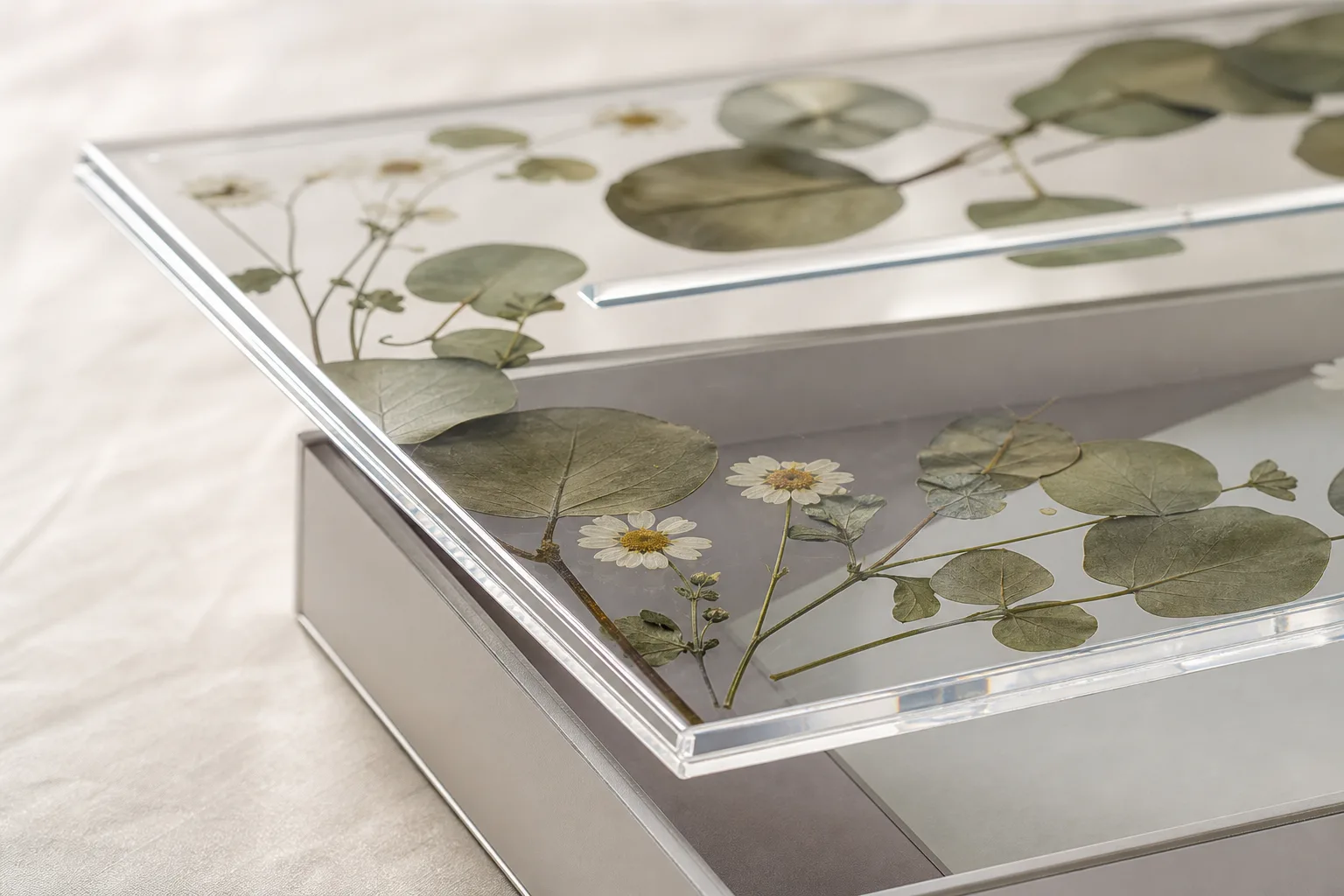
The most-requested romantic build in this category: real pressed flowers, or a printed vellum sheet, visible inside the lid of the card box. We build it as a flat laminated panel — the decorative layer is sealed between two flat acrylic sheets, bonded around the perimeter, and the finished sandwich becomes the lid. The flowers sit protected between the layers, the surfaces stay flat and polishable, and the lid still works as a lid.
The engineering constraint is the honest part: this is strictly a flat-layer technique. Pressed botanicals are already two-dimensional — that is what pressing means — and a flat flower between flat sheets keeps the panel thin, optically clean, and structurally a lid. What we do not do is cast three-dimensional objects into solid acrylic; that is a resin-casting process with different chemistry, different failure modes, and a different supplier. When a bride's planner asks for "flowers in the acrylic," the buildable version is the laminated flat panel, and it happens to be the better-looking one: pressed florals read as a deliberate design layer, evenly lit, with no distortion.
Material guidance from orders that went well: flat, low-moisture botanicals laminate cleanly — pressed eucalyptus, ferns, larkspur, daisies. Bulky or moist flowers do not press flat and do not belong between sheets. Printed vellum and fabric follow the same rule (flat, thin, dry) and open the theme up: a printed map of where the couple met, the invitation suite itself, or a stationery brand's signature pattern laminated into every lid of a product line. The perimeter bond seals the panel against handling and humidity at the edges, and the lid assembles into the box like any other — closure options are covered in our [lid and closure guide](/guide/acrylic-box-lid-closure-types-guide/).
A laminated pressed-flower lid: the botanicals are sealed flat between two acrylic sheets, so the lid stays thin, flat, and optically clean — a design layer, not an object trapped in a block.
---
## Slot size, locks, and the security nobody discusses at the tasting {#slot-security}
The slot and the lock are where wedding card box ideas stop being decor and become custody. The box holds envelopes containing cash and checks, in a public venue, for six unattended hours. Two specs cover it.
The slot is sized to the envelope. The standard A7 invitation envelope — the size most wedding stationery ships in — measures 5 1/4 x 7 1/4 inches.[^searles] A slot longer than that 7.25-inch edge (we cut 19-20cm on wedding builds) takes a flat drop even with cards inside; anything shorter forces the end-first feed that leaves guests wiggling an envelope while a line forms. Width matters less but 10-12mm accepts a card-stuffed envelope without letting a hand follow it. And the slot's edges get flame-polished — it is the one part of the box every guest touches.
The lock converts the box from furniture into a controlled container. A hinged or lift-off lid with a small cam or barrel lock keeps the slot open for deposits while making retrieval a keyed event: the couple's coordinator opens it once, at the end, on purpose. My straightforward advice by setting — hotel ballroom or public venue, lock it; private backyard, skip it; rental fleet, lock everything because the fleet owner, not the couple, answers for the one bad night. The same slot-plus-lock logic runs our [ballot and donation boxes](/products/acrylic-boxes/acrylic-ballot-donation-boxes/), which is why rental companies often order both from one file set.
The two specs that make a card box work: a slot longer than the A7 envelope's 18.4cm edge, and a lock that turns retrieval into a keyed event. Everything else is styling.
---
## Rental fleet vs one-wedding box: same drawing, different product {#rental-vs-buy}
The same card box drawing produces two different products depending on who owns it after Saturday. A one-wedding box optimizes for the couple: engraved names, a themed accent, a second life as a keepsake box for the cards themselves, the guest book, and the vow booklets. A rental box optimizes for the fleet owner: 5mm walls instead of 3mm, a lockable lid on every unit, and a plain engraved-free face that takes a fresh vinyl name set every weekend and surrenders it with a heat gun on Monday.
Those specs come from real operations, not theory. When a US wedding-rental brand built out a 100-box program with us, the build that survived van transport, weekly setups, and wipe-downs was the rental-grade variant — same CAD as the retail version, different thickness and hardware — and the full story is in the [wedding stationery card box case study](/case-studies/wedding-stationery-card-box-program/). For planners advising couples, the buy-vs-rent math is honest in both directions: renting means zero storage and a hardier box; buying means personalization that a rental can never carry and a keepsake that outlives the event.
The second-life angle deserves one more sentence, because it changes what buyers spec. A card box that will live on as home storage justifies the engraving and the pressed-flower lid; a box headed for a rental van justifies the lock and the thicker wall. Either way the box is a real fabricated product from our [acrylic boxes](/products/acrylic-boxes/) line — solvent-bonded, polished, 100% inspected — not an event prop built to survive exactly one evening.
---
## Ordering: from idea to gift table {#ordering}
Turning a card box idea into an order takes one message with five decisions: size (30 x 30 x 30cm is the workhorse; oversized guest lists go wider, not taller), personalization route (engraving, UV print, or vinyl-ready plain), accent or lamination details, slot-and-lock spec, and quantity. Send it through the [customization page](/customization/) with any reference image — a Pinterest screenshot is a legitimate starting point, and my team turns it into a production drawing for your approval before anything is cut.
Commercial terms, plainly: MOQ is 50 pieces per design — sized for planners, rental fleets, and stationery brands rather than single couples — samples ship in 3-5 days with the fee credited to your first production order, production runs 15-20 days, and payment is a 30% deposit with the balance before shipment. Every box passes 100% inspection in our ISO 9001-certified factory before packing. Browse the standard formats on the [acrylic card boxes](/products/acrylic-boxes/acrylic-card-boxes/) page, and if your line extends past weddings — ballot boxes, donation boxes, retail cases — the [acrylic boxes hub](/products/acrylic-boxes/) shows what ships from the same production line.
[^theknot]: [Wedding card box ideas — The Knot](https://www.theknot.com/content/wedding-card-box-ideas) — states the card box's purpose at a reception: a safe, designated place for guests' card envelopes that carries the wedding's design onto the gift table, the premise this guide's visibility argument builds on.
[^searles]: [Envelope sizes: a comprehensive guide — Searles Graphics](https://www.searlesgraphics.com/envelope-sizes/) — publishes the A7 envelope dimension (5 1/4 x 7 1/4 inches) and its role as the standard wedding-invitation envelope, the number the slot spec in this guide is cut against.